

Stem Cell Therapy for Multiple Sclerosis (MS)
You've just heard stem cell therapy for multiple sclerosis (MS) mentioned in a consultation, or maybe you're reading about it after a disease-modifying therapy didn't give you the control you wanted. The phrase can sound like one treatment with one clear answer, but in MS it covers very different medical strategies, different risk levels, and very different kinds of evidence.
That distinction matters. For some patients, the relevant question is whether an immune reset approach is appropriate. For others, the conversation is about experimental regenerative signaling and whether it belongs only in a carefully monitored clinical setting. If you're trying to sort hope from hype, start with the mechanism, not the marketing.
What Stem Cell Therapy Really Means for MS Patients
A person with MS often reaches this topic after a difficult turning point. Maybe a relapse broke through treatment, maybe MRI activity kept showing up, or maybe the word “progression” started appearing in notes from a neurologist. At that moment, stem cell therapy can sound like one umbrella solution, but it isn't.
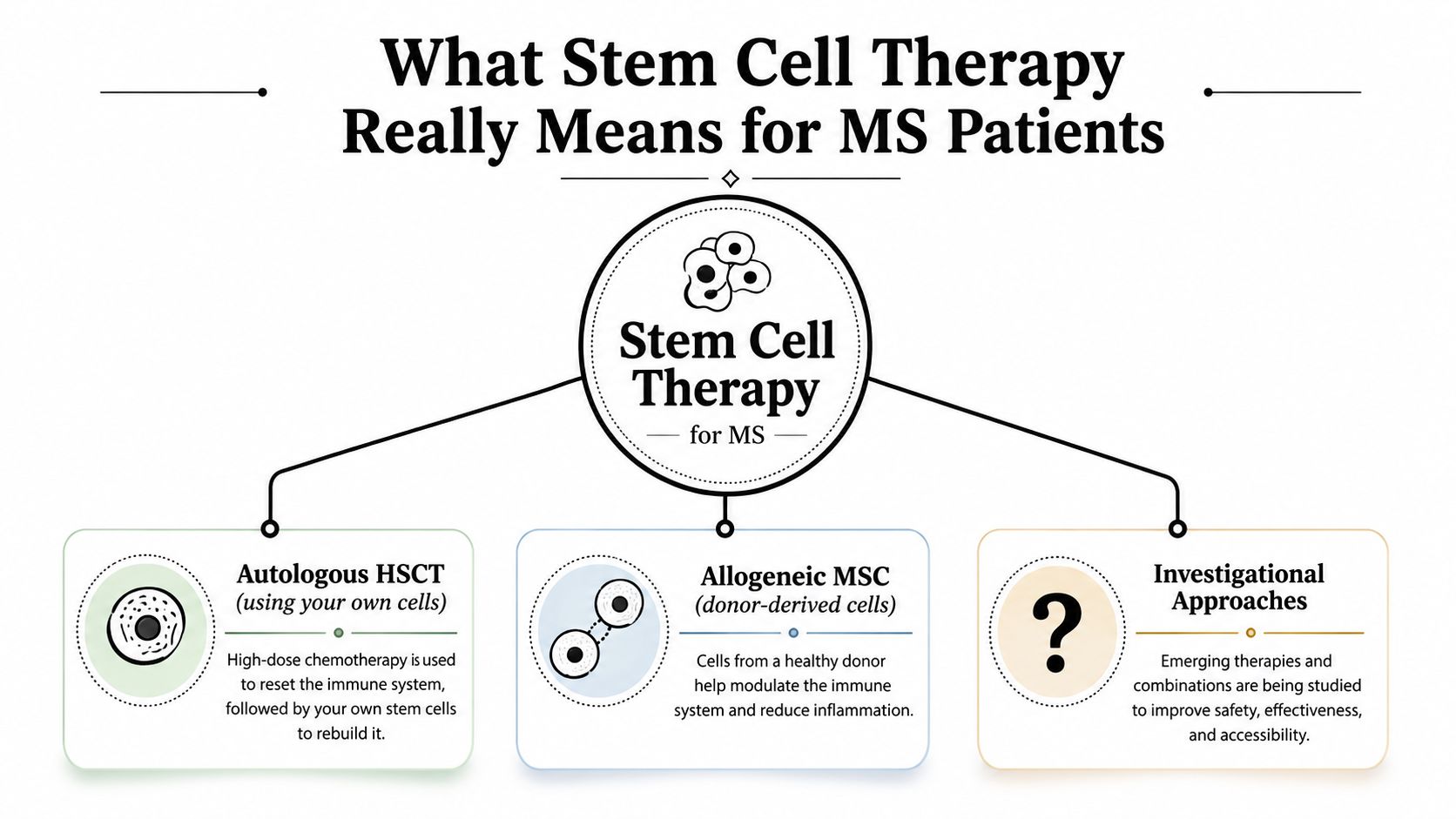
One branch of treatment is autologous hematopoietic stem cell transplantation (aHSCT), which uses a patient's own blood-forming stem cells after the immune system has been suppressed. Another branch is mesenchymal stem cell (MSC) therapy, which works through signaling, not immune ablation. These are not interchangeable, and that difference changes everything from candidacy to safety.
A practical way to think about the label
If you hear “stem cell therapy for MS,” ask one direct question. Is this an immune-reset procedure, a donor-derived cell therapy, or an investigational protocol with uncertain durability? That one question usually cuts through the confusion fast.
At Longevity Medical Institute, the focus is on allogeneic cell sources, meaning donor-derived cells produced in an in-house biotechnology lab. The toolkit includes placental, Wharton's jelly, adipose, endometrial, and dental pulp cell sources, which are used as part of a regenerative program rather than as a claim to cure MS. For patients who are not candidates for HSCT, that distinction matters because the goal shifts from immune ablation to clinical support and cautious monitoring.
Practical rule: If a clinic talks about “stem cells for MS” without saying which cell type it uses, how it's administered, and what evidence supports that specific approach, you're not getting a real medical explanation yet.
The phrase sounds broad because the field is broad. A good consultation narrows it quickly, so you know whether you're discussing a one-time immune reset, an experimental supportive strategy, or something that doesn't belong in MS care at all.
Two Very Different Mechanisms Behind Stem Cell Approaches
A patient hearing the phrase stem cell therapy for MS can easily assume every option works the same way. It does not. Some approaches are built around a one-time immune reset, while others aim to modulate inflammation and support repair signals without eliminating the immune system.
aHSCT follows the immune-reset model. High-dose conditioning chemotherapy suppresses the existing immune system, then the patient's own CD34+ stem cells are returned so immunity can repopulate in a new state. The logic is straightforward, interrupt the autoimmune attack first, then rebuild the system from its own stored cells.
That approach is very different from MSC therapy. MSCs do not wipe out immunity. They are used for immunomodulation and trophic repair signaling, meaning they may influence inflammatory activity and support pathways involved in tissue repair. For a clear overview of how those mechanisms differ, see this explanation of how stem cell therapy works.
HSCT versus MSC therapy at a glance
| Feature | HSCT | MSC Therapy |
|---|---|---|
| Main mechanism | Immune ablation with stem-cell rescue | Immunomodulation and trophic signaling |
| Cell source | Patient's own hematopoietic cells | Donor-derived or other MSC sources |
| Conditioning chemotherapy | Yes | No |
| Typical candidate | Aggressive, treatment-refractory relapsing MS | Experimental use, often when HSCT isn't appropriate |
| Clinical goal | Reset immune activity | Support inflammatory balance and repair signaling |
The practical difference matters. aHSCT is the more evidence-supported choice for selected patients with active relapsing MS who have not responded well to standard therapy. MSC therapy belongs in a different category, one that is still being refined, and human research studies are mixed rather than as a substitute for HSCT.
MS patients often hear both options described with the same shorthand, which adds confusion. A clinic should be able to say whether it is offering immune ablation and rescue, or an allogeneic cell therapy meant to influence inflammation and healing. Those are separate strategies, and they should be evaluated that way.
For patients considering allogeneic MSC options, the cell source, the route of administration, and the clinic's monitoring standards matter as much as the label on the brochure. Those details help show whether the treatment is being framed as a careful regenerative intervention or as a vague promise.
What the Evidence Shows for MS Outcomes
The evidence base for HSCT is older and more clinically mature than the evidence for MSCs. Early bone-marrow-based transplant reports described more than 600 transplants done primarily for MS, with the European Bone Marrow Transplant Registry recording 469 MS patients and the Consortium for International Blood and Marrow Transplant Research recording 143 more. That registry history also explains why the field changed, procedure-related mortality was once reported as high as 4% to 20%, then fell from 7.3% in 1995–2000 to 1.3% in 2000–2007 as patient selection and conditioning improved. Historical HSCT registry review
For selected patients, modern aHSCT series and expert-center summaries have reported 2-year no-evidence-of-disease-activity rates of about 70% to 90%, compared with 15% to 50% in conventional DMT trials. That is why aHSCT remains the most evidence-supported cell therapy for aggressive, treatment-refractory relapsing MS. Cleveland Clinic and expert summary on aHSCT for MS
Where MSC data sits
MSC studies are more mixed. One meta-analysis of 12 studies reported 40.4% of patients improved after MSC therapy, 32.8% remained stable, and 18.1% worsened. In the same analysis, studies with follow-up of 6 months or less reported an improvement rate of 45.8% across 84 patients. Another meta-analysis covering 118 patients reported 0% treatment-related mortality, 16% progression at 6 months, 35% progression at 1 year, and NEDA in 72% at 6 months and 62% at 1 year. MSC meta-analysis review
A newer 2025 meta-analysis of 11 randomized controlled trials involving 691 patients found that individuals with earlier, more inflammatory multiple sclerosis appeared more likely to experience clinical stabilization or improvements in fatigue, mobility, cognition, and quality of life, whereas patients with advanced progressive disease and established neurodegeneration generally demonstrated less benefit, suggesting that mesenchymal stem cell therapy may be most effective before irreversible axonal damage becomes the predominant driver of disability. However, when outcomes were pooled across all disease stages and patient populations, the meta-analysis found no statistically significant overall benefit compared with control for disability progression as measured by the Expanded Disability Status Scale (EDSS) or for MRI T2 lesion burden, and treatment-related adverse events were comparable between groups.
That does not erase the earlier signals. It means the most honest reading is cautious. MSC therapy may help some patients with earlier-stage MS, and the best-supported framing is patient selection within a structured program, not a guaranteed MS treatment. For patients researching how allogeneic MSC programs are being used in autoimmune care, that distinction matters because the study signal is promising in some settings, while the trial record still remains uneven. MS stem cell overview
Understanding the Risks and Safety Profile
Risk in MS care is never abstract. Patients are already weighing relapse risk, MRI activity, and the chance of disability progression, so the question is not whether a treatment has risk. The key question is whether that risk matches the disease burden and the strength of the evidence behind the intervention.
HSCT has had a steep safety learning curve. In its earliest era, procedure-related mortality was reported as high as 4% to 20%. Later registry data showed a clear improvement, with mortality falling to 1.3% in 2000 to 2007 as teams refined patient selection, conditioning regimens, and transplant protocols. That safety shift is one reason HSCT moved from a highly experimental approach toward a more standardized strategy in carefully selected patients. HSCT safety history
MSC safety feels different, but it isn't risk-free
MSC therapy has usually shown a more favorable short-term tolerability profile. In the evidence review above, pooled data reported 0% treatment-related mortality, and the adverse events described were often mild or transient. Even so, long-term safety data in MS is still maturing, and the field is still working out how route, dose, and disease subtype affect outcomes. MSC safety and meta-analysis review
For patients comparing options, the difference is straightforward. HSCT carries the heavier upfront risk because it is designed to fully suppress the immune system. MSC therapy is less intensive, but it also sits on a more uncertain evidence base, so lower short-term risk does not automatically mean a better decision.
A useful way to frame the question is to ask what kind of safety problem you are trying to avoid. HSCT safety is about intensive immunoablation, infection risk, and transplant-level monitoring. MSC safety is about infusion reactions, product quality, and whether the clinic can recognize and respond if something unexpected happens. Those are different risk profiles, and they should be discussed that way.
Ask any clinic how it monitors infusion reactions, what emergency support is on site, and whether ICU access exists if something unusual happens.
A practical safety checklist should include the following:
Adverse event monitoring: How are patients observed during and after infusion?
Emergency protocols: What happens if a reaction occurs during treatment?
Escalation pathways: Is there rapid access to higher-level care if needed?
Neurology coordination: Will the clinic communicate with your home neurologist?
For a plain-language overview of safety questions, the clinic's own educational material on stem cell therapy safety considerations can help you frame the discussion before you travel.
Who Is a Candidate and Where Allogeneic MSCs Fit In
The strongest stem-cell evidence in MS still belongs to aggressive, treatment-refractory relapsing MS, especially when inflammation is active and standard disease-modifying therapy has failed. That is the group in which aHSCT is most often discussed, because the treatment is built to suppress the immune system and then rescue it with the patient's own cells. It's a narrow lane, and it should stay that way.
That leaves a much larger group of patients who are not HSCT candidates. Some have progressive MS. Some are stable on DMTs and want adjunctive support without immune ablation. Some live far from transplant centers or aren't appropriate for conditioning chemotherapy. Those patients are often the ones asking whether allogeneic MSCs have a role.
Where donor-derived MSCs fit
MSC therapy is not an immune reset. It is a regenerative signaling approach, used to influence inflammatory pathways and support repair signaling. In practical terms, that means the therapy belongs in a different discussion than HSCT, especially for people who are not good transplant candidates.
For MS patients considering a non-transplant regenerative pathway, mesenchymal stem cell therapy is the relevant category to understand, not autologous transplantation. At LMI, that means donor-derived cell sources are the focus, including placental, Wharton's jelly, adipose, endometrial, and dental pulp options, all framed as supportive regenerative medicine rather than a replacement for standard MS care.
LMI does not perform HSCT. It also does not use autologous cells. That makes the candidacy discussion more straightforward. If you need a transplant-style immune reset, you need a different referral pathway. If you're exploring structured regenerative support, donor-derived MSC options may be part of the conversation.
The Treatment Journey From Consultation to Follow-Up
The first step is usually record review, not travel. A clinic should look at your neurologic history, prior DMTs, MRI reports, recent labs, and any relapse documentation before suggesting a path forward. That review helps determine whether you're even talking about an HSCT-type referral, an MSC-based regenerative plan, or no cell therapy at all.
For patients traveling to San José del Cabo, the process is typically outpatient and organized around baseline testing, infusion day logistics, and observation. At LMI, that can include an in-house clinical lab measuring 140 biomarkers, AI-integrated full-body MRI when appropriate, and additional cardiac assessment if your medical history calls for it. The point isn't to collect tests for their own sake, it's to reduce blind spots before treatment.
What to bring to a consultation
Recent MRI reports: Bring the actual written reports, not just the images.
Medication history: Include DMTs, steroids, and any immune therapies.
Relapse timeline: Note when symptoms changed and how long they lasted.
Laboratory results: Recent bloodwork helps the team avoid duplicating tests.
Questions for your neurologist: Coordination is easier when your home team knows the plan.
MSC-based care doesn't involve conditioning chemotherapy, so the recovery window is usually much simpler than an HSCT course. Even so, travel planning matters. You'll want enough time for observation, follow-up instructions, and a realistic buffer before heading home.
A good clinic will also map follow-up at 3, 6, and 12 months so symptom changes and safety issues aren't left to guesswork. That cadence matters because MS is a longitudinal disease, and a single infusion day never tells the whole story.
How to Evaluate a Stem Cell Clinic in Mexico
For US and Canadian patients, the first filter is credentialing, not aesthetics. A clinic should be able to explain what COFEPRIS licensing covers, how its biotechnology lab handles cell production, and what quality controls are in place before anything reaches a patient. If that explanation is vague, keep looking.
ISO certification matters because it signals a structured manufacturing environment, especially for allogeneic cell production. Ask whether the lab documents identity, sterility, traceability, and release standards in a way a physician can review. If a clinic can't show serious quality documentation, the therapy may be marketed better than it is governed.
Red flags worth taking seriously
Autologous-only marketing for MS: That can signal a mismatch between claim and treatment reality.
Vague cell-count claims: Big numbers mean little without method, source, and context.
No third-party testing: Independent verification is a basic safety expectation.
No in-house diagnostics: A clinic without lab and imaging support may be underpowered for complex patients.
LMI's differentiators in this space include a COFEPRIS-licensed, ISO-certified biotechnology lab, an in-house clinical lab, AI-enhanced full-body MRI, advanced heart evaluation, ultrasound-guided procedures, concierge accommodations, and private travel options.
If you want a deeper clinic checklist, the institute's guide to choosing a stem cell clinic in Mexico is a useful place to compare infrastructure rather than slogans.
Key Questions MS Patients Ask Before Moving Forward
Is stem cell therapy for MS FDA approved? No. For MS, stem cell therapy is still considered experimental, and major patient guidance says it should be offered only in clinical trials or under carefully selected specialist care. FDA status and patient guidance summary
What should I expect realistically? Not a cure. For the most evidence-supported option, aHSCT can produce major disease control in selected patients, while MSC therapy remains more variable and should be viewed as a supportive regenerative strategy, not a guaranteed outcome.
Can I coordinate with my home neurologist? Yes, and you should. The safest plans include shared records, MRI comparison, medication reconciliation, and follow-up communication after treatment.
How do I start with LMI? Begin with a medical records review, then discuss whether your case fits an MSC-based regenerative pathway, a transplant referral, or another standard MS plan.
Author
Dr. Kirk Sanford, DC, Founder and CEO, Longevity Medical Institute. Dr. Sanford focuses on patient education in regenerative and longevity medicine, translating complex therapies into clear, practical guidance for patients.
Medical Review
Dr. Félix Porras, MD, Medical Director, Longevity Medical Institute. Dr. Porras provides clinical oversight and medical review to help ensure accuracy, safety context, and alignment with current standards of care.
Last Reviewed: August 5, 2026
Short Disclaimer
This information is for educational purposes only and is not medical advice. It does not replace an evaluation by a qualified healthcare professional. For personalized guidance, please schedule a consultation.
Longevity Medical Institute offers physician-led regenerative medicine, advanced diagnostics, and carefully structured stem cell programs for patients who want a clear, evidence-based discussion about MS options. If you're comparing HSCT concepts with allogeneic MSC care, Longevity Medical Institute can help you review your records, discuss candidacy, and plan the next step with a specialist team.