

Stem Cell Therapy for Scleroderma: A Patient Guide
You may have arrived at this topic after noticing that your hands feel tighter, your fingers are harder to move, or a small digital ulcer refuses to heal. Perhaps your rheumatologist has explained systemic sclerosis, yet you're still searching for options that address more than one symptom at a time. Stem cell therapy for scleroderma is attracting interest because mesenchymal stem cells may influence immune signaling, inflammation, blood-vessel health, and tissue repair, but the evidence differs substantially between cell-based approaches.
This guide focuses on allogeneic mesenchymal stem cells, meaning donor-derived cells, rather than transplant-based immune-reset procedures. Early research is encouraging, but MSC therapy remains under clinical investigation. It should complement, not replace, rheumatology care, organ monitoring, and established treatment.
Understanding Systemic Sclerosis and Cellular Signaling
A person with systemic sclerosis may notice the disease first through the hands. Skin can become tight, fingers may lose flexibility, Raynaud's symptoms can interfere with everyday activities, and a minor injury may become a difficult wound. These visible changes reflect a deeper process involving immune dysregulation, persistent inflammation, injury to small blood vessels, and excessive collagen production.
The body's repair signals become poorly coordinated. Immune activity may remain overactive, endothelial cells lining the blood vessels may function abnormally, and fibroblasts may produce too much collagen. Over time, this combination can contribute to skin thickening, impaired circulation, digital ulcers, stiffness, and internal-organ complications. Systemic sclerosis isn't a skin condition, and its effects vary considerably from one patient to another.
Why MSCs are being studied
Mesenchymal stem cells, commonly called MSCs, are better understood as signaling and regulatory cells than as replacement parts. They release growth factors, cytokines, extracellular vesicles, and other biological signals that may influence nearby and distant cells.
Researchers are investigating whether these signals may:
Regulate immune responses: MSCs may help moderate excessive immune activation rather than broadly suppressing every immune function.
Reduce inflammatory signaling: Early research suggests they may influence inflammatory pathways involved in tissue injury.
Support endothelial health: MSC signaling may help blood-vessel function and circulation.
Influence fibroblast activity: Researchers are studying whether MSCs can affect pathways associated with excessive collagen production and fibrosis.
Encourage wound healing: Their signaling may support tissue repair, especially where circulation and oxygen delivery are compromised.
Manage oxidative stress: MSC-derived signals may help regulate cellular stress, although this remains an active research area.
These mechanisms are biologically plausible, but they don't prove that MSC therapy will reverse established fibrosis or stop systemic sclerosis from progressing. Patients should view MSCs as a potential biological communication tool, not a guaranteed cure. Our overview of what stem cell signals do provides additional context for this signaling-based model.
Evaluating the Clinical Evidence and Mechanisms
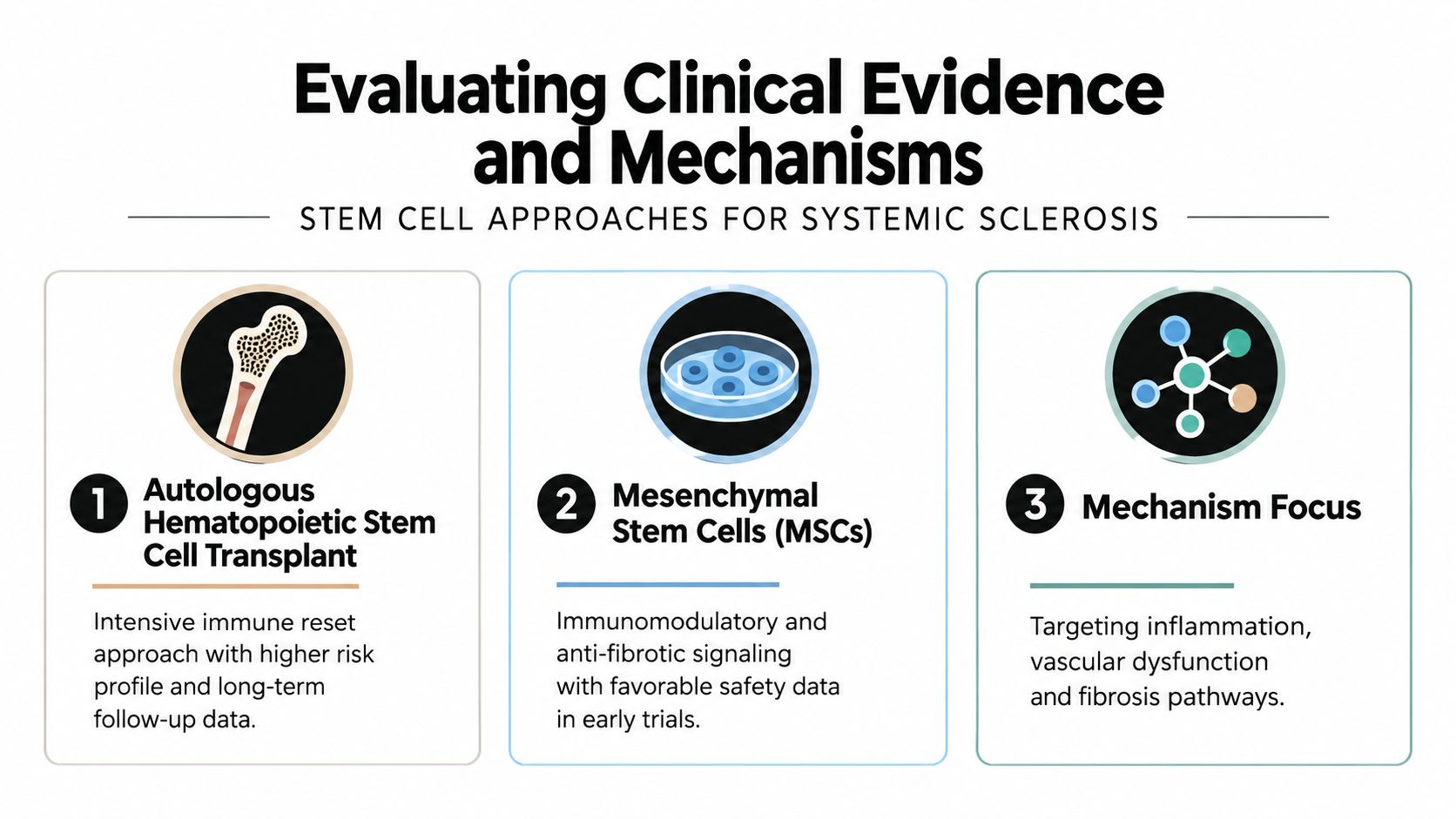
A patient with rapidly progressive systemic sclerosis may hear “stem cell therapy” and assume every option carries the same evidence and risk. They do not. Autologous hematopoietic stem cell transplantation, or AHSCT, uses a patient's own blood-forming stem cells after intensive conditioning treatment. It has the strongest clinical evidence among stem-cell approaches for systemic sclerosis, but its intensity and safety profile differ substantially from an investigational MSC infusion.
The NIH-reported long-term follow-up of the SCOT study randomized 68 patients. At 4.5 years, overall outcomes favored transplantation, with 7 deaths in the transplant group versus 14 in the cyclophosphamide group (NIH report on the SCOT study). A review of the ASTIS and SCOT trials reported four-year event-free survival of 81% with AHSCT versus 74% with cyclophosphamide in ASTIS, and 79% versus 50% in SCOT. In SCOT, six-year overall survival was 86% versus 51%. Together, these results support AHSCT as a disease-modifying option for carefully selected patients with rapidly progressive disease and organ risk.
A separate EBMT/EULAR report followed 57 patients treated with autologous stem cell transplantation. Skin scores improved at several follow-up points, and 92% of 50 evaluable patients had a partial or complete response after a median follow-up of 22.9 months. Treatment-related mortality was 8.7%, representing 5 of 57 patients, while projected five-year survival was 72% (EBMT/EULAR report). Later summaries describe improved results with refined techniques and supportive care, including 81.8% two-year progression-free survival, 90% overall survival, and an 88.7% response rate in a 2020 analysis (systemic sclerosis HSCT review).
Where MSC evidence fits
MSC treatment follows a different biological strategy. It does not use the high-intensity conditioning and immune-reset process associated with AHSCT. Researchers are studying MSCs for immunomodulatory, vascular-supportive, anti-inflammatory, and tissue-repair signaling, with the aim of influencing the cellular environment rather than replacing damaged tissue directly. Our mesenchymal stem cell research overview explains this evidence base in greater detail.
A phase one and two study involving 20 severe, refractory systemic sclerosis patients reported improvement in modified Rodnan skin score, stabilization of FVC and DLCO at twelve months, and progression-free survival in 75% of patients (MSC evidence review). A systematic review and meta-analysis covering 9 studies and 133 patients associated MSC treatment with reduced skin thickness, improved lung measurements, and less digital-ulcer burden, with few adverse effects reported in the summarized studies. The findings are encouraging, but the studies used different cell sources, doses, manufacturing processes, and administration routes. Those differences make results difficult to compare and help explain why the biological signaling properties of distinct allogeneic MSC sources matter.
Clinical perspective: Early findings support careful investigation, not a universal protocol or a guaranteed individual response.
MSC evidence remains less mature than AHSCT evidence. Many reports are small, single-center, and non-randomized, so larger controlled trials are needed before firm conclusions can be reached. Guideline-supported AHSCT criteria apply to selected adults with early diffuse disease. Later-stage diffuse disease, limited cutaneous disease, and significant organ dysfunction require individualized assessment and may not be appropriate for transplant (systemic sclerosis treatment recommendations).
Exploring Five Allogeneic Cell Sources
Longevity Medical Institute's model centers on five established allogeneic cell types, each derived from donated tissue that undergoes medical screening. The important distinction is that donor-derived MSCs aren't the same as autologous fat-derived cells, bone-marrow procedures, or unprocessed stromal vascular fraction.
Comparing Allogeneic MSC Sources for Scleroderma Support
| Cell Source | Primary Biological Focus | Potential Scleroderma Relevance |
|---|---|---|
| Wharton's jelly MSCs | Immune regulation, angiogenic signaling, expansion capacity | Systemic immune balance, inflammatory regulation, vascular support, and intravenous treatment objectives |
| Placental MSCs | Immune regulation, inflammatory control, tissue-repair signaling | Broad systemic regenerative goals, vascular support, and inflammatory balance |
| Adipose-derived MSCs | Soft-tissue support, wound healing, vascular and regenerative signaling | Skin, hands, digital ulcers, localized circulation, and musculoskeletal or aesthetic tissue objectives |
| Endometrial MSCs | Cyclic repair biology, immune regulation, angiogenic and vascular-repair properties | Emerging option for vascular and tissue-repair goals, with limited direct systemic sclerosis evidence |
| Dental pulp stem cells | Angiogenic, immunomodulatory, neurotrophic, and tissue-repair signaling | Research-stage interest in vascular support, wound healing, nerve health, and oral or maxillofacial tissues |
Wharton's jelly MSCs, or WJ-MSCs, come from donated and medically screened umbilical cord tissue. They originate from young tissue and demonstrate strong expansion, immune-regulating, angiogenic, and regenerative signaling characteristics. These properties may make them particularly relevant when the clinical objective involves systemic immune regulation, inflammatory balance, vascular support, or intravenous treatment.
Placental MSCs, also called P-MSCs, come from donated and medically screened placental tissue obtained with informed consent. Their biological profile is being studied for systemic immune regulation, inflammatory control, vascular support, tissue repair, and broader regenerative objectives. Placental MSCs shouldn't be described as proven superior to Wharton's jelly MSCs. The choice depends on the patient and the protocol.
Adipose-derived MSCs, or AD-MSCs, come from fat tissue obtained from young, healthy, prescreened donors. Their potential relevance is strongest in discussions involving skin, hands, soft tissue, wound healing, digital ulcers, localized vascular support, and musculoskeletal applications. Some published scleroderma research has used autologous adipose cells or stromal vascular fraction, which aren't identical to purified and expanded donor-derived MSCs.
Endometrial MSCs, or EnMSCs, come from healthy, medically screened female donors. Endometrial tissue naturally undergoes repeated cycles of growth and repair, which gives these cells an interesting biological profile. Their immune-regulating, angiogenic, and vascular-repair properties are promising, but direct clinical evidence involving EnMSCs and systemic sclerosis remains limited.
Dental pulp stem cells, or DPSCs, are obtained from the soft connective tissue inside appropriately sourced and screened teeth. Early research describes proliferative, angiogenic, immunomodulatory, neurotrophic, and tissue-repair characteristics. Those features may be relevant to vascular support, wound healing, nerve health, and oral or maxillofacial tissues, but direct human research involving DPSCs and systemic sclerosis is limited.
No cell source has been proven universally superior. The appropriate choice depends on disease pattern, organ involvement, clinical objectives, administration route, donor screening, cell viability, manufacturing quality, and physician assessment. Umbilical stem cell therapy information can help patients understand why tissue source matters without turning one source into a one-size-fits-all answer.
The Critical Role of Laboratory Quality and Safety
Cell therapy quality begins before administration. At Longevity Medical Institute's 15,000-square-foot facility in San José del Cabo, an on-site biotechnology laboratory supports direct coordination between cell preparation and the medical team. The facility is described as an ISO-certified biotechnology laboratory within a federally licensed clinical environment using compliance-approved language.
What responsible oversight should include
A patient should be able to ask where the cells came from, how donors were screened, how the cells were handled, and how the clinic links the product to the individual treatment record. Informed consent and traceability matter because the origin and handling history affect both safety review and clinical accountability.
Quality oversight commonly addresses:
Cell identity: Confirming that the prepared product matches the intended cell type.
Sterility and contamination controls: Reducing the risk of microbial contamination during preparation and handling.
Viability and concentration: Assessing whether the cells are alive and prepared at the intended concentration.
Culture conditions and passage number: Documenting how cells were expanded and maintained.
Storage and chain of custody: Tracking the product from laboratory handling through clinical administration.
Donor screening: Using medically appropriate screening and documentation before cells enter the clinical workflow.
The laboratory should operate as part of a physician-led pathway, not as an isolated product supplier. A consultation needs to connect cell selection with systemic sclerosis history, medications, vascular symptoms, wound status, pulmonary findings, cardiac considerations, and the patient's goals. The clinic's explanation of why in-house biotechnology and fresh stem cells matter offers further context for evaluating integrated laboratory oversight.
A visual explanation of laboratory workflow can be useful before a consultation:
No laboratory standard can eliminate all medical risk. High-quality processing improves transparency and control, but it doesn't make an investigational therapy universally appropriate.
Integrating Supportive Regenerative Modalities
Systemic sclerosis can create a difficult local environment for healing. Narrowed or dysfunctional small vessels, reduced oxygen delivery, inflammation, skin tightening, and repeated mechanical stress may all matter when a digital ulcer or fragile area of skin is trying to recover. Supportive modalities can address aspects of that environment, but they don't replace disease-directed rheumatology care.
Hyperbaric Oxygen Therapy, or HBOT, may be valuable for selected patients with impaired circulation, tissue hypoxia, or difficult-to-heal digital ulcers. By delivering oxygen under increased pressure, HBOT may support wound recovery and tissue repair. Early reports and small clinical observations are encouraging, but evidence remains limited. HBOT doesn't control the underlying autoimmune disease or prevent internal-organ progression. Patients can review the relationship between hyperbaric oxygen therapy and stem cells as part of a broader discussion with their physicians.
The Longevity Recharge Station
The Longevity Recharge Station is a supportive 20-minute experience combining several modalities:
Photobiomodulation: Uses 10 wavelengths from 450 to 1064 nanometers. Early evidence is most directly relevant to systemic sclerosis-related skin wounds and digital ulcers. Researchers are studying potential effects on mitochondrial activity, cellular energy, nitric-oxide signaling, circulation, inflammation, oxidative stress, and tissue repair.
Molecular hydrogen inhalation: An emerging approach for oxidative-stress and inflammatory regulation. Direct evidence in systemic sclerosis remains insufficient.
Micro-impact plate therapy: Intended as supportive care for muscle activation, mobility, balance, and bone health.
Vagus nerve stimulation: May support relaxation, autonomic balance, and recovery.
These components should be understood as supportive rather than disease-modifying. Their purpose is to improve the conditions in which a patient manages symptoms, movement, tissue recovery, and general resilience. They shouldn't be marketed as a replacement for immunomodulatory medication, pulmonary monitoring, vascular management, wound care, or other conventional services.
A coordinated plan might combine physician-selected MSC therapy with wound assessment, circulation support, physical therapy, nutrition, sleep care, and appropriate oxygen-based treatment. The right combination depends on organ involvement and medical risk, not on a standard package.
Setting Realistic Expectations and Next Steps
MSC therapy offers a reason for cautious optimism because it may address several connected features of systemic sclerosis at once. Researchers are investigating its potential effects on immune imbalance, inflammatory signaling, vascular injury, impaired healing, and fibrotic pathways. That broad biological reach is encouraging, but it doesn't mean the therapy is a cure or that it reverses established fibrosis.
Current reviews describe transient mild infusion reactions, including fever and rash, while reporting no serious adverse events in the summarized MSC studies. These observations are reassuring but limited by the small, mostly uncontrolled evidence base (recent MSC review). Individual responses may vary, and a patient's underlying organ status can influence both eligibility and expected benefit.
A responsible plan should answer three questions clearly: what is being treated, what evidence supports the approach, and how will conventional care continue?
Before choosing a clinic, ask for:
Physician oversight: Which physician reviews your systemic sclerosis history and organ risks?
Cell transparency: What is the donor source, and how are identity, sterility, viability, and traceability documented?
Treatment boundaries: Which outcomes are realistic, and which claims remain experimental?
Rheumatology coordination: How will your existing medications, monitoring, and specialist relationships be handled?
Follow-up planning: Who evaluates changes in skin, circulation, ulcers, function, lung status, and quality of life?
Longevity Medical Institute offers physician-supervised allogeneic MSC protocols and supportive services such as HBOT and photobiomodulation in an integrated clinical and laboratory environment. A medical review can determine whether an investigational protocol or supportive therapy is appropriate, rather than assuming that every patient with scleroderma should receive the same intervention.
Frequently Asked Questions About MSC Therapy
How are allogeneic MSCs different from autologous cells?
Allogeneic MSCs come from screened donors. They don't require the patient to undergo cell harvesting. Autologous approaches use the patient's own tissue or blood-forming cells, and the evidence, preparation, risks, and clinical purpose differ between therapies.
Can MSC therapy replace my rheumatologist or medications?
No. MSC therapy shouldn't replace conventional rheumatology care, immunomodulatory treatment, vascular management, wound care, or organ surveillance. Any consideration of MSCs should be coordinated with the physicians managing your systemic sclerosis.
What happens during the evaluation?
The clinical team reviews your diagnosis, disease pattern, medications, circulation, skin changes, ulcers, organ involvement, prior treatments, and goals. Laboratory and imaging needs depend on your history and the proposed protocol.
Can treatment be coordinated with immunosuppressive medication?
Possibly, but there isn't a universal answer. Medication timing and safety depend on the drug, dose, infection risk, organ status, and treating physicians. Don't stop or change prescribed medication without medical direction.
What might recovery feel like?
Some patients may experience temporary fatigue or mild infusion-related symptoms, while others may notice little immediate change. Improvement, if it occurs, may develop gradually, and results can't be guaranteed.
Which cell source is right for me?
There's no universally superior source. Physician assessment should guide the decision based on your disease pattern, organ involvement, treatment objective, administration route, and laboratory quality controls.
Longevity Medical Institute provides physician-led evaluation for allogeneic MSC protocols, systemic sclerosis-related concerns, Hyperbaric Oxygen Therapy, and supportive photobiomodulation services. Visit Longevity Medical Institute to request a medical review and discuss whether an investigational or supportive pathway fits your health goals.
Author
Dr. Kirk Sanford, DC, Founder & CEO, Longevity Medical Institute. Dr. Sanford focuses on patient education in regenerative and longevity medicine, translating complex therapies into clear, practical guidance for patients.
Medical Review
Dr. Félix Porras, MD, Medical Director, Longevity Medical Institute. Dr. Porras provides clinical oversight and medical review to help ensure accuracy, safety context, and alignment with current standards of care.
Last Reviewed: September 17, 2026
Short Disclaimer
This information is for educational purposes only. It isn't medical advice and doesn't replace an evaluation by a qualified healthcare professional. For personalized guidance, please schedule a consultation.