

Why In-House Biotechnology and Fresh Stem Cells Matter
The most popular advice about stem cell therapy is often the least useful: ask how many cells a clinic provides. A number such as 25 million, 50 million or 100 million cells sounds precise, but it doesn't tell you whether those cells are viable at administration, what their identity is, how they were handled, or how much biological stress they experienced before reaching you.
Stem cells are living biological products. Their condition can change during culture, storage, transportation, thawing, formulation, and final preparation. Stem cell therapy doesn't begin when the IV starts or the injection is delivered. It begins in the biotechnology laboratory.
Stem Cell Therapy Begins in the Laboratory
Two clinics can advertise the same cell count while delivering materially different products. One may administer cells shortly after final quality assessment in the same facility where they were cultured and prepared. Another may receive cells manufactured elsewhere, keep them frozen, ship them across borders, store them, thaw them, and prepare them later. The label may look similar. The chain of custody isn't.
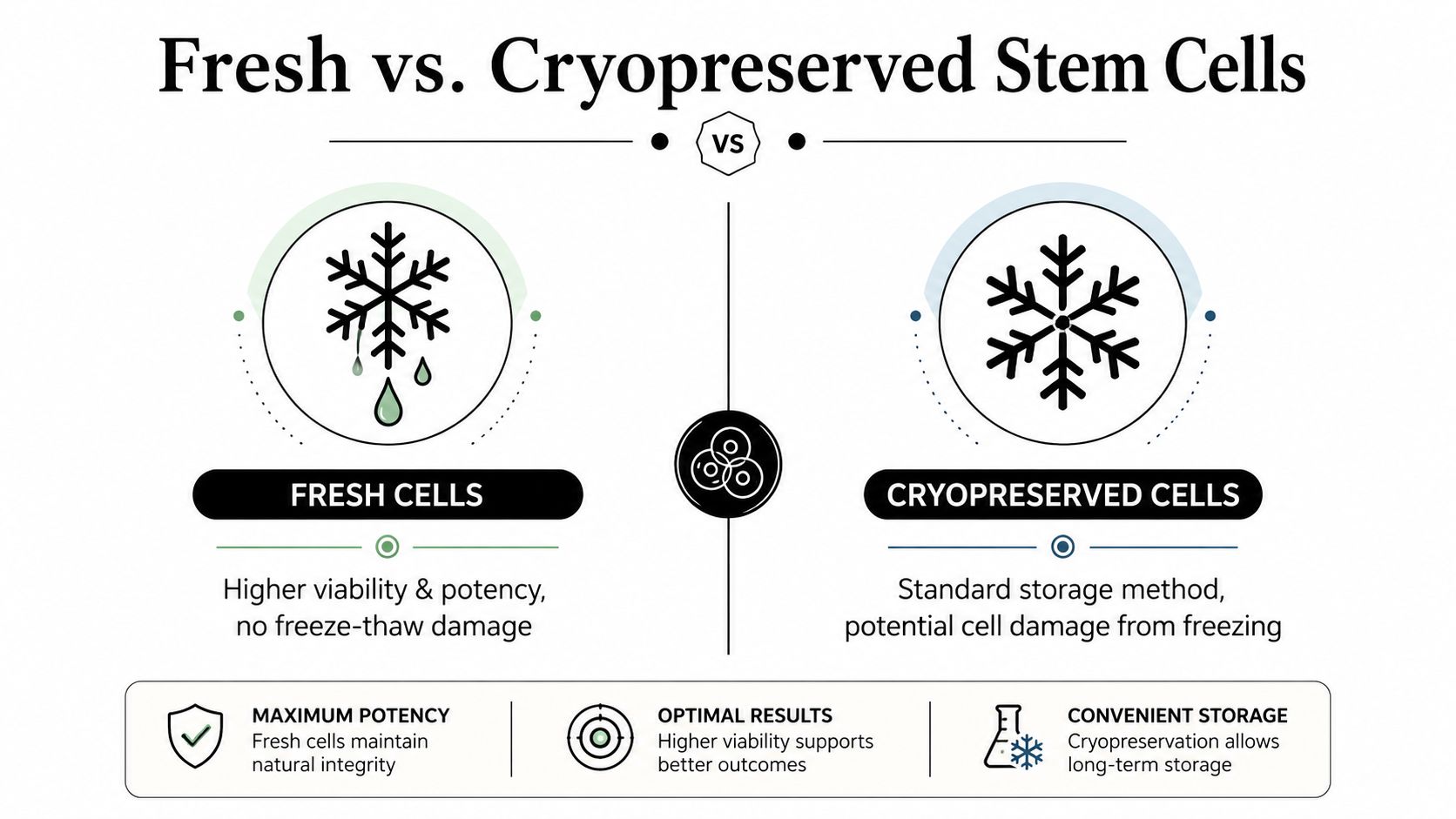
That distinction matters because viability falls as collection-to-processing time increases. This is why fresh, in-house production matters. In a 2023 research study of cryopreserved MSCs, certain commonly used post-thaw conditions resulted in more than 40% cell loss and viability falling below 80% after just one hour at room temperature, while the researchers also found that thawing conditions themselves could result in losses of up to 50% of the cells. When cells are produced fresh in-house and administered directly to the patient, we eliminate the freezing, shipping and thawing steps altogether and the additional variables they introduce.
The product is more than the label
A cell dose should be understood as a biological preparation with a history. Culture conditions, passage number, donor material, contamination controls, storage temperature, shipping conditions, thawing technique, and the time between thawing and administration can all influence what ultimately reaches the patient.
That is why facility design and workflow matter. A laboratory requires controlled movement, appropriate segregation, validated procedures, and documentation that follows material from source to release.
Practical rule: Ask where the cells were produced, where they were tested, and where they were prepared for your treatment. Those may be three different locations.
An integrated model brings those activities into one medical environment. You can see an example of the laboratory context in this inside-the-lab video from Longevity Medical Institute. The important point isn't the appearance of the facility. It's whether the team can connect the physical laboratory to documented release criteria and patient-specific administration.
What an In-House Biotechnology Laboratory Does
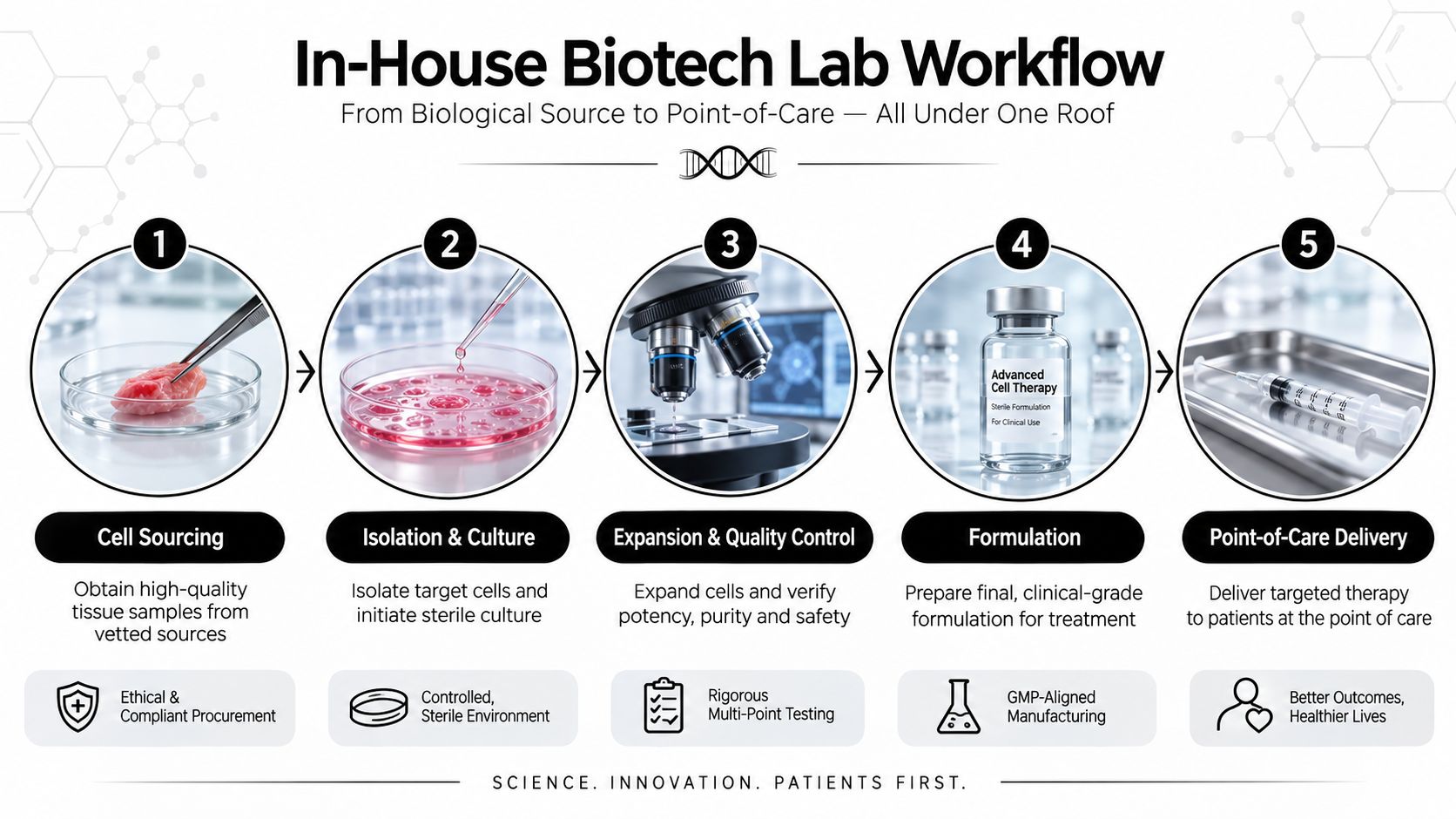
An in-house biotechnology laboratory is the production and quality-control environment for a living therapeutic material, not just a room where cells are placed into a syringe. Its work starts with tissue sourcing and continues through culture, testing, preparation, and delivery at the point of care. Patients can review what this model involves inside the biotechnology laboratory.
Sourcing establishes the starting material
Longevity Medical Institute exclusively uses allogeneic cells and produces five types in its biotechnology laboratory: placental, Wharton's jelly, adipose, endometrial, and dental pulp stem cells. Allogeneic cells come from a donor rather than from the patient receiving treatment.
Source tissue affects the characteristics of the resulting cell population. Review literature describes placental, adipose, and Wharton's jelly-derived mesenchymal stromal cells as a strong allogeneic candidate because they can be harvested in abundance, are non-controversial, and are considered hypoimmunogenic. The review also reports no tumorigenesis in the data discussed and describes applications.
Culture and expansion require discipline
After isolation, cells are cultured under defined conditions and expanded into a usable preparation. The laboratory must control the culture environment, monitor morphology and growth, record passage number, and determine whether each batch meets its release requirements. Passage number matters because repeated expansion can change cellular behavior, even when the final vial contains the advertised cell count.
A biotechnology workflow may also include harvesting exosomes, preparing cellular products for a specific administration route, and completing final checks before release. Every handoff can introduce variability. Keeping production, testing, and preparation within one operational system makes responsibility easier to trace.
Release testing protects the patient
Quality systems for stem-cell medicinal products address identity, purity, safety, potency, and stability. They also examine microbial and endotoxin contamination, residual materials, abnormal immune responses, tumorigenicity, and biological effectiveness, as described in a peer-reviewed review of stem-cell product controls (stem-cell quality systems review). You can view Longevity Medical Institute flow cytometry report for every patient.
Routine microbiological and viral testing includes mycoplasma, sterility, and adventitious-agent screening. Donor material should also be screened for HIV-1, HIV-2, hepatitis B, and hepatitis C before biobanking or distribution. In Mexico, advanced cell therapies must operate through COFEPRIS-sanctioned research and authorization pathways, with appropriate ethics and transplant oversight, rather than being treated as ordinary wellness services (view example of COFEPRIS licensing).
An in-house laboratory does not remove oversight. It makes the clinic responsible for demonstrating how quarantine, documentation, testing, release decisions, and regulatory requirements function in daily practice.
The Biology of Fresh Versus Cryopreserved Stem Cells
Cryopreservation is an established technology, and frozen cells aren't automatically poor quality. It allows biological material to be stored and transported under controlled conditions. The relevant question is whether the freezing and thawing process introduces variables that affect the product at the time of administration.
Freezing and thawing can affect more than just how many MSCs survive. In another study published in Cytotherapy found viability of freshly thawed MSCs fell to just 44–61%, compared with 91–92% in cultured cells, while the thawed cells also showed significantly impaired immunosuppressive function.
That finding calls for precision. It supports attention to immediate viability and handling. It doesn't prove that fresh cells are superior for every indication, route, or clinical objective.
What thawing can change
One quantitative study found that cryopreservation reduced viability, increased apoptosis, and impaired metabolic activity and adhesion during the first 4 hours after thawing. Fresh samples in that study showed viability of 99.1%, 99.2%, and 98.4% across donors, all above the ≥90% clinical benchmark (quantitative study of post-thaw MSC function).
Adhesion and metabolic activity aren't cosmetic laboratory measures. They relate to how cells interact with their environment, communicate with surrounding tissues, and participate in repair or engraftment dynamics. A preparation can therefore meet a basic viability threshold while still showing temporary functional impairment after thawing.
Damaged cells are biologically active
Historically, dead cells were often treated as cells that offered no therapeutic benefit. The biology is more complicated. Damaged and freeze-thawed MSCs can interact with the innate immune system, activate complement, and influence immune-cell behavior. Research has also described greater susceptibility to complement-mediated destruction and stronger instant blood-mediated inflammatory responses with some freeze-thawed MSC preparations than with fresh cells.
That doesn't mean all apoptotic MSCs are harmful. Apoptosis is a normal biological process, and its consequences depend on the product, the degree of damage, the recipient, and the clinical context. The defensible conclusion is narrower: viability matters both because nonviable cells don't provide the intended living-cell dose and because product condition may influence the recipient's biological response.
Readers interested in the patient-facing explanation can explore the relevant discussion in The Language of Healing. Fresh preparation may reduce certain handling variables, but it remains only one part of a complete quality system.
Integrated Lab Versus Outsourced Cell Supply
The central difference between the two models is control. An integrated clinic can connect culture, testing, final formulation, and administration through one facility and one accountable workflow. An outsourced model may still use a high-quality manufacturer, but it adds shipping, storage, receiving, thawing, and local preparation steps.
Neither model should be judged by marketing language alone. The patient should ask how the clinic proves quality at administration, not just where the cells originated.
| Quality Variable | Integrated In-House Lab | Outsourced and Shipped Cells |
|---|---|---|
| Chain of custody | Fewer transfers within one medical facility | More transfers between manufacturer, carrier, storage site, and clinic |
| Culture conditions | Direct local oversight of the culture and expansion process | Dependence on the external manufacturer's process and records |
| Passage number | Can be connected directly to the batch record and treatment plan | Must be verified through external documentation |
| Storage and transport | Can reduce dependence on prolonged shipping and storage | Requires validated shipping, receiving, storage, and thawing controls |
| Final preparation | Completed close to administration under the clinic's control | Performed after receipt, often following thawing |
| Quality assessment timing | Potentially shorter interval between final assessment and use | Time may pass between release, transport, thawing, and administration |
| Accountability | One integrated clinical and laboratory structure | Shared responsibility across multiple organizations |
Mexico's regulatory environment adds another layer. Advanced cell therapies need compliant pathways involving COFEPRIS, ethics oversight, and transplant-related governance where applicable. Freshness isn't a substitute for legality, sterility, identity, or documentation.
The strongest integrated model combines proximity with proof. Patients should be able to review the laboratory's licensing and certification scope, understand the release workflow, and receive a clear explanation of what happens between final testing and administration.
Why Advertised Cell Count Is Not Enough
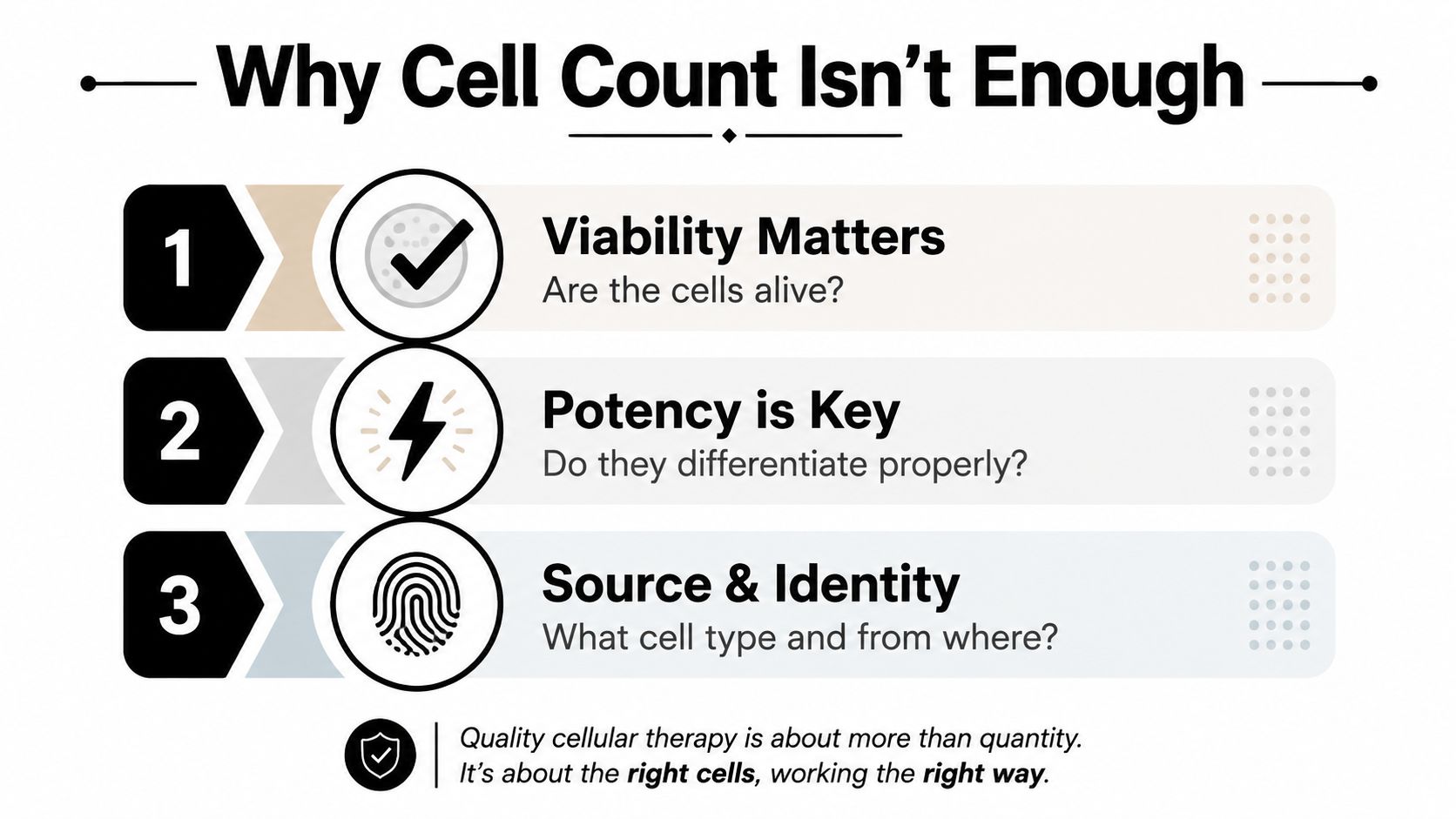
A high advertised cell count can conceal the variables that determine whether a product is suitable for administration. The labeled number may include damaged or nonviable cells, poorly characterized populations, residual materials, or cells that do not match the stated identity.
Ask any clinic advertising 25 million, 50 million, or 100 million cells a more useful question: how many cells are viable at administration? The answer should come from the flow cytometry documented batch and final preparation, not from a general estimate. Chain of custody matters because storage, transport, thawing, and handling can change the product before it reaches the patient.
The quality equation
A practical review examines several dimensions:
Viability: What proportion of cells remain alive at administration, and how was that measured?
Identity: What testing confirms the stated cell type and relevant population markers?
Purity: Which unwanted populations, residual materials, or process contaminants were excluded?
Sterility: What testing addresses bacteria, fungi, mycoplasma, endotoxin, viruses, and adventitious agents?
Potency: What biological activity is expected, and how is it assessed for the intended use?
Stability: How does the product behave during storage, transport, thawing, and final preparation?
Flow cytometry can help characterize identity and population markers. Its result must be interpreted with the batch record, culture history, passage number, viability assessment, and contamination testing. One laboratory result cannot replace a complete release package.
Questions that expose missing information
Patients should ask whether the cells were frozen, how they were thawed, how long they remained after thawing, and whether viability was measured before or after final formulation. They should also ask about donor screening, quarantine procedures, sterility and mycoplasma testing, endotoxin controls, and the process used to verify identity.
The earlier stem-cell quality review identifies identity, contamination, residual materials, immune responses, tumorigenicity, and biological effectiveness as relevant considerations for stem cell-based medicinal products. These categories explain why cell count cannot stand in for safety or potency.
A transparent clinic should explain which tests it performs, when testing occurs, what acceptance criteria apply, and how a batch is quarantined or rejected when it fails those criteria. It should also show how final results connect to the specific product administered.
The Longevity Medical Institute Approach to Vertical Integration
Longevity Medical Institute applies vertical integration to the point where cell therapy begins, in the laboratory, rather than at the IV line. Its allogeneic cell production, laboratory testing, diagnostics, and clinical administration operate within the same medical environment. The biotechnology laboratory produces five allogeneic stem cell types, placental, Wharton's jelly, adipose, endometrial, and dental pulp, within a COFEPRIS-licensed, ISO-certified framework.
The practical benefit is control over handoffs. Clinical and laboratory teams can connect source material with culture conditions, passage number, characterization, viability assessment, formulation, and administration. That can shorten the chain of custody and reduce outside shipping and handling. It does not remove the need for documented release criteria, contamination controls, or regulatory oversight.
Laboratory quality meets clinical context
A cell product must be considered alongside the patient receiving it. The institute's clinical ecosystem includes an in-house clinical laboratory measuring 140 biomarkers, AI-enhanced full-body MRI, and advanced cardiac assessments. These tools give clinicians information about health status, risk, and treatment context before they decide whether a regenerative protocol is appropriate.
Diagnostics do not establish that a cell therapy will work. They support patient selection, risk assessment, and follow-up. Outcomes can vary with the indication, cell preparation, comparator, and delivery route, so the laboratory record and the clinical rationale need to remain connected.
A broader account of how LMI differs from traditional longevity clinics describes the integrated model. The operating principle is direct: the clinic should explain what it administers, how the product is controlled, and why it fits the patient's clinical plan.
Questions to Ask Before Choosing a Stem Cell Clinic
Before scheduling treatment, ask for clear answers to these questions:
Laboratory oversight: Is the facility licensed and certified, and what activities do those credentials cover?
Cell source: Are the cells allogeneic, and are they placental, Wharton's jelly, adipose, endometrial, dental pulp, or another source?
Viability at administration: What percentage of cells are viable after final preparation?
Passage number: How extensively were the cells expanded?
Freeze-thaw history: Were they cryopreserved, how were they thawed, and how long were they held afterward?
Identity and purity: Was flow cytometry or another validated characterization method used?
Safety testing: Were donor screening, sterility, mycoplasma, endotoxin, viral, and adventitious-agent tests completed?
Chain of custody: Can the clinic document each transfer from source through administration?
Clinical rationale: What evidence supports the proposed use, and what outcomes remain uncertain?
A clinic that highlights cell count while avoiding viability, passage number, testing, and regulatory questions deserves caution. The 15-question stem cell clinic test can help organize your consultation.
Author
Dr. Kirk Sanford, DC, Founder & CEO, Longevity Medical Institute. Dr. Sanford focuses on patient education in regenerative and longevity medicine, translating complex therapies into clear, practical guidance for patients.
Medical Review
Dr. Félix Porras, MD, Medical Director, Longevity Medical Institute. Dr. Porras provides clinical oversight and medical review to help ensure accuracy, safety context, and alignment with current standards of care.
Last Reviewed: September 4, 2026
Short Disclaimer
This information is for educational purposes only and isn't medical advice. It doesn't replace an evaluation by a qualified healthcare professional. For personalized guidance, please schedule a consultation.
Longevity Medical Institute offers physician-led regenerative medicine supported by an on-site biotechnology laboratory, advanced diagnostics, and coordinated clinical oversight. Visit Longevity Medical Institute to discuss your goals and ask the laboratory and clinical questions that should guide a responsible treatment decision.