

Stem Cells and Exosomes for Asthma and Allergic Airway Inflammation
You can do everything right with inhalers and still feel like asthma is running your life. You watch pollen counts, keep rescue medication close, and still wake up coughing when the airways decide to tighten on their own terms. That gap between symptom control and true immune calm is why stem cell and exosome research keeps getting attention in asthma and allergic airway inflammation, even though the science is still early and not yet considered standardized care.
Asthma remains a major global disease burden, affecting an estimated 363 million people in 2023 and causing 442,000 deaths, according to the WHO-linked review literature on regenerative approaches for allergic airway inflammation (PMC review). Standard therapy matters, and it saves lives, but it doesn't always reset the underlying inflammatory circuit. That's the reason researchers keep asking whether mesenchymal stem cells, usually shortened to MSCs, and MSC-derived exosomes can help re-educate the airway environment rather than just blunt symptoms for a few hours.
Living With Asthma That Never Quite Goes Away
A patient with poorly controlled allergic asthma often knows the routine by heart. There's the controller inhaler on the counter, the rescue inhaler in the bag, the weather app checked before going outside, and the quiet frustration of still waking up at night because the chest feels tight or the cough won't settle.
That pattern tells you something important. Inhalers can dampen bronchospasm and inflammation, but they don't necessarily erase the immune memory that keeps the airways reactive. Even when the symptoms improve, the airway lining may still be living in an inflamed, hyperresponsive state, which is why people can cycle between short-lived relief and the next flare.
Why regenerative medicine entered the conversation
MSCs are being studied because they may act more like immune conductors than replacement parts. Instead of trying to patch over one narrow symptom, they appear to influence the airway's inflammatory setting, including the signals that keep eosinophils, T cells, and macrophages in an overactive loop (PMC review).
Practical rule: if a therapy is being discussed as a “cure” for asthma, pause. The credible question is whether it can modulate inflammation and fit safely alongside standard care.
That distinction matters for patients. The first question isn't whether regenerative medicine sounds exciting, it's whether the biology makes sense and whether the evidence is strong enough to justify anything beyond research settings. For a plain-language foundation on the concepts used in this field, how Mesenchymal Stem Cells Work.
What Stem Cells and Exosomes Actually Are
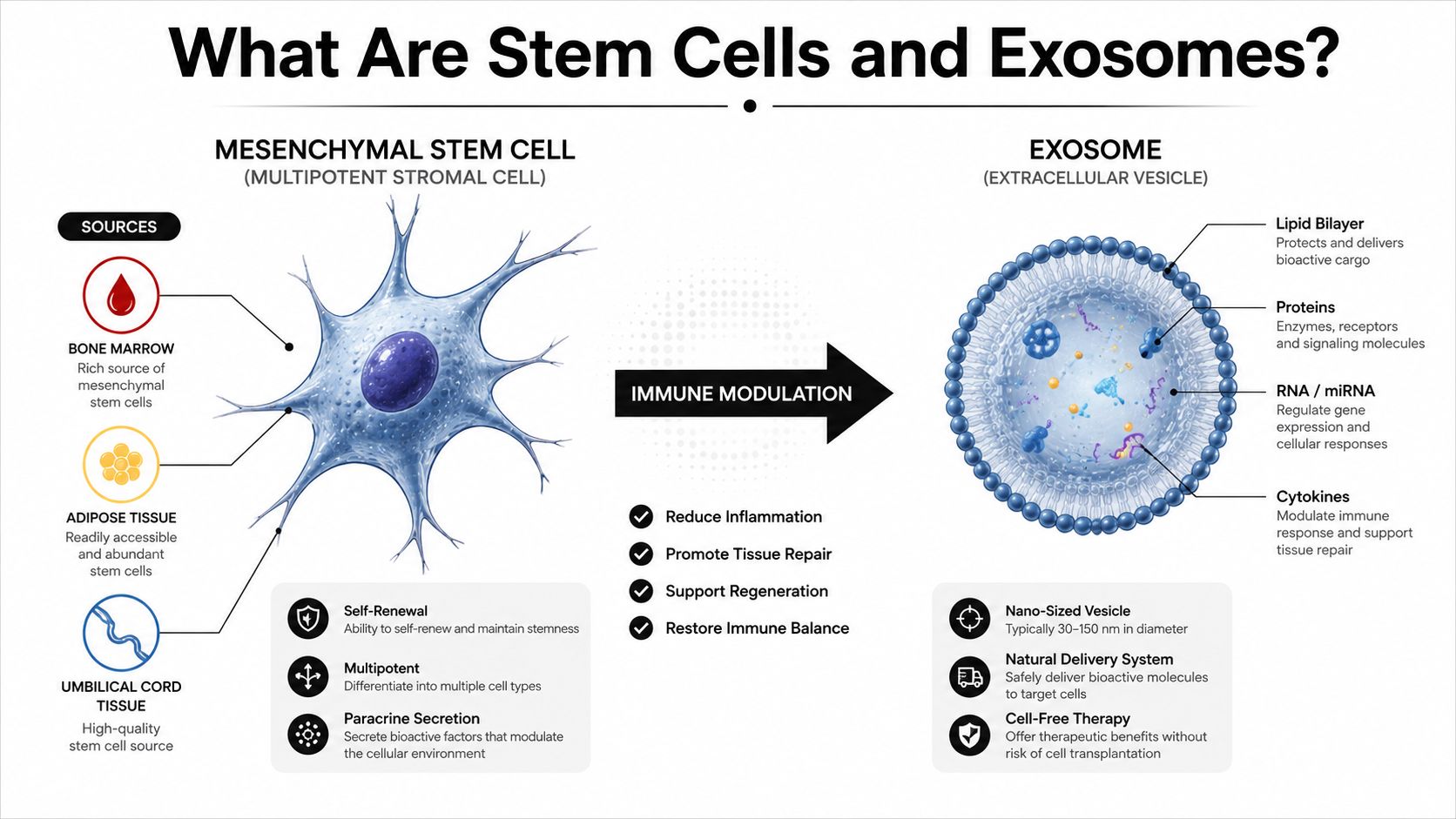
Mesenchymal stem cells are better understood as multipotent stromal cells, usually sourced from placental, bone marrow, adipose tissue, or umbilical cord tissue. In asthma research, their value isn't that they become new airway cells on demand, it's that they send out messages that can quiet immune overreaction and influence how nearby cells behave (PMC review).
A useful way to think about them is as a command center. They don't just sit in the tissue and “fill a hole.” They release signals that tell immune cells to slow down, shift behavior, or stop escalating inflammation in the first place.
Exosomes are the cell-free version of that signaling
Exosomes are tiny membrane-bound vesicles, generally discussed in the 30 to 150 nm range in the research literature, that carry proteins, lipids, mRNA, and regulatory microRNAs from the parent cell. In practical terms, they're one of the main ways MSCs communicate without needing the whole live cell to be present (PubMed review).
That's why exosomes are getting so much attention. They offer a cell-free way to deliver immunomodulatory cargo, which may simplify some translational problems that come with live-cell therapy, including storage, consistency, and route of delivery. The literature also notes that exosomes from healthy and asthmatic individuals can carry different biologically relevant cargo, which is one reason source selection matters (PubMed review).
Longevity Medical Institute describes its regenerative products as allogeneic, culture-expanded MSCs and exosomes from screened donor tissue under GMP workflows. That's different from point-of-care autologous preparations, and the distinction matters because “stem cell” is not a single product category. In asthma, neither MSCs nor exosomes are FDA-approved treatments, so any clinic presenting them otherwise is misrepresenting the current state of care.
Why Asthma Is More Than Just Tight Airways
Asthma is not just a problem of airway narrowing. It's a chronic inflammatory disease in which the lining of the airways stays primed to overreact, so even modest triggers can lead to cough, wheeze, chest tightness, and mucus.
The allergic pattern that drives many cases
In many patients, the immune response is Th2-dominant. Allergen-presenting dendritic cells activate Th2 lymphocytes, which then promote IgE class switching, eosinophil recruitment and survival, goblet-cell changes, and excess mucus. That sequence helps explain why asthma can feel like a moving target, even when a patient is using standard medication appropriately.
Airway remodeling makes the disease harder to ignore over time. Repeated inflammation can leave behind smooth muscle hypertrophy, subepithelial fibrosis, and basement-membrane thickening, so the airway becomes structurally less forgiving. The review literature also recognizes that asthma is heterogeneous, with non-type-2 patterns such as Th17-high, neutrophilic, and paucigranulocytic disease, which is one reason one-size-fits-all treatment rarely works perfectly.
Key cells and mediators in allergic airway inflammation
| Cell or Mediator | Primary Role in Asthma |
|---|---|
| Dendritic cells | Present allergens and help initiate adaptive immune activation |
| Th2 lymphocytes | Drive the allergic inflammatory pattern in many patients |
| IgE | Supports allergic sensitization and downstream mediator release |
| Eosinophils | Contribute to airway inflammation and tissue injury |
| Goblet cells | Increase mucus production |
| Airway smooth muscle | Contracts and contributes to airway narrowing |
| Fibroblasts | Participate in remodeling and fibrosis |
Current inhalers and biologics often target symptoms, bronchoconstriction, or selected cytokines. MSC and exosome strategies are being studied earlier in the cascade, with the hope of changing the immune environment that keeps the airway reactive in the first place.
How MSCs and Exosomes Try to Calm the Immune System
A patient may use an inhaler correctly yet continue to experience allergic airway inflammation. MSC research addresses that broader problem by examining how several immune pathways interact at once. The 2025 review on MSC-derived exosomes in asthma describes these therapies as immunomodulatory tools that shift a Th2-skewed response toward a more regulated immune state (PubMed review).
What the immune shift looks like
Reported MSC effects include supporting Th1/Th2 balance, promoting regulatory T cells, reducing excessive Th17 signaling, and directing macrophage polarization toward an anti-inflammatory M2 pattern. MSCs also influence dendritic-cell activation, an upstream control point that can help determine whether an allergic response continues escalating or begins to settle.
Exosomes use a related mechanism without requiring a live cell to engraft. MSC-derived exosomes carry microRNAs, proteins, and lipids that communicate with recipient cells. The review literature discusses cargo such as miR-146a, miR-223, and TSG-6, together with effects involving NF-κB, STAT6, PI3K/Akt, TRAF1, and Wnt/β-catenin signaling (PubMed review).
The practical question is which patients fit this biology. These approaches are most relevant to inflammatory, particularly allergic or type-2-pattern, asthma, while the appropriate phenotype, product, dose, and delivery route remain unsettled. They are not substitutes for prescribed inhalers or biologics.
Clinical takeaway: exosomes are not “natural steroids.” Their proposed role is to alter the inflammatory environment rather than only suppress symptoms downstream.
These mechanisms connect to concerns patients recognize. Less eosinophil activity can reduce airway irritation, lower IgE signaling can weaken allergic amplification, and reduced remodeling signals could support longer-term breathing stability.
For a clinical overview of how this concept fits into regenerative care, see immune modulation with stem cells. A credible clinic should explain the asthma phenotype, evidence stage, product characterization, route of administration, and how standard treatment will continue alongside any investigational therapy.
The patterns that keep showing up
One early milestone was a 2014 NIH-indexed preclinical study showing that intravenous adipose-derived stem cells significantly reduced allergic symptoms and eosinophilic inflammation in asthmatic mice (PubMed review). Later work moved beyond whole cells. Bone-marrow MSC exosomes improved airway hyperreactivity and pulmonary inflammation in preclinical models, and intratracheal or intranasal delivery has been reported to reverse histopathology and inflammatory readouts in allergic airway disease.
The literature also includes umbilical-cord MSCs and iPSC-derived MSCs in house-dust-mite or ovalbumin asthma models, with findings that point in the same direction, less eosinophilic inflammation and less structural injury. Some engineered or preconditioned products, including IL-1β-primed or TSG-6-overexpressing MSCs, have shown stronger effects than naïve cells in animal systems, which is one reason product design has become such a serious research question.
Selected preclinical MSC and exosome studies in asthma models
| Source | Model | Route | Key Outcome |
|---|---|---|---|
| Adipose-derived stem cells | Asthmatic mice | Intravenous | Reduced allergic symptoms and eosinophilic inflammation. |
| Bone-marrow MSC exosomes | Allergic airway models | Intratracheal or intranasal | Improved airway hyperreactivity and inflammatory readouts |
| Umbilical-cord MSC exosomes | Ovalbumin-induced asthma | Aerosolized | Suppressed pulmonary inflammation and prevented remodeling |
| MSC-derived exosomes | Murine allergic airway inflammation | Various preclinical routes | Reduced eosinophilic infiltration, IgE, and mucus hypersecretion |
For a broader research summary, see mesenchymal stem cell research.
How These Therapies Get Into the Lungs
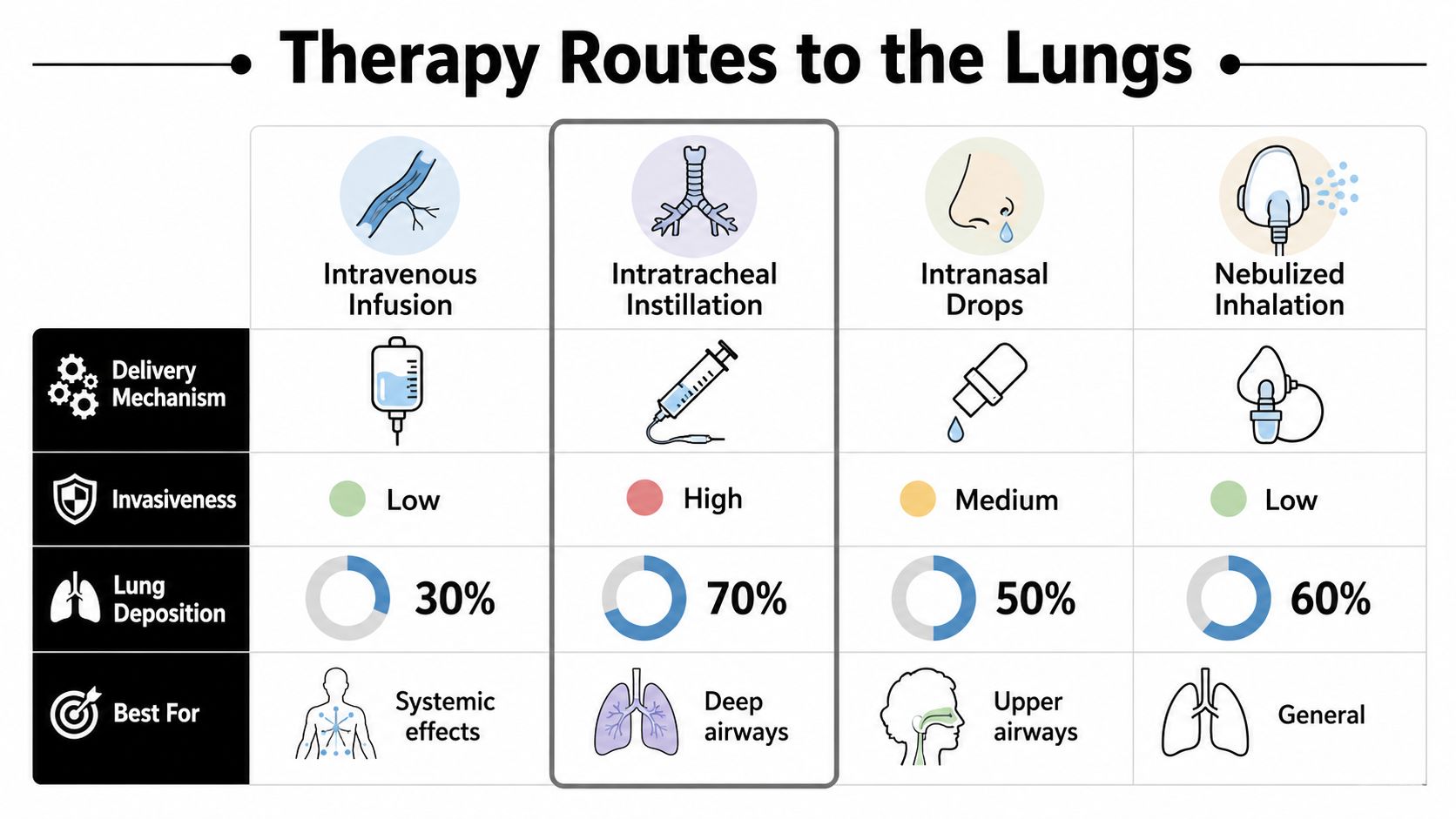
The delivery route determines where a product deposits, how much reaches the airway, and how burdensome treatment becomes. Intravenous, intratracheal, intranasal, and nebulized approaches therefore involve different tradeoffs.
Four routes, four different tradeoffs
Intravenous infusion is the route many patients hear about first. In asthma studies, IV MSCs are largely retained in the pulmonary capillary bed during first pass. That may support lung-directed effects, but systemic dosing does not create a predictable level of exposure at the airway surface, as described in this PubMed review.
Intratracheal instillation and intranasal delivery place the therapy closer to the airway epithelium. Local exposure may be higher, although these methods can be more procedural and less convenient. Nebulized inhalation is easier to repeat for exosome dosing, and a preliminary case report described nebulized hUCMSC-derived exosomes alongside improved lung function and no major adverse events. That remains early evidence, not proof of established treatment (PMC review). Patients can also review the practical differences in how stem cell therapy is given.
Different protocols that share the same label can still behave like different drugs.
The source and preparation matter as well. Umbilical cord, plcenta, adipose, and bone marrow-derived products may behave differently. Fresh and cryopreserved material can differ, as can passage number, preconditioning, and genetic engineering. Route and source therefore help shape the mechanism, rather than serving as simple packaging choices.
The Human Evidence So Far
A patient may find a clinic describing exosomes as a promising asthma treatment, then ask a reasonable question: what has been tested in people? The published human evidence remains sparse. Reviews continue to show reassuring safety profiles, but note that more large, randomized, placebo-controlled trials and standardized protocols are needed (Frontiers review).
Published human reports of MSC or exosome therapy for asthma
| Reference | Patient Phenotype | Intervention | Follow-up | Outcome |
|---|---|---|---|---|
| Published case report | Uncontrolled asthma | IV umbilical-cord-derived MSCs | Reported follow-up in the case literature | Symptom improvement, no adverse events reported |
| Preliminary case report/series | Asthma | Nebulized hUCMSC-derived exosomes | Early follow-up | Improved lung function, no major adverse events |
Questions to Ask Any Clinic Before You Travel
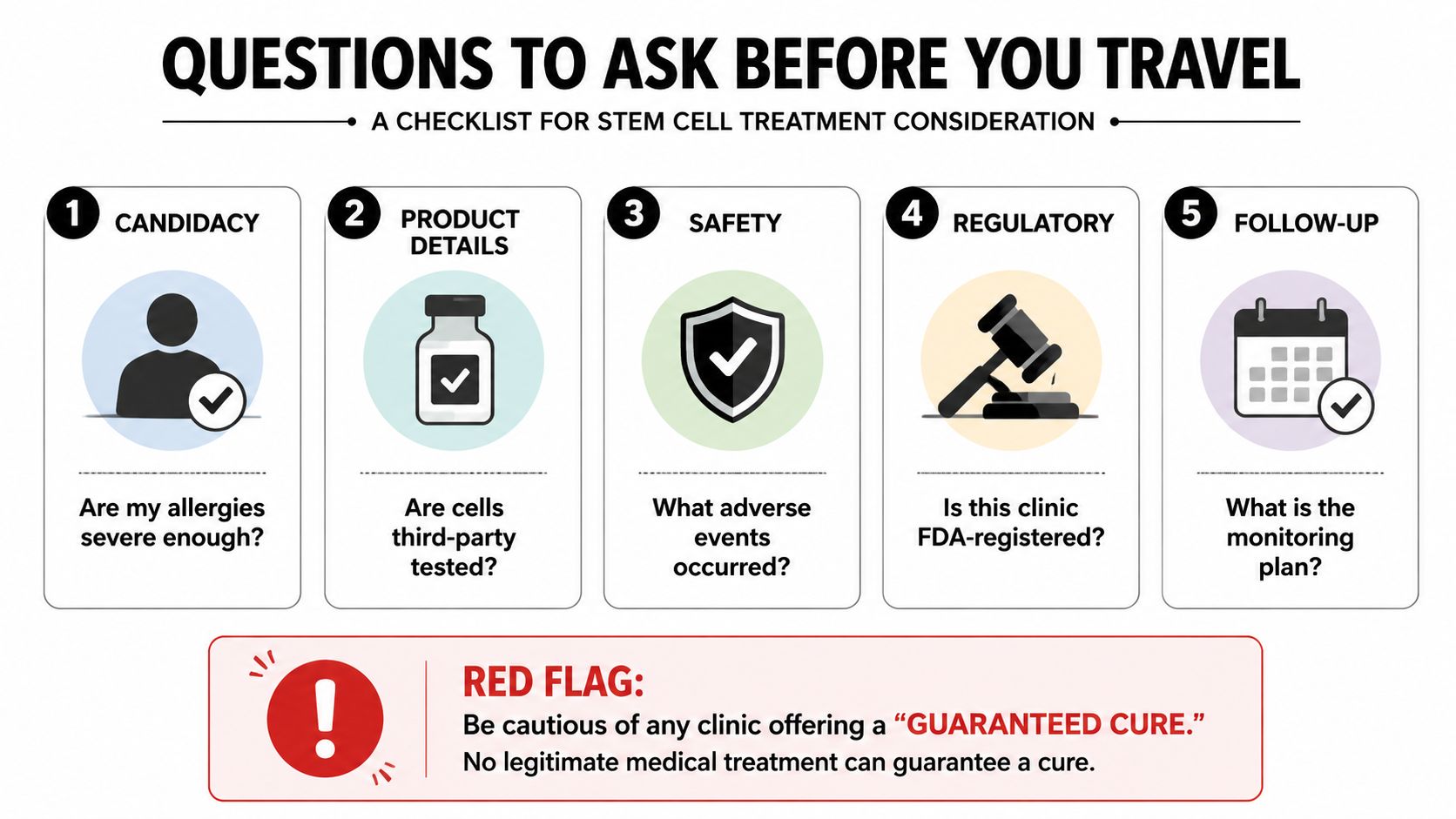
A credible clinic should be able to answer basic questions without deflecting. If they can't, that's your answer.
Start with candidacy and product details
Ask who is a candidate. Severe allergic eosinophilic asthma, steroid-resistant disease, pediatric asthma, and overlap phenotypes are all different clinical questions, and the literature does not support treating them as the same problem.
Ask for the source and format. You want to know whether the product is placental, umbilical-cord, bone-marrow, adipose, or exosome-based, and whether it's characterized and third-party tested.
Ask about dose and route. Intravenous, intratracheal, intranasal, and nebulized delivery are not interchangeable.
Safety, regulation, and follow-up matter just as much
Ask what adverse events have been observed. A serious clinic should discuss reporting, not hide behind vague reassurance.
Ask whether the use is investigational. For asthma, MSCs and exosomes remain non-standard-of-care.
Ask what monitoring happens after treatment. You should hear a clear plan for symptom tracking, lung function, and follow-up.
Red flags are easy to spot once you know what to listen for. A clinic promising a guaranteed cure, offering inhaled “live stem cell” nebulization of unprocessed products, or refusing to disclose source, dose, or testing is asking you to trust marketing over medicine.
If you'd like a careful, physician-led discussion of whether regenerative medicine is relevant to your breathing symptoms, schedule a consultation with Longevity Medical Institute. The team can review your history, explain what is still investigational, and help you understand where MSC and exosome therapy may or may not fit alongside standard asthma care.
Author
Dr. Kirk Sanford, Founder & CEO, Longevity Medical Institute. Dr. Sanford focuses on patient education in regenerative and longevity medicine, translating complex therapies into clear, practical guidance for patients.
Medical Review
Dr. Félix Porras, MD, Medical Director, Longevity Medical Institute. Dr. Porras provides clinical oversight and medical review to help ensure accuracy, safety context, and alignment with current standards of care.
Last Reviewed: August 20, 2026
Short Disclaimer
This information is for educational purposes only. It isn't medical advice and doesn't replace an evaluation by a qualified healthcare professional. For personalized guidance, please schedule a consultation.