

Brenee’s Story and Her Fight Against Familial Pulmonary Fibrosis

This is one of the most heartwarming, yet heartbreaking, stories we are sharing in this month’s newsletter.
At Longevity Medical Institute®, we meet many patients living with complicated and progressive conditions for which conventional medicine has few good answers. Sometimes the available treatments carry significant side effects. Other times, patients are simply told that their disease is terminal, and there is no cure.
Brenee was diagnosed with familial pulmonary fibrosis one year ago. In her words, the diagnosis felt like “a death sentence.”
Yet what inspires me most about Brenee, and so many of the patients we meet who are fighting pulmonary fibrosis, ALS, Parkinson’s disease, Alzheimer's, and other serious incurable diseases, is their extraordinary mental strength. They refuse to stop searching. They continue fighting for more time, a better quality of life, and the possibility that tomorrow may bring a new treatment or discovery.
When I asked Brenee why she wanted to share her journey with the world, she said, “I have an opportunity to give something to humanity and perhaps help others with this condition have hope.”
Hope Remains a Powerful Force for These Patients
Hope for more time. Hope for more good days with the people they love. Hope to preserve their independence and quality of life. Hope that medical science will advance quickly enough to give them another option.
As Brenee explained, “Places like yours give me hope that I can gain enough time for researchers to find a cure. My goal is to slow the decline in my lung function as much as possible.”
Pulmonary fibrosis is a progressive and currently incurable disease that causes scar tissue to accumulate in the lungs. As the tissue becomes thicker and stiffer, it becomes increasingly difficult for oxygen to pass into the bloodstream.
When I asked her what daily life with pulmonary fibrosis feels like, her answer was painfully simple: “It’s like an elephant sitting on your chest. It’s struggling.”
When no identifiable cause is found, the condition is called idiopathic pulmonary fibrosis. When pulmonary fibrosis affects two or more members of the same family, it is known as familial pulmonary fibrosis.
Idiopathic pulmonary fibrosis has historically carried a median survival of approximately three to five years after diagnosis, although every patient’s course is different. Familial pulmonary fibrosis does not have one fixed life expectancy, but it can be equally serious and may progress more aggressively in some families.
The Reality Brenee Is Facing
For Brenee, this disease is deeply personal. She lost her mother to pulmonary fibrosis, and her brother has already undergone two lung transplants. Brenee has now been told that the next step in her own journey is to begin planning for a lung transplant at Cedars-Sinai Lung Transplant Center.
At 65, Brenee understands the magnitude of that decision.
She told us, “I’m in a do-or-die situation. If I don’t do the lung transplant, I die. If I do it, I’m 65, and at my age, usually the mortality rate is five years, if you’re lucky. Well, I want to live longer than five years.”
A lung transplant can be lifesaving, but it presents major challenges. These include finding a suitable donor, surviving a complex operation, completing a demanding rehabilitation process, and facing the possibility of acute or chronic organ rejection. Recipients must take lifelong immunosuppressive medication, which increases the risk of serious infections, kidney damage, diabetes, osteoporosis, and certain cancers.
What Her Pulmonologist Said
When Brenee told her pulmonologist that she was considering traveling to Mexico for stem cell therapy, she did not know what response to expect. Her pulmonologist is one of the most respected physicians in his field. Rather than dismissing her, he took the time to consider the emerging research, our institute, and told her, “If you want to try something else, I’m supportive. I know stem cells are being studied in clinical trials right now.”
That kind of physician deserves tremendous respect. He was honest about the limitations of current medicine while remaining open to responsibly exploring early-stage options. He understood that when someone is facing a progressive, incurable disease, hope and scientific curiosity still matter.
Why She Chose Us
Brenee researched clinics in South Korea, Thailand, Mexico, and elsewhere before choosing Longevity Medical Institute.
When discussing what initially drew her to our clinic, she shared how the combination of our treatment options and approach gave her a renewed sense of hope.
She told us, “What drew me to you was your nebulizer, the opportunity to inhale these stem cells and exosomes right into my respiratory system, right into my lung cavity, as well as intravenously because everything goes through the lungs, but just the thought of the microRNAs getting in there, getting busy, starting to regenerate new tissue, stop the inflammation, the anti-fibrotic properties, all of that gives me hope.”
Beyond the treatment options themselves, she emphasized that the quality of care, transparency, and personalized approach ultimately solidified her decision.
Why Our Biotech Lab Matters
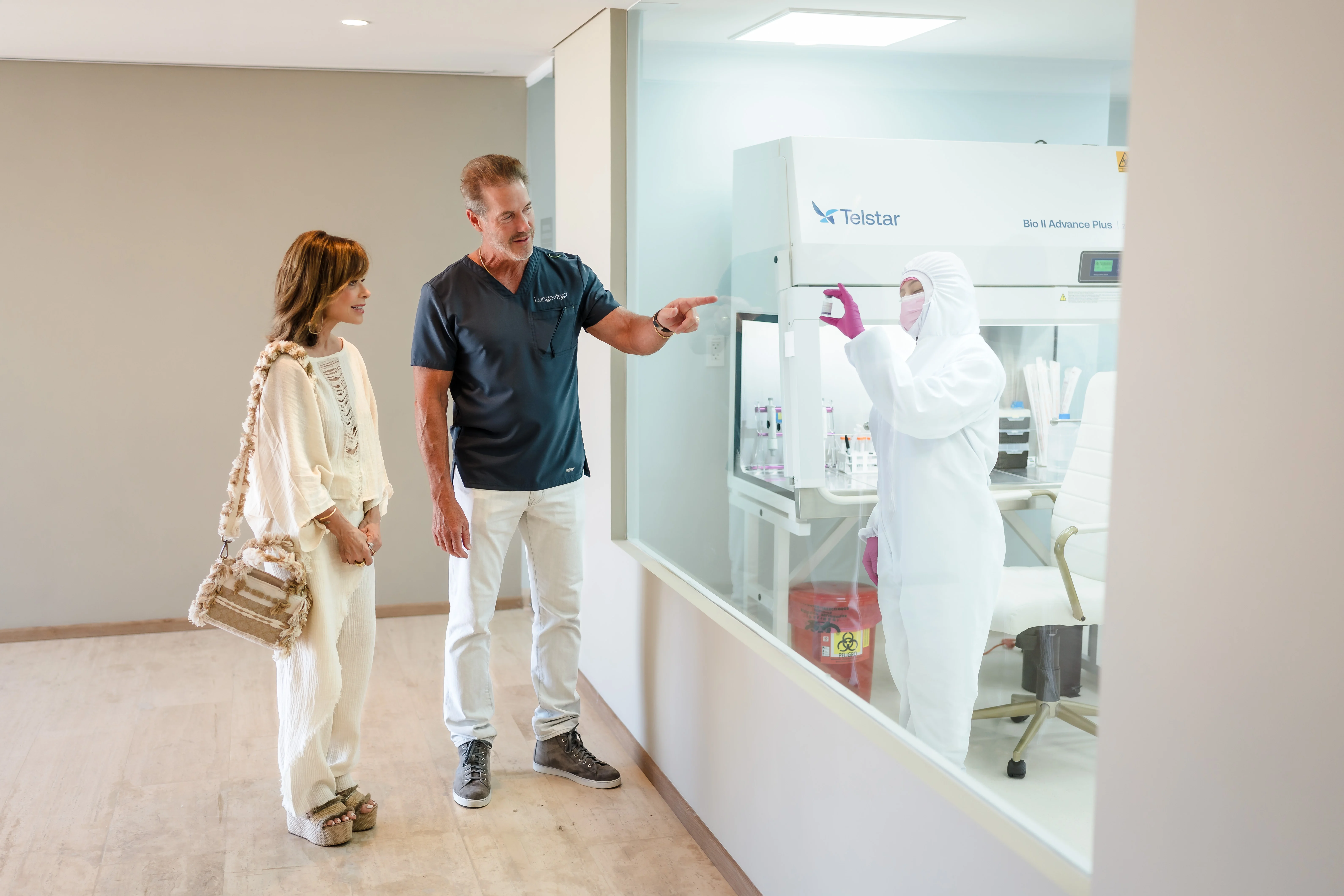
She goes on to note, “The high quality of the cells being produced right here on-site and knowing you watch it every step of the way, because otherwise where do you know they are coming from? How do you know if they are alive? That is what drove us here. After researching clinics in other countries, I felt you offered everything they did and more, with a much more convenient trip.”
Brenee came to our institute for a one-week personalized regenerative protocol. Her treatment combined stem cells and exosomes administered intravenously and through nebulization, together with supportive nutraceutical IVs and hyperbaric oxygen therapy.
Stem cells are not expected to permanently replace scarred lung tissue by simply becoming new lung cells. Their potential benefit comes from the biological signals they release. This secretory profile includes growth factors, cytokines, proteins, lipids, microRNAs, and exosomes that allow cells to communicate with one another.
In the lungs, these signals may help regulate excessive inflammation, encourage macrophages to adopt a more repair-oriented state, influence TGF-β and other pathways involved in fibrosis, limit the activation of collagen-producing fibroblasts, and support injured alveolar tissue and small blood vessels.
Hyperbaric oxygen therapy and nutraceutical IVs were included to further support oxygen availability, cellular metabolism, recovery, and the overall healing environment.
These therapies are not a cure for pulmonary fibrosis. Their ability to slow disease progression, preserve lung function, or delay transplantation remains under investigation. We believe patients deserve both hope and honesty about what is known, what remains uncertain, and what we are trying to accomplish.
For more than a year, Brenee reported oxygen saturation readings of approximately 93 to 96 percent while using her oxygen concentrator. During the final two days of her protocol, she recorded readings of 100 percent.
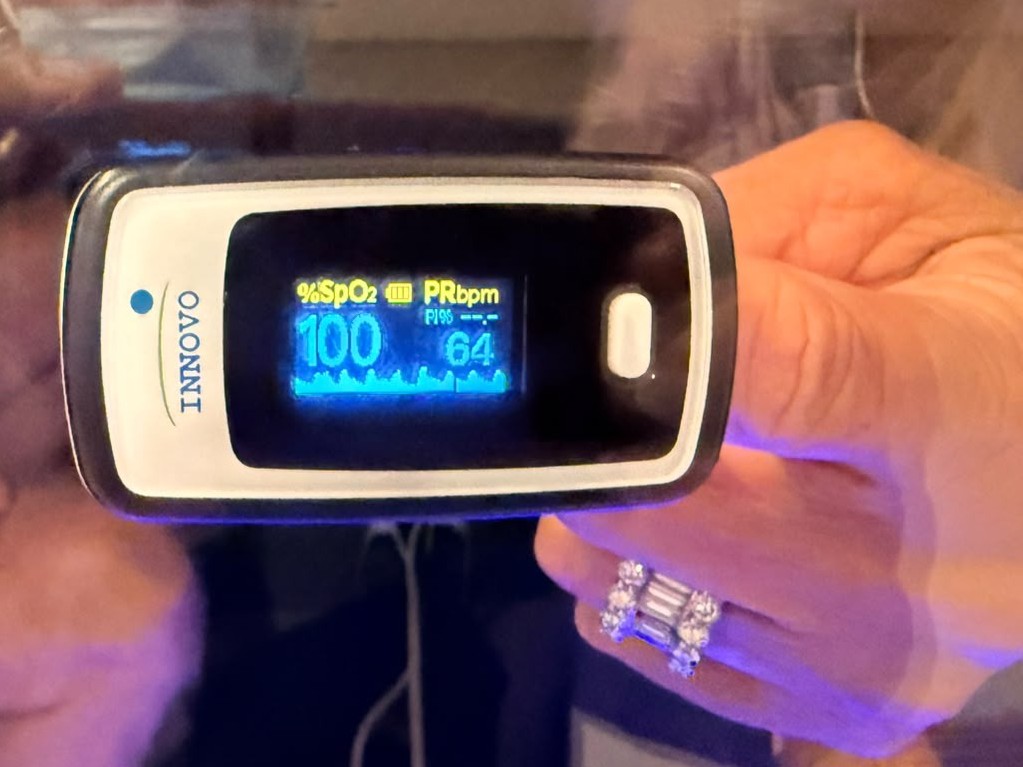
One of our physicians described it as “one of the most remarkable short-term improvements in oxygen saturation we have observed.” It was an encouraging moment for Brenee and our entire team, but we also understand that these early readings must be interpreted carefully. What matters now is whether she can maintain these improvements and whether her lung function and quality of life remain stable over time.
How Will We Know If Our Protocol Made a Difference?
In January, Brenee will undergo another CT scan and a full series of pulmonary function tests. Those results will help us understand whether her lung structure and function have remained stable, improved, or continued to decline. The honest answer is that nobody knows what they will show.
Based on our review of publicly available medical literature and clinical trial registries, we have not identified another documented case involving our protocol of intravenous and nebulized stem cells and exosomes, supportive nutraceutical IV infusions, and hyperbaric oxygen therapy.
We will follow Brenee’s progress carefully, objectively, and transparently. Whatever the results may be, her willingness to share her journey may contribute valuable observations that could inform future research and help others facing this devastating disease.
Brenee’s goal is clear. She wants to preserve and, if possible, improve her remaining lung function. She wants to push transplantation as far into the future as possible and give medical research more time to develop better treatments and, hopefully, one day find a cure.
Brenee is not fighting only for herself. By sharing her story, she is giving something to every person and every family facing this disease. She reminds them they are not alone and that even when medicine does not yet have all the answers, there is still a reason to keep moving forward.
This is Brenee’s fight.
A fight for more time. More moments with the people she loves. More options. And above all, more hope.
If you or someone you love is living with pulmonary fibrosis or another serious lung condition, we invite you to schedule a free online consultation with Ivanna, or reach out to any of our patient coordinators: Nico, Roman, and Erick.
In Loving Memory of Gina Derry
Many of you followed Gina Derry’s story through the videos we shared during her time with us. Her strength and determination touched people worldwide, including many of our patients and their families.
Gina came into our lives shortly after we opened and became an important part of our earliest chapter. Her trust in our team and willingness to openly share her experience helped shape who we are today. She strengthened our commitment to keep learning, improving, and searching for better options for every patient who follows.
She arrived with her husband, Jason, their children, Maxwell and MacKenzie, and other family members who surrounded her with extraordinary love and support.
Average survival following an ALS diagnosis is approximately three years, although every person’s experience is different. Gina understood what she was facing, but she never allowed ALS to define who she was or take away the hope and faith that guided her.
In her own words, “I feel alive, vibrant, hopeful, and happy.”
That was Gina, even as she faced the devastating reality of ALS.
Gina was so much more than her diagnosis. She was a devoted wife, a loving mother, an adventurer, and someone who lived life fully.
Her husband, Jason, shared these words with us:
“She had prayer lists of people, and a common theme she prayed for was happiness for others. Throughout the disease, she strived to be happy and remained grateful for the life she lived. The people who touched her life throughout her journey helped her hold on to that happiness for herself.”
Gina passed away on August 1, 2026, at the age of 52. With Jason’s blessing, we created this video to honor her life and the lasting impact she had on everyone at LMI.
Gina, your courage, determination, and positive spirit inspired us all, as did the incredible love of Jason, Maxwell, MacKenzie, and your entire family, who stood beside you every step of the way.
From everyone at Longevity Medical Institute, we were blessed to know you. We will never forget you.
Your Feedback Makes a Difference
We're proud to share that we've already received multiple five-star reviews — thank you to everyone who's taken the time to support us!
As a new clinic, your positive feedback not only means the world to us, but it also helps boost our visibility online so more people can discover us.
If you’ve had a positive experience at Longevity Medical Institute, we’d be truly grateful for your review. Select the button below to Leave a Google Review
See more of our articles
Be up to date and check our newest educational materials.
Can Stem Cells Help With Aging?
What The Research Shows, Why The Fundamentals Come First, And My 80/20 Rule
Urologic Health and Why I Believe It Belongs in Longevity Medicine
For this mid-month newsletter, I wanted to focus on an area of health that becomes increasingly important as we get older but often receives little attention until something changes: urologic health.

Announcing Regenerative Neurological Therapy
A New Non-Invasive Intranasal Approach to Delivering Stem Cells, Exosomes, and Peptides to the Brain
Bridging the expertise of traditional medicine with the innovations of tomorrow.
With decades of experience spanning tens of thousands of patient cases, our doctors provide an unparalleled depth of care.