

Why Combining InBody 970, InGrip and VO2 Max Testing Gives a Clearer Health Picture
Body composition, muscular strength, and cardiorespiratory fitness are three different health signals, and together they catch sarcopenia, excess visceral fat, and aerobic decline earlier than weight or BMI alone. In one adult study, grip strength correlated with body size and with peak VO2, while peak VO2 also moved inversely with waist-to-height ratio, which is why the combined picture is more revealing than any single number alone.
Benefits of Combining InBody 970, InGrip and VO2 Max Testing come down to this, one test shows what you carry, one shows what you can forcefully do, and one shows how efficiently you use oxygen under exertion. That combination gives a more honest view of physical aging, functional reserve, and longevity risk than a scale ever can. The Institute's approach uses those three measurements as objective baselines, then interprets them alongside labs and imaging rather than pretending any one test can tell the full story.
Why Body Composition, Strength and Aerobic Capacity Belong Together
Traditional markers miss early decline because they compress too much into one label. Body weight and BMI can look acceptable while muscle is falling, visceral fat is rising, or aerobic reserve is shrinking. A patient can also be lighter than expected and still carry a poor health profile if the weight loss is mostly lean mass.
Three different dimensions of health
Body composition describes how much of the body is skeletal muscle, fat, water, and other components. In practical terms, that means looking beyond total weight to see whether a person is losing muscle, storing more visceral fat, or drifting into a pattern that suggests sarcopenia. Muscular strength is the force the body can generate, and a handgrip test is a fast way to quantify it. Cardiorespiratory fitness is the capacity to take in, transport, and use oxygen during exertion, which is why VO2 max is so useful as a physiologic endpoint.
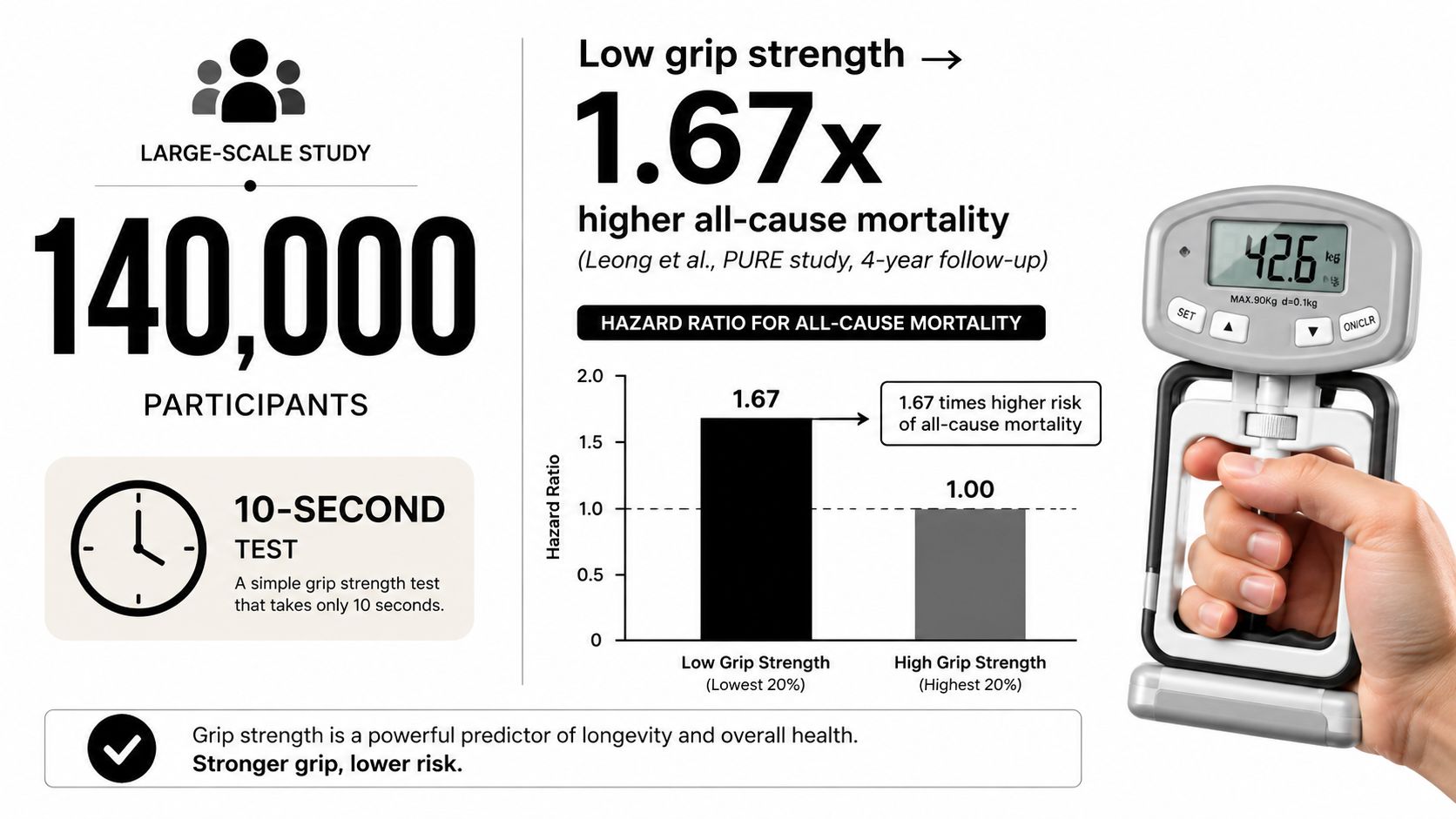
Research supports keeping these measures together. Grip strength has been linked with mortality outcomes, and higher cardiorespiratory fitness has also been linked with lower all-cause risk. The key clinical point is that these are not interchangeable markers. A strong person can still be poorly conditioned, and someone with decent aerobic capacity can still be functionally weak.

Practical rule: if the scale looks fine but strength or aerobic capacity is falling, the body is aging faster than the number on the scale suggests.
This is why the trio is especially useful in longevity medicine. It can distinguish fit but weak, strong but deconditioned, and normal-weight patients with hidden visceral adiposity. For patients seeking a more complete diagnostic package, comprehensive lab panels can be a helpful comparison point for how multi-modality testing is structured.
Inside the InBody 970 and What Its Numbers Mean
The InBody 970 is a Direct Segmental Multi-Frequency BIA device, and that matters because it estimates more than total body composition. It measures five body cylinders, left arm, right arm, torso, left leg, and right leg, using multiple frequencies and impedance readings across those segments. InBody's own product description notes six frequencies from 5 kHz to 3 MHz and 30 impedance measurements across the five segments.
What the device estimates
Bioelectrical impedance works because lean tissue conducts electricity better than fat does. The machine sends a small current through contact electrodes at the hands and feet, then uses the resistance pattern to estimate segmental water, skeletal muscle mass, and body fat mass. That gives a practical view of distribution, where muscle and fat sit, not just total weight.
For longevity and physical aging, the clinically useful outputs matter most. Skeletal muscle mass, percent body fat, visceral fat area, extracellular water ratio, and phase angle are the readings that usually add the most context. Phase angle is often treated as a marker of cell membrane integrity and tissue quality, which can be more informative than body weight when someone is losing reserve.
A useful InBody result answers a clinical question, not an aesthetic one.
| InBody 970 Outputs and Longevity Relevance | ||
|---|---|---|
| Measurement | What It Reflects | Clinical Threshold |
| Skeletal Muscle Mass | Structural reserve and sarcopenia risk | Compare against age- and sex-specific trend, not a single vanity target |
| Percent Body Fat | Total adiposity burden | Useful when rising despite stable weight |
| Visceral Fat Area | Metabolic risk stored around organs | Above 100 cm² is a meaningful concern threshold in clinical interpretation |
| Extracellular Water Ratio | Fluid balance and edema tendency | Rising values can suggest abnormal fluid distribution |
| Phase Angle | Cell health and tissue quality | Downward trend can signal declining reserve |
There are limitations. Like all BIA methods, results are affected by hydration status and by the assumptions used to model body geometry. That is why InBody works best as a trend tool and as part of a broader assessment, not as a stand-alone verdict. For readers who want the device-specific clinical framing, the internal overview of the InBody 970 assessment explains how the test fits into physician-led interpretation.
InGrip Handgrip Strength as a Standalone Longevity Marker
A patient squeezes a dynamometer for a few seconds, but the result reflects whole-body strength, neurologic coordination, frailty risk, and metabolic reserve. That is why InGrip has value in clinic, especially when the goal is to judge reserve rather than appearance.
Why a brief test carries so much prognostic weight
In the PURE cohort, weaker grip strength tracked with higher mortality risk, and each 5 kg reduction in grip strength was associated with about 16% higher all-cause mortality risk, 17% higher cardiovascular mortality risk, and 9% higher cancer mortality risk. Those associations held independently of BMI, blood pressure, and activity level.
That is the practical value of InGrip. It gives a quick read on whether the body still has reserve. For a patient recovering from illness, rebuilding after time away from training, or being watched for frailty, grip strength helps show whether function is coming back or whether weight is changing without real recovery.
The protocol matters. A standard seated assessment usually uses the elbow flexed to 90 degrees, with repeated attempts and brief rest. Cutoffs commonly used in clinical screening place low grip strength below 27 kg in men and 16 kg in women. Cutoffs serve as screening thresholds, but the goal is detecting decline trends before daily function becomes harder.
| Handgrip Strength Interpretation | Clinical Meaning |
|---|---|
| Below common sex-specific cutoffs | Possible low strength or dynapenia |
| Strong grip with low aerobic fitness | Strength preserved, conditioning lagging |
| Falling grip over time | Early signal of functional decline |
| Grip normalized after rehab | Useful sign that interventions are working |
The InGrip strength assessment explains why this brief test carries outsized value when a clinician reads it in context. Used that way, it fits into a physician-led longevity workup as a marker of function that body weight alone cannot show.
VO2 Max Testing and the Gold-Standard Aerobic Measurement
VO2 max is the highest oxygen uptake measured during a maximal test, making it the best single laboratory measure of aerobic capacity. It is a physiologic endpoint, not a loose label for being “in shape.” During exercise, it reflects how well the heart, lungs, circulation, and working muscles perform together under stress.
What the test measures
At a clinic, VO2 max testing is usually done on a treadmill or a cycle ergometer. The Bruce treadmill protocol is common because it raises speed and incline in three-minute stages until near-maximal effort is reached, often within 8 to 12 minutes. Breath-by-breath gas analysis with a metabolic cart and mask turns exertion into a measurable oxygen value.
Test quality matters. A useful result is not just hard effort, it is effort that meets physiologic signs of a maximal or near-maximal test. Clinicians look for a plateau or near-plateau in oxygen uptake, a fitting heart-rate response, and clear evidence that the patient pushed close to their limit. Without that context, the number carries less weight.
VO2 max shows something body weight cannot: cardiovascular reserve. A lean, strong person can still have a low value. A person with extra body mass can still test better than expected. That distinction matters in longevity care because aerobic fitness affects how well the body handles illness, surgery, and training stress.
| VO2 Max Interpretation | What It Suggests |
|---|---|
| Higher values | Better aerobic reserve and exercise tolerance |
| Lower values | Reduced cardiorespiratory fitness |
| Rising trend over time | Improved conditioning and physiologic efficiency |
| Low VO2 max with good strength | Strength and endurance are mismatched |
For clinic-specific context, the VO2 max testing overview explains the testing framework patients are usually given before the treadmill or cycle protocol begins.
Profiles the Trio Can Reveal That Single Tests Miss
The scale can make very different bodies look the same. That's the core problem with relying on weight alone. Two patients may have the same BMI, but one may be losing muscle while another is carrying hidden visceral fat, and the clinical implications are completely different.
Three patterns that change the intervention
A fit-but-weak patient often has good aerobic capacity but poor grip strength. That combination can happen in people who do a lot of cardio but not enough progressive resistance work. The physician response is usually to increase strength training, protein adequacy, and recovery monitoring, because the aerobic system is not the limiting factor. For context on why muscle loss matters so much, the article on the silent accelerator of aging is a useful companion piece.
A strong-but-deconditioned patient looks different. Grip is decent, lean mass may be reasonable, but VO2 max is lagging. That person often needs a better cardiovascular stimulus, not just more lifting. Resistance work alone won't fix a low aerobic ceiling.
A healthy-weight-with-hidden-visceral-fat patient is the one most often missed by BMI. The body weight looks fine, but the InBody 970 shows higher visceral fat area and the metabolic risk profile starts to look less benign. In that case, the intervention shifts toward visceral-fat reduction, nutrition tightening, and a training plan that addresses both strength and aerobic capacity.
Clinical shortcut: if two of the three measures look good and one is clearly off, treat the weak link first. That's usually where the aging signal is hiding.
| Profile | What Looks Normal | What Actually Stands Out |
|---|---|---|
| Fit but weak | Cardio looks strong | Grip strength is low |
| Strong but deconditioned | Muscle and force look good | VO2 max is low |
| Healthy weight with hidden visceral fat | BMI looks reassuring | Visceral fat is high |
The value of the trio is that it turns a flat result into a layered decision. Instead of asking whether the patient is “healthy,” the physician can ask what needs fixing first, strength, aerobic capacity, or body composition.
How These Tests Layer Onto Biomarkers, MRI and Cardiovascular Evaluation
The most useful longevity work doesn't treat body composition, grip, and VO2 max as replacements for lab work or imaging. It uses them as functional anchors that help interpret the rest of the diagnostic picture. That's especially important when a patient feels “mostly fine” but is drifting in the wrong direction.
Turning static data into functional context
A 140-plus biomarker panel can show inflammation, glycemic strain, hormonal imbalance, or other metabolic shifts, but biomarkers alone don't tell you how those changes are affecting physical function. Grip strength can provide a bedside read on whether reserve is being lost, while segmental body composition can show whether muscle is falling off in a pattern that matches frailty or sarcopenia risk. Whole-body MRI then adds structural context by revealing abnormalities that may not yet be producing symptoms.
The same logic applies to heart evaluation. A low VO2 max doesn't diagnose coronary disease by itself, but it does tell the physician that the patient's cardiorespiratory ceiling is limited and deserves context. Paired with cardiovascular testing, it can sharpen concern when exercise tolerance is lower than expected. That's why the exercise response matters so much more than resting numbers alone.
Longevity Medical Institute uses this kind of layered reading across diagnostics, including its advanced cardiovascular biomarkers resource, where the goal is to connect physiology, imaging, and laboratory data into one usable plan. The point isn't to collect more data for its own sake. It's to make sure the data changes what the physician does next.
| Test Layer | What It Adds |
|---|---|
| InBody 970 | Body composition and hidden adiposity |
| InGrip | Functional strength and frailty signal |
| VO2 Max | Aerobic reserve and endurance capacity |
| Biomarkers | Metabolic, inflammatory, and hormonal context |
| MRI | Structural anatomy and early abnormalities |
| Cardiovascular evaluation | Heart and vascular function under clinical scrutiny |
That multidimensional model is more clinically honest than any single longevity score. It shows how the body is built, how it performs, and where it may be failing before symptoms become obvious.
Repeating the Battery to Track Real Change Over Time
A single result is useful. A trend is better. The practical question is not just what the baseline shows, but whether the next result reflects real biology or ordinary day-to-day noise. That's why repeat testing should be planned, not improvised.
A workable cadence
A sensible approach is to repeat InBody 970 and InGrip about every six months, then repeat VO2 max annually if training is stable, or every six to nine months during active training blocks. That timing gives enough room for physiologic change without making the data too sparse to guide decisions. Recent clinic guidance often uses similar intervals for tracking change over time.
The interpretation should always account for confounders. Hydration status can shift body composition results, recent resistance training can temporarily affect performance, illness can lower exertion tolerance, and caffeine, altitude, and menstrual cycle phase can all influence testing conditions. The physician needs those details to know whether a result is changed or just contextually noisy.
| Test | Useful Follow-Up Pattern | What Counts as Real Change |
|---|---|---|
| InBody 970 | About every 6 months | Trend in lean mass, fat distribution, or phase angle |
| InGrip | About every 6 months | Repeatable change in force, not a single outlier |
| VO2 Max | Annually if stable, sooner in training blocks | Sustained change in aerobic capacity rather than test-day variance |
A follow-up review should ask three simple questions. Is lean mass moving in the right direction? Is visceral fat falling? Is aerobic ceiling rising? If the answer to any of those is no, the training or nutrition plan needs to change. If the answer is yes, the current program is probably doing what it should.
If the number changes but the plan doesn't, the test was just a snapshot. If the number changes and the plan changes with it, you've got a clinical feedback loop.
Putting It Together for Longevity and Next Steps at LMI
No single metric defines healthy aging. InBody 970 reveals hidden visceral fat and sarcopenia risk, InGrip quantifies muscular reserve, and VO2 max anchors cardiorespiratory fitness, one of the most important physiologic markers of long-term resilience. Together, they create an objective baseline that can be acted on, rather than a vague sense that someone is “doing well.”
That baseline becomes even more valuable when it sits next to lab data, MRI findings, and cardiovascular evaluation. A patient can have decent blood work and still be functionally underperforming. Another patient can look fit on the outside and still be losing strength, storing visceral fat, or carrying a low aerobic ceiling. The combined battery catches those mismatches early, which is exactly what a physician-led longevity program should do.
For patients pursuing a structured assessment, Longevity Medical Institute can pair these measurements with broader diagnostics in one clinical setting. The process is straightforward. Arrive prepared, expect the full battery to take time, and leave with a written interpretation that ties each result to specific next steps in training, nutrition, or physician-directed care.
Benefits of Combining InBody 970, InGrip and VO2 Max Testing are most meaningful when the results are repeated and interpreted together, not treated like isolated scores. That's how physical aging becomes measurable, and that's how healthspan stops being a slogan and starts becoming a plan.
If you're ready to see how your body composition, grip strength, and aerobic capacity fit together, schedule a consultation with Longevity Medical Institute. A physician-guided assessment can show whether your current routine is preserving muscle, limiting visceral fat, and improving cardiorespiratory reserve, or whether a more targeted plan would serve you better.
Author
Dr. Kirk Sanford, DC, Founder & CEO, Longevity Medical Institute. Dr. Sanford focuses on patient education in regenerative and longevity medicine, translating complex therapies into clear, practical guidance for patients.
Medical Review
Dr. Félix Porras, MD, Medical Director, Longevity Medical Institute. Dr. Porras provides clinical oversight and medical review to help ensure accuracy, safety context, and alignment with current standards of care.
Last Reviewed: September 3, 2026
Short Disclaimer
This information is for educational purposes only and is not medical advice. It does not replace an evaluation by a qualified healthcare professional. For personalized guidance, please schedule a consultation.