

Hyperbaric Oxygen Therapy for Anti-Aging: A Clinical Guide
Anti-aging is frequently viewed as something done on the surface. Better skin care. Better supplements. Better exercise habits. Those matter, but they don't fully address the deeper question: what if aging is also shaped by the environment surrounding your cells?
That's where Hyperbaric Oxygen Therapy for Anti-Aging becomes clinically interesting. HBOT isn't a spa trend or a simple oxygen boost. It's a medical therapy that changes how oxygen is delivered under pressure, creating conditions that can influence repair, recovery, and cellular signaling in ways ordinary breathing can't.
In longevity medicine, the goal isn't to chase youth as a cosmetic ideal. It's to preserve healthspan, which means keeping tissues, organs, and energy systems functioning with more resilience as the years pass. If you're comparing modern options, this overview of anti-aging treatment approaches helps place HBOT in the broader context.
The Science of Youthful Aging
Aging looks visible on the outside, but it starts as a biological story on the inside. Cells communicate less efficiently. Energy production becomes less reliable. Repair signals can grow weaker or more chaotic. Some cells stop contributing usefully but remain in circulation, creating what many patients describe as a sense of gradual wear rather than one clear disease.
HBOT matters because it targets one of the most basic requirements of cellular performance: oxygen availability. Under pressurized conditions, the body can dissolve more oxygen into plasma and deliver it more effectively into tissues that may not be getting enough support in ordinary conditions. That doesn't mean HBOT turns back time in a simplistic way. It means it may help create a more favorable internal environment for repair.
Why oxygen changes the conversation
Every tissue in your body depends on oxygen to make energy, coordinate healing, and maintain structure. When delivery is suboptimal, the body often shifts into compensation mode. You may still function, but not with the same reserve.
A helpful analogy is to think of your cells as a luxury hotel staff trying to maintain a property during a supply bottleneck. The building is still open. The lights are still on. But housekeeping, repairs, and upkeep begin to lag. HBOT is one way of improving supply access so the maintenance systems can work with greater precision.
Healthy aging isn't only about reducing damage. It's about restoring the conditions that allow the body to repair itself well.
A clinical lens, not a trend lens
Patients sometimes hear “oxygen therapy” and assume it's interchangeable with wellness oxygen bars or casual recovery tools. It isn't. Hyperbaric treatment uses pressure as part of the therapy. That pressure changes how oxygen behaves in the body, which is why HBOT belongs in a medical discussion about tissue support, regeneration, and longevity.
For patients exploring longevity care, the key question isn't “Does this sound futuristic?” It's “Does this influence meaningful biology?” HBOT entered the anti-aging conversation because researchers began examining exactly that.
How HBOT Rejuvenates at a Cellular Level
How can more oxygen under pressure influence something as complex as biological aging?
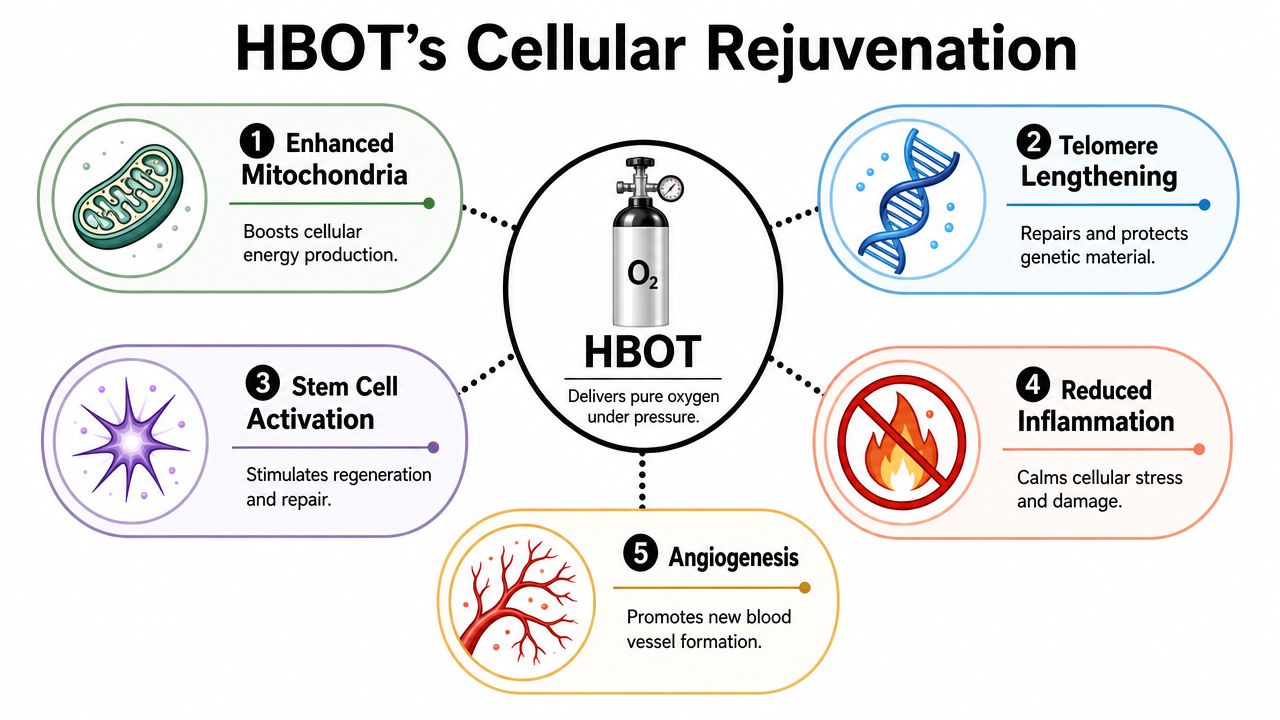
HBOT draws interest in longevity medicine because it affects several layers of cellular function at the same time. Under pressure, oxygen dissolves into plasma in higher amounts than it does during normal breathing. That changes the tissue environment cells experience, and cells respond to that change with adaptive repair signaling rather than simple short-term stimulation.
If you want a practical overview of chamber-based treatment itself, this guide to the hyperbaric oxygen chamber is a useful companion.
A useful way to understand HBOT is to see it as metabolic conditioning. The treatment briefly exposes tissues to unusually high oxygen availability, then the body adjusts its repair behavior in response. In clinical longevity programs, that matters because better oxygen delivery can support the biologic setting in which other therapies work, including regenerative strategies such as allogeneic stem cells and targeted peptides.
Telomeres and senescent cells
Telomeres work like protective caps on chromosomes, similar to the plastic tips that keep shoelaces from fraying. As cells divide and age, those caps tend to shorten. Senescent cells present a different problem. They remain in the tissue but contribute less useful function and more disruptive inflammatory signaling.
One often-cited human study published in Aging reported both increased telomere length in peripheral blood mononuclear cells and reductions in senescent cell markers after a course of repeated HBOT sessions, as described in the study text in Aging. Those findings helped shift the conversation from general wellness claims toward measurable aging biology.
For patients, the practical point is straightforward. Researchers have examined HBOT against cellular markers tied to how tissues age, not only against how refreshed someone feels after treatment.
Mitochondria and energy production
Mitochondria are the energy plants inside your cells. They use oxygen to help generate ATP, the fuel that powers repair, signaling, and day-to-day function. If oxygen delivery is inconsistent, energy production can become less efficient, especially in tissues already under strain.
HBOT may support this process by increasing oxygen availability where aerobic metabolism occurs. A high-performance engine with a cleaner fuel supply is a useful comparison. The engine is the same engine, but it can run with better efficiency and less stress.
That distinction matters in longevity care. A therapy does not need to create a brand-new biology to be useful. It can improve the conditions that allow existing biology to perform with more reserve.
Inflammation, signaling, and tissue repair
Aging also reflects changes in communication between cells. Oxygen levels influence gene expression, inflammatory signaling, blood vessel behavior, and repair pathways. HBOT appears to affect several of these systems at once, which is why its role in anti-aging medicine is broader than “more oxygen equals more energy.”
Clinically, integration holds importance. Peptides are often used to influence signaling and tissue recovery. Cell-based therapies aim to support regeneration. HBOT may complement both by improving microenvironment conditions such as oxygenation, circulation, and cellular signaling, which can help tissues respond more favorably to regenerative inputs.
Why this matters in a longevity program
Viewed in isolation, HBOT can sound like a single tool looking for a broad promise. Viewed clinically, it makes more sense as part of a layered strategy. Better tissue oxygenation may help prepare the terrain, while stem cells, peptides, nutrition, sleep, and exercise provide the raw materials and signals for repair.
That is the idea behind cellular rejuvenation. The goal is not a dramatic reset. The goal is to improve the internal conditions in which recovery, maintenance, and regeneration take place.
The Clinical Evidence for HBOT in Longevity
Can a therapy that changes the oxygen environment around your cells also influence markers linked to biological aging in humans?
That question matters because longevity medicine should rest on more than theory. For HBOT, the most discussed human data comes from structured clinical protocols, not occasional wellness sessions. In practice, that means the evidence applies to a sustained treatment course delivered under medical supervision.
What the commonly cited protocol looks like
The protocol most often referenced in anti-aging discussions uses about 10 sessions, usually given 3-5 days per week for roughly 60 minutes per session. The same clinical summary also describes a study of 35 adults over age 64 that reported an additional 20% protection to telomeres, as outlined in this overview of HBOT anti-aging protocol details and findings.
That detail helps patients interpret the literature correctly. The published conversation around HBOT and longevity is centered on treatment intensity, consistency, and clinical dosing. It is not based on a few isolated chamber visits.
How to read these findings without overstating them
A useful way to view HBOT is to compare it to cardiac rehabilitation or physical therapy. Results depend on the protocol, the patient, and the biological goal. A chamber session can create a physiological signal. A full program is what gives that signal enough repetition to produce measurable adaptation.
That is also why HBOT fits more naturally into a longevity plan than into a single-therapy promise.
| Clinical question | Practical interpretation |
|---|---|
| Has HBOT been studied in people for aging-related outcomes? | Yes. Human studies have looked at biomarkers associated with aging, not only self-reported wellness. |
| Do the published findings come from a light or occasional schedule? | No. The commonly cited protocol is intensive and depends on adherence. |
| Does this mean HBOT works as a stand-alone longevity treatment? | No. The evidence supports HBOT as one clinical tool that may strengthen a broader regenerative strategy. |
For a patient, that is good news. It means the therapy is being judged by medical standards, with attention to dose, response, and context.
Where HBOT fits in a regenerative longevity program
From a clinical perspective, HBOT is often more useful as a biologic primer than as a solo intervention. If tissues receive better oxygen delivery and show stronger repair signaling, they may be more receptive to other regenerative inputs. That is one reason physicians may pair HBOT with peptide protocols, structured exercise recovery plans, or allogeneic stem cell programs when appropriate.
The logic is similar to preparing soil before planting. HBOT may help condition the tissue environment, while peptides influence signaling and cell-based therapies contribute regenerative potential. Used together, these therapies are not interchangeable. They are complementary.
That overlap between repair medicine and healthy aging is one reason HBOT appears in both fields. This discussion of oxygen therapy for recovery explains why recovery capacity and long-term function are so closely linked.
A careful longevity program does not treat promising evidence as proof of a cure. It uses the evidence objectively, then places HBOT where it can add the most clinical value.
Your Personalized HBOT Treatment Program
For most patients, the biggest source of hesitation isn't the biology. It's the process. They want to know what treatment feels like, how a program is built, and whether HBOT can be personalized rather than prescribed as a one-size-fits-all routine.
If you're exploring options by location, this page on hyperbaric oxygen therapy near you may help you understand what to look for in a clinical setting.
The evaluation comes first
A thoughtful HBOT plan starts before anyone enters a chamber. A physician-led team reviews medical history, goals, medications, lung and ear considerations, and the broader reason for treatment. In a longevity context, that review often includes inflammatory patterns, recovery capacity, sleep quality, exercise tolerance, and biomarker interpretation.
At Longevity Medical Institute, HBOT can be integrated with in-house lab analysis, advanced imaging, and broader regenerative planning when clinically appropriate. That matters because some patients are using HBOT for healthy aging, while others are combining it with recovery, inflammation support, or performance-focused care.
What a session usually feels like
Most patients are surprised by how uneventful the session itself feels. You enter the chamber, get settled, and notice pressure changes most clearly in the ears, similar to what happens during airplane descent. The clinical team coaches you through equalizing pressure, and comfort measures are built into the experience.
Once the chamber reaches treatment pressure, many patients read, rest, or relax. The therapy is active at the tissue level, but the experience often feels calm and quiet.
Here's a visual overview that helps many first-time patients understand the treatment environment:
Personalization changes the purpose
The same chamber can serve very different goals. One patient may be focused on recovery after inflammation-related setbacks. Another may be pursuing a longevity plan centered on resilience, cognition support, and regenerative therapies. A third may be preparing tissues before a broader treatment sequence.
That's why personalization matters. A meaningful program considers:
Your biology: Existing medical conditions, healing capacity, and how well you tolerate pressure-related treatment.
Your timeline: Some patients can commit to a concentrated schedule. Others need a staged approach.
Your broader plan: HBOT may be used alone, or it may be coordinated with peptides, rehabilitation, diagnostics, or regenerative medicine.
Your treatment goals: Better recovery and better aging aren't always identical goals, even when they overlap.
The chamber is only one part of care. The protocol around it often determines whether treatment is generic or genuinely useful.
HBOT as a Catalyst for Regenerative Medicine
HBOT becomes even more interesting when it's viewed not as an isolated therapy, but as a biological primer. In regenerative medicine, results often depend on the quality of the tissue environment receiving treatment. Oxygen delivery, vascular support, inflammatory tone, and cellular signaling all influence how well the body responds.
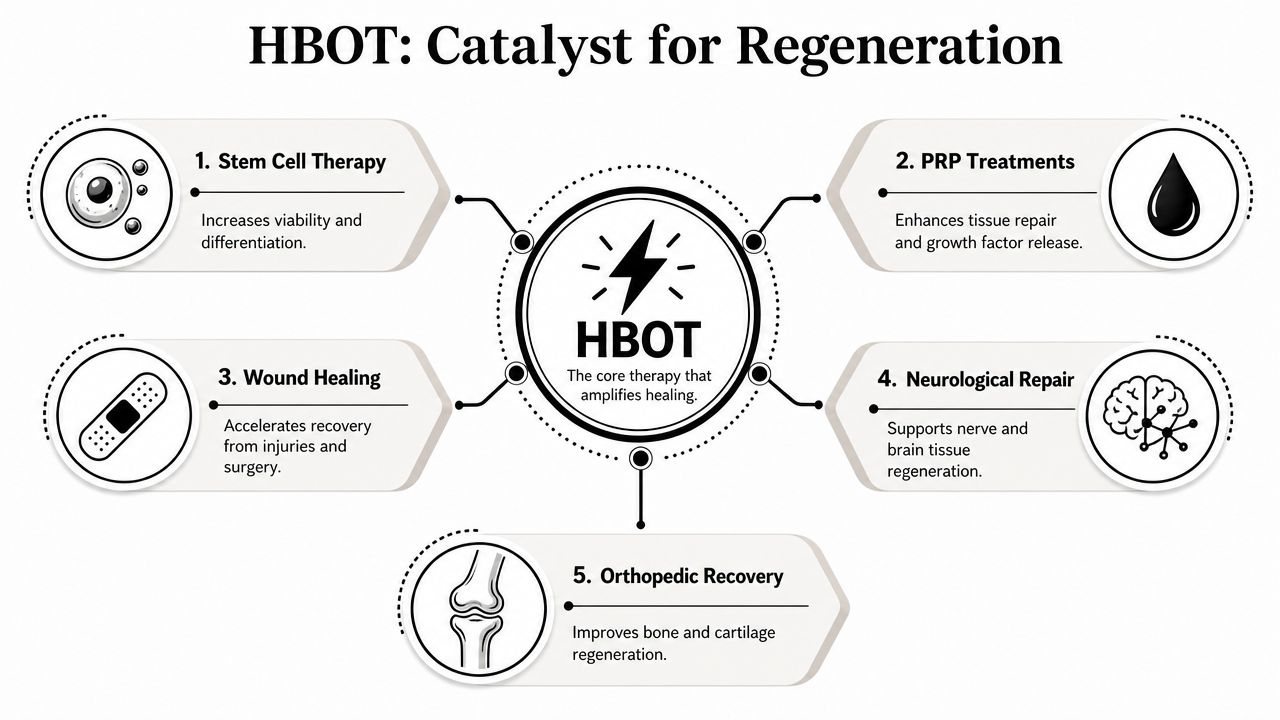
A useful way to think about this is agriculture. Regenerative therapies are the seeds. HBOT helps condition the soil.
Why oxygen-rich tissue may support regenerative goals
Clinical HBOT protocols use 96-100% oxygen at pressures above 1 ATA, and a 2024 review noted that this hyperoxic-hyperbaric exposure can alter gene expression, promote angiogenesis, modulate cellular senescence, and improve tissue oxygen bioavailability, according to the 2024 review in Frontiers in Aging. Those mechanisms are directly relevant to regenerative medicine because tissues respond better when circulation, signaling, and repair conditions improve.
That doesn't mean HBOT “makes” other therapies work. It means HBOT may help prepare a more receptive terrain.
Synergy with allogeneic stem cells and peptides
This matters in programs that include allogeneic stem cells, especially when the aim is broad support for repair and recovery rather than a single narrow target. If tissues are under-oxygenated or chronically inflamed, the body may be less ready to coordinate a strong regenerative response. HBOT may help improve that context.
The same logic applies to peptides. Peptides act as signals. Signals are more useful when tissues can respond to them. If oxygen delivery, circulation, and local recovery conditions improve, the body may be better positioned to translate regenerative signaling into meaningful function.
For patients comparing options, this broader view of cell regeneration therapy helps place HBOT within a multi-modal plan rather than treating it like a stand-alone intervention.
Where integration often makes clinical sense
Rather than listing every possible combination, it's more useful to look at patterns:
Before regenerative treatment: HBOT may help optimize tissue conditions.
During a structured program: It can complement rehabilitation, recovery, and signaling-based therapies.
After procedures or biologic interventions: It may support a cleaner healing environment.
Regenerative medicine works best when the body has both the right tools and the right terrain.
This is the true anti-aging value of HBOT in advanced practice. It's not only a therapy. It can also function as a catalyst that helps the rest of a longevity program operate in a more coordinated way.
Realistic Benefits Safety and Contraindications
HBOT should be approached with optimism and restraint at the same time. The optimistic part comes from the fact that it can influence meaningful biology. The restraint comes from remembering that not every patient is a candidate, not every goal is appropriate, and not every claimed benefit has equal evidence behind it.
Benefits patients often seek
Patients usually don't pursue Hyperbaric Oxygen Therapy for Anti-Aging because they want one abstract biomarker to improve. They pursue it because they want to age with better reserve. In clinical practice, that usually means goals such as supporting recovery, improving tissue resilience, helping the body manage inflammation more effectively, or complementing a broader regenerative plan.
Some patients also hope for changes in energy, mental clarity, exercise recovery, skin quality, or overall vitality. Those goals are understandable. They should still be framed as individualized possibilities, not promises.
Safety starts with screening
HBOT is a medical therapy, and safety begins with proper screening. A strong program reviews pulmonary history, ear and sinus health, medications, prior pressure sensitivity, and whether there are any conditions that could make chamber treatment unsafe or poorly tolerated.
A simple summary looks like this:
| Safety area | Why it matters |
|---|---|
| Ear pressure tolerance | Pressure changes can stress the middle ear if equalization is difficult. |
| Lung history | Certain lung conditions can increase risk under pressure. |
| Medication review | Some medications may require added caution. |
| Claustrophobia or anxiety | Chamber comfort affects whether treatment is realistic. |
Contraindications and cautions
There are patients who shouldn't proceed until a physician determines treatment is appropriate. Concerns can include certain lung issues, difficulty clearing ear pressure, active upper respiratory problems, and other medical situations where pressure exposure may not be advisable.
Even in appropriate patients, temporary side effects can occur. Some people notice ear discomfort, sinus pressure, fatigue after a session, or temporary vision changes. Those effects are part of why supervised care matters.
Safety principle: The right question isn't “Is HBOT safe in general?” It's “Is HBOT appropriate for this patient, under this protocol, with this level of oversight?”
That distinction protects patients from both unnecessary fear and careless enthusiasm.
Frequently Asked Questions About HBOT
What does a session feel like
The beginning of a session is often described as the most noticeable part because that's when pressure changes occur. Your ears may need to equalize, similar to being on a plane. After that, the session usually feels quiet and controlled, and many patients relax comfortably.
How should I prepare for treatment
Follow the clinic's pre-treatment instructions closely. In general, you'll want to arrive well hydrated, avoid anything the medical team tells you could interfere with safety, and mention any congestion, ear pain, or recent illness before entering the chamber. Good preparation reduces discomfort and helps the team adjust treatment if needed.
Are there post-treatment instructions
Most patients can return to normal activities after treatment, but it's smart to pay attention to how you feel. Some people feel energized. Others prefer a lighter schedule the same day. If you notice ear discomfort, unusual fatigue, or anything unexpected, report it rather than assuming it's unimportant.
How soon will I notice results
That depends on why you're receiving HBOT. Some people notice recovery-related changes earlier, while longevity-related goals often require patience and consistency. HBOT is better understood as a cumulative therapy than an instant one.
Is more oxygen always better
No. Dose matters. Pressure matters. Session frequency matters. Medical oversight matters. HBOT is effective because it uses oxygen under controlled pressure conditions, not because oxygen is being used casually.
Can HBOT replace exercise sleep and nutrition
No. It should be viewed as an adjunct, not a substitute. The best longevity programs still depend on movement, restorative sleep, nutrition, stress regulation, and personalized medical care.
Can HBOT be combined with regenerative therapies
Yes, in selected patients. That combination is one reason HBOT is so relevant in modern longevity care. It may help prepare tissues and support a more favorable recovery environment, especially when used as part of a broader physician-guided plan.
If you're considering a personalized longevity strategy that may include Hyperbaric Oxygen Therapy, advanced diagnostics, peptides, or regenerative options such as allogeneic stem cells, Longevity Medical Institute offers consultation-based care to help determine what's appropriate for your goals and medical profile.
Author
Dr. Kirk Sanford, DC, Founder & CEO, Longevity Medical Institute. Dr. Sanford focuses on patient education in regenerative and longevity medicine, translating complex therapies into clear, practical guidance for patients.
Medical Review
Dr. Félix Porras, MD, Medical Director, Longevity Medical Institute. Dr. Porras provides clinical oversight and medical review to help ensure accuracy, safety context, and alignment with current standards of care.
Last Reviewed: June 7, 2026
Short Disclaimer
This information is for educational purposes only and is not medical advice. It does not replace an evaluation by a qualified healthcare professional. For personalized guidance, please schedule a consultation.