

Micro Impact Plate Therapy: A Guide to Cellular Healing
You may be doing many things right already. You eat well, stay active, invest in recovery, and still notice that your body doesn't bounce back the way it used to. A stiff back lingers for days. Training soreness hangs on longer. Balance feels a little less automatic. Even if nothing is dramatically wrong, recovery can feel slower and less reliable.
That's where Micro Impact Plate Therapy becomes interesting. It isn't built around intensity. It's built around precision. Instead of asking your joints, muscles, and bones to absorb heavy force, it delivers subtle mechanical signals that your cells can detect and respond to.
For many educated patients, that idea sounds almost too gentle to matter. But biology often responds to the right signal more than the biggest signal. A quiet, repeated cue can change how tissue behaves over time.
A New Approach to Cellular Restoration
A common patient scenario looks like this. Someone is still functioning well, but they're no longer recovering at the speed they expect. They may have low-grade joint discomfort, a sense of physical fragility after an injury, or a strong interest in protecting bone and mobility before a problem becomes obvious.
Micro impact plate therapy fits that moment because it doesn't treat the body like a machine that needs to be forced into action. It treats the body like a living system that needs better communication. The platform sends gentle mechanical input through the musculoskeletal system, and that input is meant to encourage a more favorable cellular response.
Why subtle signals matter
Consider it similar to tapping a piano key rather than slamming the instrument. The goal isn't brute force. The goal is a clean signal that reaches the right structure. In this case, the “listeners” are cells in bone, muscle, connective tissue, and related support systems.
Patients often assume recovery tools must feel dramatic to be effective. That's not always true. Some of the most valuable longevity therapies work because they reduce friction inside the system. They help cells receive, process, and respond to information more efficiently.
Micro impact plate therapy is best understood as a signaling therapy, not a workout machine.
That distinction matters. If you're already doing exercise, strength training, physical therapy, or regenerative care, this type of therapy may serve as a foundation rather than a replacement. It can support the terrain in which healing and adaptation happen.
A longevity lens
From a longevity perspective, stronger bones, steadier balance, and better musculoskeletal resilience aren't niche goals. They're central goals. They influence how confidently you move, how well you tolerate stress, and how long you can stay active without feeling like every setback costs too much.
Micro impact plate therapy belongs in that conversation because it works upstream. It aims to support the cellular environment that underlies structural health, recovery capacity, and long-term performance.
The Science of Micro Impact Therapy
The core scientific idea behind micro impact plate therapy is mechanotransduction. That term sounds technical, but the concept is simple. Cells can sense physical forces and convert them into biochemical activity.
The cellular tune-up concept
A useful analogy is a cellular tune-up. When a car is tuned well, it doesn't need to be pushed harder. It runs more efficiently because its parts are communicating properly. In the body, mechanical cues can influence how cells organize repair, maintenance, and adaptation.
Micro impact plate therapy delivers calibrated mechanical pulses that are intentionally small. One technical description reports output around 0.3 to 0.4 g at 32 to 37 Hz, designed to stimulate mechanotransduction with less joint loading than conventional high-amplitude vibration plates, as described in this technical overview of micro-impact and whole-body vibration differences.
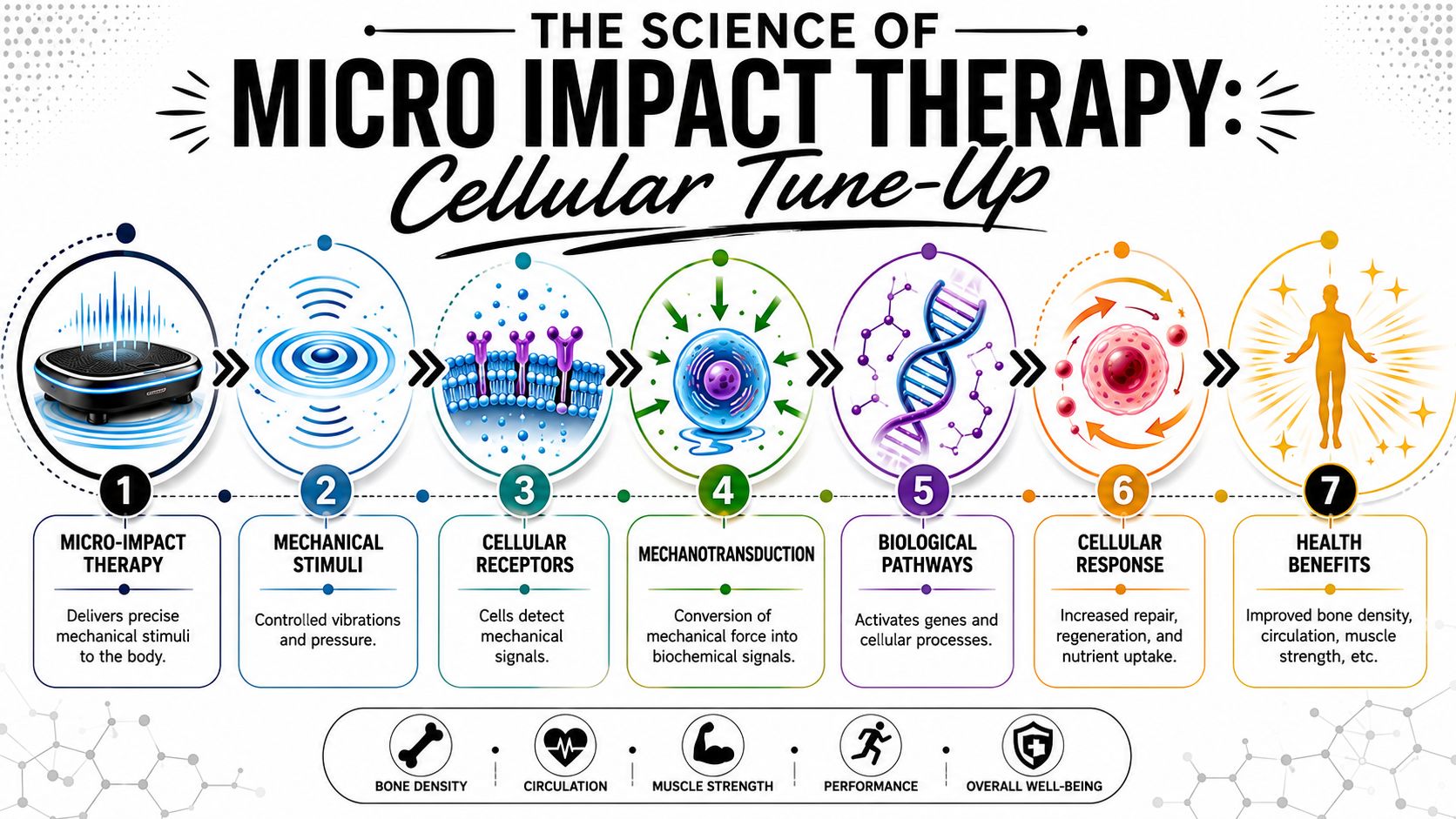
If you want a broader framework for how physical signals fit into healing biology, this overview of how regenerative medicine works provides helpful context.
How it differs from gym vibration plates
This is one of the most important points of confusion.
Many people hear “plate therapy” and think of commercial vibration platforms used in fitness settings. Those systems are generally designed to provoke muscular effort through larger, more forceful vibration. Micro impact therapy is a different category. The intent is not to create a jarring training stimulus. The intent is to provide a low-magnitude signal that tissues can tolerate repeatedly.
Here's a simple comparison:
| Feature | Micro impact plate therapy | Typical gym vibration plate |
|---|---|---|
| Primary aim | Cellular signaling and support | Exercise stimulus |
| Mechanical feel | Gentle, subtle | More pronounced |
| Joint stress | Designed to be minimal | Can feel more loading-heavy |
| Best use case | Recovery, bone support, longevity protocols | Fitness and conditioning |
Why repetition matters
Cells usually don't change behavior from a single dramatic event. They respond to repeated, appropriate cues. That's why gentle daily exposure can be more meaningful than occasional high-force effort for the right patient.
Practical rule: The point isn't to feel shaken. The point is to deliver a precise signal your body can use.
For patients who can't tolerate impact exercise, or who want to complement a broader recovery plan, that distinction can make micro impact plate therapy much more appealing.
Clinical Benefits and Patient Outcomes
Clinical interest in micro impact plate therapy centers on a few practical outcomes. The most discussed are bone health, physical stability, and recovery support. These outcomes matter not just for disease prevention, but for preserving function over time.
A commercially important milestone came from the Juvent platform, which is described as representing $45 million in research and development and 20+ worldwide patents. Reporting tied to that platform also cites a study result in which users had an 11% increase in bone density compared with a 1% bone density loss in the placebo group, as summarized in this video discussion of Juvent platform development and study findings.
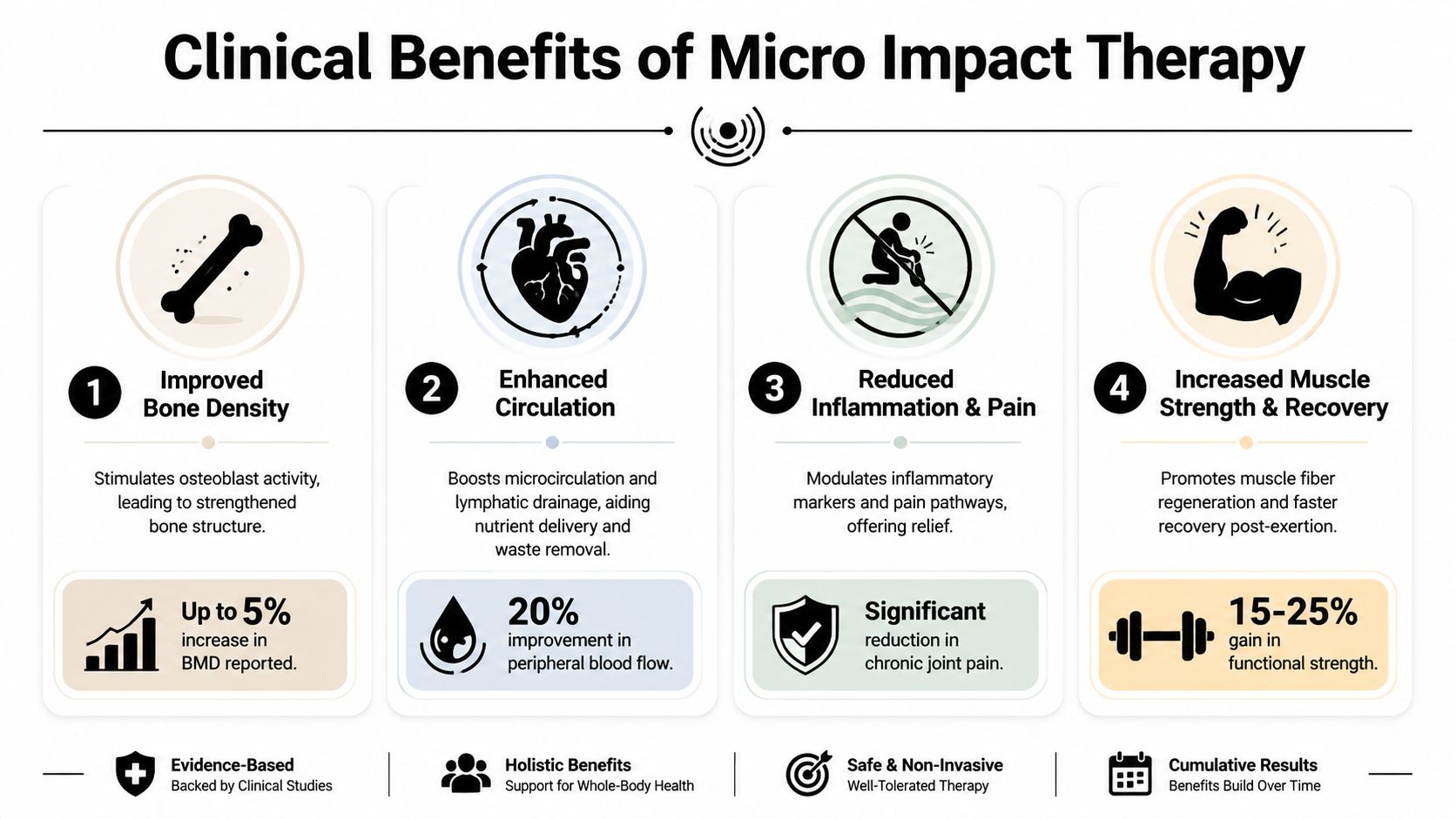
A related rehabilitation perspective is available in this page on regenerative rehabilitation therapy.
What those outcomes mean in real life
Bone density can sound abstract until you connect it to daily function. Stronger bone supports confidence in movement, better tolerance for training, and more resilience after periods of inactivity. It's part of maintaining a durable frame for an active life.
Balance and lower-body performance matter just as much. Patients often focus on pain first, but stability often determines independence. If your body can react quickly, transfer force efficiently, and maintain posture with less strain, everyday movement becomes safer and more fluid.
Common patient goals
People usually pursue this therapy for one or more of these reasons:
Bone support: They want to preserve skeletal integrity as they age or during periods when impact exercise isn't realistic.
Recovery support: They're trying to improve the conditions that allow tissues to recover more consistently.
Better balance: They want to feel more steady, especially after injury, deconditioning, or age-related decline.
Performance maintenance: They're active and want supportive input that doesn't add more training stress.
Some patients look for dramatic immediate sensations. A better way to judge this therapy is by whether it supports steadier function over time.
Why this matters for longevity medicine
In longevity practice, the goal isn't only symptom reduction. It's structural preservation. Bone, balance, and tissue responsiveness sit at the center of that mission. A therapy that helps maintain those systems can be valuable even when it doesn't feel intense.
That's why micro impact plate therapy often appeals to a wide range of patients. It can fit the older adult who wants to stay independent, the active traveler who wants to recover faster, and the athlete who wants supportive input without adding more load.
The Patient Journey at Longevity Medical Institute
For most patients, the experience starts with a screening conversation, not a sales pitch. The first question isn't whether micro impact plate therapy sounds interesting. It's whether it fits the patient's goals, tissue status, and overall plan.
One product description notes that a typical protocol involves passive use for approximately 20 minutes per day, while also noting that use for conditions such as osteoporosis or bone mineral density improvement is considered investigational in some regions. That same description frames it as a supportive therapy for recovery and wellness in routine use. You can read that context in this overview of how Juvent works and typical daily use.
What a session feels like
Patients are often surprised by how uneventful the session feels. You typically stand on the platform while it delivers low-level mechanical stimulation. There's no need to perform a workout. There's no requirement to push through strain. The therapy is passive by design.
That passivity is part of the appeal. Someone recovering from a demanding training block, dealing with fragility, or adding multiple therapies to a longevity protocol may not want another exhausting intervention.
How it fits into a modern care experience
In a structured clinical setting, the therapy works best when it's part of a broader data-informed plan. Tracking symptoms, diagnostics, response patterns, and recovery routines gives the treatment more meaning than using it in isolation. Patients interested in integrated monitoring can also explore this overview of the Longevity Patient App and its 360-degree health view.
A calm, private treatment setting also matters more than people expect. When the intervention is subtle, consistency becomes important. Patients are more likely to stay consistent when the process is simple, time-efficient, and easy to tolerate.
Synergy in Advanced Regenerative Protocols
Micro impact plate therapy becomes even more interesting when you stop viewing it as a standalone device and start viewing it as a primer. In regenerative medicine, the body's response often depends on the condition of the tissue environment. Better circulation, better signaling, and lower physiologic friction can make other interventions more coherent.
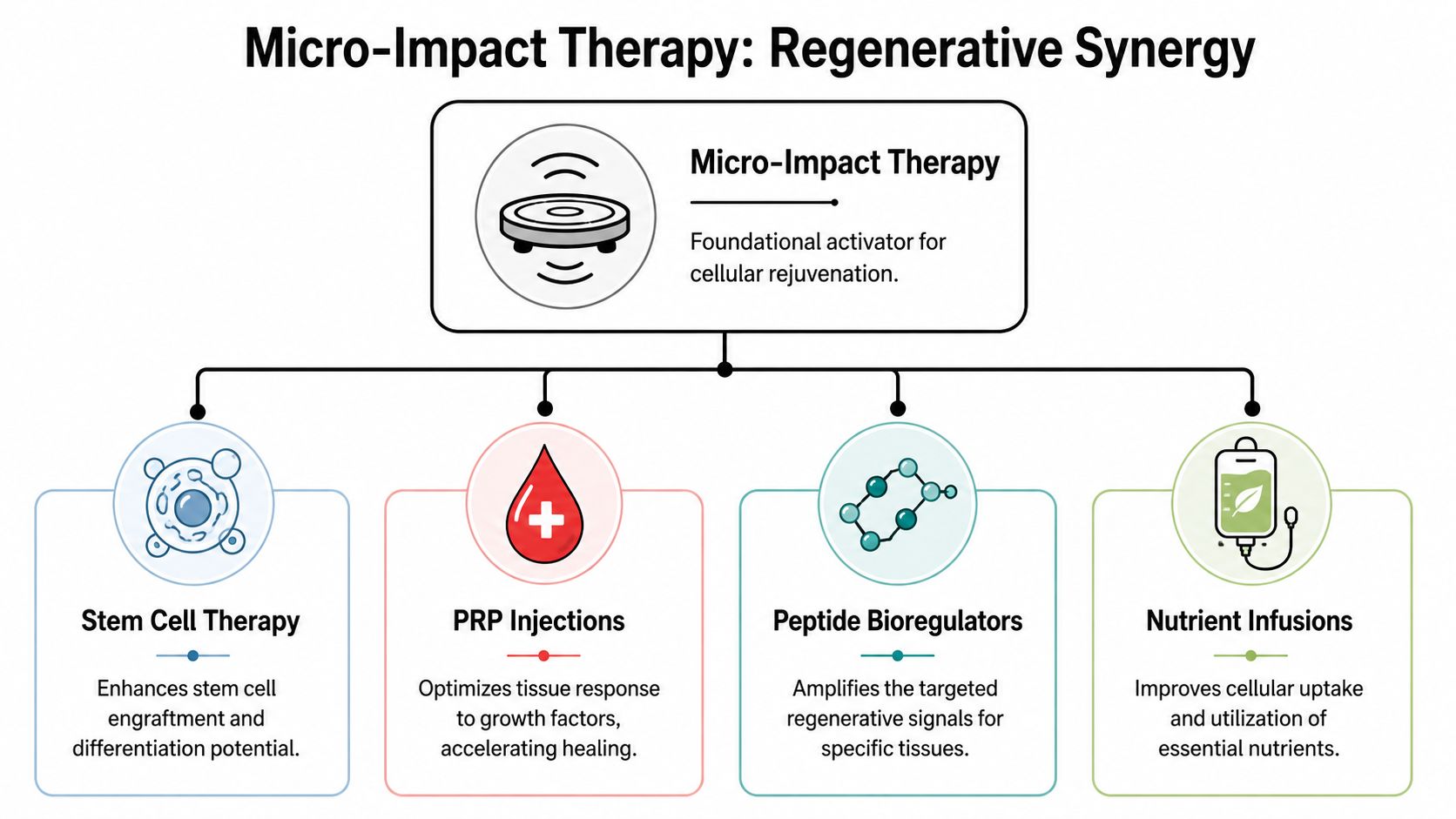
Why “priming” matters
If a patient receives a regenerative therapy, the treatment doesn't act in a vacuum. Cells and signaling molecules enter a biologic environment that may be inflamed, under-recovered, poorly conditioned, or mechanically deconditioned. Supportive therapies can help make that environment more receptive.
Micro impact plate therapy plays a logical role. By improving the quality of mechanical signaling through the musculoskeletal system, it may support a more responsive healing terrain. That doesn't mean it replaces advanced regenerative care. It means it may help the body use that care more effectively.
A practical example with allogeneic regenerative medicine
At Longevity Medical Institute, micro impact plate therapy is used as part of the Longevity Recharge Station, alongside other supportive modalities within a broader recovery framework. In that context, it can complement advanced regenerative protocols that may include allogeneic stem cell and exosome-based strategies.
That distinction matters because this clinic's focus is not on autologous stem cells. It uses allogeneic cellular approaches and produces five different stem cell types in its biotechnology lab, including placental, Wharton's jelly, adipose, endometrial, and dental pulp. For patients, the important point is that supportive therapies like micro impact can help prepare tissue before, during, or after a regenerative plan rather than competing with it.
Where synergy can show up
Consider these combinations:
With allogeneic stem cell protocols: A better-conditioned tissue environment may support more organized recovery signaling.
With exosome-based approaches: Mechanical input may help create a setting where communication pathways are more responsive.
With peptide or nutrient protocols: Patients often use supportive therapies to improve the body's readiness to receive and utilize a broader intervention plan.
With recovery-focused oxygen therapies: Better blood flow and tissue readiness can fit naturally with oxygen-based recovery strategies.
A related example is the intersection between oxygen support and cellular therapy, discussed in this article on hyperbaric oxygen therapy and stem cells.
The strongest regenerative programs rarely rely on one heroic treatment. They stack compatible signals.
Why this matters for peak performance
Athletes and high-functioning adults often think in terms of output. But output depends on the integrity of the system underneath it. If bone, soft tissue, circulation, and neuromuscular responsiveness are better supported, performance strategies become more sustainable.
That's the deeper value of micro impact plate therapy. It can occupy the space between diagnostics and intervention. It helps condition the terrain where restoration has to happen.
Safety Profile and Clinical Contraindications
A trustworthy discussion of micro impact plate therapy has to include who may need caution or who may need to avoid it altogether. Public marketing often skips this part. Clinical decision-making shouldn't.
One clinically relevant review of public-facing concerns notes that appropriate patient screening is critical. It also states that contraindications for vibration-based therapies can include recent fractures, risk of thrombosis, severe neuropathy, or acute inflammatory episodes, as described in this discussion of Juvent micro-impact platform safety considerations.
Patients who need careful screening
That doesn't mean every person in those categories is automatically excluded. It means they need a clinician to judge timing, risk, and appropriateness.
Examples include:
Recent fractures: Mechanical input may be poorly timed during early healing.
Thrombosis risk: Any circulation-affecting modality deserves extra caution.
Severe neuropathy: Reduced sensation can make it harder to gauge tolerance or detect issues.
Acute inflammatory flares: During active irritation, even gentle input may be the wrong stimulus.
Questions a clinician should ask
A proper screening process should explore more than diagnosis labels. It should ask:
What is the current tissue state? New injury and stable chronic degeneration are not the same scenario.
Is there sensory impairment? If sensation or proprioception is reduced, monitoring becomes more important.
Are there balance-related symptoms? Patients with vestibular sensitivity or instability may need a modified plan or a different therapy.
Is the patient combining multiple interventions? In complex longevity or medical travel settings, stacking therapies without sequencing can create confusion.
Safety isn't only about whether a therapy is “gentle.” It's about whether it's appropriate for the person standing on the platform.
That's why a one-size-fits-all approach doesn't work well here. Good clinics treat screening as part of the therapy, not as paperwork before the therapy.
Evidence and Research in Mechanical Stimulation
Micro impact plate therapy sits within the broader field of low-magnitude mechanical stimulation, sometimes shortened to LMMS. This area of research looks at whether tiny, repeated mechanical forces can influence bone and physical function without the heavy loading required in conventional exercise.
A 2023 review in PMC summarized clinical trial data on related vibration-based interventions and reported that, in one study, treatment groups showed a 2.032% increase in bone mass density versus a 0.046% decrease in controls, with noted improvements in balance and leg power after six months of therapy, as detailed in this PMC review of low-magnitude mechanical stimulation and bone outcomes.
What that means for patients
This kind of evidence doesn't prove that every device works the same way for every person. It does show that the underlying concept has moved beyond theory. Researchers have studied these signals in humans, not just in models or lab speculation.
That matters if you're trying to separate a genuine therapeutic category from a wellness trend. Mechanical stimulation has a plausible biologic basis, a growing clinical literature, and measurable outcomes in selected settings.
How it fits a broader recovery strategy
Patients rarely pursue one therapy in isolation. They combine movement, nutrition, diagnostics, and recovery tools. In that context, micro impact plate therapy makes the most sense as a supportive intervention within a larger plan.
Another example of noninvasive supportive care in this broader category is photobiomodulation therapy, which also aims to influence biology through targeted signaling rather than brute force.
Frequently Asked Questions About Micro Impact Therapy
How is this different from the vibration plates at my gym
Gym vibration plates are usually built for exercise intensity and muscular challenge. Micro impact plate therapy is built around low-magnitude mechanical signaling. It's a therapeutic tool, not a fitness shortcut, and the experience is typically much gentler.
How long does it take to see or feel results
Some people notice changes in comfort, steadiness, or recovery relatively early. Structural changes such as bone-related improvements usually take longer because those are slow biologic processes. The best way to think about results is cumulative rather than instant.
Can micro impact therapy replace exercise or my other treatments
No. It shouldn't replace exercise, medical care, or a personalized rehabilitation plan. It works best as a complement that supports tissue responsiveness, especially when used alongside an intelligent longevity or regenerative program.
Is it only for older adults
Not at all. Older adults may value it for bone and balance support, but active adults, athletes, and patients recovering from injury may also find it useful because it adds low-load stimulation without demanding another hard session.
Author
Dr. Kirk Sanford, DC, Founder & CEO, Longevity Medical Institute. Dr. Sanford focuses on patient education in regenerative and longevity medicine, translating complex therapies into clear, practical guidance for patients.
Medical Review
Dr. Félix Porras, MD, Medical Director, Longevity Medical Institute. Dr. Porras provides clinical oversight and medical review to help ensure accuracy, safety context, and alignment with current standards of care.
Last Reviewed: June 17, 2026
Short Disclaimer
This information is for educational purposes only and is not medical advice. It does not replace an evaluation by a qualified healthcare professional. For personalized guidance, please schedule a consultation.
If you're considering Micro Impact Plate Therapy as part of a broader longevity, recovery, or regenerative plan, Longevity Medical Institute offers physician-guided evaluation to determine whether it fits your goals, tissue condition, and overall treatment strategy.