

Prostate Health: A Guide to Longevity and Vitality
Most men are taught to think about the prostate only when two things happen. A blood test rises, or urination becomes annoying. That approach is too narrow for modern prostate health.
The prostate is part of a wider biological network that affects comfort, sexual function, sleep quality, inflammation burden, and how well a man ages overall. If you wait for obvious symptoms, you're often waiting until the system is already under strain. A better strategy is to treat prostate health as part of preventive longevity medicine, not just a cancer checkpoint.
Rethinking Prostate Health for Male Longevity
Conventional advice often reduces prostate care to one question. Do you have cancer, or not? That framing misses a critical clinical reality. Prostate inflammation may matter even before a man has alarming symptoms or a definitive diagnosis, and emerging data suggests that inflammatory activity in the prostate can connect to broader aging patterns and even cardiovascular decline, while standard screening often overlooks these markers of reduced healthspan as discussed in this scientific overview.
That changes the conversation.
Instead of seeing the prostate as a small organ that only becomes relevant late in life, I encourage patients to think of it as a strategic checkpoint in male longevity. When this tissue is irritated, congested, enlarged, or chronically inflamed, the effect isn't always dramatic at first. It can show up as fragmented sleep from nighttime urination, pelvic tension, diminished resilience, sexual frustration, or low-grade discomfort that men normalize for years.
Why the old model falls short
The old model is reactive. A man notices symptoms, gets a basic workup, and then gets funneled into a narrow discussion about medication, biopsy, or surgery. That model helps in some cases, but it doesn't ask a more important question. Why did the tissue become dysfunctional in the first place?
Prostate health sits close to several larger systems:
Inflammatory signaling that affects tissue behavior over time
Hormonal balance that shapes function and symptoms
Vascular health that influences oxygen delivery and healing
Metabolic health that contributes to aging biology
For men also exploring hormone optimization, this broader lens matters. A well-written complete resource for men's HRT can help patients understand how testosterone, symptoms, and long-term male health intersect.
Clinical perspective: A prostate evaluation shouldn't begin and end with fear of cancer. It should ask whether the organ is aging well.
Men who want a wider longevity framework can also review our men's health resource center, where prostate function fits into a much larger preventive picture.
Understanding Your Prostate Anatomy and Function
Many men spend years monitoring the wrong signal. They focus on the bladder because that is where they feel urgency, or on sexual performance because that is where they notice change. The prostate often remains in the background, even though its position and biology can shape both.
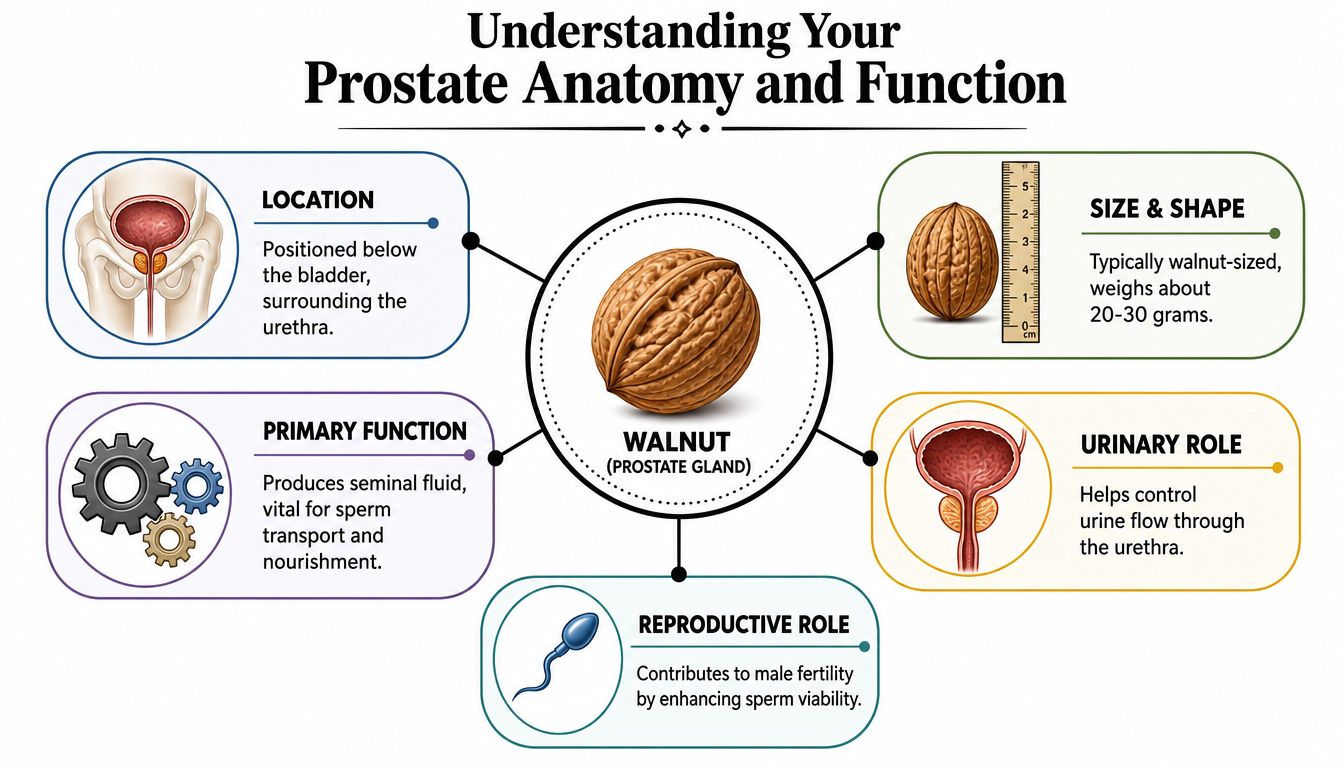
The gland is usually about the size of a walnut. It sits just below the bladder and wraps around the first segment of the urethra, the tube that carries urine out of the body. The National Institute of Diabetes and Digestive and Kidney Diseases explains that the prostate makes some of the fluid in semen and surrounds the urethra in a way that helps explain why enlargement can affect urination according to NIDDK.
A practical way to picture it is as a soft collar around a narrow hose. If the collar becomes irritated, congested, or larger with age, the hose does not have much extra space. Small structural changes can produce noticeable effects.
What the prostate actually does
Patients often mix up the jobs of the prostate, bladder, and testicles. The distinction matters because symptoms can mislead you.
| Function | What it means in plain language |
|---|---|
| Fluid production | The prostate contributes fluid to semen, helping protect and transport sperm |
| Flow regulation by location | Because it surrounds the urethra, swelling or growth can slow the urinary stream or create resistance |
| Reproductive support | Its secretions support normal ejaculation and fertility potential |
If you enjoy visual learning, Discover effective anatomy study resources offers helpful ways to make structures like the prostate easier to picture.
That anatomy also explains why prostate health belongs in a longevity conversation. A gland sitting at the crossroads of urinary function, sexual function, inflammatory signaling, and hormone response can act like an early indicator of broader male aging patterns. Men tracking key longevity biomarkers often find that prostate changes make more sense when viewed alongside metabolic, vascular, and inflammatory data rather than as an isolated organ problem.
The three common prostate problems
Three patterns account for most clinical conversations.
Benign prostatic hyperplasia, or BPH. This is noncancerous enlargement of the prostate. It can narrow the urethral channel and lead to weak stream, hesitancy, urgency, or waking at night to urinate.
Prostatitis. This term refers to inflammation of the prostate. Some men feel pelvic aching, pressure, burning, or pain with urination or ejaculation.
Prostate cancer. This involves abnormal cell growth in the gland. Some cancers move slowly. Others behave more aggressively, which is why proper evaluation matters.
The confusing part is symptom overlap. Inflammation can mimic enlargement. Enlargement can produce symptoms that feel dramatic yet remain benign. Cancer can be silent. That is why a symptom by itself is only a clue, not a diagnosis.
Age-related enlargement is common. The Urology Care Foundation notes that BPH affects about half of men by age 60 and up to 90 percent by age 85, particularly in developed countries according to the Urology Care Foundation. Those numbers matter because they help explain a frequent blind spot in men's health. Many urinary changes get dismissed as ordinary aging, even when they may reflect a mix of tissue growth, impaired drainage, pelvic floor tension, and chronic low-grade inflammation.
That broader frame offers an important anatomy lesson. The prostate is not just a cancer screening target. It is a small gland in a strategically important location, and when its tissue environment shifts, the effects can ripple into sleep, sexual function, comfort, and long-term healthspan.
Proactive Prevention and Key Risk Factors
Many men are taught to view the prostate as a cancer question that begins later in life. That framing is too narrow. Prostate health is also an inflammation question, a vascular question, and a longevity question, because the same biological conditions that disturb prostate tissue often show up elsewhere in the aging male body.
Some risk is inherited. Some risk is built, slowly, through the tissue environment your body lives in every day.
Risks you need to know
Prostate cancer is the second most commonly diagnosed cancer in men worldwide according to the World Cancer Research Fund. In clinical terms, that means the prostate deserves the same disciplined attention men often give to cholesterol, blood pressure, and blood sugar.
Age remains one of the strongest drivers of risk. Family history also matters, especially when prostate cancer appears in a father or brother. Black men face a higher burden and benefit from earlier, more deliberate conversations about screening and follow-up.
Those facts should sharpen attention, not create fatalism. Genetics may load the gun. The tissue environment influences whether the trigger gets pulled.
The part you can influence
This is the blind spot in most prostate education. Men hear about symptoms and screening, but much less about the chronic inflammatory load that can make prostate tissue more reactive, more swollen, and potentially more vulnerable over time.
A prostate does not function in isolation. It lives downstream from metabolism, circulation, hormone signaling, immune behavior, sleep quality, and toxin exposure. If those systems are strained for years, the prostate often reflects that strain.
A useful comparison is soil health in a vineyard. The vine matters, but the soil determines how well the vine tolerates stress, infection, heat, and time. In the body, that soil includes insulin sensitivity, visceral fat, endothelial health, oxidative stress, and the background level of inflammation.
Patterns that improve that internal terrain include:
Nutrition quality that lowers inflammatory burden rather than reinforcing it
Regular exercise that improves metabolic flexibility, circulation, and body composition
Restorative sleep that supports immune regulation and hormone balance
Stress control that reduces chronic sympathetic overactivation
Lower toxic burden from repeated exposures that interfere with repair and recovery
None of these guarantees protection. They change probabilities, which is how preventive medicine usually works.
Biomarkers make prevention measurable
Men often understand prevention conceptually but struggle to translate it into action. Measurement helps. Longitudinal lab trends can reveal whether your inflammatory and metabolic terrain is improving, stable, or drifting in the wrong direction. Our guide to longevity biomarkers explains how those patterns can inform more precise preventive decisions.
That broader perspective matters. Proactive prostate care is not only about avoiding one diagnosis. It is about preserving urinary function, sexual health, sleep quality, and the systemic resilience that supports a longer healthspan.
The Modern Diagnostic Pathway from PSA to AI-Powered MRI
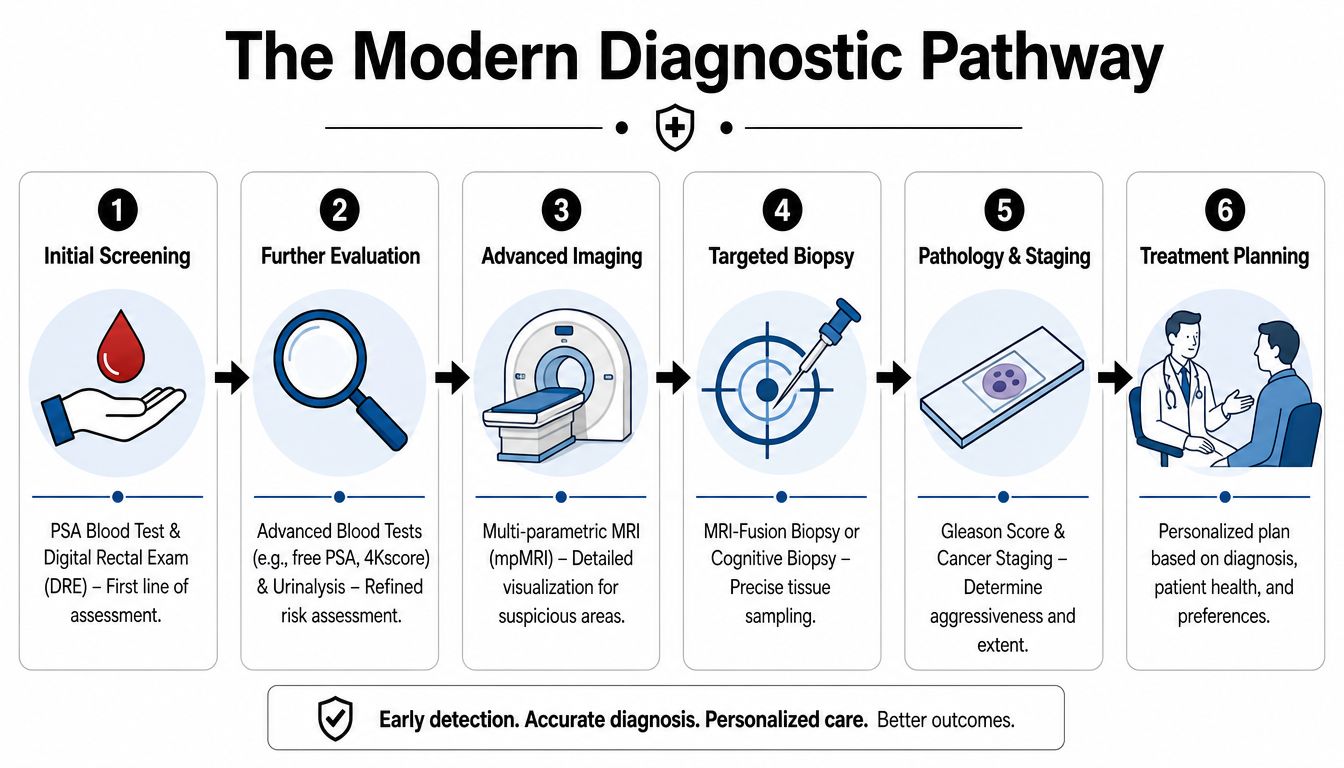
A good prostate workup is a sequence, not a single test. Patients often arrive worried that one high PSA means cancer. It doesn't.
A PSA result is better understood as a signal flare, not a verdict. It tells the clinician to look more carefully, because PSA can rise for more than one reason.
Where screening usually starts
Expert guidance supports a baseline PSA screening at age 45 for average-risk men and age 40 for high-risk groups, with follow-up intervals adjusted to the initial result. If PSA levels are high, the test should be repeated in 4 to 6 weeks to rule out temporary causes based on Mayo Clinic Press guidance.
That repeat step matters because temporary irritation can distort the first reading.
A traditional pathway may include:
PSA blood testing to identify whether further investigation is warranted
Clinical history and symptom review to understand context
Digital rectal exam in selected cases
Follow-up testing or imaging if the signal remains concerning
Why PSA alone is incomplete
PSA is useful, but it has limits. It doesn't directly tell you whether a rise reflects inflammation, benign enlargement, recent irritation, or a malignant process. That's why patients get confused. They assume a higher number has only one explanation.
It doesn't.
Practical rule: Don't interpret PSA in isolation. Interpret it in context, and confirm abnormal results before escalating.
What advanced imaging adds
Modern diagnostics offer a way to change the patient experience. High-quality imaging can clarify anatomy, identify suspicious regions, and reduce guesswork. For men who want to understand how this technology works, our overview of AI full body MRI explains how advanced imaging can support a broader preventive strategy.
A complex diagnostic pathway often combines several layers:
| Tool | What it helps answer |
|---|---|
| PSA and related blood markers | Is there a signal that deserves follow-up? |
| Urinalysis and clinical review | Could inflammation or another benign cause be contributing? |
| MRI-based imaging | Is there a visible structural abnormality that changes the level of concern? |
| Biopsy when indicated | Is tissue confirmation necessary? |
For some men, the greatest value of advanced imaging is precision. It can help focus the next step instead of forcing decisions from incomplete information. That matters whether the concern is cancer, BPH, or chronic inflammation.
A Full Spectrum of Prostate Treatment Options
Prostate care shouldn't be framed as a false choice between “do nothing” and “have surgery.” There's a full treatment spectrum, and the right place to start depends on the biology, symptoms, imaging, and goals of the patient.
Conservative and conventional options
At one end of the spectrum, some men need monitoring more than intervention. If symptoms are mild and the risk profile is low, clinicians may recommend observation, repeat labs, and structured follow-up.
Conventional options may include:
Lifestyle measures aimed at lowering irritation and improving urinary habits
Medications to relax tissue, improve flow, or reduce enlargement
Procedural care when symptoms become disruptive or anatomy creates obstruction
Surgical treatment when less invasive methods no longer provide adequate relief
This stepwise model is still important. Not every man needs a regenerative approach first. Not every man should avoid standard treatment.
Why inflammation changes the treatment conversation
Here is the blind spot in much of conventional prostate care. It often treats enlargement as a plumbing problem and cancer as an oncology problem, while giving less attention to the inflammatory environment that may be driving tissue dysfunction.
That matters because meta-analytic data found a pooled prevalence estimate of BPH around 13% in aging male populations, while prostate cancer prevalence was described as nearly ubiquitous in advanced age, highlighting the importance of options that can address BPH without automatically moving toward major surgery in this meta-analysis.
In practice, many men want to know whether there are ways to support the tissue environment, not just suppress symptoms.
Regenerative and integrative options
In this context, a broader longevity model becomes useful. Regenerative strategies are designed to engage repair biology, modulate inflammation, and support tissue function. Depending on the clinical situation, physicians may consider tools such as allogeneic stem cells, exosomes, peptides, oxygen-based therapies, and targeted supportive infusions.
At Longevity Medical Institute, physicians may evaluate prostate and urologic concerns within a larger protocol that can include diagnostics, procedural planning, and regenerative medicine. Our related overview of advanced urology procedures explains how these decisions can fit into a structured care plan.
A few important points matter here:
We use allogeneic stem cells, not autologous cells. That distinction is intentional.
Our biotechnology lab produces five different stem cell types, including placental, Wharton's jelly, adipose, endometrial, and dental pulp.
Exosomes and peptides may be used as part of a broader strategy to influence cellular signaling and recovery.
Hyperbaric oxygen therapy and IV nutraceutical support can complement tissue-focused care by supporting oxygen delivery and physiologic resilience.
Patients sometimes ask whether regenerative medicine “shrinks the prostate.” That question is too simplistic. The better question is whether a therapy may help reduce inflammatory burden, improve tissue environment, and support function in the right patient. For chronic prostatitis or inflammation-dominant patterns, that distinction is especially important.
Surgery addresses structure. Regenerative medicine aims to influence the biology that shaped the structure.
That doesn't mean regenerative care replaces every conventional option. It means men deserve a treatment discussion broad enough to match the complexity of the problem.
Your Journey to Prostate Wellness with LMI
Most patients don't seek prostate care because they enjoy diagnostics. They come in because something no longer feels right. Sleep is interrupted. Urination changes. A prior PSA created anxiety. Pelvic discomfort keeps recurring. Or they want a deeper preventive assessment before symptoms start.
The process should feel orderly, not confusing.
What patients usually need first
A thorough starting point often includes history, symptom pattern, prior labs, current medications, and the timing of any urinary or sexual changes. For some men, the issue is straightforward. For others, symptoms sit at the crossroads of hormones, inflammation, pelvic dysfunction, metabolic health, and vascular aging.
That's why a modern intake should ask more than “How often are you urinating?”
What an integrated evaluation looks like
For men traveling for care, the ideal pathway is coordinated. A patient may begin with remote review, then arrive for a more complete workup that can include imaging, laboratory analysis, and specialist assessment under one roof. Men exploring our urology and men's health services can see how prostate care fits into a broader evaluation model.
A detailed plan may include:
Advanced imaging when anatomy needs clarification
In-house laboratory assessment when metabolic or inflammatory context matters
Cardiovascular review because vascular health and longevity are linked
Personalized treatment planning based on symptoms, goals, and diagnostic findings
For medical travelers, convenience matters. So does clinical coherence. A fragmented experience creates delays, mixed messaging, and unnecessary repetition. A coordinated pathway lets the patient move from concern to clarity with fewer handoffs.
Taking Control of Your Prostate Health Today
The most important shift is simple. Don't treat prostate health as a late-stage problem. Treat it as part of male longevity.
That means paying attention before symptoms become disruptive. It means understanding that inflammation, urinary changes, sexual function, hormone balance, imaging, and cardiometabolic health often belong in the same clinical conversation. It also means resisting two common mistakes. Ignoring the issue because you feel mostly fine, or assuming every abnormal signal points to the worst-case scenario.
Both are outdated responses.
A proactive approach is more useful. Track symptoms. Discuss screening at the right time. Confirm abnormal findings instead of reacting to a single data point. If necessary, pursue a more complete diagnostic picture that includes anatomy, biomarkers, and tissue context. Then choose treatment from the full spectrum, not from fear.
When men do that, prostate care stops being a narrow discussion about avoiding catastrophe. It becomes part of preserving sleep, confidence, comfort, sexual wellness, and long-term function.
Author
Dr. Kirk Sanford, DC, Founder & CEO, Longevity Medical Institute. Dr. Sanford focuses on patient education in regenerative and longevity medicine, translating complex therapies into clear, practical guidance for patients.
Medical Review
Dr. Félix Porras, MD, Medical Director, Longevity Medical Institute. Dr. Porras provides clinical oversight and medical review to help ensure accuracy, safety context, and alignment with current standards of care.
Last Reviewed: July 13, 2026
Short Disclaimer
This information is for educational purposes only and is not medical advice. It does not replace an evaluation by a qualified healthcare professional. For personalized guidance, please schedule a consultation.
If you're ready to take a more precise, longevity-focused approach to prostate health, schedule a consultation with Longevity Medical Institute. You can explore more educational articles and treatment resources at LMI Treatments and Resources.