

Stem Cell & Exosome Therapy for Age-Related Hearing Loss
Stem cell and exosome approaches are promising investigational options, but they cannot yet reverse established age-related hearing loss in humans. More than 25% of people older than 60 have disabling hearing loss, so the need for better treatments is clear, even though regenerative hearing research remains early.
You may notice the change during dinner. You can hear that someone is speaking, but the words blur when several people talk at once. Higher-pitched voices become harder to follow, and turning up the television helps less than it used to. This gradual pattern is often called presbycusis, or age-related sensorineural hearing loss.
Current care can improve communication and daily function. Hearing aids, cochlear implants when appropriate, communication strategies, and hearing protection remain important. Stem cell and exosome therapy for age-related hearing loss belongs in a different category. These approaches are being investigated for their ability to support the inner ear's remaining cells, not as proven replacements for established hearing care.
Understanding the Science of Age-Related Hearing Loss
The cochlea is a delicate, spiral-shaped structure inside the inner ear. Tiny cochlear hair cells translate sound vibrations into electrical signals, while supporting tissues maintain the fluid balance, energy supply, and cellular environment needed for that process. Auditory nerve connections then carry information toward the brain.
With aging, several parts of this system can become less resilient. Hair cells may be damaged or lost, connections between hair cells and auditory neurons may weaken, and the tissues that sustain cochlear function may become less efficient. Genetics influence vulnerability, while cumulative noise exposure, oxidative stress, inflammation, and metabolic health can add to the burden. The result isn't always a sudden change. Hearing often declines gradually over years.
Why conversations become difficult
Many people first struggle with speech in noisy rooms, rather than noticing complete loss of sound. Higher-frequency sounds may fade first, making consonants and the voices of children or women more difficult to distinguish. Tinnitus, listening fatigue, and the need to ask others to repeat themselves can accompany the hearing change.
Age is a particularly strong determinant of disabling hearing loss. One global estimate found disabling hearing loss in 20.1% of adults older than 50 and 44.4% of adults older than 70, according to the World Health Organization's hearing-loss fact sheet. U.S. data show the same broad age gradient, with hearing loss present in 63.1% of adults aged 70 and older under the study's defined hearing-loss measure.
Practical rule: A hearing test is more reliable than the volume setting on a television. Symptoms alone can't show whether the main problem involves hair cells, auditory nerve connections, the middle ear, or another condition.
Mammals have limited ability to replace mature cochlear hair cells after substantial injury. That biological limitation explains why researchers are studying cellular signals that might preserve surviving structures. The more realistic near-term objective is often support and protection, while complete replacement of lost human hair cells remains a much harder research goal.
How Stem Cells and Exosomes Support Inner Ear Health
Mesenchymal stromal cells, commonly called MSCs, are attracting interest because they can release signals that influence nearby tissues. Their potential value isn't limited to becoming replacement cells. In many regenerative studies, MSCs act more like a mobile support team, releasing biological instructions that may affect inflammation, oxidative stress, blood-vessel function, and cell survival.
Their extracellular vesicles, including exosome-enriched preparations, function like small delivery packages. They can carry proteins, regulatory RNA, and other signaling molecules between cells. In the inner ear, researchers are investigating whether these signals might reduce harmful inflammation, support auditory neurons, protect hair cells from further stress, and improve the environment around surviving tissue. A review of the field describes mechanisms involving reduced inflammation, oxidative stress, hair-cell apoptosis, and spiral-ganglion-neuron injury, while also emphasizing that human evidence remains limited. Research on stem cells and exosomes for hearing health should therefore be read as a developing scientific area, not as proof of a standard treatment.
Why preservation currently makes more sense than replacement
Think of a cochlea as an orchestra. Hair cells are part of the sound-producing section, auditory neurons carry the performance onward, and supporting tissues keep the stage supplied and stable. If some musicians are still present but surrounded by inflammation and metabolic stress, improving the environment may help them function. Replacing an entire missing orchestra is far more complex.
This is the central biological distinction for patients. MSCs and exosomes may offer paracrine support, meaning their released signals act on nearby cells. That doesn't mean every preparation reaches the cochlea, carries the same cargo, or produces the same response. Product source, manufacturing method, dose, route, and the patient's remaining inner-ear structures all matter.
Preclinical studies have described proteins, microRNAs, and other molecules that may regulate inflammatory pathways and cell-survival signals. Animal models have also reported protection of auditory structures after toxic injury. Those observations help researchers formulate hypotheses, but they don't establish restored speech understanding or quality of life in older adults with ordinary presbycusis.
Current Research and Preclinical Evidence
The most encouraging findings come from laboratory and animal research. A systematic review identified 867 records and found mixed results across hearing-related cell studies. Some experiments reported better hearing thresholds, while others found no meaningful effect. The review emphasized differences in methods and the limited amount of human evidence. The systematic review of cell-based approaches for hearing loss supports continued investigation, but not a clinical promise.
Recent preclinical studies have examined MSCs and extracellular vesicles carrying Apelin, a signaling molecule involved in tissue biology. Researchers reported improved hearing measures and lower markers associated with cochlear aging and inflammation. These findings are encouraging because they connect a possible molecular mechanism with measurable auditory changes in an aging model. They still don't demonstrate hearing restoration in humans.
What noise-injury studies can and can't tell us
Related animal research has found that MSC-derived extracellular vesicles protected hearing after noise-related injury. Other preclinical models involving toxic injury reported protection of cochlear hair cells, reduced inflammation, and improved auditory-neuron survival. These results make preserving remaining cells and connections a plausible research objective.
They don't answer every question about presbycusis. Noise injury, medication-related injury, sudden hearing loss, and gradual aging can affect different structures and biological pathways. A treatment that protects tissue after a defined injury may not reverse years of cumulative degeneration.
The human evidence is still early. A report involving two adults who received MSCs found no treatment-related toxicity, but neither patient showed markedly improved hearing thresholds. Another uncontrolled report involving children with acquired hearing loss reported reduced auditory brainstem-response thresholds in some participants, but the ages, diagnoses, and study design differ substantially from age-related hearing loss. These findings can't be generalized to presbycusis.
A single uncontrolled cochlear-implant case involving direct administration of mesenchymal-cell-derived exosomes reported better speech comprehension and local tissue activity over 24 months. Reviews also report no completed clinical trials specifically evaluating MSC exosomes. Research on exosome approaches for tinnitus and inner-ear conditions illustrates why biological plausibility must remain separate from demonstrated efficacy.
Treatment Delivery Options and Routes of Administration
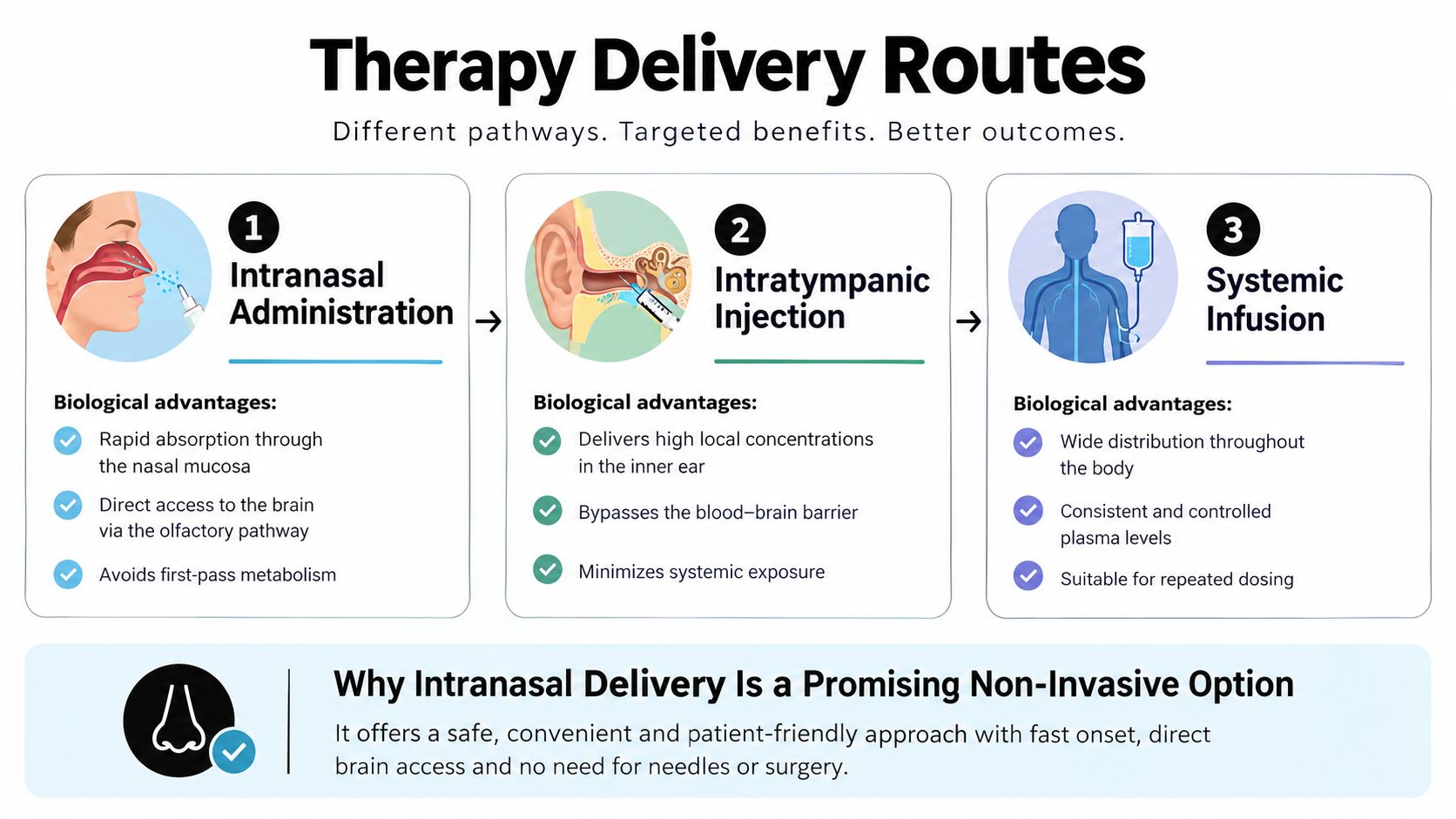
Route selection matters because the inner ear is protected by specialized barriers, including the blood-labyrinth barrier. A therapy circulating through the body may influence systemic inflammation without delivering a predictable amount of cargo to cochlear tissue. Local delivery can increase exposure near the ear, yet it is more invasive and still may not reach the intended cellular targets. For age-related hearing loss, the practical goal is usually to support and preserve surviving cells, not to assume that any route can replace hair cells already lost.
How researchers are studying the routes
Intranasal delivery is being studied as a non-invasive pathway toward the nervous system. Research in aging mice reported improved hearing measures after intranasal nerve growth factor. That result supports further investigation, but it does not show that intranasal exosomes behave similarly or produce equivalent effects. The route therefore remains experimental for aging-related hearing changes.
Intravenous administration may influence systemic immune signaling and inflammation. However, the blood-labyrinth barrier limits predictable access to the cochlea. Researchers still need clearer evidence about biodistribution, dose equivalence, and pharmacokinetics. Learn more about IV stem cell therapy and how systemic delivery is used in regenerative protocols.
Intratympanic or outer-ear application places treatment closer to the middle and inner ear than a systemic infusion. Crossing the eardrum is only the first step. The therapy must still reach cochlear hair cells or auditory neurons, and local exposure does not prove cellular protection or restoration. Direct cochlear delivery may increase local exposure, but it is invasive and has not been shown to be superior to hearing aids, cochlear implants, or approved medical management.
A physician may consider a targeted route only after weighing the suspected tissue target, patient anatomy, available evidence, and route-specific risks. A more direct procedure is not automatically a more effective one. Each approach should be judged by whether it can safely support remaining inner-ear cells and deliver treatment where it may act.
Safety Profile and Clinical Considerations
MSC administration has a generally favorable safety profile across more than 15 years of clinical research, according to clinical experience summarized in a clinical review of safety and evidence in hearing-related regenerative approaches. That record is reassuring, not a guarantee. Risk depends on the cell product, preparation, dose, delivery route, physician experience, monitoring, and the patient's health. Transient fever is a recognized adverse effect of MSC administration. For a fuller discussion, see the safety of stem cell therapy, including product-specific safety questions.
MSC findings cannot be transferred automatically to MUSE cells or exosomes. MUSE cells are a distinct allogeneic cell population. Exosomes are cell-derived extracellular vesicles, not living cells. Their manufacturing, biological behavior, distribution, and safety profiles differ. Exosomes also have a newer human safety record, while hearing-specific outcomes remain under study.
Questions a responsible assessment should answer
Before considering an investigational protocol, ask:
Product identity: What cell type or extracellular-vesicle preparation is used, and how is it characterized?
Quality control: How are viability, sterility, contamination, particle concentration, cargo profile, and potency assessed?
Route rationale: Why does the proposed delivery method fit the suspected target tissue?
Baseline testing: Which measures will establish the starting point for hearing, speech understanding, tinnitus, and quality of life?
Clinical oversight: Who will review medical history, identify contraindications, explain uncertainties, and monitor adverse effects?
A favorable safety record does not establish effectiveness. HBOT has clinical support in selected cases of recent sudden hearing loss, yet that evidence does not establish it for gradual age-related decline. Sound-paired vagus nerve stimulation has been studied for tinnitus, while reversal of presbycusis remains unestablished. These therapies are better viewed as potentially protective or supportive. Preserving surviving inner-ear cells is currently more plausible than replacing hair cells that have already been lost.
LMI's Integrated Approach to Regenerative Care
Longevity Medical Institute evaluates investigational regenerative options within a broader clinical assessment rather than treating a hearing test in isolation. Its 15,000-square-foot facility brings 17 specialized physicians, chemists, and scientists together under one roof, with an in-house clinical laboratory measuring 140 biomarkers, AI-integrated full-body MRI, advanced cardiovascular evaluation, and other diagnostic services. These figures and capabilities are described through the institute's clinical approach and facility information.
The biotechnology laboratory prepares and characterizes LMI's allogeneic cellular platform. It includes MUSE cells, placental stem cells, Wharton's jelly stem cells, adipose stem cells, endometrial stem cells, dental pulp stem cells, and cell-derived exosomes. LMI doesn't use autologous stem cells. These cell sources have different biological characteristics, and the choice should depend on the patient's condition, treatment objective, available evidence, and safety assessment.
Why preparation and handling matter
Cell quality isn't a minor technical detail. Viability, identity, sterility, handling time, storage, and preparation conditions can influence what a product contains and how it behaves. Access to freshly prepared cells and an in-house laboratory can support coordination between the clinical and biotechnology teams, although it doesn't remove the need for patient-specific risk assessment or evidence-based follow-up.
LMI also produces and activates autologous natural killer, or NK, cells in its biotechnology laboratory. NK cells participate in immune surveillance, and emerging research is examining their role in specific clinical applications. NK-cell therapy is a separate modality from MSC or exosome therapy, with its own preparation, indications, safety questions, and evidence base. It shouldn't be presented as a hearing-restoration treatment.
Other services may be considered separately, including physician-supervised peptides, nutraceutical therapies, TriFusion EBOO, IV infusions, and the Longevity Recharge Station. HBOT may be discussed for selected clinical situations, but its evidence for recent sudden hearing loss is distinct from the evidence for age-related decline. Complementary modalities may support overall health goals, yet no particular combination should be assumed to provide additional hearing benefits unless research demonstrates that effect.
Next Steps and Realistic Expectations
Start with diagnosis, not treatment selection. A full evaluation should distinguish age-related sensorineural loss from conductive problems, sudden hearing loss, medication-related injury, autoimmune disease, and auditory nerve disorders. Bring recent audiograms, hearing history, ENT records, imaging when available, and details about hearing aids or cochlear implants.
Protect the hearing you still have. Reduce avoidable loud-noise exposure, use appropriate hearing protection, and address metabolic or vascular health concerns with a qualified clinician. Hearing aids and cochlear implants remain appropriate for many people and should not be stopped because an investigational therapy is being considered.
Measurable follow-up is essential. A practical plan may include:
Pure-tone audiometry: Track hearing thresholds against the same baseline.
Speech-in-noise testing: Assess the everyday challenge that many patients notice first.
Otoacoustic emissions: Evaluate cochlear responses when measurable.
Tympanometry: Check middle-ear function.
Tinnitus and quality-of-life instruments: Record changes beyond the audiogram.
The most honest expectation today is not a guaranteed return of normal hearing. It is a carefully assessed possibility that cellular signals may help support remaining auditory structures, with outcomes determined through objective testing rather than impressions alone. A free online consultation can help clarify whether an investigational discussion is reasonable and what goals would be realistic for your hearing profile.
Author
Dr. Kirk Sanford, Founder & CEO, Longevity Medical Institute. Dr. Sanford focuses on patient education in regenerative and longevity medicine, translating complex therapies into clear, practical guidance for patients.
Medical Review
Dr. Félix Porras, MD, Medical Director, Longevity Medical Institute. Dr. Porras provides clinical oversight and medical review to help ensure accuracy, safety context, and alignment with current standards of care.
Last Reviewed
October 6, 2026
Short Disclaimer
This information is for educational purposes only and is not medical advice. It does not replace an evaluation by a qualified healthcare professional. For personalized guidance, please schedule a consultation.
Longevity Medical Institute offers physician-led assessment, advanced diagnostics, in-house biotechnology support, and individualized regenerative medicine discussions for patients exploring age-related hearing loss research. Visit Longevity Medical Institute to request a free online consultation and discuss realistic goals, hearing testing, and investigational options with the clinical team.