

Stem Cell & Exosome Therapy for Vertigo and Post-Viral Balance Disorders
A routine viral illness can end, yet the room still seems to move. You may feel pulled sideways while walking, become uncomfortable turning your head, or find that screens and busy environments trigger a wave of disequilibrium. Some people also describe brain fog, fatigue, nausea, or a sense that their eyes and inner ears no longer agree.
That experience deserves a careful diagnosis. Vertigo and dizziness are symptoms, not diagnoses, and several different syndromes can produce them. This guide to stem cell and exosome therapy for vertigo and post-viral balance disorders explains where regenerative medicine may have a plausible role, where established care remains more appropriate, and how individualized testing can prevent an appealing treatment from being applied to the wrong problem.
The information is published for the treatment and resource library of Longevity Medical Institute, where emerging biologic therapies should be considered alongside, not instead of, proper vestibular evaluation and rehabilitation.
Living With Vertigo and Post-Viral Imbalance
A patient might describe it like this. The fever and respiratory symptoms are gone, but walking through a supermarket feels like stepping onto a floor that shifts underfoot. Turning the head to check traffic brings a brief surge of disequilibrium. Reading becomes tiring, and an ordinary walk leaves the person unsure of where the ground is.
That pattern can follow vestibular neuritis, labyrinthitis, or another post-viral process. Vestibular neuritis often improves after the acute episode, yet some people still have imbalance or nonspecific dizziness for months. The clinical overview of vestibular neuritis describes this variable course and explains why persistent symptoms can reflect incomplete vestibular compensation rather than a vague complaint.
The word vertigo usually means an illusion of movement, such as spinning, tilting, or being pulled. Dizziness is broader and may include light-headedness, visual disorientation, motion sensitivity, or unsteadiness. Neither term identifies the injured structure by itself.
Why symptoms can outlast the infection
Your balance system combines input from the inner ears, eyes, muscles, joints, and brain. If one vestibular organ suddenly sends weaker or distorted signals, the brain has to recalibrate. That process is called vestibular compensation, and it can slow down when a person avoids movement, remains highly fatigued, has migraine biology, or develops anxiety around falling.
Post-viral balance disorders also deserve separation from the causes of virus-related exhaustion. Fatigue can intensify dizziness, but exhaustion alone does not prove that the inner ear or vestibular nerve has been damaged. After COVID-19, dizziness can also involve autonomic, cardiovascular, neurologic, medication-related, or inner-ear factors.
Practical rule: Persistent dizziness should be localized before anyone discusses a biologic treatment. The same symptom can call for a repositioning maneuver, migraine care, rehabilitation, or a broader medical evaluation.
A 2022 NIH-hosted study reported vestibular symptoms still present at screening in recovered COVID-19 patients, and a review of post-COVID vertigo cases reported vestibular neuritis in 6 of 7 patients, or 85.7%, and BPPV in 1 of 7, or 14.3%. Because this case series involved only 7 patients, those percentages should be read as illustrative rather than as prevalence estimates. Standard care, spontaneous recovery, and vestibular rehabilitation still help many people, while a persistent subgroup may reasonably ask whether investigational options like stem cells and exosomes have a biologic fit. NIH-hosted clinical evidence
For patients whose evaluation suggests a neurologic contribution, LMI also describes a regenerative neurological therapy pathway. The next step is diagnosis, not a promise that one intervention will correct every form of dizziness.
Understanding the Different Types of Vertigo
The first question is not which regenerative product someone should receive. It is which balance disorder they have. Vertigo is a family of syndromes, and each one points to a different mechanism, so the biologic discussion only makes sense after the diagnosis is clearer.
BPPV is a mechanical problem
Benign paroxysmal positional vertigo, or BPPV, happens when calcium carbonate crystals move into a semicircular canal. The inner ear works like a motion sensor, and displaced crystals send a false signal when the head changes position. Rolling in bed, looking upward, or bending down may trigger brief spinning.
The usual treatment is a canalith repositioning maneuver, selected and performed by a trained clinician. Exosomes or stem cells do not put a crystal back in place. For uncomplicated BPPV, repeated biologic treatment would miss the mechanical cause.
Vestibular neuritis and labyrinthitis involve injury or inflammation
Vestibular neuritis damages the nerve that carries balance signals, while labyrinthitis affects the inner-ear sensors themselves. Inflammation can distort those signals even after the infection has cleared. These syndromes often follow a viral illness and may leave a person with persistent imbalance after the acute phase is over.
These conditions create the clearest mechanistic reason to study regenerative support, especially when testing shows ongoing unilateral dysfunction, inflammatory features, medication-related injury, or incomplete compensation. That still does not make biologic therapy standard care. Vestibular exercises and appropriate medical treatment remain central.
Vestibular migraine is a network disorder
Vestibular migraine can cause vertigo, visual sensitivity, motion intolerance, and imbalance with or without a typical headache. The main problem is altered brain-network processing, not a displaced crystal or a single injured sensor.
Migraine prevention, trigger management, medication when appropriate, sleep support, and balance therapy may fit better than a local inner-ear biologic. Vagus nerve stimulation, or VNS, may be considered as a separate neuromodulation strategy, not as proof that stem cells or exosomes belong in every dizziness case.
Post-viral imbalance describes the residual state
After neuritis, labyrinthitis, or another illness, the infection may be gone while the nervous system is still recalibrating. Testing may show spontaneous or positional nystagmus, impaired smooth pursuit, or unilateral weakness. In a post-COVID clinical series of 58 patients with vertigo, BPPV was the most common vestibular disorder, and videonystagmography found spontaneous nystagmus in 13.8%, positional nystagmus in 24.1%, abnormal smooth pursuit in 39.7%, and unilateral weakness in 39.7%. The reported post-COVID vestibular findings
| Syndrome | Typical Cause | Hallmark Feature | First-Line Treatment | Role of Regenerative Biologics |
|---|---|---|---|---|
| BPPV | Displaced inner-ear crystals | Brief positional spinning | Repositioning maneuvers | Usually no mechanistic fit |
| Vestibular neuritis | Vestibular nerve inflammation or injury | Sudden vertigo followed by imbalance | Medical assessment and vestibular rehabilitation | Investigational consideration when dysfunction persists |
| Labyrinthitis | Inner-ear inflammation or injury | Vertigo with possible hearing symptoms | Medical assessment, hearing evaluation, and rehabilitation | Investigational, especially when injury is documented |
| Vestibular migraine | Altered sensory and migraine processing | Motion sensitivity and episodic dizziness | Migraine-focused care and balance work | Not a universal biologic indication |
| Post-viral imbalance | Incomplete compensation after illness | Persistent unsteadiness or head-motion intolerance | Vestibular rehabilitation and individualized care | Investigational option for selected cases |
How MSC-Derived Exosomes May Support Balance Recovery
Exosomes are microscopic extracellular vesicles, sometimes described as biological parcels released by stem cells. MSC-derived exosomes can carry proteins, lipids, and nucleic-acid signals that influence neighboring cells. Researchers are exploring whether that cargo can help regulate inflammation, reduce oxidative stress, protect surviving sensory cells, and support repair processes in an injured vestibular environment.
The distinction matters. Exosomes don't replace a lost vestibular hair cell or rebuild a severed nerve. Their proposed role is closer to changing the conditions around vulnerable cells so that residual tissue has a more supportive environment. Much of this mechanism remains preclinical, which means laboratory and animal findings help establish plausibility but don't guarantee a clinical outcome.

Exosomes and infused MSCs are not interchangeable
Infused mesenchymal stem cells also work largely through paracrine signaling, meaning they release factors that influence immune and tissue behavior. They may add other interactions, including cell-to-cell contact, but they shouldn't automatically be described as becoming replacement inner-ear tissue.
Exosomes are cell-free messengers, while MSC therapy involves living cells. That difference affects manufacturing, storage, route selection, biological persistence, and safety assessment. A clinician should explain which product is being considered, what it is intended to do, and what evidence applies to that specific route and indication. LMI's overview of stem cell and exosome therapy should be read as service information, not as proof of established efficacy for vertigo.
A 2025 preclinical study delivered human umbilical-cord MSC-derived exosomes through an intratympanic injection. The vesicles reached vestibular sensory epithelia and were internalized by cells in the utricle, saccule, and crista ampullaris. In a gentamicin-induced injury model, the treatment improved balance performance and supported hair-cell preservation, with proposed involvement of autophagy and SNARE-pathway regulation. The preclinical inner-ear study
Those results are encouraging because they show anatomically verified delivery and measurable biological effects in a preclinical model. They don't establish that exosomes restore human vestibular function, regenerate lost hair cells, or work through every administration route.
Comparing Exosome Delivery Routes for Vestibular Care
Route is not a technical footnote. It determines where a product begins, which barriers it must cross, and whether the intended inner-ear target has been demonstrated.
Intratympanic administration
An intratympanic injection places the product in the middle ear, close to the round-window region. From there, vesicles may cross into inner-ear fluids and reach vestibular sensory epithelia. The 2025 preclinical work described above used this local route, and a small human report involving refractory sudden hearing loss described vertigo improvement in two patients after injections through the eardrum.
These findings are useful anchors, but they remain limited. The animal study wasn't a human vertigo trial, and a small human hearing-loss report doesn't establish effectiveness for post-viral imbalance in every situation. Local injection also involves an invasive procedure and doesn't guarantee uniform distribution through the labyrinth.
Intranasal delivery
The nasal mucosa offers access to neural pathways, and researchers have proposed that material may reach inner-ear fluid through cerebrospinal-fluid connections. Preclinical work has shown brain distribution of intranasal MSC-derived exosomes, while separate research has demonstrated cochlear delivery of intranasal nerve growth factor.
That evidence supports a plausible route, not confirmed vestibular exosome delivery. Mucosal clearance, variable absorption, and the distance between the nasal compartment and vestibular end organs remain important limitations.
Outer-ear drops
Outer-ear drops are exploratory. Engineered lipid vesicles similar in size to exosomes have crossed intact eardrums in preclinical studies. Even if a vesicle crosses the eardrum, it must still negotiate another barrier before reaching the inner ear.
Intravenous delivery
IV administration exposes the body to systemic signals and may be considered when inflammation or immune activation extends beyond the ear. The trade-off is uncertainty about how much product reaches vestibular tissue. Systemic distribution, clearance, and uptake by other organs can occur before any direct inner-ear effect.
| Delivery Route | Anatomical Target | Theoretical Reach to Inner Ear | Evidence Anchor | Key Limitation |
|---|---|---|---|---|
| Intratympanic injection | Middle ear and round-window niche | Local access toward inner-ear fluids | Preclinical vestibular delivery and a small human hearing-loss report | Invasive, with uncertain distribution in humans |
| Intranasal delivery | Nasal mucosa and neural pathways | Potential neural or cerebrospinal-fluid connection | Animal brain distribution and separate cochlear delivery research | Natural exosome vestibular passage remains early |
| Outer-ear drops | External auditory canal and tympanic membrane | Possible passage across the eardrum | Engineered lipid-vesicle animal research | Similar-sized engineered vesicles aren't natural exosomes |
| IV infusion | Systemic circulation | Indirect immune-modulating influence | Systemic biologic rationale | Direct vestibular uptake remains uncertain |
Patients should ask how the proposed route fits the diagnosed syndrome, what barrier the product must cross, and what evidence demonstrates arrival at the intended tissue. The general principles of how stem cell therapy is given can help frame that conversation, but route selection should never be based on marketing language alone.
The Role of MSCs in Inflammatory and Immune-Driven Vestibular Dysfunction
MSCs are best understood here as biological regulators, not replacement parts. When administered in an investigational setting, they may release paracrine factors that influence immune cells, inflammatory signaling, blood-vessel behavior, and the survival environment around stressed neurons.
A proposed mechanism involves shifting macrophage activity toward a less inflammatory state. MSC-derived signals may also influence cytokine balance and help reduce collateral damage around vulnerable tissue. These concepts are relevant when a clinician suspects an inflammatory or immune-driven component, but they don't prove that MSCs will rebuild vestibular tissue.
Who might be considered
A candidate might have persistent, objectively documented vestibular dysfunction after neuritis, labyrinthitis, medication-related injury, or another inflammatory process. The decision would also depend on hearing findings, neurological examination, current medications, comorbidities, and whether conventional rehabilitation has been used appropriately.
Mammalian vestibular hair cells have a limited capacity to regenerate after injury. That limitation makes it more accurate to discuss protection of residual function and modulation of the inflammatory environment than to promise new tissue formation.
A clinician should also rule out disorders that need different treatment. The presence of dizziness after a viral illness doesn't establish an autoimmune vestibulopathy, and a patient shouldn't be labeled immune-driven solely because symptoms have lasted.
The immune modulation approach with stem cells may provide useful general context, but stem cell therapy for vertigo remains investigational. Individualized consideration is more responsible than a standardized protocol offered to everyone with dizziness.
Supportive Neuromodulation and Oxygen Therapies for Balance Disorders
Regenerative biologics aren't the only emerging tools being discussed. Vagus nerve stimulation and hyperbaric oxygen therapy have different mechanisms and different evidence bases, so they should be evaluated separately.
Vagus nerve stimulation
Auricular or transcutaneous VNS, like the one used as part of the LMI Recharge Station, uses stimulation near branches of the vagus nerve to influence autonomic and central nervous system signaling. Researchers propose that this may engage cholinergic anti-inflammatory pathways and support the brain's ability to integrate mismatched vestibular information.
A 2025 randomized study involving 40 patients reported greater improvements in balance, dizziness, and fatigue when auricular VNS was added to vestibular rehabilitation. A small 2019 vestibular-migraine study reported improvement in 13 of 14 patients during acute attacks. These are encouraging early findings, but the specific stimulation methods and patient groups matter. They don't show that every VNS device or protocol produces the same result, and they don't make VNS a substitute for migraine management or rehabilitation.
Hyperbaric oxygen therapy
HBOT increases the amount of oxygen dissolved in plasma while a patient breathes oxygen in a pressurized chamber. The strongest ear-related evidence concerns sudden sensorineural hearing loss, which can sometimes occur with vertigo. One randomized study reported improvement or disappearance of vertigo in approximately 92% of patients receiving HBOT plus alprostadil, compared with 77% receiving alprostadil alone. This finding is specific to that sudden-hearing-loss context and shouldn't be generalized to all vertigo. Evidence-based context for post-viral balance treatment
HBOT may support oxygen availability in tissue affected by hypoxia or acute injury, but it doesn't reposition BPPV crystals or automatically correct vestibular migraine. VNS and HBOT may be discussed as adjuncts when their mechanisms match the patient's diagnosis, with rehabilitation and appropriate medical treatment remaining important.

The hyperbaric oxygen and stem cell therapy overview may help patients understand how HBOT is used within a broader regenerative-medicine setting. Treatment decisions still require an ear, neurologic, and general medical assessment.
Safety, Quality, and Why Product Source Matters
A favorable safety record for MSC therapy across more than 15 years of clinical research is reassuring, but it isn't a guarantee for every product or route. Safety depends on the cell source, manufacturing process, dose, handling, administration method, physician experience, and the patient's medical condition.
Exosome safety research is newer and should be discussed separately from MSC safety. Exosomes may be cell-free, but they are biologically active products. A responsible clinic should be able to explain how it characterizes the product and controls contamination risk.
What quality documentation should address
Patients don't need to become laboratory scientists, but they should expect clear answers about:
Identity: Particle characterization, relevant tetraspanin markers such as CD9, CD63, and CD81, and the biological contents being evaluated.
Sterility: Endotoxin, mycoplasma, and culture-pathogen testing appropriate to the product.
Handling: Temperature control, cryopreservation procedures, transport, thawing, and time between preparation and administration.
Consistency: Batch-to-batch documentation, potency testing, and traceability from source material to final preparation.
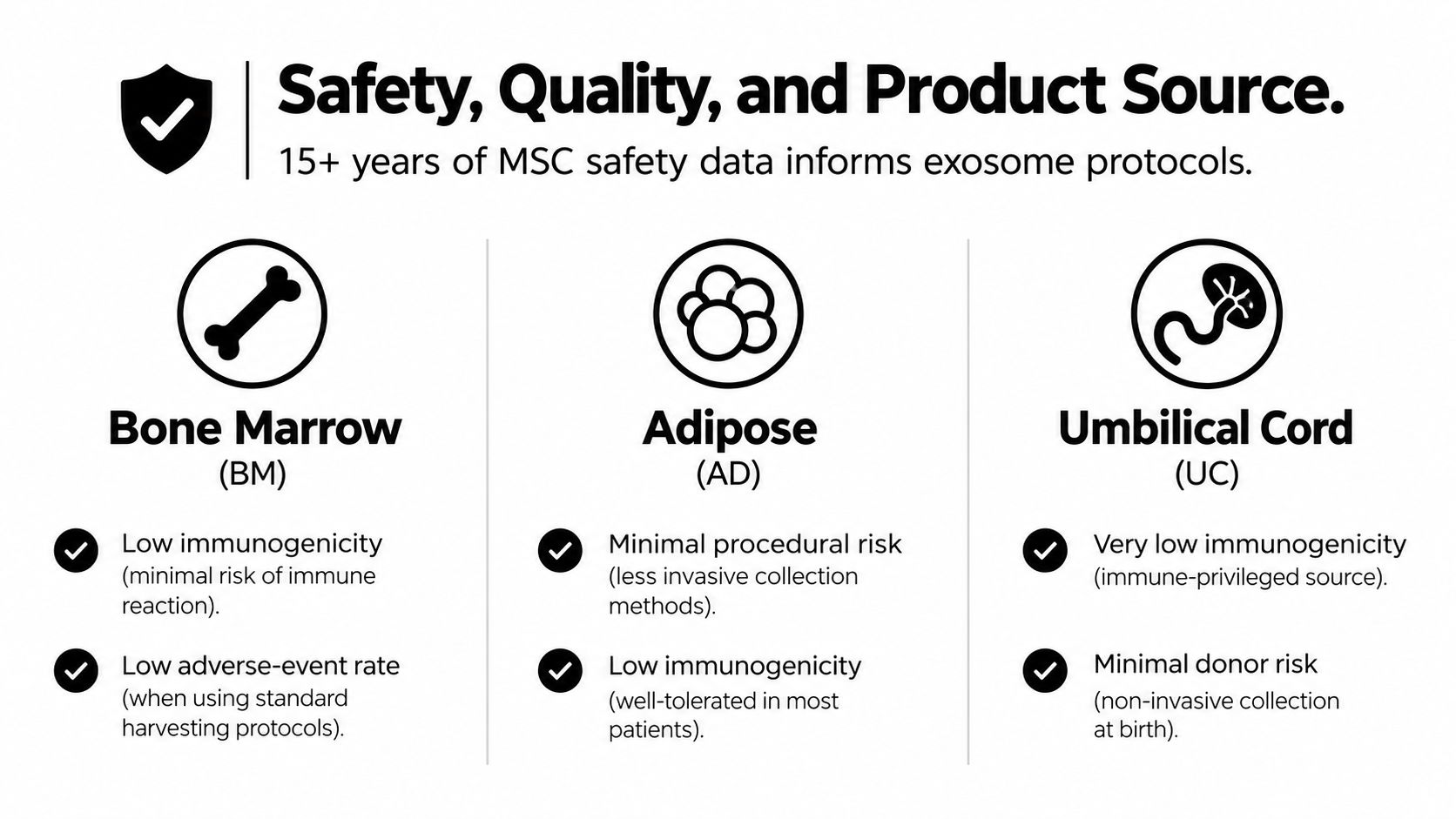
Longevity Medical Institute describes an in-house biotechnology laboratory as part of its product-development and quality-control structure. That arrangement is intended to keep product origin, laboratory documentation, handling, and quality records closer to the clinical decision than an opaque third-party supply chain.
The clinic also describes work with allogeneic sources, including MUSE, placental, Wharton's jelly, adipose, endometrial, and dental pulp cell types. Different sources may have different biological properties, so “stem cells” isn't a sufficient product description. Ask which source is being used, why it was selected, how the final product is tested, and what risks apply to the proposed route.
Your Individualized Evaluation and Next Steps
A thoughtful evaluation starts with the symptom pattern. Is the room spinning, or do you feel faint? Does turning in bed trigger a brief attack? Did hearing change? Did the illness involve ear pain, medication exposure, headache, visual sensitivity, or neurological symptoms? These details help separate BPPV, neuritis, labyrinthitis, migraine, post-viral compensation problems, and non-vestibular causes.
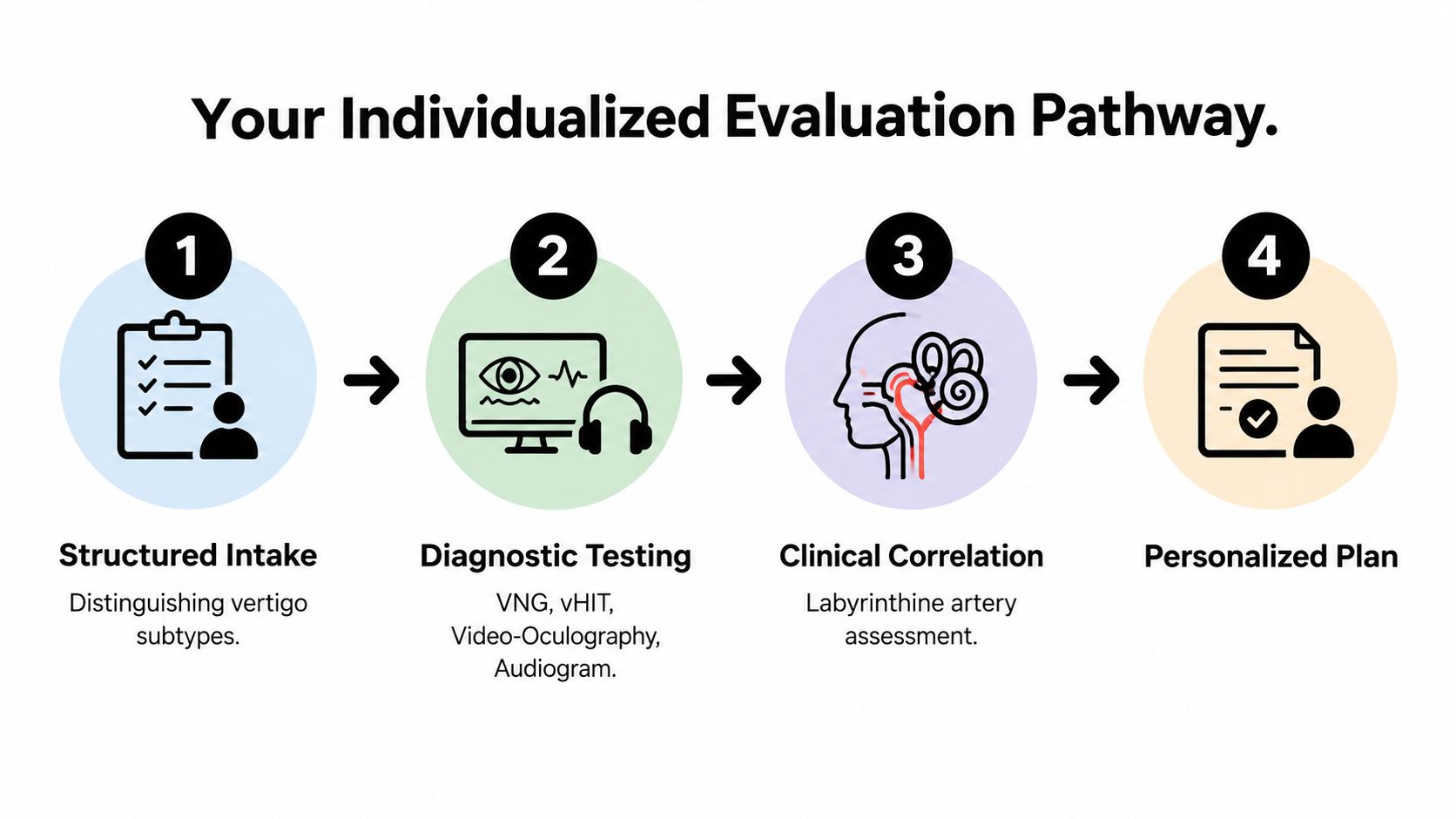
A practical clinical pathway
Structured intake: Document onset, triggers, duration, hearing symptoms, falls, fatigue, migraine features, viral history, medication exposure, and previous treatment.
Hearing and vestibular testing: Depending on the presentation, assessment may include an audiogram, videonystagmography, video-oculography, and video head impulse testing. These tools can reveal patterns that a symptom description alone can't localize.
Clinical correlation: Test results must be interpreted alongside the examination and medical history. A laboratory abnormality or an imaging finding shouldn't be treated as the cause without a coherent clinical connection.
Personalized plan: The plan may emphasize vestibular rehabilitation, repositioning maneuvers, migraine care, medical treatment, VNS, HBOT, or an investigational biologic discussion. Dosing and route shouldn't be formulaic.
Vestibular rehabilitation remains one of the most important tools for persistent imbalance. It retrains the brain to interpret balance signals and encourages natural movement after the acute phase. Guidance for vestibular neuritis describes exercises performed for at least 30 minutes, three times a day, while recovery timelines vary. Some people regain balance within 2 to 6 weeks, while others remain unsteady for months, and dynamic vestibular deficits can persist beyond 1 year in more than 30% of vestibular neuritis patients. Vestibular rehabilitation guidance and recovery timeline information
Follow-up should use measurable outcomes rather than memory alone. Repeat the relevant hearing or vestibular tests at an appropriate interval, track dizziness triggers and walking confidence, and record whether rehabilitation improves daily function. A biologic treatment should only be judged against a defined baseline and a clinically meaningful goal.
Gather prior audiograms, vestibular reports, imaging, medication lists, and a timeline of the illness before a consultation. A free online consultation at Longevity Medical Institute can help determine whether the next step is rehabilitation, further testing, supportive care, or a discussion of an individualized investigational pathway.
Longevity Medical Institute evaluates post-viral dizziness and vestibular dysfunction through physician-led assessment, hearing and balance testing, rehabilitation planning, and carefully selected regenerative or supportive therapies. Visit Longevity Medical Institute to book a free online consultation and discuss your symptoms, previous test results, and realistic next steps.
Author
Dr. Kirk Sanford, DC, Founder & CEO, Longevity Medical Institute. Dr. Sanford focuses on patient education in regenerative and longevity medicine, translating complex therapies into clear, practical guidance for patients.
Medical Review
Dr. Félix Porras, MD, Medical Director, Longevity Medical Institute. Dr. Porras provides clinical oversight and medical review to help ensure accuracy, safety context, and alignment with current standards of care.
Last Reviewed: October 4, 2026
Short Disclaimer
This information is for educational purposes only and isn't medical advice. It doesn't replace an evaluation by a qualified healthcare professional. For personalized guidance, please schedule a consultation.