

Stem Cell Therapy Benefits for Aging: A Longevity Guide
Aging is not just a countdown on a calendar. In human studies, the body's repair signals, inflammatory activity, and physical performance can change in measurable ways, which is why Stem Cell Therapy Benefits for Aging has become a serious topic in longevity medicine rather than a cosmetic promise. The most credible work so far centers on allogeneic mesenchymal stromal cells, or MSCs, because they appear to influence how tissues communicate, repair, and recover.
That matters because the goal of modern longevity care is not to live forever. It's to stay strong, energetic, mentally clear, optimistic, and independent for as many years as possible. MSC therapy is not a replacement for exercise, nutrition, sleep, metabolic health, or established medical care, but it may become one additional layer in a carefully designed longevity program.
Redefining Aging and the Promise of Regenerative Medicine
Aging medicine used to focus on reacting to decline after it appeared. Regenerative medicine asks a better question, which biological processes are driving the decline, and which ones can be measured and influenced? That is why MSCs have drawn attention in longevity care, because they are being studied as part of a broader effort to understand how tissues repair, communicate, and recover.
Aging rarely follows one pattern. One person may notice inflammation and fatigue first, another muscle loss, another joint wear, and another slower thinking or stiffer blood vessels. Age, medical history, muscle mass, cardiovascular health, inflammation, existing disease, and personal goals all shape the plan, so there is no standard longevity patient.
Why personalized evaluation matters
Aging is a set of overlapping biological changes, and they do not show up the same way in every body. A thoughtful longevity plan starts with a real clinical evaluation, because the right intervention depends on what is happening, not on a label alone.
Practical rule: if the biology is different, the plan should be different.
A good regenerative program looks at the whole person, not just the diagnosis. That means asking what can be improved now, what needs safety screening, and what outcome would count as a real win, better walking capacity, less pain, steadier energy, or clearer thinking.
The best frame for Stem Cell Therapy Benefits for Aging is not a fountain of youth. It is one measurable layer in a larger longevity strategy, where MSCs, their signaling effects, and related tools such as exosomes may complement exercise, nutrition, sleep, metabolic care, and careful biomarker tracking.
The Biological Hallmarks of Aging Explained
Aging becomes much easier to understand once you break it into its component parts. Stem-cell exhaustion means the body's reserve of repair cells becomes smaller and less efficient with age. Inflammaging is persistent, low-grade inflammation that can interfere with tissue function and repair, while cellular senescence describes damaged or aging cells that stop dividing but remain in the body and release inflammatory signals that affect neighboring cells.

What happens inside aging tissue
Mitochondrial dysfunction reduces cellular energy production and may contribute to fatigue, metabolic decline, and reduced physical resilience. Epigenetic changes alter how genetic instructions are read and expressed, while extracellular-matrix deterioration affects collagen, elastin, and the structural environment surrounding cells. Altered intercellular communication means signaling among cells, hormones, and the immune system becomes less coordinated.
The picture gets even more complete when you add telomere shortening, accumulated DNA damage, altered nutrient sensing, and declining protein quality control. None of these processes acts alone. They interact, which is exactly why aging can feel so broad, muscle loss, slower recovery, brain fog, poorer circulation, and less repair after stress all tend to travel together.
The encouraging part is that biology is no longer invisible. When researchers can measure these pathways, they have more ways to study how healthy aging might be supported. That doesn't mean every aging mechanism can be reversed, but it does mean aging is more than a vague sense of getting older. It's a set of biological changes that can increasingly be tracked with the right tools.
For readers who want a deeper glossary of these concepts, the Language of Healing resource on the hallmarks of aging is a useful companion.
How Mesenchymal Stem Cells and Exosomes Support Longevity
MSCs are no longer understood mainly as replacement cells that permanently engraft and become new tissue. Their most interesting value appears to come from the signals they release, which influence the cells already in the body. You can think of them as responsive biological pharmacies, because the environment they encounter helps determine which mix of growth factors, cytokines, chemokines, and extracellular vesicles they release.

What those signals can influence
Those MSC signals may influence inflammatory activity, immune regulation, blood-vessel formation, cell survival, fibrosis, tissue repair, and cellular communication. That is an important scientific evolution. The promise is not based on cells traveling through the body and turning into new tissue; it's based largely on how they communicate with and influence the body's own repair systems.
Exosomes are one component of the material naturally released by MSCs. They're closely related to stem-cell biology, but they're not the same thing as a living MSC. An isolated exosome product is not identical to a whole cell therapy, which is why the details of product type, processing, and indication matter so much in regenerative medicine.
For readers comparing options, the distinction between the two is outlined in exosomes vs stem cells. That difference matters because a therapy's mechanism should match the problem being treated.
MSCs work best conceptually when you stop thinking of them as spare parts and start thinking of them as signal coordinators.
That framework also explains why current research is so focused on inflammation and tissue repair. MSCs aren't trying to overwrite the whole aging process. They may help recalibrate parts of it.
Promising Human Research on Stem Cell Therapy Benefits for Aging
The strongest human evidence so far comes from frailty research, because frailty is one of the clearest aging-related indications. In a randomized, double-blinded, dose-finding trial of 30 older adults with a mean age of 75.5 years, intravenous allogeneic MSCs were reported to be safe and were associated with better physical performance and inflammatory biomarkers 2017 frailty trial. A later randomized phase 2b trial in 148 ambulatory adults with frailty found a 63.4-meter improvement in the 6-minute walk test at 9 months versus placebo, with p = 0.0077 phase 2b trial.
What the human data suggests
These are functional outcomes, not abstract lab signals. Walking farther, moving better, and maintaining strength are changes patients can feel in daily life. The same line of research also points to inflammatory biology moving in a healthier direction.
A few patterns matter here.
| Condition | Key Metric | Improvement vs Placebo |
|---|---|---|
| Frailty | 6-minute walk test | 63.4 meters at 9 months phase 2b trial |
| Frailty | Physical performance and inflammatory biomarkers | Improved in a randomized trial of older adults 2017 frailty trial |
| Frailty | Clinical trial development in aging | A later trial report summarized the same functional benchmark Biomed Gerontology trial report |
A separate review of aging-focused stem cell research found 11 registered anti-aging stem cell trials, with MSCs used in 81.8% of them frontiers review. That does not prove benefit by itself, but it shows where clinical attention is concentrated. For readers who want a broader overview, the mesenchymal stem cell research library organizes the evidence without turning it into hype.
Cardiovascular aging is another area of interest. In a randomized, double-blind human trial in 116 patients after a heart attack, MSC recipients had improved myocardial perfusion, viability, and ejection fraction versus placebo, which is why clinicians pay close attention to this line of research Biomed Gerontology trial report.
Cognitive aging is also being studied. In a randomized, double-blind, placebo-controlled trial in mild Alzheimer's disease, IV MSC-treated patients reportedly showed less whole-brain and hippocampal volume decline over 39 weeks, along with reduced neuroinflammation and improvement on one cognitive measure frontiers review. Joint and spine studies are also being explored, especially in the knee and intervertebral disc.
Safety, Quality Control, and Choosing the Right Clinic
Stem cell medicine is only as good as the product, the indication, and the protocol. Reviews of aging-focused therapies repeatedly point to unresolved questions around long-term safety, dosing, manufacturing standards, immune compatibility, and delivery systems safety review. That's why the most honest answer to “Does it work?” is always tied to “For whom, with what product, and under what controls?”
What quality actually means
MSC efficacy depends strongly on cell senescence state. Aging MSCs lose immunomodulatory potency through downregulation of PD-L1, a key suppressive molecule, which means clinically meaningful rejuvenation effects depend on cell quality, donor age, and manufacturing controls cell quality review. Younger or well-characterized allogeneic products are favored in research because they preserve stronger anti-inflammatory signaling and are more likely to improve functional endpoints.
A serious clinic should be able to answer practical questions clearly.
Product source: where the cells come from, how they're screened, and how they're characterized.
Manufacturing standards: whether the lab uses documented quality controls, sterile handling, and traceable release criteria.
Follow-up plan: how outcomes and adverse events are monitored after treatment.
Indication fit: whether the therapy matches the patient's actual problem, not a broad anti-aging pitch.
Patients comparing legitimate clinical programs with off-label or cash-pay rejuvenation offerings should ask about safety, durability, and product quality before anything else. The Stem Cell Clinic test questions are a useful starting point for that conversation.
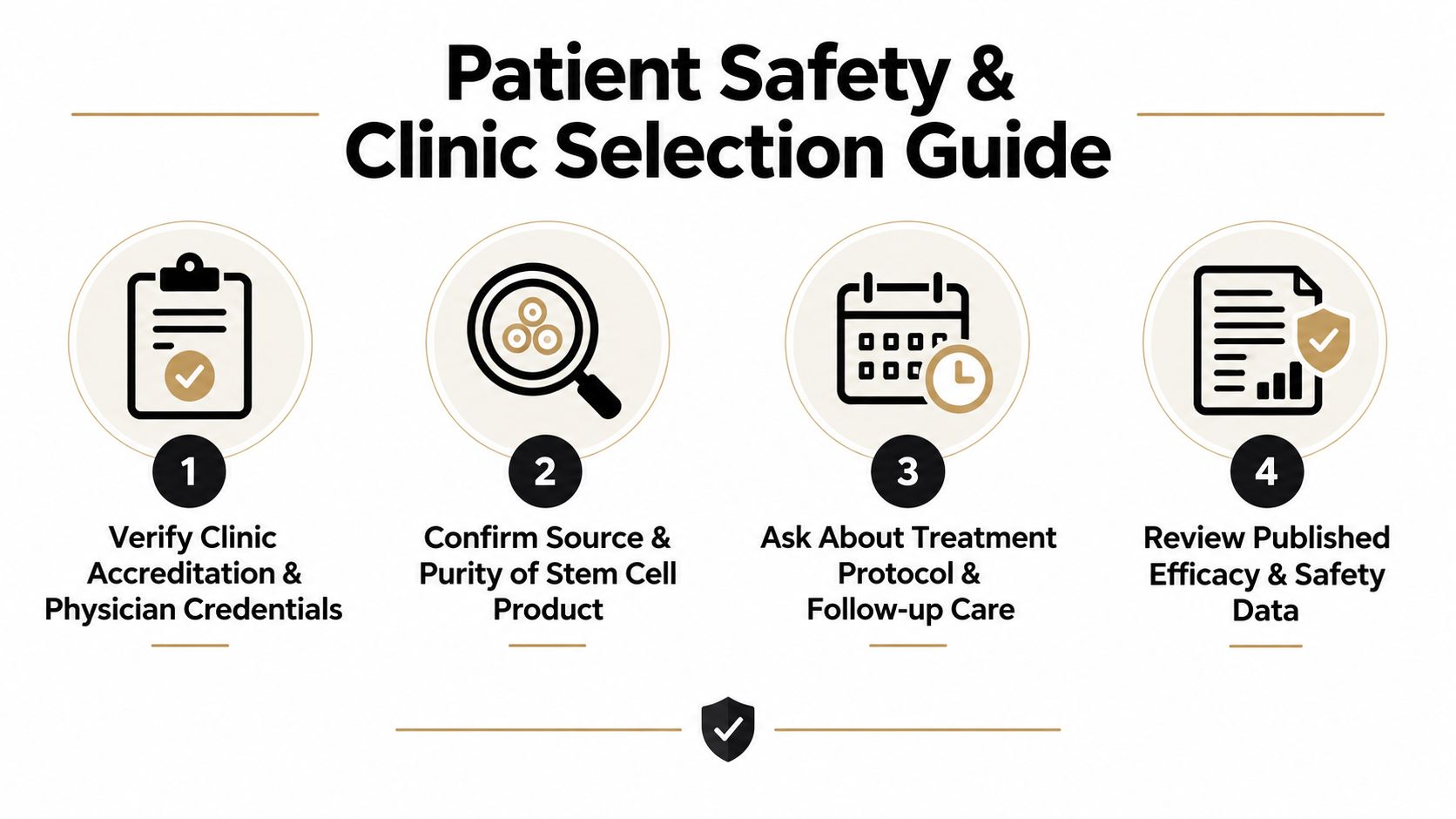
No two people age in exactly the same way, so no clinic should treat them as if they do. The safest regenerative programs are transparent about uncertainty, careful about screening, and disciplined about matching therapy to biology.
Layered Longevity Care and Hyperbaric Oxygen Therapy
Aging care works best as a layered plan. Start with a detailed evaluation, add biomarker tracking, then choose targeted therapies instead of treating one intervention like a cure-all. A broad lab panel and a full-body MRI can show where biology is changing, which gives clinicians a clearer basis for planning regenerative care. Learn more about clinical protocols in our overview of hyperbaric oxygen therapy for longevity.
Why HBOT belongs in the conversation
Hyperbaric oxygen therapy, or HBOT, is drawing interest because researchers are studying its effects on oxygen delivery, circulation, inflammation, progenitor-cell mobilization, and tissue repair HBOT review. In one human study, a single HBOT session approximately doubled circulating stem and progenitor cells, while twenty sessions increased them approximately eightfold.
Another human study in adults over 64 reported increases of more than 20% in telomere length in several immune-cell populations, along with meaningful reductions in some senescent immune-cell populations. These findings matter because they measure objective biological change, not just how a person feels.
A separate human study used saliva and urine biomarkers, including reactive oxygen species, antioxidant capacity, cytokines, lipid peroxidation, DNA damage, and renal status, and it observed reductions in oxidative stress and inflammation after treatment biomarker study. That fits a broader longevity model built around a 140-biomarker clinical lens.
For readers exploring recovery-oriented HBOT strategies, recovery therapy from Longevity Medical Institute offers a helpful external overview of how oxygen-based recovery is discussed in clinical wellness settings.
The point is not that HBOT reverses aging. It can still be useful as a measured layer within a larger program, because it may support pathways tied to recovery, inflammation, and repair, which is the kind of support longevity medicine tries to personalize.
Your Path to Healthspan and Vitality
The most realistic and hopeful view of Stem Cell Therapy Benefits for Aging is this, we can't stop aging, but aging is not just the passage of time. It is a set of biological processes that can increasingly be measured, and in some cases influenced. MSCs are interesting because they may support inflammation control, immune regulation, tissue repair, and communication between cells, especially when they're part of a broader plan that also respects sleep, nutrition, movement, and metabolic health.
The right question isn't whether one therapy promises eternal youth. The right question is whether a patient's function, resilience, and independence can be supported intelligently and safely. For readers who want a practical supplement perspective alongside regenerative care, Revive Supplements is a useful reference point for thinking about supportive ingredients without losing sight of the bigger clinical picture.
If you're considering a personalized longevity plan, Longevity Medical Institute can evaluate your biomarkers, imaging, and treatment options in one coordinated setting, then help match the right regenerative tools to your goals. Visit Longevity Medical Institute to schedule a consultation and learn whether a stem cell-based longevity strategy makes sense for you.
Author
Dr. Kirk Sanford, DC, Founder & CEO, Longevity Medical Institute. Dr. Sanford focuses on patient education in regenerative and longevity medicine, translating complex therapies into clear, practical guidance for patients.
Medical Review
Dr. Félix Porras, MD, Medical Director, Longevity Medical Institute. Dr. Porras provides clinical oversight and medical review to help ensure accuracy, safety context, and alignment with current standards of care.
Last Reviewed: September 8, 2026
Short Disclaimer
This information is for educational purposes only and is not medical advice. It does not replace an evaluation by a qualified healthcare professional. For personalized guidance, please schedule a consultation.