

Stem Cell Therapy Cost in Mexico: 2026 Price Index
Stem cell therapy in Mexico in 2026 generally costs about $2,500 to $30,000 or more, depending on protocol complexity, cell count, cell source, processing, facility standards, and physician involvement. Lower-cost orthopedic programs sit near the entry end, while hospital-based, neurological, systemic, and intrathecal programs occupy the higher end.
You may be comparing a short quote from a clinic in Tijuana, Cancún, or Monterrey with a much larger estimate from a United States provider. The numbers can look simple until you ask what the quote includes, how the cells were prepared, who administers them, and what follow-up is provided. A price index is useful only when it separates those variables.
This guide is designed as a budgeting and due-diligence tool, not as a promise of treatment efficacy. For a clinic-specific estimate, review the current stem cell therapy pricing and request an itemized proposal based on your diagnosis and medical records.
What Stem Cell Therapy in Mexico Actually Costs in 2026
A patient with osteoarthritis may receive quotes that appear to describe the same treatment, yet differ substantially. One clinic may quote a focused joint injection, another may include intravenous support, advanced imaging, additional joints, laboratory testing, and several days of physician-supervised care. Comparing the totals without comparing the clinical work behind them is a reliable way to choose the wrong option.
The defensible 2026 Mexico price band is roughly $2,500 to $30,000 or more. Published market guides place focused orthopedic or lower-dose programs at approximately $2,500 to $7,500, programs involving one or more orthopedic areas with IV support at $5,000 to $15,000, and hospital-based or intrathecal procedures at $15,000 to $30,000 or more. These ranges are reported in the 2026 Mexico stem cell treatment pricing snapshot and BioInformant's The Cost Of Stem Cell Therapy in 2026.
The five variables behind the spread
Cell count affects laboratory workload and the amount administered, but it isn't a complete measure of value. Cell source influences collection, screening, processing, compatibility considerations, and the clinical rationale for use. Processing includes isolation, expansion or concentration, testing, storage, and preparation for administration.
Facility standards also affect the quote. A clinic with an on-site laboratory, advanced imaging, procedural staff, operating-room capability, and structured monitoring carries different costs from a facility that purchases a vial and administers it during a brief appointment. Finally, physician involvement matters. A physician-led diagnostic review, image-guided procedure, anesthesia support, and follow-up plan require more clinical resources than a standardized package.
Mexico often costs less than the United States or Canada because labor, real estate, operating overhead, and certain sourcing models can be less expensive. That price difference doesn't establish equivalent quality. A lower quote can represent efficient care, a narrower protocol, fewer included services, or weaker documentation. You need to identify which one.
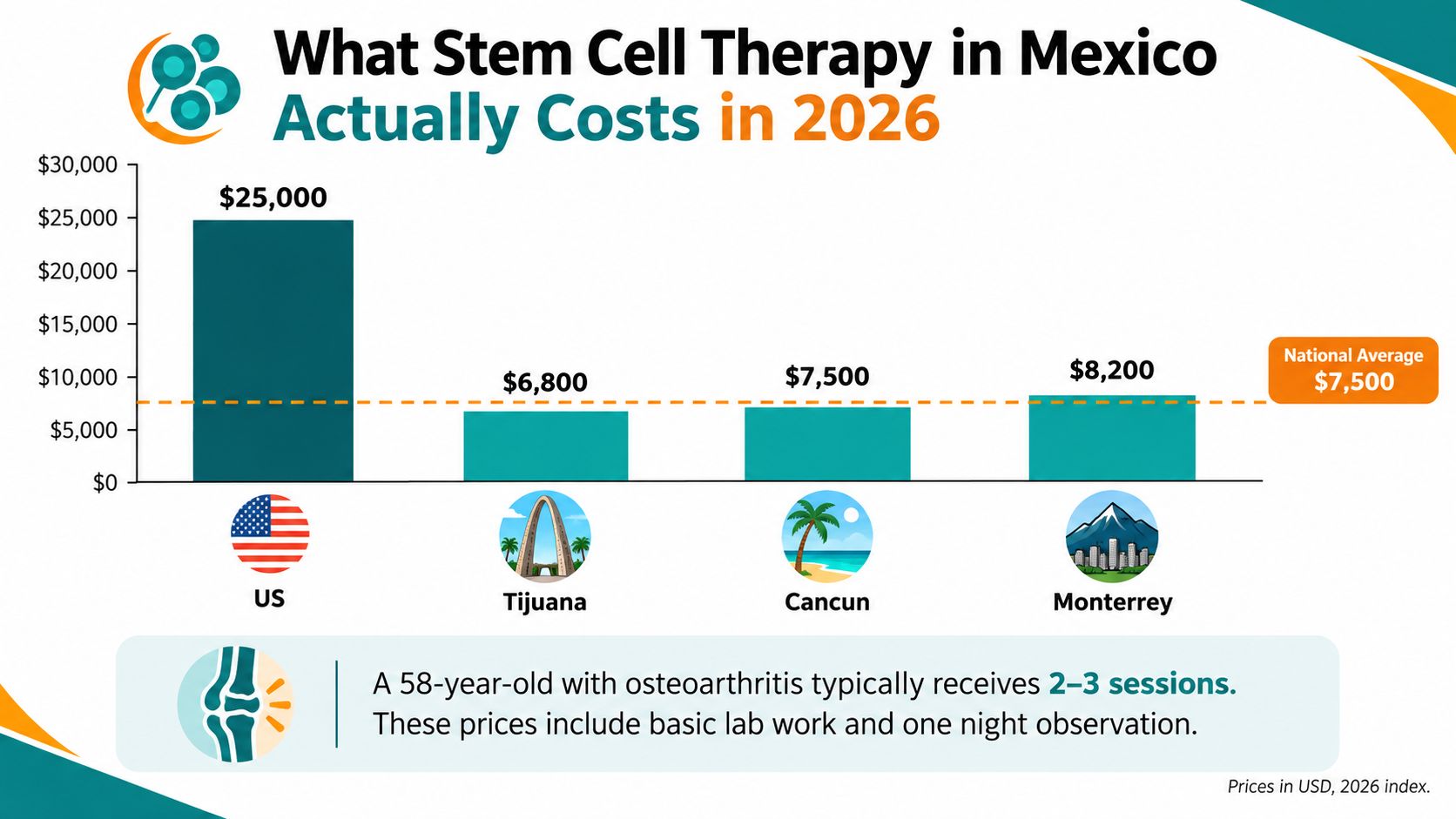
The broader market snapshot cited above lists many current Mexico options between approximately $3,000 and $10,000, with some independent guides placing the average around $7,500. Those figures are useful orientation points, but they aren't a universal national price. Your appropriate budget depends on the treatment route, indication, testing, and level of medical supervision.
For an additional comparison of treatment economics, see this Mexico versus United States stem cell therapy cost comparison. Treat this article as a framework for asking better questions, not as a substitute for a written clinical plan.
A 2026 Price Index by Protocol Type
The most practical way to read a quote is to classify it by clinical complexity, not by the advertised number of cells. A focused injection performed with limited testing belongs in a different category from a neurological or systemic protocol requiring extensive assessment, multiple delivery routes, observation, and follow-up.
The table below combines published Mexico pricing bands with clearly identified market estimates. The upper ranges for specific protocol categories are planning estimates, not universal public tariffs. A clinic should explain any quote that falls well outside the relevant band.
| Protocol Type | 2026 Low (USD) | 2026 High (USD) | Primary Cost Driver |
|---|---|---|---|
| IV stem cell therapy | $4,500 | $9,000 | Cell dose, infusion monitoring, laboratory preparation |
| Single joint injection | $5,500 | $12,500 | Image guidance, joint complexity, physician expertise |
| Multiple joint injections | $8,000 | $15,000 | Number of sites, imaging, dose, procedural time |
| Spine procedure | $8,500 | $18,000 | Image guidance, anatomy, sedation or operating-room support |
| Neurological protocol | $12,000 | $25,000 | Diagnostic review, delivery route, monitoring, physician involvement |
| Autoimmune protocol | $10,000 | $22,000 | Systemic assessment, supportive care, repeat dosing |
| Longevity or intensive program | $15,000 | $30,000+ | Broad diagnostics, multiple therapies, extended supervision |
| Exosome-only therapy | $2,500 | $6,500 | Product source, dose, testing, administration route |
| Combined stem cell and exosome protocol | $18,000 | $35,000+ | Combined products, dosing, testing, monitoring, follow-up |
A basic quote normally includes a consultation, review of existing records, the cellular product, administration, and immediate observation. The higher end may reflect a larger dose, additional laboratory work, repeat treatment, more than one delivery route, advanced imaging, or a longer stay. Those additions must appear in writing.
Published package pricing illustrates why dose matters but also why dose cannot stand alone. One Mexico clinic guide lists $3,999 for 25 million cells and $18,499 for 250 million cells, while another cites $9,499 for 100 million cells and $15,499 for 200 million cells. These figures shouldn't be treated as directly comparable until source, viability, testing, and administration are known.
A separate 2026 guide lists $4,950 for 25 million cells, $6,950 for 50 million, $8,950 for 75 million, $10,500 for 100 million, and $13,550 for 150 million. It also states that its 50-million-cell package includes 25 billion exosomes plus PRP and a multivitamin IV drip.
For a broader discussion of international price positioning, read the stem cell therapy cost comparison with global markets. The correct question isn't “How much per million cells?” It's “What medically appropriate service is being delivered, with what documentation and oversight?”
Why Cell Count and Price Alone Mislead Patients
A cell count tells you how many cells a clinic says it will administer. It doesn't tell you how many are viable, what they are, how they were processed, or whether the dose is appropriate for the intended route.
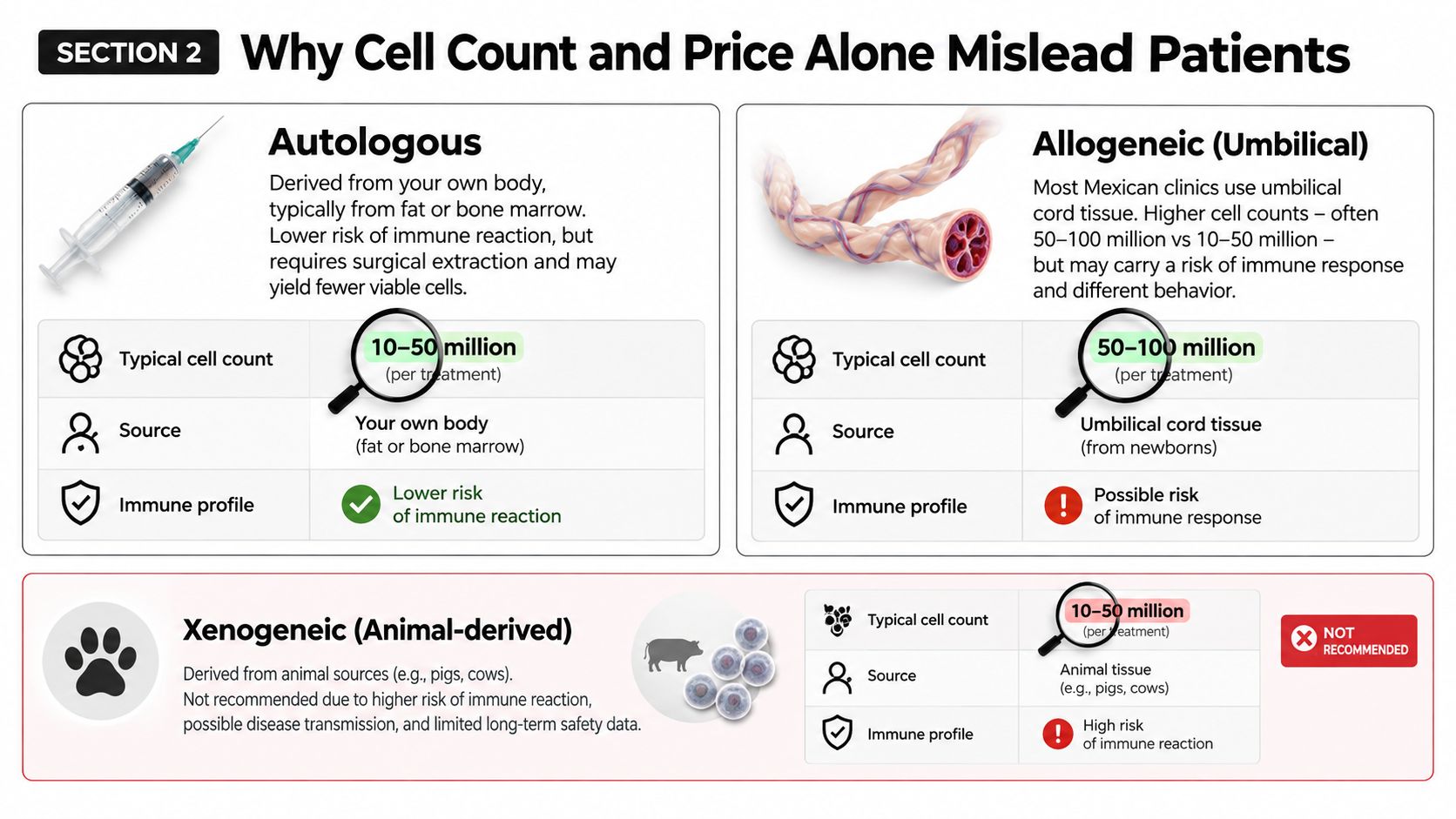
Start with cell source. Allogeneic cells come from a donor, while autologous products come from the patient. Xenogeneic products come from animals and raise a separate set of compatibility and safety questions. The source affects screening, processing, immune considerations, and the clinical evidence relevant to the proposed use.
Passage number matters for cultured cells. A quote should identify whether cells are fresh, concentrated, cryopreserved, or expanded, and should state the passage number when expansion is used. The phrase “stem cells” is too broad to support a meaningful comparison by itself.
The delivered dose is not the label dose
Viability changes the practical meaning of a dose. A vial labeled as containing 100 million cells at 65% viability would contain fewer viable cells at administration than a dose labeled as 50 million cells at 95% viability. The arithmetic is simple, but the clinical interpretation still requires information about cell identity, potency, preparation, and route.
Ask whether the clinic reports viable cell count at administration, not only the nominal count before shipment or thawing. Also ask whether the Certificate of Analysis is specific to your batch and whether it includes identity, sterility, viability, and any relevant marker or potency testing.
A Certificate of Analysis from a Flow Cytometer should be part of the comparison process, not something you request after paying a deposit. It should identify the product, source, testing performed, release criteria, and the laboratory responsible for the results. If a clinic won't provide meaningful documentation, the price is impossible to evaluate responsibly.
Other variables include whether testing occurs before shipment or after thawing, whether the product is pooled or donor-specific, whether the laboratory follows documented quality systems, and whether the physician has chosen the route based on imaging and diagnosis. A lower price may reflect a simpler product, but it may also reflect less information.
Practical rule: Never compare two cell counts until you know whether both figures describe viable cells at administration.
The quoted dose also shouldn't be confused with a proven effective dose. More cells aren't automatically better, and a larger package isn't automatically more appropriate. A physician should explain why the proposed source, dose, route, and schedule fit your diagnosis and risk profile.
Fresh Cells Versus Shipped and Thawed Cells
Fresh and shipped products represent different operating models. Fresh, lab-prepared cells may be processed close to the time of administration, tested within the clinic's workflow, and released under direct physician and laboratory coordination. Shipped and thawed products are prepared remotely, transported under controlled conditions, stored, and reconstituted before use.
Neither label resolves the quality question by itself. The important issue is whether the clinic can document what happened to the product from processing through administration.
| Variable | Fresh Lab-Prepared Cells | Shipped and Thawed Cells |
|---|---|---|
| Dosing | Can be adjusted closer to administration | Often determined before shipment |
| Scheduling | May allow greater coordination with clinical findings | Requires advance logistics and product availability |
| Quality review | May allow current release testing within the facility | Depends on pre-shipment records and post-thaw verification |
| Viability | Should be documented at administration | Should include post-thaw viability, not only pre-freeze results |
| Cost structure | Includes laboratory personnel, facility systems, and preparation | May reduce local processing requirements |
| Follow-up | Can be coordinated with on-site clinical findings | Requires careful planning if the patient develops questions after treatment |
Fresh preparation can involve additional laboratory time, cleanroom controls, individualized dosing, and close coordination between the treating physician and laboratory. Shipped products may offer logistical convenience or a defined package, but the patient should ask how the clinic verifies viability after thawing and whether the dose is adjusted if the released product differs from the planned amount. Read Why In-House Biotechnology and Fresh Stem Cells Matter.
The route matters too. An IV infusion, a joint injection, and a spine procedure don't place the same demands on staff, imaging, monitoring, or procedural space. A low-cost product can still result in a high total bill if the administration requires additional imaging, sedation, or hospital-level support.
For a patient-facing discussion of preparation and verification, review fresh, verified stem cell protocols. Use the following questions when comparing similar advertised counts:
Was the count measured before freezing, after thawing, or immediately before administration?
Is the product prepared on-site or shipped from another facility?
Does the Certificate of Analysis apply to the actual batch?
What happens if post-thaw viability or sterility testing doesn't meet release criteria?
Are the physician, imaging, monitoring, and follow-up fees included?
A quote that answers these questions clearly is more valuable than one that displays a large cell number.
Hidden Costs Most Price Comparisons Leave Out
A clinic's advertised treatment price is usually the clinical starting point, not the trip total. Patients may still pay for medical clearance, imaging, travel, lodging, medication, companion support, and follow-up. Build an out-the-door estimate that lists every required and reasonably foreseeable expense before booking.
Build the budget before booking travel
Ask for a written quote divided into required, optional, and contingency costs. Require the clinic to address:
Medical clearance: Bloodwork, infectious-disease screening, ECG or EKG, medication review, and specialist records may be billed separately.
Imaging: MRI, X-ray, ultrasound, or other diagnostic studies may cost extra if the quote assumes you arrive with current records.
Procedure support: Ultrasound or fluoroscopic guidance, IV access, sedation, anesthesia, operating-room use, and additional injection sites may sit outside the headline price.
Adjunctive therapies: PRP, exosomes, IV nutrients, peptides, medications, and rehabilitation services should have separate prices when they are not included.
Travel logistics: Flights, airport transfers, hotel nights, caregiver accommodation, meals, and extended recovery stays all affect the budget.
Follow-up: Telemedicine visits, repeat imaging, second infusions, physical therapy, and treatment for an unexpected issue may occur after the initial appointment.
The final amount depends on where you travel, how long your care requires, and what your home physician recommends. Do not treat a clinic-created travel budget as a medical guarantee. Do not assume a package includes services merely because a coordinator calls it all-inclusive.
A low headline price is not a low total price when diagnostics, guidance, adjuncts, and follow-up are billed separately.
Treat discounts tied to immediate deposits as a reason to slow down. Before committing travel funds, obtain enough information to review the product, administration route, risks, alternatives, and complete cost.
What COFEPRIS Licensing Really Means
COFEPRIS is Mexico's federal health authority. It regulates healthcare facilities and activities, but it isn't the Mexican equivalent of FDA treatment approval. A facility license, a laboratory authorization, and evidence for a particular clinical indication are separate matters.
A clinic may have permission to operate as a healthcare facility. Its laboratory may have authorization to handle or process biological materials. Neither fact, by itself, demonstrates that a stem cell intervention is approved, effective, or appropriate for your condition.
What patients should verify
Ask for documentation rather than accepting broad phrases such as “COFEPRIS approved” or “FDA approved in Mexico.” The latter isn't a meaningful Mexican regulatory category.
Facility status: Request the facility's legal name, address, license information, and scope of permitted activities.
Laboratory documentation: Ask where processing occurs, who operates the laboratory, and what quality system and testing records apply.
Product records: Request the Certificate of Analysis, source information, sterility results, viability results, and release criteria.
Clinical basis: Ask whether the proposed use is standard care, an investigational protocol, or a clinic-developed intervention.
Physician credentials: Confirm the name, specialty, license, and responsibility of the physician who evaluates and treats you.
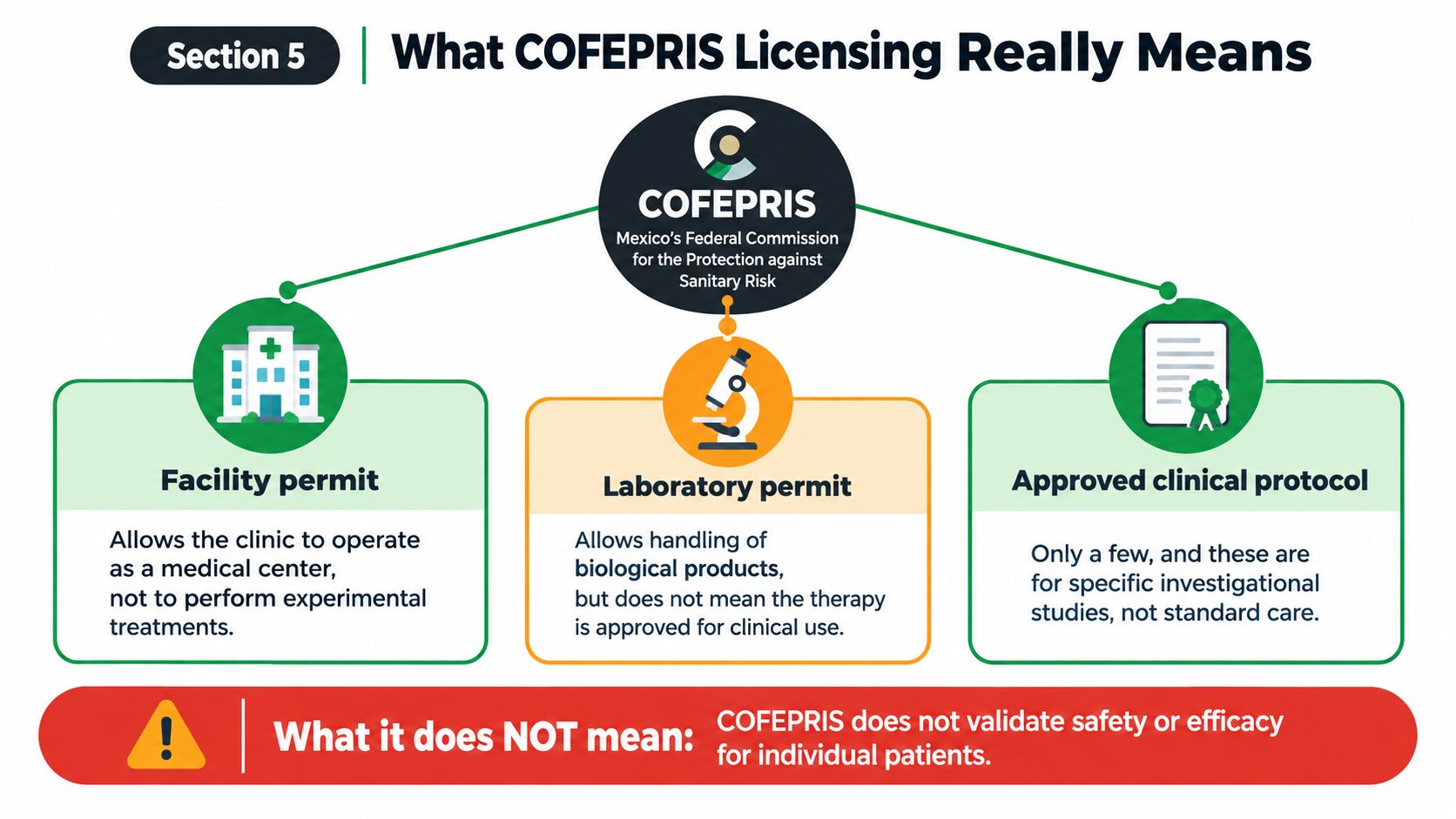
COFEPRIS-related documentation can help you assess whether a clinic operates within a recognized healthcare framework. It doesn't validate efficacy for an individual patient and doesn't replace peer-reviewed human evidence, informed consent, or a clear adverse-event plan. A credible quote should state exactly what is licensed and avoid turning facility oversight into a treatment-approval claim.
For information about laboratory infrastructure, see the Longevity Medical Institute biotechnology stem cell laboratory. Evaluate the documents, not the reassuring language around them.
The Longevity Medical Institute Standard for 2026
Some clinics compete primarily through a package price. A higher-standard model starts with infrastructure and patient selection, then builds the quote around the diagnosis. That approach costs more to operate, but it gives the patient more information about what they're purchasing.
Longevity Medical Institute is a 15,000-square-foot medical campus in San José del Cabo with specialist physicians, an on-site biotechnology laboratory, a clinical laboratory, advanced imaging, and a hospital-grade operating room. The campus operates under five federal COFEPRIS licenses, which should be understood as facility and activity oversight, not as proof that every regenerative treatment has been approved for every indication.
What individualized pricing changes
The institute can prepare cells fresh for administration, uses passage four or earlier, and targets viability above 98%. Those specifications are operational standards described by the institute, and patients should still request batch-specific documentation for their own treatment.
The clinical plan is individualized by diagnosis, cell source, dose, delivery method, and physician involvement. That differs from selling the same package to every patient based only on a per-million-cell price. A physician may recommend a joint injection, IV administration, exosome support, or no cellular treatment after reviewing the patient's records. The appropriate choice depends on the clinical assessment, not on the largest available package.
The campus model also brings diagnostics and treatment planning into one environment. Advanced imaging can support precise procedures, while the clinical laboratory can inform medical clearance and monitoring. Follow-up should be defined before treatment, including the responsible physician, timing, warning signs, and communication process.
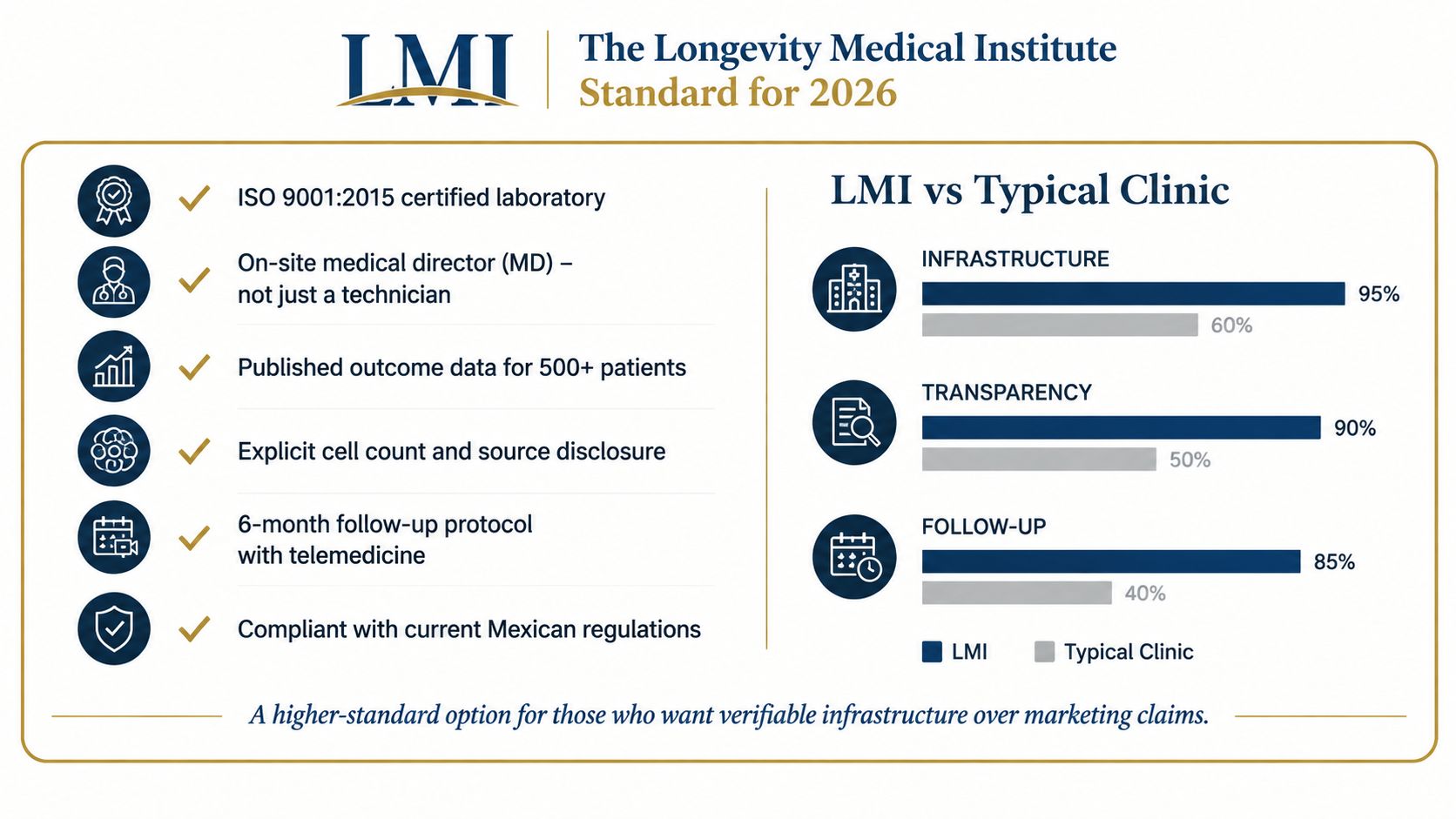
The institute's broader regenerative menu includes orthopedic services, exosome protocols, NK cell programs, and longevity-focused packages. Those offerings should be viewed as components of a clinical decision framework, not as automatic additions to a stem cell quote.
My recommendation is straightforward. If two quotes are close in price, choose the one that names the treating physician, documents the product, explains the dose, includes the administration details, and defines follow-up. Infrastructure and transparency are more useful measures of value than a promotional cell-count headline.
Questions to Ask Any Clinic and Smart Next Steps
Before paying a deposit, ask for an itemized proposal and written answers to the following questions:
Physician responsibility: Who will evaluate me, administer the treatment, manage complications, and conduct follow-up?
Cell source: Are the cells allogeneic, autologous, or another type, and why is that source appropriate for my case?
Processing: Where are the cells processed, and are they fresh, cryopreserved, shipped, or thawed on-site?
Passage and identity: What is the passage number, cell identity, and release standard?
Viability: Is the count reported before freezing or at administration, and can I review batch-specific viability results?
Testing: Does the Certificate of Analysis include sterility, identity, viability, and relevant quality testing?
Delivery route: Will administration be intravenous, intra-articular, image-guided, intrathecal, or another route?
Clinical rationale: What evidence supports the proposed use for my diagnosis, and what alternatives should I consider?
Total cost: Are consultation, laboratory work, imaging, guidance, medications, PRP, exosomes, lodging, transfers, and follow-up included?
Safety planning: What adverse events can occur, who manages them, and where would emergency care take place?
Follow-up: How will the clinic monitor me after I return home, and what records will be provided to my local physician?
Red flags include aggressive discounts, pressure to deposit immediately, an unnamed treating physician, vague claims about “FDA approval,” missing batch documentation, no third-party verification, and promises to cure a neurological disease, autoimmune condition, or aging. A clinic that can't explain its exclusions clearly shouldn't receive your travel budget.
Use this 15-question stem cell clinic evaluation checklist while reviewing proposals. Send the clinic your relevant records, imaging, medication list, diagnosis, and treatment goals. Then request a case review and a written plan that states the proposed source, dose, route, physician, testing, follow-up, and total price.
The information in this article is for educational purposes only and isn't medical advice. It doesn't replace an evaluation by a qualified healthcare professional. For personalized guidance, schedule a consultation.
Author
Dr. Kirk Sanford, DC, Founder and CEO, Longevity Medical Institute. Dr. Sanford focuses on patient education in regenerative and longevity medicine, translating complex therapies into clear, practical guidance for patients.
Medical Review
Dr. Félix Porras, MD, Medical Director, Longevity Medical Institute. Dr. Porras provides clinical oversight and medical review to help ensure accuracy, safety context, and alignment with current standards of care.
Last Reviewed: September 9, 2026
Longevity Medical Institute provides physician-led regenerative care, on-site biotechnology and clinical laboratory services, advanced imaging, and individualized treatment planning in San José del Cabo. Review the Longevity Medical Institute resources and current pricing, then request an itemized, personalized treatment proposal before arranging travel.