

Stem Cell Therapy for IgA Nephropathy: What to Expect
Receiving an IgA nephropathy diagnosis can leave you focused on every urine test, creatinine result, and change in blood pressure. You may also be wondering whether newer regenerative treatments can protect your kidneys, rather than only manage the disease after damage has occurred. Stem cell and exosome therapy for IgA nephropathy is an emerging area of research, offering a reason for hope while still requiring careful medical judgment.
The most important distinction is this: early studies suggest biological activity and short-term tolerability, but they haven't yet proven long-term preservation of kidney function. A thoughtful plan combines nephrology care, individualized assessment, transparent safety information, and measurable follow-up.
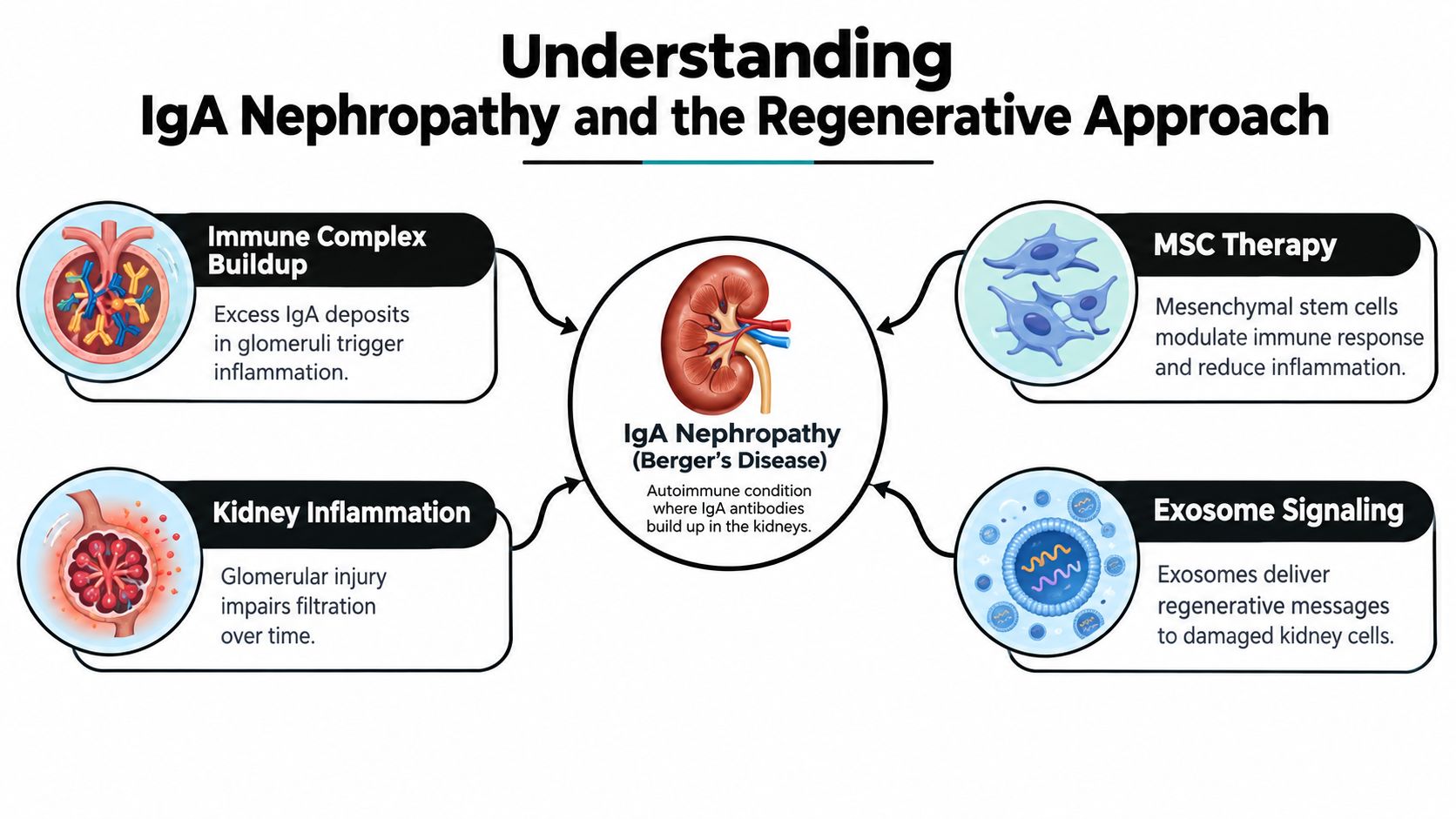
Understanding IgA Nephropathy and the Regenerative Approach
IgA nephropathy, also called Berger's disease, affects the filtering structures inside the kidneys. The immune system produces IgA-containing material that can collect in the glomeruli, the tiny filters that remove waste while retaining important proteins. These deposits may trigger inflammation, protein leakage into the urine, and progressive injury.
The condition can behave differently from one person to another. Some people have relatively stable kidney function, while others develop persistent proteinuria, rising creatinine, high blood pressure, or evidence of continuing damage. That's why early assessment matters. A nephrologist looks at laboratory trends, blood pressure, biopsy findings, symptoms, and the wider medical history instead of relying on one result.
From immune injury to tissue support
Traditional care aims to reduce kidney stress and control the processes that drive progression. Regenerative medicine asks a complementary question: can carefully selected biological signals help create a calmer environment around injured kidney tissue?
Mesenchymal stromal cells, or MSCs, are being studied mainly for their immune-regulating and tissue-supporting effects, not because they replace an entire damaged kidney. Proposed actions include moderating abnormal B-cell and T-cell activity, influencing signaling linked to galactose-deficient IgA1, and reducing signals associated with mesangial-cell proliferation, podocyte injury, and fibrosis (review of MSC research in IgA nephropathy).
Patients managing complex kidney care may also benefit from better clinical documentation between visits. For broader context on immune-focused cell approaches, see MSC therapy for autoimmune disease.
Practical rule: A regenerative approach should support, not replace, nephrologist-directed treatment and long-term kidney monitoring.
How Stem Cells and Exosomes Support Kidney Health
MSCs and exosomes don't function like replacement parts that become new kidney filters. Their potential value lies largely in cellular communication. After administration, MSCs and exosomes can release paracrine signals, meaning molecules that influence nearby or distant cells without requiring them to permanently become kidney tissue.
A simple analogy is a coordination team arriving at a noisy worksite. The team may not rebuild every structure directly, but it can send signals that reduce unnecessary activity, coordinate repair responses, and support a safer environment. In IgA nephropathy, this concept is relevant because immune-complex inflammation can affect several kidney cell types at once.
MSC signaling
Proposed MSC mechanisms include:
Immune modulation: MSCs may help reduce excessive B-cell and T-cell activity involved in abnormal immune signaling.
Mucosal signaling support: Researchers are examining whether MSC-related signals can influence pathways associated with galactose-deficient IgA1 production.
Paracrine communication: Secreted factors may affect mesangial cells, podocytes, immune cells, and other structures involved in glomerular injury.
Tissue protection: Laboratory and preclinical work is exploring effects on inflammatory signaling, oxidative stress, and fibrosis-related processes.
These mechanisms are scientifically plausible, but a plausible mechanism isn't the same as a demonstrated clinical outcome for every patient. MSC treatment should be viewed as an emerging and investigational option, not a proven way to remove immune deposits or reverse established scarring.
What exosomes add to the discussion
Exosomes are small membrane-bound packages released by stem cells. They can carry proteins, lipids, and genetic messages that influence how recipient cells behave. In regenerative research, cell-derived exosomes are being explored as a way to deliver biological signals without administering whole cells.
That difference matters. Exosomes aren't interchangeable with MSCs, and evidence for one doesn't automatically prove evidence for the other. Product source, preparation, dose, route, storage, and quality testing can all affect how a therapy behaves. A patient-friendly overview of these approaches is available in stem cell and exosome therapy resources.
Current Research and Clinical Evidence
The clearest human benchmark comes from a 2024 Japanese phase I ADR-001 study involving adults with treatment-resistant IgA nephropathy. Participants received a single intravenous dose of 1×10^8 allogeneic adipose-derived MSCs, with cohorts of three to six patients (Japanese phase I study).
Nine treated participants met the study's primary safety endpoints, and investigators observed no severe adverse clinical events. They also reported immediate reductions in urinary protein and kidney-injury markers, which supports short-term biological activity. However, the study was small, open-label, and noncomparative.
Surrogate markers versus meaningful kidney outcomes
Proteinuria and injury markers can be useful because they show how the kidney is behaving at a particular time. But a short-term reduction doesn't automatically prove that the treatment has changed the long-term course of IgA nephropathy.
Patients should ask whether follow-up will assess:
Sustained urine protein reduction, not only one early result.
Serial creatinine and eGFR trends, including the direction of change over time.
Blood pressure control and medication requirements.
Adverse events, infections, and other safety concerns.
The effect of ongoing conventional treatment, which can influence laboratory results.
A 2022 umbilical cord MSC case report described improved creatinine in a patient with IgA nephropathy. That report is interesting, but recovery from acute kidney injury and prior treatment could also have contributed, so one case can't establish that MSCs caused all the improvement.
The 2026 study of umbilical cord MSC-derived exosomes involved an IgA nephropathy. Researchers reported improvements in kidney injury measures and inflammatory markers, but these are preclinical findings, not human treatment results. Animal studies can help identify mechanisms and guide future trials, while larger controlled human studies are needed to clarify who may benefit and whether laboratory changes translate into lasting kidney protection. Readers can explore the broader field through mesenchymal stem cell research.
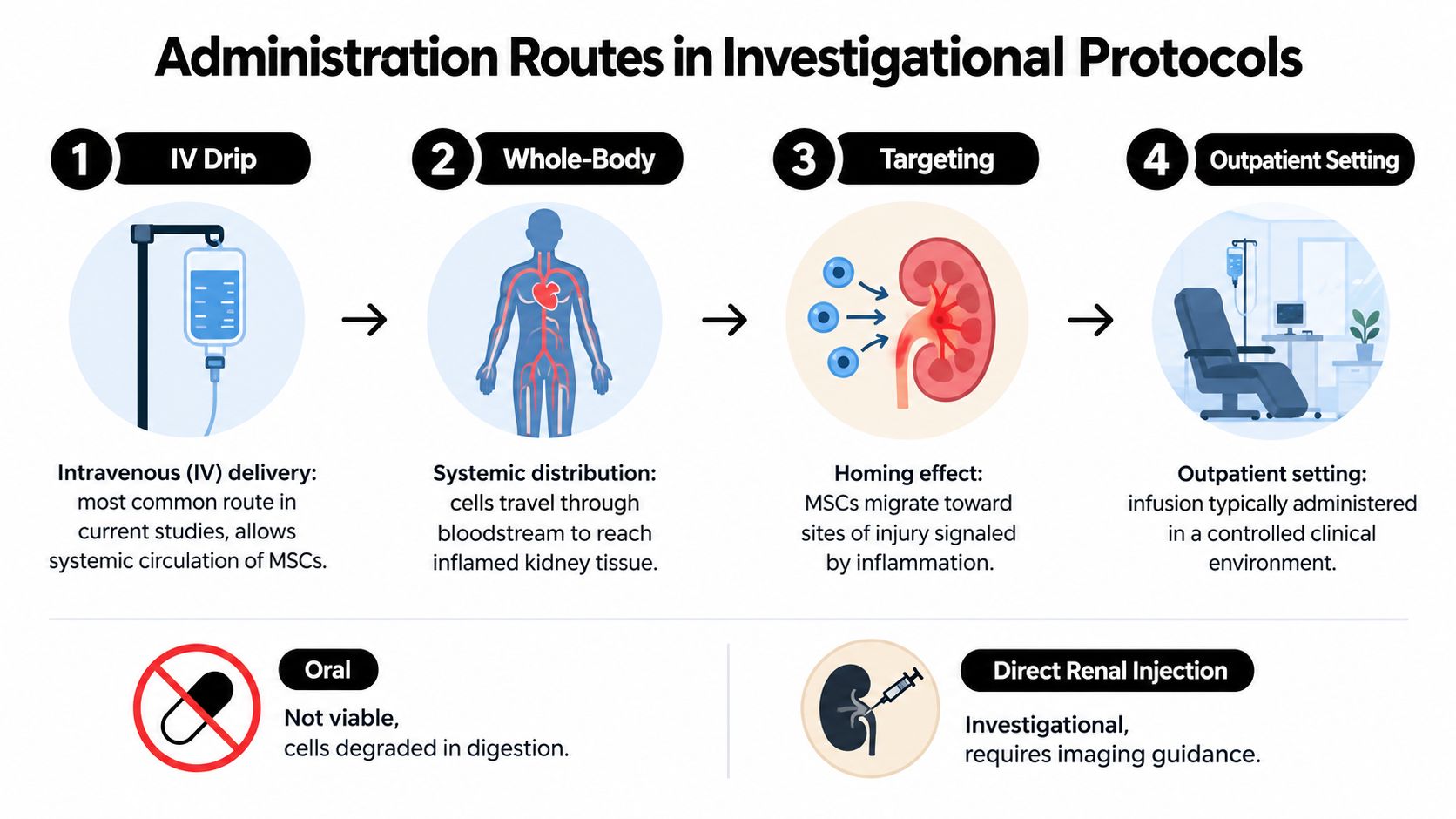
Administration Routes in Investigational Protocols
The route of administration is part of the treatment design, not a minor technical detail. It affects where cells or exosomes travel, how clinicians monitor the patient, and which risks must be considered.
Intravenous delivery has the most concrete preliminary human evidence in IgA nephropathy. An IV infusion places the product into systemic circulation, allowing biological signals to reach the kidneys through the bloodstream. It's generally performed in a controlled clinical environment with observation before and after administration.
Proposed local approaches
Some investigators, like Longevity Medical Institute, have considered targeted kidney infiltration with stem cells or exosomes to deliver signals closer to injured tissue. This remains a proposed investigational approach for IgA nephropathy, along with IV delivery.
Two procedures must be distinguished clearly:
Direct kidney tissue injection: A needle delivers a product into kidney tissue, generally requiring image guidance and careful attention to anatomy.
Renal artery infusion: A catheter delivers a product through the blood vessel supplying the kidney. This is a different procedure with its own vascular risks.
Neither approach should be presented as proven kidney therapy. Potential concerns include bleeding, infection, vascular complications, and tissue injury. A specialist would need to assess biopsy findings, anatomy, bleeding risk, kidney function, medications, and the clinical setting before considering such a protocol.
Route selection should follow the condition, target tissue, available human evidence, and route-specific safety considerations. A plain-language overview of how different treatments may be administered appears in how stem cell therapy is given.
Evaluating Treatment Options and Patient Selection
Regenerative treatment shouldn't be the first question. The first question is whether the patient's current kidney care is complete, appropriate, and actively protecting remaining function.
Established options can include kidney-protective blood pressure medications, SGLT2 inhibitors, and disease-directed therapies such as targeted-release budesonide or sparsentan when appropriate. The right choice depends on biopsy risk category, proteinuria, blood pressure, eGFR, other conditions, medication tolerance, and the nephrologist's assessment.
What an individualized evaluation examines
A careful review may include:
Creatinine and eGFR: These help describe filtering performance and reveal trends over time.
Urine protein: Persistent protein leakage can indicate continuing damage to the kidney's filtration barrier.
Blood pressure: Poorly controlled pressure adds stress to already vulnerable glomeruli.
Biopsy findings: Histology can help identify the pattern and severity of injury.
Treatment history: A refractory patient in an early phase I study isn't automatically comparable to someone newly diagnosed or at lower risk.
Safety factors: Infection risk, cardiovascular status, medications, and the possibility of bleeding or other complications all matter.
A useful question for any clinic: “What outcome will you measure, over what period, and what will you do if kidney function declines?”
The decision should also account for opportunity cost. An experimental infusion must not displace proven nephroprotective care, because delaying effective treatment could allow IgA nephropathy to progress while the regenerative approach remains uncertain.
At Longevity Medical Institute, physician-led assessment can incorporate kidney laboratory results, blood pressure, biopsy information, and wider diagnostic findings when considering whether an advanced therapy discussion is appropriate. A laboratory or facility can support careful preparation, but quality control doesn't prove efficacy. Patient selection and follow-up remain central.
The Importance of Quality and Laboratory Standards
Patients considering advanced cell therapy should ask where the product comes from, who prepares it, how it's tested, and how quickly it reaches the treatment setting. Cell viability, sterility, identity, handling, and timely preparation matter because inconsistent processing can affect the biological product and complicate safety assessment.
LMI describes an in-house biotechnology platform that includes allogeneic MUSE cells, placental stem cells, Wharton's jelly stem cells, adipose-derived stem cells, endometrial stem cells, dental pulp stem cells, and cell-derived exosomes. The institute doesn't use autologous stem cells. These sources have different biological characteristics, and a physician should explain why a particular source is being considered rather than treating all cell products as equivalent.
What an in-house lab can and cannot show
An in-house laboratory may improve coordination between clinical assessment and preparation. It can help the medical team manage handling, testing, scheduling, and communication without relying on multiple external transfers.
Patients asking about laboratory standards may also want to understand how facilities validate water, air, surfaces, equipment, and sterile workflows.
Longevity Medical Institute also produces autologous natural killer, or NK, cell therapy in its biotechnology laboratory. In that process, a patient's own NK cells are expanded and activated under laboratory conditions before being prepared for clinical use. NK cells are part of immune surveillance, and research is exploring specific applications, but NK cell therapy isn't the same as MSC or exosome therapy and shouldn't be assumed to treat IgA nephropathy.
The facility integrates clinical care and laboratory functions within a 15,000-square-foot center, where 17 specialized physicians, chemists, and scientists work together under one roof (LMI's in-house biotechnology approach). Its broader assessment resources include an in-house clinical laboratory measuring 140 biomarkers, AI-integrated full-body MRI, advanced cardiovascular evaluation, and other diagnostic services. Those tools can help characterize a patient's overall health, but kidney suitability still requires focused nephrology review.
Looking Forward, A New Horizon for Kidney Care
The future of regenerative kidney care may depend less on dramatic claims and more on better questions. Researchers need to determine whether MSCs or exosomes can produce sustained reductions in proteinuria, preserve eGFR, reduce fibrosis, and improve meaningful long-term outcomes in carefully selected patients.
Early human evidence from the Japanese phase I program is encouraging because it supports short-term tolerability and biological activity. The absence of severe adverse clinical events in that small study is a useful safety signal, not proof that the therapy is risk-free.
Broader MSC research has also described transient same-day fever after infusion in 6% of patients, while available analyses haven't established increased risks of severe infection, malignancy, or ectopic tissue formation.
Questions worth taking to a consultation
Ask for clear answers about:
The product: Is it allogeneic or autologous, and what cell source is being used?
The preparation: What are the dose, viability, sterility checks, and release criteria?
The evidence: Which findings come from humans, and which come only from animals or laboratory studies?
The route: Why is IV delivery or another route being considered for your condition?
The outcome: Will success mean a temporary marker change, sustained proteinuria reduction, stable eGFR, or something else?
The follow-up: Who will monitor you after treatment, and what happens if kidney function worsens?
A personalized evaluation can place the early research in the context of your biopsy findings, creatinine, eGFR, urine protein, blood pressure, current medication, and treatment goals. Hope is most useful when it's paired with honest expectations, thoughtful selection, and measurable follow-up. Stem cell therapy for IgA nephropathy may become more defined as research develops, but it shouldn't be marketed as a cure, a guaranteed way to reverse scarring, or a replacement for dialysis planning when dialysis is medically necessary.
Longevity Medical Institute offers physician-led evaluations that can review kidney markers, biopsy information, blood pressure, and overall health before discussing regenerative options such as MSC or exosome therapy. Visit Longevity Medical Institute to request a personalized consultation focused on realistic goals, treatment safety, and structured follow-up.
Author
Dr. Kirk Sanford, Founder & CEO, Longevity Medical Institute. Dr. Sanford focuses on patient education in regenerative and longevity medicine, translating complex therapies into clear, practical guidance for patients.
Medical Review
Dr. Félix Porras, MD, Medical Director, Longevity Medical Institute. Dr. Porras provides clinical oversight and medical review to help ensure accuracy, safety context, and alignment with current standards of care.
Last Reviewed
October 10, 2026
Short Disclaimer
This information is for educational purposes only and is not medical advice. It does not replace an evaluation by a qualified healthcare professional. For personalized guidance, please schedule a consultation.