

Stem Cell and Exosome Therapy for Liver Cirrhosis
You may be reading a cirrhosis diagnosis, comparing lab results, and wondering whether regenerative medicine could help. Stem cell therapy for liver cirrhosis is an emerging option under active study. Some early findings offer reasons for optimism, although researchers are still working out who may benefit most and whether treatment improves long-term outcomes. You can review the evidence with your care team and decide whether exploring this option fits your goals.
Current Evidence for Stem Cell Therapy at a Glance
Reading the research on stem cell therapy for cirrhosis is like watching a car's dashboard. Gauges such as albumin, MELD, and Child-Pugh scores can move in the right direction, and that movement is worth studying. What patients want to know is different: whether treatment helps them feel better, avoid complications, stay out of the hospital, or live longer. That gap between better lab numbers and better lives runs through every study below.
| Study | Participants | Main reported signal | Key limitation |
|---|---|---|---|
| Phase I–II study | Small group of patients with cirrhosis; autologous bone-marrow MSCs | Less ascites, improved MELD, INR, and creatinine; no adverse effects observed | Very small sample; short follow-up |
| Single-arm trial | Small group with hepatitis B-associated decompensated cirrhosis | High early survival across dose groups; two-year survival varied between groups | No control group; larger randomized trials needed |
| Randomized phase II trial | Patients with alcoholic cirrhosis | Improved Child-Pugh scores; no change in MELD, albumin, or bilirubin | Mixed endpoints; modest size |
| Randomized study, hepatitis B-related decompensated cirrhosis | 219 patients: 108 received MSCs plus conventional care, 111 were controls | Improved liver-function measures; better survival during months 13–75 | Single study; one underlying cause |
| Systematic review and meta-analysis, 2023 | 11 eligible clinical trials | Albumin rose from 2 weeks to 6 months; MELD fell at 1, 2, and 6 months; no severe adverse effects in included studies | Mostly surrogate outcomes; studies differ in design |
| Systematic review and meta-analysis, 2025 | Randomized controlled trials only | Pooled analysis suggested lower mortality with treatment | Very low certainty; substantial differences between trials |
The earliest studies are encouraging and very small. One early-phase trial using MSCs reported less abdominal fluid buildup and better MELD, INR, and creatinine values, with no adverse effects observed. A single-arm trial in hepatitis B-associated decompensated cirrhosis reported high early survival across its dose groups.
Two randomized trials show why reading past the headline matters. In alcoholic cirrhosis, one trial improved Child-Pugh scores yet found no change in MELD, albumin, or bilirubin, a real signal on one gauge and silence on the others. A randomized study of 219 patients with hepatitis B-related decompensated cirrhosis went further, reporting improved liver-function measures and better survival during months 13–75 when umbilical-cord MSCs were added to conventional care (the study of umbilical-cord MSC treatment). A survival benefit is the kind of outcome patients feel most directly. It still rests on one study and one underlying cause.
Meta-analyses pool these trials, and the same pattern repeats. The 2023 systematic review and meta-analysis of MSC treatment for cirrhosis included 11 trials: albumin rose at several follow-up points, MELD fell in subgroup analyses, and no severe adverse effects were reported. A more recent review restricted to randomized trials also found lower pooled mortality with treatment, though its authors rated the certainty of that evidence very low. A clean safety record is required for any future therapy.
The research pipeline is busy. As of March 31, 2025, more than 110 registered studies had examined stem-cell therapies for chronic liver disease, most in Phase I or II, with efficacy and protocols still inconsistent (the review of registered liver-disease trials). For a plain-language overview of the science behind these trials, see mesenchymal stem cell research. These signals offer a reason to keep studying stem-cell therapy. If the approach interests you, a hepatologist can help you consider how the research relates to your diagnosis and what questions to ask before making a decision.
Cirrhosis and Fatty Liver Are Different Conditions
A liver containing excess fat can still retain much of its normal architecture. Fatty liver works like clutter filling a house: when the underlying drivers are addressed early, the rooms may function well again. Cirrhosis resembles damage to the walls and floor plan. Scar tissue replaces healthy tissue, distorts blood flow, and makes full structural repair much harder even when the original cause is controlled.
The causes can overlap, and the conditions may occur together. Fatty liver disease often develops alongside insulin resistance, excess weight, and high triglycerides. Cirrhosis can follow long-term hepatitis B or C, heavy alcohol use, fatty liver that has progressed, or autoimmune liver disease. A person may have fatty liver without cirrhosis, while some cases progress over time.
| Feature | Fatty liver disease | Cirrhosis |
|---|---|---|
| What happens | Fat builds up inside liver cells | Scar tissue replaces healthy tissue and reduces liver function |
| Typical stage | Early or moderate liver injury | Advanced, late-stage liver damage |
| Common drivers | Insulin resistance, excess weight, high triglycerides | Long-term hepatitis B or C, heavy alcohol use, progressed fatty liver, autoimmune disease |
| Reversibility | Often improves with weight loss, diet, and activity when caught early | Scarring may stabilize or partly improve with cause treatment; full reversal is uncommon |
| Stem cell research | Far more limited | The main focus of clinical trials so far |
Doctors also distinguish compensated cirrhosis, when the liver still performs many functions without major symptoms, from decompensated cirrhosis, when complications appear. Ascites, variceal bleeding, encephalopathy, and jaundice are signs of decompensation that call for close specialist care. This stage changes what benefit would need to look like: stable disease may focus on delaying complications, while advanced disease places greater weight on survival and symptom control.
Because these conditions can overlap, blood results need context. Common blood tests for fatty liver can help explain what routine testing may suggest about fat-related risk, although testing alone does not tell the whole story about scarring.
The stem-cell evidence discussed here concerns cirrhosis. Fatty-liver research remains more limited and raises different questions around stem cell and exosome therapy for fatty liver disease. In either condition, a favorable laboratory result should be read separately from outcomes patients can feel, such as fewer complications, delayed transplantation, or longer survival.
How Stem Cells May Support Liver Repair
Think of mesenchymal stem cells, or MSCs, less as builders laying new bricks and more as site foremen coordinating a repair crew. They release biological signals that may influence inflammation and tissue repair. That possibility is a scientific rationale for research, not proof that an infusion rebuilds a cirrhotic liver.
Here are four ways researchers think those signals could matter:
Calming inflammation: MSCs release messenger proteins that may reduce an overactive immune response in an injured liver. Persistent inflammation can contribute to ongoing tissue damage.
Guiding immune cells: In laboratory and animal research, MSC signals may influence macrophages, immune cells that can contribute to inflammation or take part in repair.
Influencing scar formation: Hepatic stellate cells produce collagen when the liver is injured. Researchers are studying whether MSC signals can reduce their activation and affect pathways involved in fibrosis.
Supporting liver-cell survival: Growth factors such as hepatocyte growth factor may help support the survival and repair activity of liver cells.
Exosomes are cell-free messengers released by cells. They carry proteins and genetic material that may convey some of the signals associated with MSCs, but the two approaches aren't interchangeable. Cell-derived exosome treatments have their own questions about composition, preparation, and effects in people with cirrhosis.
Much of the evidence for these biological mechanisms are in the pre-clinical stage. That work helps researchers form hypotheses and choose what to test in human trials; it doesn't demonstrate a clinical benefit in patients. Human studies so far have measured selected laboratory and clinical outcomes.
The rationale is still worth investigating: reducing inflammation, influencing scar-forming pathways, and supporting existing liver cells could be valuable goals. The key is to evaluate whether those possible effects translate into outcomes patients care about, such as fewer complications and longer survival.
Cell Types and Delivery Routes Compared
Two patients can both "receive stem cell therapy" and undergo completely different procedures. One might receive bone-marrow MSCs infused into the portal vein; another might receive umbilical-cord MSCs through a vein in the arm. Those are not the same treatment, so results from one study cannot be read as evidence for every product sold under the stem-cell label.
Cell sources differ as well. Bone marrow, umbilical cord tissue such as Wharton's jelly, and adipose tissue all appear in liver research. Their biological characteristics can differ, which may inform a physician's choice, but no source has been established as best for every patient. Autologous cells come from the patient's own body; allogeneic cells come from a donor. Longevity Medical Institute offers stem cell therapy using MSC and MUSE stem cells under physician supervision, along with exosome therapy, and the cell source and approach are set by the treating physician for each patient.
Dose is the third variable. There is no standard cirrhosis dose. In broader regenerative protocols, MSCs generally range from 10 million to 100 million cells, depending on the indication and overall treatment strategy. That range describes general regenerative practice. It is not a recommended cirrhosis dose; a physician sets any treatment plan according to the patient's diagnosis, condition, and clinical objectives.
| Route | How it is given | What the research shows | Key consideration |
|---|---|---|---|
| Intravenous, peripheral vein | Infusion through an arm vein; cells circulate through the whole body | Most studied route; small early reports describe improved MELD scores in some patients and no side effects during follow-up | Reaches the liver indirectly; requires hepatology assessment |
| Portal vein | Infusion into the vein that carries blood from the gut to the liver | Early-phase research reported reduced ascites in treated patients | Requires a specialist procedure with imaging guidance |
| Hepatic artery | Catheter placed in the artery supplying the liver | A small early study using CD34-positive cells produced inconsistent results, and a death from kidney complications led investigators to judge the route unsafe in that patient group | Highest procedural risk; reserved for specialist evaluation |
| Intravenous, MUSE cells or exosomes | Systemic infusion of MUSE cells or cell-free exosomes | Human cirrhosis data are sparse compared with MSCs; much of the work is preclinical | Evidence must be judged separately from MSC studies |
In the most detailed of the peripheral-vein reports, a phase 1 study of four patients with decompensated cirrhosis found that MELD improved in two of them and no side effects were reported during follow-up. That is an encouraging signal, but a four-patient series can only show that a procedure is feasible. It cannot establish that the treatment works, and a lower MELD score is a laboratory marker, not proof of longer survival or fewer complications.
The delivery route also shapes how much risk a procedure adds. Peripheral-vein infusion is the most studied and the least invasive option. Portal-vein delivery needs specialist procedural planning and imaging guidance, and hepatic-artery delivery carries the greatest procedural risk. For more on the systemic route, see intravenous stem cell therapy. No route should be assumed to rebuild damaged liver tissue directly. Each one requires a physician to weigh the patient's condition, potential complications, and transplant eligibility before recommending it.
Safety Questions to Ask Before Any Treatment
The safety picture for MSCs is encouraging in some early research: the 2023 meta-analysis reported that none of its included studies described severe adverse effects. But a favorable safety signal doesn't show that a therapy works for every patient.
Safety depends on the cell product, how it was prepared, the dose, the delivery route, the treating physician's experience, and the patient's condition. A phase 1 study of four patients with decompensated cirrhosis who received CD34-positive cells through the hepatic artery reported mixed outcomes. One patient developed contrast-associated kidney injury followed by type 1 hepatorenal syndrome and died; the investigators concluded that the approach wasn't safe for that patient group (the hepatic-artery safety study).
That case makes screening especially important for people with advanced decompensation. Kidney dysfunction, low blood pressure or other hemodynamic instability, clotting problems, active infection, and hepatocellular carcinoma can all affect whether a procedure is appropriate. Evidence about MSCs also can't be used to assume that MUSE cells or exosomes have the same safety profile.

Bring practical questions to your consultation:
Kidney and clotting status: Have my kidney function and clotting tests been reviewed for this specific procedure?
Infection screening: What infection checks are needed before treatment, and what would delay or stop it?
Cancer surveillance: Have my hepatocellular carcinoma surveillance results been reviewed?
Product quality: Can the clinic document the cell identity, sterility, viability, and release testing for the preparation?
Monitoring and follow-up: How will adverse events be recorded, how long will I be followed, and what findings would stop treatment?
A protocol should also include renal and coagulation monitoring and clear stopping criteria. Questions about stem cell therapy safety can help you prepare for a clinical conversation. Ask for a candid explanation of what the plan can monitor and what it can't yet establish, including whether a change in MELD or liver tests is expected to predict a lasting benefit.
How to Judge Stem Cell Treatment Claims
A laboratory improvement isn't the same as a patient outcome. Albumin and MELD are useful measures, but they don't by themselves show that a person has fewer hospitalizations, infections, or complications, avoids transplantation, or enjoys better quality of life.
Cause matters, too. A result in hepatitis B-related cirrhosis can't automatically be applied to alcohol-related, metabolic, autoimmune, or hepatitis C-related disease. The treatment needs to be evaluated for the specific cell product, delivery route, and disease stage being offered. A 2025 review highlights differences in cell sourcing, preparation, dose, and administration, and calls for larger randomized trials to clarify results (the review of product quality and patient eligibility).
| Claim you may hear | Question to ask | Why it matters |
|---|---|---|
| Reverses cirrhosis | Which patient outcome showed reversal, and how was it measured? | Lab improvement isn't the same as reversal of scarring |
| Proven to extend life | Was survival a primary endpoint in randomized trials? | Current survival evidence is very low certainty |
| Our cells are tested | Can you share cell source, identity, sterility, and viability results? | Product quality shapes what the patient receives |
| Works for all liver disease | Was this studied in my specific cause of cirrhosis? | Results differ by cause and disease stage |
| No side effects, so it is safe | How were adverse events recorded, and for how long were patients followed? | Short follow-up can miss late complications |
| Better than standard care | Does this replace or add to hepatology care? | Current evidence supports an adjunct role, not a substitute |
Ask to see documentation of the cell source and identity, sterility and viability testing, manufacturing oversight, adverse-event reporting, and follow-up duration. Find out whether the protocol is registered and whether it is authorized or being offered as a clinical trial in the treatment jurisdiction. A responsible provider should explain what evidence applies to your situation rather than generalizing from a different cell source or patient group.
The 15 questions to ask a stem cell clinic can help organize a discussion. You can also search study registries such as ClinicalTrials.gov and ask a hepatologist whether an open trial matches your cirrhosis cause and stage. A program's willingness to answer direct questions is part of how you assess it.
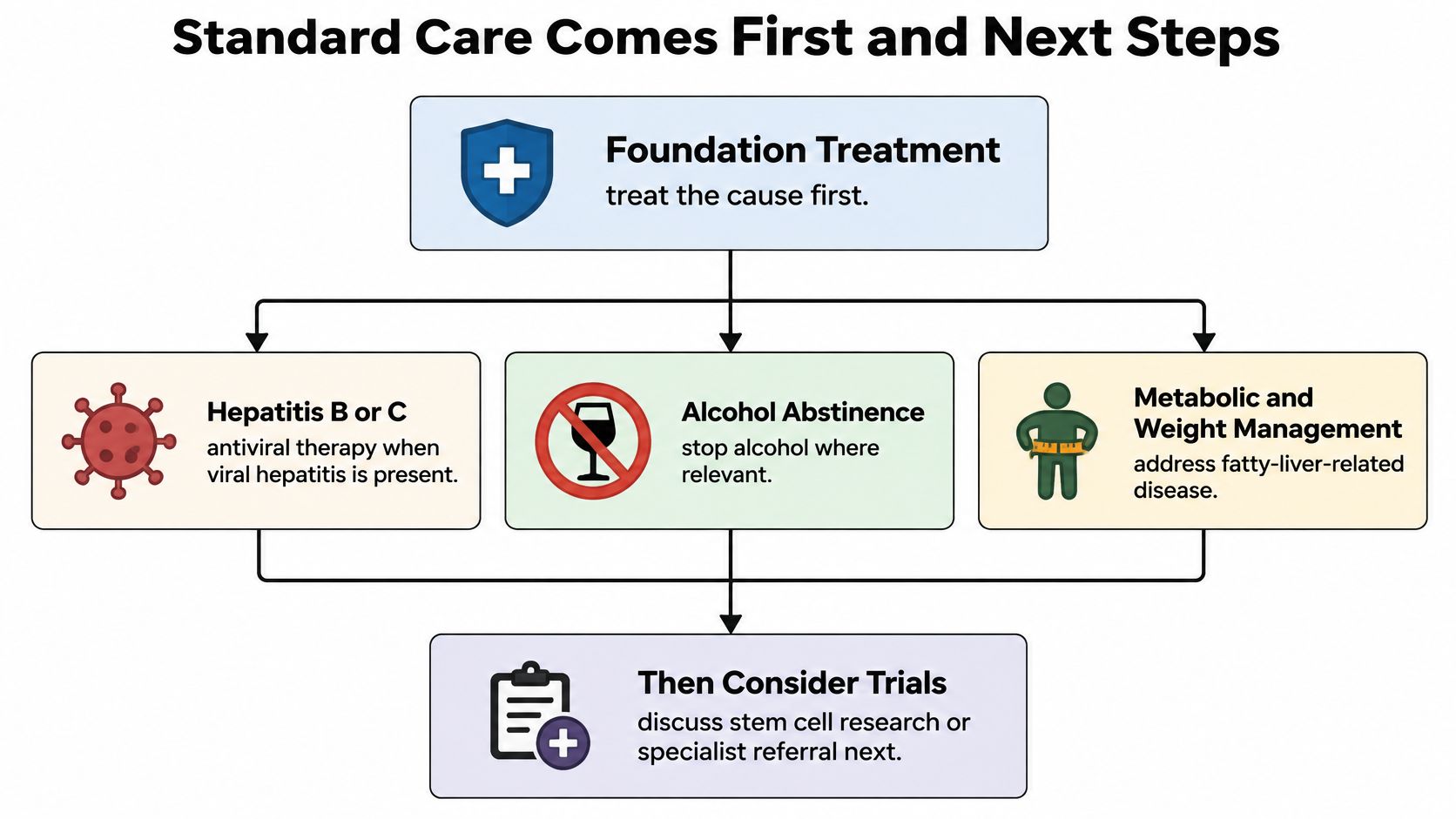
Standard Care Comes First and Next Steps
A patient with cirrhosis may feel well while the disease still benefits from regular attention. Treating the cause and managing complications gives you a strong foundation as you consider other options. Depending on the cause, care may include antiviral therapy for hepatitis B or C, avoiding alcohol when it contributes to liver damage, and addressing metabolic health and weight in fatty-liver-related disease. If stem-cell treatment interests you, you can discuss it as a possible addition to your care rather than a replacement for it.
Care is adapted to each person. Ascites may be managed with sodium restriction and diuretics; varices may call for medication or banding; and encephalopathy may be treated with lactulose and related therapies. Vaccination, infection prevention, adequate protein intake, and reviewing medicines that may harm the liver also belong in the care plan.
Regular liver cancer surveillance is another part of cirrhosis care. For advanced disease, eligible patients may need a transplant evaluation. Discussing transplant evaluation at the appropriate time helps you understand all your options, including how a regenerative approach might fit into your broader care plan.
Keep the roles clear: Specialist care manages cirrhosis and its risks. A cell-based approach, if considered, is a possible complement under medical supervision.
A review of standard cirrhosis care and stem-cell research explains why a change in albumin or another lab marker does not by itself prove that cirrhosis has reversed, complications have been prevented, or survival has improved. More than 110 registered studies had examined stem-cell therapies for chronic liver disease by March 31, 2025, with most still in early phases, according to the review of clinical development in chronic liver disease. When weighing possible benefit, distinguish signals in tests such as albumin or MELD from outcomes patients experience, including fewer hospitalizations or complications, better quality of life, and longer transplant-free survival.
Plan your next steps:
Confirm the cause and stage of cirrhosis with a hepatologist. Gather your MELD or Child-Pugh results and recent imaging.
Bring recent kidney and clotting results, infection screening, and liver cancer surveillance information to treatment discussions.
Ask how the evidence applies to your disease stage, cell type, and proposed delivery route.
Check whether a properly governed clinical trial is open and suitable. Longevity Medical Institute provides physician-supervised regenerative programs, with treatment planning based on a patient's clinical picture and medical evaluation.
If you are considering stem-cell therapy for cirrhosis, Longevity Medical Institute provides physician-supervised regenerative programs and individualized medical assessment. A consultation can help you discuss your diagnosis, current hepatology care, and whether a regenerative approach or clinical-trial referral is appropriate.
Author
Dr. Kirk Sanford, DC, Founder & CEO, Longevity Medical Institute. Dr. Sanford focuses on patient education in regenerative and longevity medicine, translating complex therapies into clear, practical guidance for patients.
Medical Review
Dr. Félix Porras, MD, Medical Director, Longevity Medical Institute. Dr. Porras provides clinical oversight and medical review to help ensure accuracy, safety context, and alignment with current standards of care.
Published: October 29, 2026
Short Disclaimer
This information is for educational purposes only and is not medical advice. It does not replace an evaluation by a qualified healthcare professional. For personalized guidance, please schedule a consultation.