

Stem Cell Therapy for Ménière’s Disease Guide
You may be sitting still when the room suddenly seems to move. A spinning attack arrives without warning, followed by ringing, pressure in one ear, and hearing that sounds muffled or distorted. Afterward, the fear isn't limited to the symptoms themselves. You may start planning your day around the possibility of another episode, wondering whether hearing aids, medication, surgery, or a regenerative treatment could offer a better path.
Stem Cell Therapy for Ménière's Disease is an area of active scientific interest, but it isn't an established cure. The most responsible way to evaluate it is to understand the inner-ear biology involved, the difficulty of delivering any therapy to the cochlea, and the difference between laboratory findings, early human signals, and proven clinical care.
This guide is written for patients considering options locally or traveling to Mexico for evaluation. It explains what stem cells and extracellular vesicles might do, what current research doesn't prove, how safety and candidacy should be assessed, and how regenerative concepts compare with conventional treatment. For broader background, this overview of how regenerative medicine works can help clarify why biological signaling isn't the same as direct tissue replacement.
You should finish this article with a clearer set of questions for an otologist or regenerative-medicine physician. You should also know when established care deserves priority, when an investigational consultation may be reasonable, and what promises should make you cautious.
Introduction to Ménière's Disease and Why New Options Matter
Ménière's disease can turn ordinary moments into difficult calculations. A person may be preparing breakfast, driving to work, or speaking with family when vertigo begins. The spinning can make standing unsafe, while tinnitus and ear pressure continue after the attack. Fluctuating hearing loss adds another layer of uncertainty because communication may be easy one day and exhausting the next.
The condition is chronic and affects the inner ear's hearing and balance systems. It most often affects adults between 40 and 60, and U.S. prevalence is commonly reported around 50 to 200 per 100,000 adults, with an estimate near 190 per 100,000. These figures come from the NCBI clinical reference on Ménière's disease.
Many patients begin searching for regenerative medicine after conventional care has helped only partially, produced unwanted effects, or failed to restore confidence in daily life. That search is understandable. It can also expose patients to language that blurs the distinction between a promising mechanism and a demonstrated treatment.
A practical standard: A responsible consultation should explain what the therapy is intended to influence, how it reaches the inner ear, what evidence supports it, and what remains unknown.
Stem-cell-related research for Ménière's disease is not yet at the point where a clinician can promise restored hearing or permanent control of vertigo. The field is exploring ways to protect surviving cells, regulate inflammation, and deliver biologic signals more precisely. Those goals are scientifically meaningful, but they don't guarantee a clinical outcome.
For medical tourists, the setting matters as much as the proposed product. Ask who evaluates your diagnosis, how the biologic material is handled, which follow-up is included, and whether the clinic will continue standard audiology and ear care rather than asking you to abandon it. A premium experience should make uncertainty clearer, not hide it.
Understanding Ménière's Disease and How It Affects the Inner Ear
The inner ear contains two closely connected systems. The cochlea converts mechanical vibrations into electrical signals for hearing. The vestibular organs, including the semicircular canals, detect head movement and help the brain maintain balance.
These structures depend on carefully controlled fluids. Endolymph and perilymph have different compositions, and the inner ear maintains that chemical separation to support normal sensory signaling. A useful analogy is a precision hydraulic and electrical system. If fluid pressure or composition shifts, the sensory cells may send unstable information to the brain.
The attack pattern matters
Diagnosis isn't based on dizziness alone. According to the American Academy of Family Physicians diagnostic criteria, definite Ménière's disease requires at least two episodes of vertigo lasting 20 minutes to 12 hours, accompanied by fluctuating hearing loss, tinnitus, or ear pressure. Another disorder must not better explain the symptoms.
That pattern helps clinicians distinguish Ménière's disease from other causes of vestibular symptoms. Vestibular migraine, benign paroxysmal positional vertigo, autoimmune inner-ear disease, infections, medication effects, and neurological conditions can produce overlapping complaints. A careful history, hearing assessment, examination, and appropriate imaging or laboratory work may be needed.
Why symptoms can feel inconsistent
The disease doesn't always behave like a steadily worsening mechanical injury. Symptoms may fluctuate, and hearing can change between attacks. The brain also adapts to altered balance signals, so two people with similar test results may describe very different levels of disability.
Patients may struggle with conversation, crowded environments, travel, exercise, or work that requires stable balance. Tinnitus can interfere with concentration and sleep, while the fear of vertigo can lead to avoidance of activities that once felt routine.
Conventional treatment therefore focuses on controlling attacks, supporting hearing, reducing functional disruption, and addressing complications. Regenerative research is interesting because the inner ear has limited natural repair capacity. It is difficult because any intervention must influence a delicate, enclosed structure without damaging the sensory cells and neural connections that remain.
How Allogeneic Stem Cells and Exosomes Might Support Inner Ear Health
Allogeneic stem cells come from a donor rather than from the patient receiving treatment. Longevity Medical Institute uses an allogeneic approach and produces five types of stem cells in its biotechnology lab, including placental, Wharton's jelly, adipose, endometrial, and dental pulp sources.
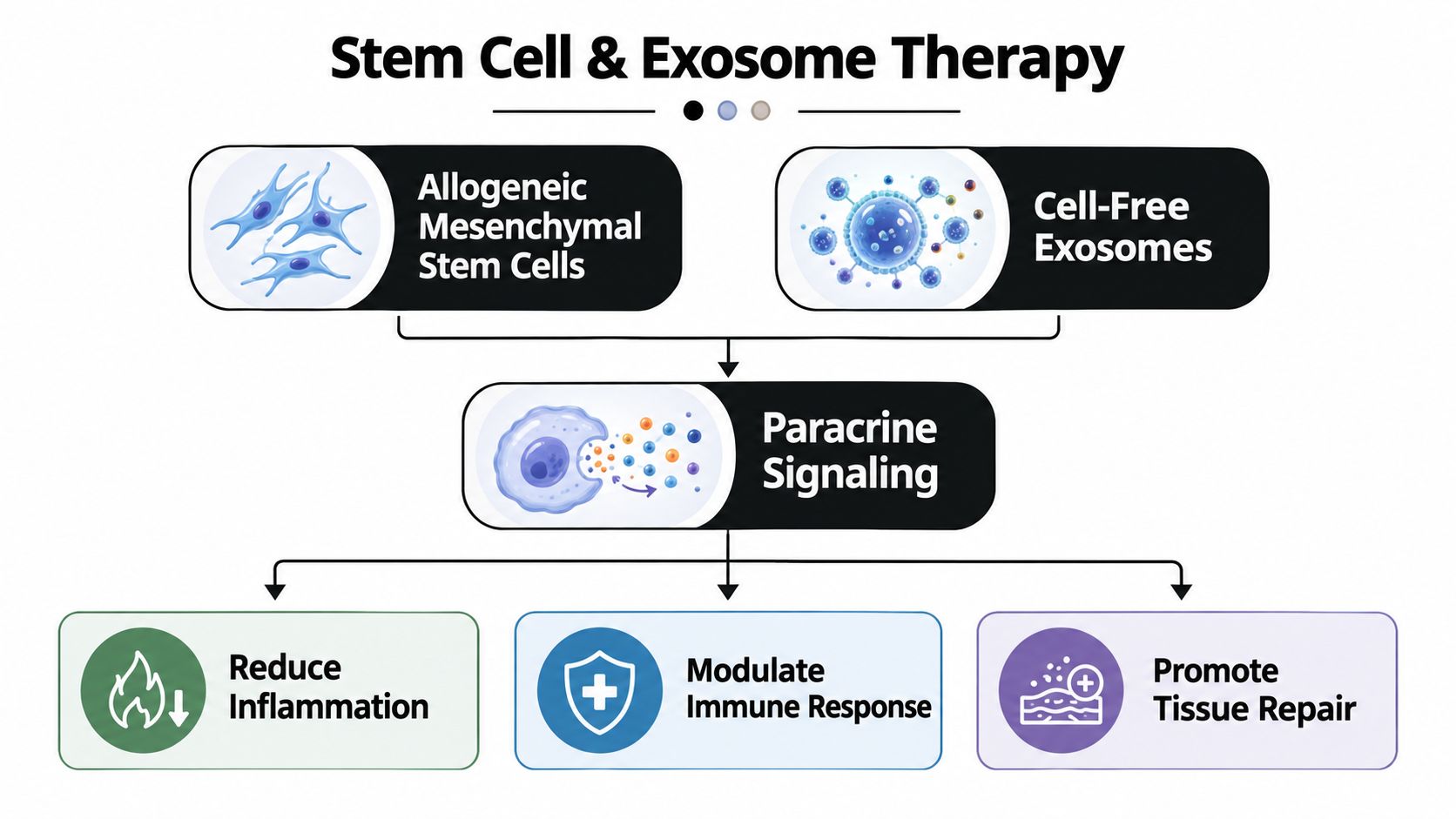
The proposed role of mesenchymal stem cells is often misunderstood. Researchers aren't generally expecting infused cells to travel into the cochlea, rebuild every damaged hair cell, and permanently reconstruct the inner ear. Instead, the main concept involves paracrine signaling, meaning cells release biological messages that may influence nearby or distant tissues.
Imagine a command center sending instructions to a damaged building. The command center doesn't become every brick, wire, or window. It sends messengers that may help coordinate inflammation, blood-vessel behavior, cell survival, and repair responses. MSCs can release proteins, growth factors, and other signaling molecules that researchers study for these effects.
Exosomes are smaller, cell-free packages released by stem cells. They can carry proteins, lipids, and microRNA cargo. In simple terms, they function more like sealed messages than living construction crews. Their appeal includes the possibility of delivering selected biologic signals without administering whole cells, although their preparation, characterization, dose, route, and clinical effects still require careful evaluation.
Delivery is the central problem
The cochlea is small, protected, and anatomically difficult to access. A systemic infusion may expose the body to biologic signals, but it doesn't ensure that a clinically meaningful concentration reaches the precise inner-ear structures involved in hearing and balance.
Local delivery concepts attempt to shorten that distance. Depending on the therapy and clinical setting, researchers may investigate transtympanic, intracochlear, or other targeted approaches. Each route introduces its own questions about concentration, distribution, sterility, procedural risk, and whether the material reaches the intended cells without causing additional injury.
The distinction between systemic and local treatment matters for medical tourists. A clinic should explain the intended route plainly rather than implying that any stem-cell infusion automatically targets the ear. Patients should also ask whether the proposed product is a whole-cell therapy, an extracellular-vesicle product, or another biologic preparation, because those are not interchangeable.
For additional context, LMI's information on stem cells and exosomes describes the broader signaling rationale. For Ménière's disease specifically, however, the mechanism remains a hypothesis under investigation rather than a validated clinical protocol.
What Current Research Shows and Where Evidence Is Still Limited
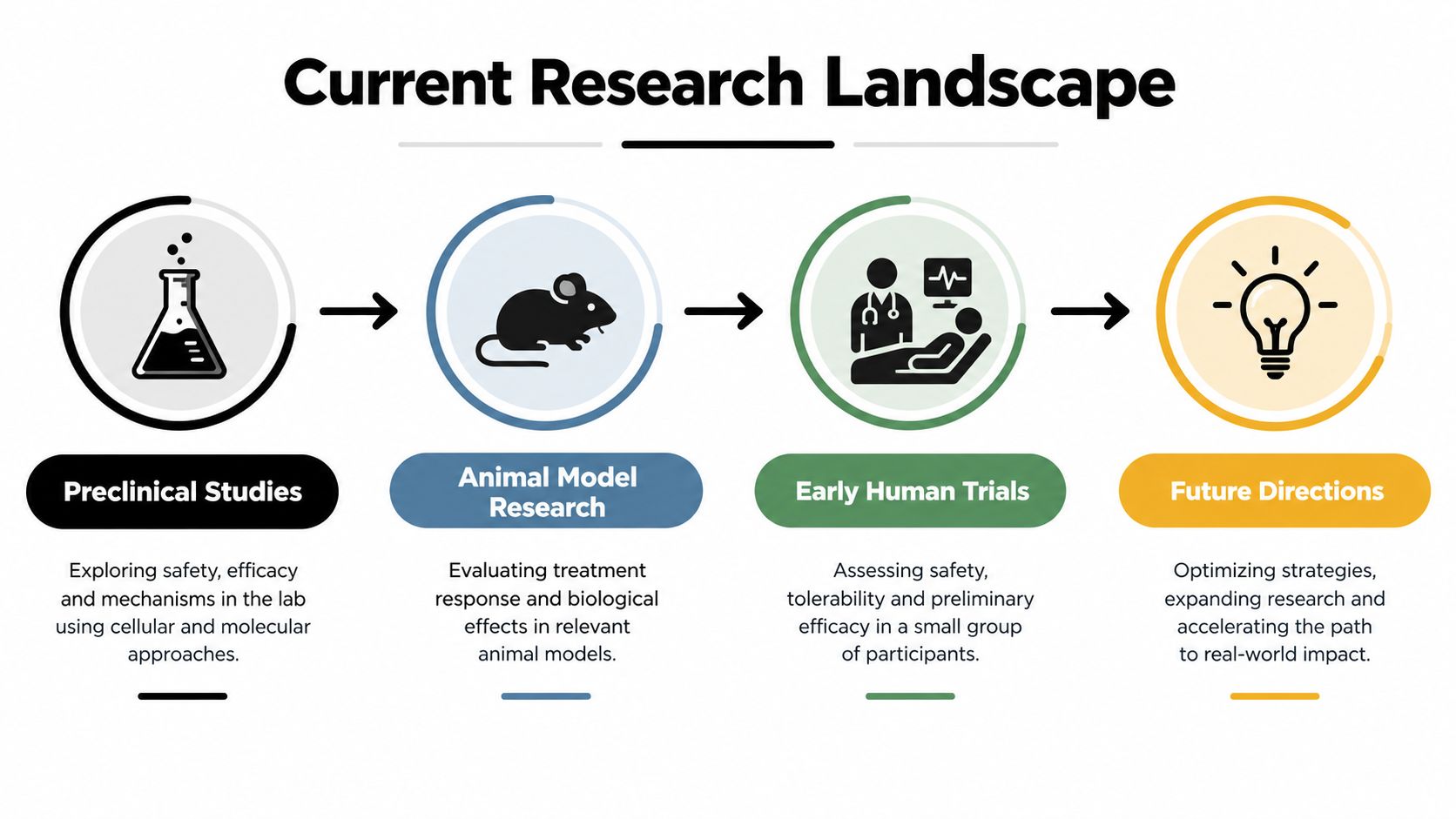
The current evidence requires careful calibration. A 2023 peer-reviewed review in Cells found that stem-cell-related work for Ménière's disease remains largely preclinical. The work centers on human induced pluripotent stem cells, or iPSCs, used to model genetic sensorineural hearing loss and Ménière disease rather than to prove a clinical treatment. The PubMed record for that review describes stem cells as a translational research platform for inner-ear disease, while emphasizing that human efficacy data remain lacking.
That distinction is important. A disease model can help researchers study genetic mechanisms, identify potential drug targets, and observe how inner-ear cells respond to injury. It cannot by itself establish that a treatment will reduce vertigo, stabilize hearing, or improve tinnitus in patients.
What direct MSC studies have shown
A 2020 review of mesenchymal stem-cell therapy for inner-ear disorders reported that transtympanic administration of bone-marrow mesenchymal stem cells produced no significant improvement in hearing thresholds measured by auditory brainstem response and distortion product otoacoustic emissions. The findings are summarized in the peer-reviewed review available through PMC.
This doesn't prove that every possible cell product or delivery route is ineffective. It does show why broad claims about direct stem-cell treatment for hearing improvement are premature. The route, cell source, preparation, timing, disease mechanism, and outcome measures all matter.
Why survival and durability remain unresolved
A separate 2023 review of human stem-cell applications in sensorineural hearing loss and Ménière's disease noted that clinical care remains centered on medical therapy, hearing aids, surgery, or cochlear implants. It also identified the long-term survival of transplanted otic progenitors as a major challenge because early animal gains were transient. The full review in PMC provides that clinical and translational context.
A transplanted cell may survive briefly, fail to integrate with the correct neural network, or release signals that fade before the underlying disease process is controlled. Even if a biological effect is observed, researchers still need to determine whether it changes meaningful patient outcomes and remains durable.
The shift toward extracellular vesicles
The most technically relevant human signal is currently cell-free rather than classic stem-cell transplantation. A first-in-human intracochlear delivery of human stromal cell-derived extracellular vesicles was reported in a 55-year-old patient with Ménière's disease. A 2025 systematic review table summarized the report as associated with no observed toxicity and better speech intelligibility. The finding is described in the Journal of Extracellular Vesicles review.
This is an early signal, not randomized clinical proof. One patient cannot establish effectiveness, identify which patients may benefit, or show whether an effect persists. It does, however, illustrate why researchers are increasingly interested in local biologic delivery to the cochlea rather than assuming that systemic stem-cell infusion will solve the delivery problem.
Patients reviewing clinics and protocols can also consult LMI's mesenchymal stem-cell research resource, while keeping the Ménière's-specific evidence limitations in view.
Comparing Conventional Therapies and Regenerative Options
A rational treatment decision begins with the goal. Do you need fewer vertigo attacks, better communication, tinnitus support, protection of remaining hearing, or evaluation of a possible alternative diagnosis? Different therapies address different problems, and regenerative concepts shouldn't be judged as though they perform the same function as a hearing aid or a cochlear implant.
| Approach | Primary Goal | Evidence Status | Key Considerations |
|---|---|---|---|
| Medical therapy | Control symptoms and reduce disruption from attacks | Established clinical care, selected according to the diagnosis | Requires individualized review because causes and responses differ |
| Hearing aids | Improve access to sound and communication | Established clinical care | Supports hearing function but doesn't repair the inner ear |
| Surgery | Address severe or persistent disease in selected patients | Established option for appropriate candidates | Invasive and dependent on anatomy, diagnosis, and specialist judgment |
| Cochlear implants | Provide auditory input when conventional amplification isn't adequate | Established clinical technology | Doesn't treat every aspect of Ménière's disease and requires specialist evaluation |
| Stem-cell concepts | Support cellular signaling, tissue protection, or repair | Investigational for Ménière's disease | Human efficacy data remain limited, and delivery is a major challenge |
| Exosome or extracellular-vesicle concepts | Deliver cell-free biologic signals locally or systemically | Early translational research | Product quality, route, dose, and durability require careful scrutiny |
Conventional care generally remains the foundation because it has defined clinical roles and a clearer evidence base. A regenerative consultation may be considered when a patient understands that the approach is investigational, has received appropriate ear and hearing evaluation, and wants to discuss whether a biologic strategy is scientifically plausible for their specific condition.
Decision principle: Don't compare a possible future biological effect with an established device as though both provide the same immediate service.
A credible clinician should be willing to recommend continued audiology, hearing devices, or specialist care even while discussing regenerative options. Be cautious if a provider promises complete hearing restoration, guaranteed vertigo control, or asks you to discontinue effective conventional treatment without a medically sound reason.
Candidacy Safety Evaluation and What to Expect at LMI
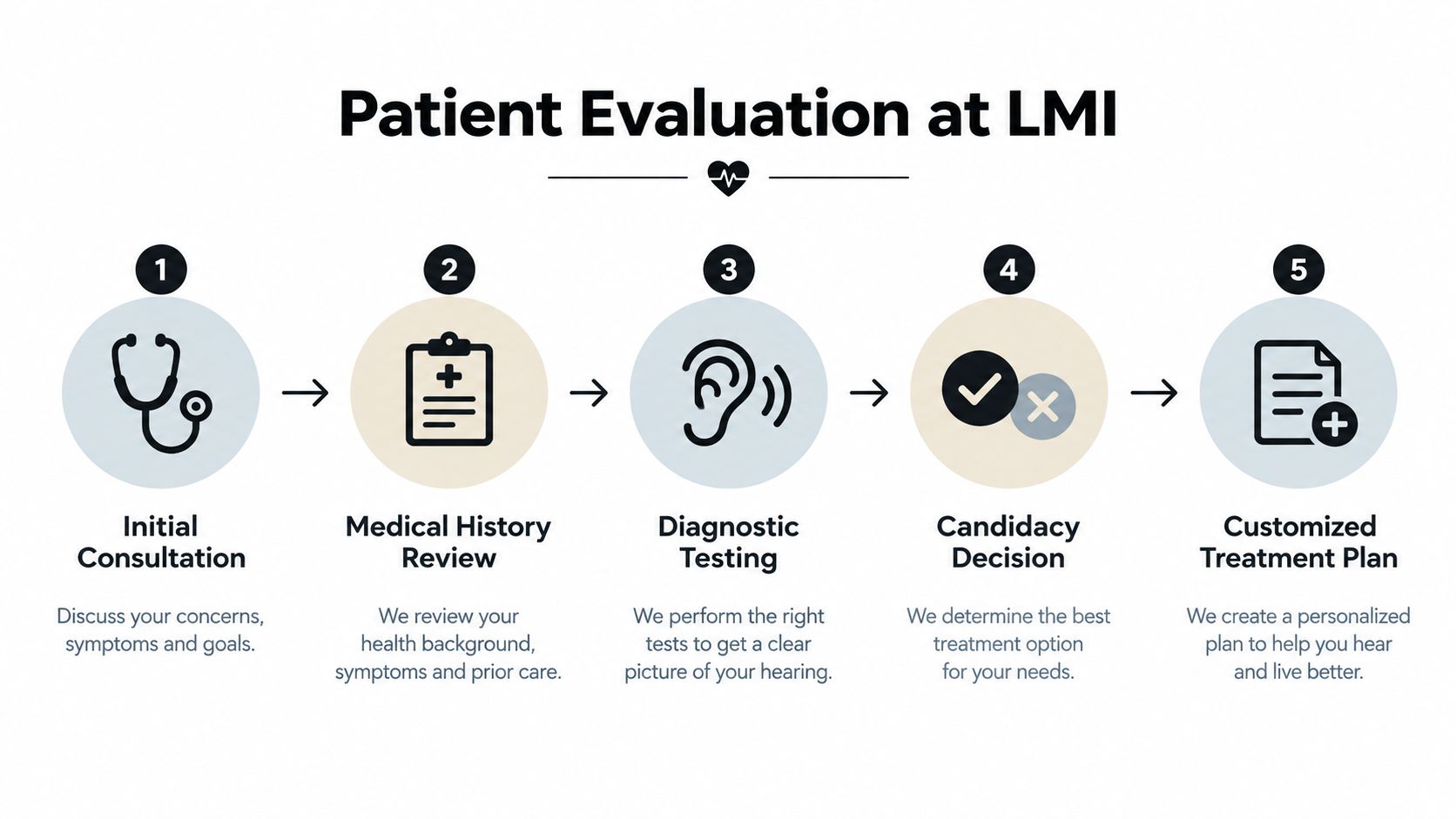
Candidacy begins with diagnosis, not with a product menu. A physician should review the attack pattern, hearing history, tinnitus, ear pressure, previous treatments, medications, neurological symptoms, infection history, cancer history, and any available audiograms or imaging.
Treatment may not be appropriate when the diagnosis is uncertain, an active ear or systemic infection is present, significant medical conditions increase procedural risk, or the proposed biological mechanism doesn't match the patient's disease. A responsible clinic also needs to explain whether the treatment is investigational, what regulatory framework applies, and what follow-up will be available after travel.
The evaluation pathway
At Longevity Medical Institute, the evaluation can incorporate an in-house clinical laboratory measuring 120 biomarkers, an AI-enhanced full-body MRI, and cardiac assessment when clinically appropriate. These tools don't diagnose Ménière's disease by themselves. They help physicians understand broader health factors that may affect treatment planning and procedural safety.
A typical consultation should address:
Medical record review: Bring hearing tests, ENT reports, imaging, medication information, and a written symptom timeline.
Diagnostic clarification: Confirm that the symptoms fit Ménière's disease and consider competing explanations.
Risk assessment: Review infection risk, immune status, malignancy history, cardiovascular health, and other factors relevant to treatment.
Product and route discussion: Ask whether the proposal involves allogeneic MSCs, exosomes, extracellular vesicles, systemic administration, or a local approach.
Follow-up planning: Establish how hearing, speech intelligibility, tinnitus, vertigo, balance, and adverse events will be tracked.
Quality and medical-tourism questions
Allogeneic sourcing requires transparent donor screening, processing controls, storage procedures, and release testing. Patients should ask how identity, sterility, viability, and contamination risks are assessed, and whether the laboratory operates under the relevant Mexican regulatory framework, including COFEPRIS licensing where applicable.
Travel planning also deserves clinical attention. Ask how many visits are expected, what happens if symptoms worsen after returning home, who coordinates records with your local ENT, and whether transportation, accommodation, translation, and emergency arrangements are clearly defined. LMI's safety information for stem-cell therapy in Los Cabos offers a starting point for questions, but your own physician must determine whether travel and treatment are appropriate.
Realistic Outcomes Timelines and Next Steps for Informed Decisions
Regenerative care for Ménière's disease should be evaluated over time, not by an immediate impression after a procedure. The reviewed transtympanic MSC data didn't show significant hearing-threshold improvement, and the broader field still lacks randomized clinical proof for Ménière's-specific stem-cell treatment. Any proposed benefit should therefore be described as uncertain, potentially gradual, and variable.
Track symptoms against a baseline. Record vertigo episodes, duration, triggers, tinnitus intensity, ear pressure, hearing changes, falls or near-falls, sleep disruption, and communication difficulty. Repeat hearing and speech assessments should be interpreted alongside your conventional care, not used in isolation.
Before a consultation, prepare these questions:
What confirms my diagnosis?
What outcome are we measuring?
Is the proposed product a whole-cell therapy or a cell-free vesicle product?
How is the material sourced, tested, stored, and released?
What is known about the delivery route?
What conventional treatments should I continue?
Who manages complications after I return home?
What findings would mean that treatment isn't recommended?
LMI may also discuss complementary services such as peptides, hyperbaric oxygen, or the Longevity Recharge Station when they fit a patient's broader medical plan. Those services shouldn't be presented as proven treatments for Ménière's disease, and they don't replace specialist ear care. For general planning, review what recovery after a stem-cell injection may involve.
Author
Dr. Kirk Sanford, DC, Founder & CEO, Longevity Medical Institute. Dr. Sanford focuses on patient education in regenerative and longevity medicine, translating complex therapies into clear, practical guidance for patients.
Medical Review
Dr. Félix Porras, MD, Medical Director, Longevity Medical Institute. Dr. Porras provides clinical oversight and medical review to help ensure accuracy, safety context, and alignment with current standards of care.
Last Reviewed: September 14, 2026
Short Disclaimer
This information is for educational purposes only. It isn't medical advice and doesn't replace an evaluation by a qualified healthcare professional. For personalized guidance, please schedule a consultation.
If you're evaluating Stem Cell Therapy for Ménière's Disease, Longevity Medical Institute can review your records, hearing history, diagnostic needs, and medical-tourism logistics before discussing whether an investigational regenerative consultation is appropriate. Visit Longevity Medical Institute to request a physician-led evaluation in San José del Cabo.