

Stem Cell Therapy for Migraines: What the Research Shows
Popular advice says migraines are “just headaches” and should be managed only with pills, rest, and avoidance of triggers. That view is too small. Migraine is a neurological disorder, and the reason regenerative therapies keep attracting attention is that they aim at the biology underneath the attack, not just the pain on top of it.
Stem cell therapy for migraine is still being studied, but that does not make it irrelevant or outside the evidence base. Early human findings, mechanistic data, and preclinical research together give clinicians and patients a reasonable scientific basis for interest, even as larger studies are still needed to define who responds best, how treatment should be delivered, and what outcomes are most realistic to expect.
Stem Cell Therapy for Migraines Is Still Emerging
The appeal of Stem Cell Therapy for Migraines is understandable, but its strongest case remains biological rather than clinical. Migraine affects a very large patient population, with global prevalence estimates reaching about 1.16 billion people in 2021, roughly 14% of the world population (PMC review). In the United States, prevalence has remained relatively stable for decades at 11.7% to 14.7%, while chronic migraine affects about 0.91% of adults. That burden helps explain the search for treatments that address more than individual attacks.
Why researchers are looking at regenerative neurology
Mesenchymal stem or stromal cells, MSCs, are being studied for their potential effects on inflammation, immune signaling, and neuronal stress responses. Their proposed role resembles biological coordination more than cellular replacement. MSCs may release signals that alter the environment around stressed nerves, which could matter in migraine because trigeminal activation, inflammatory messaging, and pain-network sensitization interact.
Early mechanistic promise is now supported by a small but meaningful layer of human evidence. While larger controlled studies are still important, existing MSC research already provides a clinically relevant signal that regenerative approaches may help some migraine patients, especially when interpreted alongside the broader biology of neuroinflammation, pain signaling, and nervous system repair.
Researchers are also examining exosomes and extracellular vesicles, tiny signaling packages released by cells. They can carry proteins, lipids, growth factors, and microRNAs involved in cell-to-cell communication. That makes them theoretically useful as a more targeted delivery approach than whole-cell transplantation, although their migraine applications remain experimental.
Practical rule: the strongest clinics explain stem cell therapy for migraine as an evidence-informed, evolving option and discuss both what is known and what is still being clarified.
For patients, the distinction is still important: Biological plausibility, early human outcomes, and clinical proof each represent different layers of evidence. Migraine research in regenerative medicine is advancing, and better-designed human studies will help clarify how these tools compare with established therapies and where they may add the most value.
Migraines Begin in the Brain
Migraine doesn't start as a simple head pain problem. It begins in the brain and its pain networks, where electrical signaling, vascular responses, and inflammatory messaging interact. The trigeminovascular system is often described as the body's migraine alarm network, because the trigeminal nerve, blood vessels, and pain-processing centers can amplify one another once a migraine is underway.
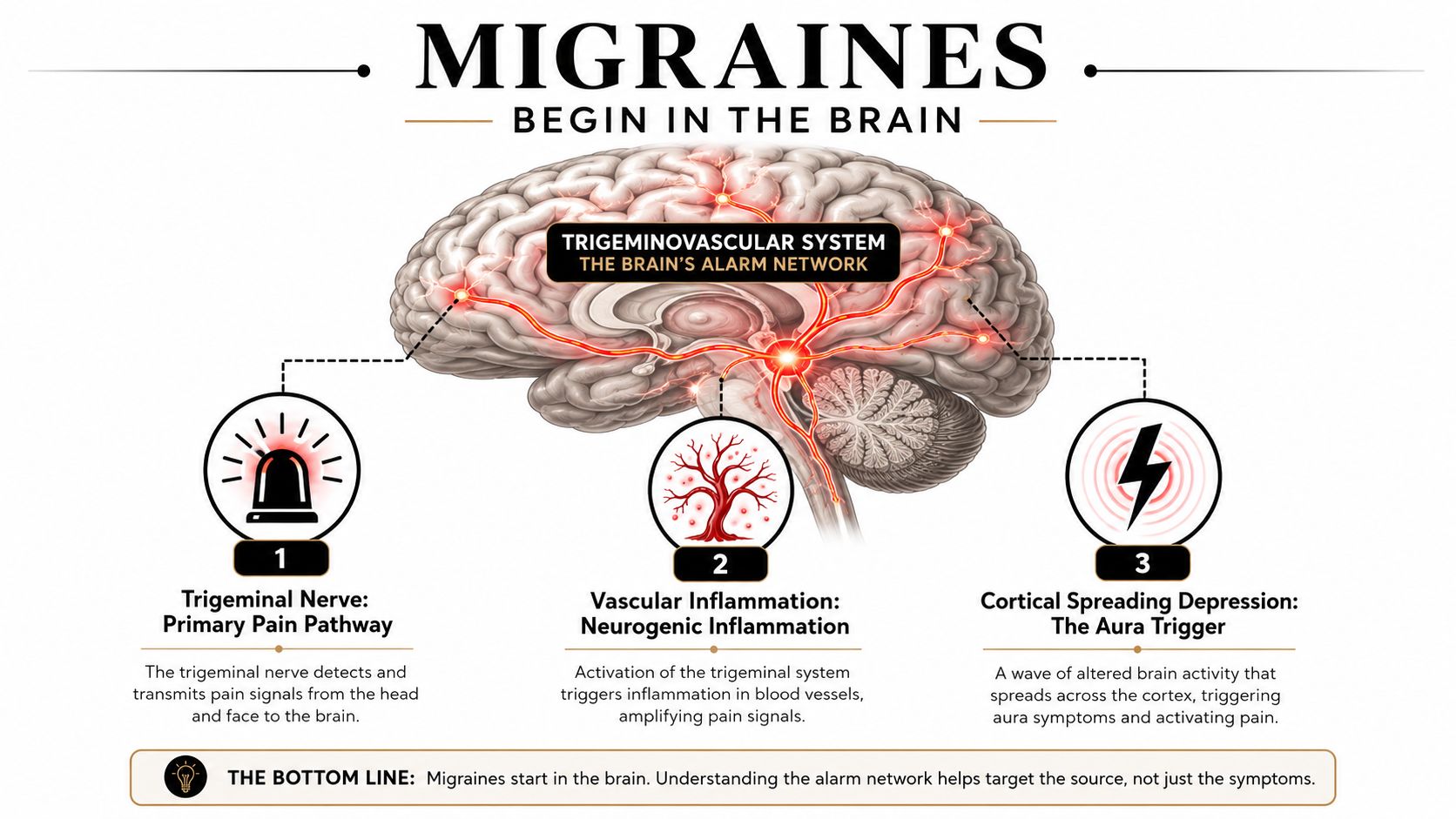
The signaling loop that drives attacks
One important messenger is CGRP, calcitonin gene-related peptide. It plays a central role in migraine biology, because it participates in pain transmission and neurogenic inflammation. When CGRP-related signaling rises, the nervous system can become more reactive, and the migraine threshold drops.
Another key concept is cortical spreading depression, which is linked to aura in some patients. This is a wave of altered neuronal activity across the cortex, and it helps explain why migraine can involve visual, sensory, or speech symptoms, not just head pain. Mitochondrial dysfunction has also been discussed as part of the broader susceptibility, because energy handling in nerve cells may influence how easily attacks are triggered.
The result is central sensitization, where repeated attacks make the nervous system increasingly reactive. A good analogy is a smoke detector that starts going off from steam or toast after enough false alarms.
The internal anatomy matters too. The trigeminal pathways connect to brainstem and cortical processing centers, which is why migraine can feel like a whole-body neurological event rather than a local pain issue. For a deeper overview of how stem cells are framed in nervous system medicine, see this educational resource on stem cells and the brain.
What Mesenchymal Stem Cell Research Shows
The human signal in migraine research is still small. A 2017 review of refractory chronic migraine reported that 7 of 9 patients had a lower MIDAS disability score after treatment, but only 2 had what investigators considered meaningful improvement, which shows how early the clinical experience was (2017 review). The same review also makes clear that human migraine data for stem cells have mostly come from tiny case series, not large controlled trials.
A small human signal, not a finished answer
Another small report described a 2014 case series of migraine and tension-type headache patients treated with stromal vascular fraction. 7 of 9 patients improved, and the mean MIDAS score was 88 at three months, suggesting substantial baseline disability in that cohort (NeurologyLive summary). That kind of observation is interesting, but it does not establish effectiveness.
The key scientific point is straightforward: migraine stem cell research is being built from early clinical experience, case-based observations, and mechanistic science that together support continued development. While a completed randomized controlled trial would strengthen the case considerably, smaller human reports still matter and can provide meaningful evidence signals, particularly in an emerging field where treatment concepts often mature step by step.
Why do researchers keep looking at MSCs at all? Their preclinical effects fit migraine biology better than a direct cell-replacement idea. MSCs appear to influence inflammation, immune signaling, nerve-support pathways, and paracrine communication, so the interest is in how they may change the environment around pain circuits rather than replacing neurons.
| Evidence Type | Study Design | Cell Source | Key Findings | Limitations |
|---|---|---|---|---|
| Human | Small case series | Adipose-derived stromal vascular fraction containing MSCs | Reduced MIDAS disability in some patients | Tiny sample, no randomized control |
| Human | Small review of refractory chronic migraine | Mixed early reports | Some disability reduction signals | Very limited clinical experience |
| Preclinical | Animal and laboratory studies | MSCs | Immunomodulatory and anti-inflammatory effects | Does not prove human migraine benefit |
For readers who want a broader research overview, this MSC research resource adds context on how these therapies are being studied.
Exosomes and Extracellular Vesicles in Migraine Science
A lot of the current excitement around MSCs really belongs to exosomes and extracellular vesicles, EVs. These are small biological packages that cells use to communicate. They can carry proteins, lipids, growth factors, and miRNAs, which makes them interesting for nervous system research.
Why vesicles may matter more than whole cells
Preclinical work suggests MSC-derived EVs may influence inflammatory signaling, including pathways linked to CGRP, neuroinflammation, and neuropathic pain biology. They also matter because vesicles may be easier to standardize than living cells, which is one reason researchers are paying close attention to sourcing, isolation, dosing, and potency testing.
Human evidence remains very limited. There are no completed human clinical trials proving MSC exosomes treat migraine, so the current case for migraine is still mechanistic and preclinical. A closer look at the topic is available in this educational page on stem cell exosomes.
The most responsible reading is straightforward, exosomes are promising messengers, though they remain investigational for migraine.
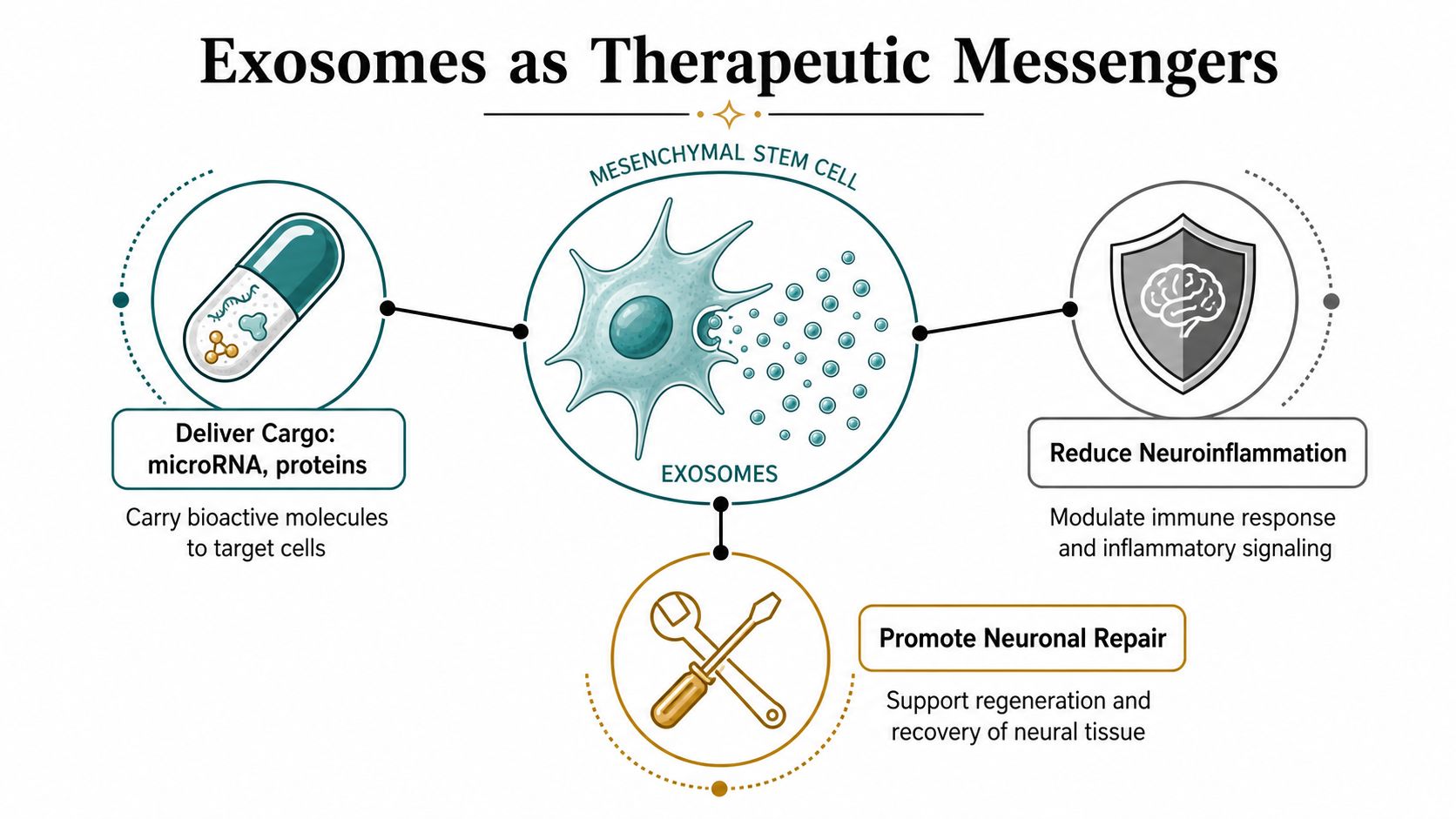
The brain-relevant part of this science is communication. If migraine involves overactive pain circuits and inflammatory signaling, then a vesicle that shifts those messages is worth studying. The remaining problem is translation, because a biologic payload is only useful if manufacturing, consistency, and dose can be controlled well enough to make results reproducible.
Intranasal Neurological Therapy and Nose-to-Brain Delivery
The nose is more than an airway. It also gives access to the olfactory and trigeminal pathways, which is why intranasal delivery is being studied for neurological therapies. The basic idea is to move therapeutic material toward the central nervous system while reducing some of the barriers posed by the blood-brain barrier.
Why the nasal route is attractive for migraine research
Migraine biology makes this route especially interesting. The trigeminal system sits at the center of migraine signaling, so a nose-to-brain strategy matches the disorder's wiring. Researchers are studying intranasal MSCs and MSC-derived exosomes or EVs in preclinical settings because the route may help direct cargo toward brain regions involved in pain processing.
The evidence base is still mostly preclinical, and direct migraine trials are lacking. Variable absorption, mucosal irritation, and dosing precision remain real limitations. A nasal delivery route can be elegant in theory, but the therapy still has to reach the right tissue in the right amount.
Longevity Medical Institute describes an intranasal neurological therapy approach that uses regenerative neurological therapeutics through this route. That should be understood as investigational. It is not yet a proven migraine treatment. For more context on the broader approach, see LMI's regenerative neurological therapy page.
Intranasal delivery is being explored because it fits the problem. Migraine is a brain network disorder, not a surface-level pain event. If a therapy is designed to influence brain signaling, the route of delivery matters.
Safety, Migraine Types and Supportive Therapies
Safety should come before enthusiasm. Human research on MSCs suggests a generally favorable safety profile, with the most commonly reported adverse effects being mild and transient, including fever, headache and infusion reactions (Oxford stem cell publication). That does not make every product safe. Manufacturing quality, sterility, dose, route, and patient selection still shape risk in practice.
Migraine patients also do not all sit in the same category. Chronic refractory migraine differs from episodic migraine. Migraine with aura may reflect different biology than migraine without aura, and other subtypes can behave differently again. Researchers may eventually identify which clinical patterns fit regenerative approaches better, but current evidence has not defined clear responder groups.
The supportive therapies deserve the same careful framing. Hyperbaric oxygen therapy, HBOT, may support oxygenation and cerebral metabolic function. Photobiomodulation may influence mitochondrial activity, nitric-oxide signaling, neuroinflammation, and pain signaling. Those mechanisms are interesting, but they do not prove migraine efficacy on their own.
A useful safety lens is side effects across regenerative options, including how reactions can vary by delivery method and patient history. For a broader overview, see this overview of stem cell therapy side effects.
A multimodal framework makes sense because each piece targets a different layer of the problem. MSCs may contribute immunomodulation and neurotrophic signaling. Exosomes and EVs may extend cell-to-cell signaling with possible inflammatory modulation. Intranasal delivery is the transport concept. PBM and HBOT serve as supportive tools within a broader framework.
Where the Evidence Stands Today
The honest verdict is simple. Stem cell therapy for migraine is an emerging, evidence-informed area of regenerative medicine. MSCs and MSC-derived exosomes have compelling mechanistic rationale in neuroinflammation, CGRP-related signaling, mitochondrial function, and neurotrophic pathways, and the early human literature adds enough support to justify serious clinical and scientific interest.
Migraine is a heterogeneous disorder, so no one should expect a single regenerative tool to fit everyone. People considering this topic should look for board-certified clinicians who can explain how preclinical findings, early human evidence, and personalized treatment planning fit together in a responsible clinical framework.
If you're exploring regenerative neurology in a medically supervised setting, Longevity Medical Institute offers physician-guided programs that bring together regenerative medicine, intranasal delivery concepts, HBOT, and photobiomodulation in one clinical environment. Learn more at Longevity Medical Institute, and bring your migraine history, current medications, and prior imaging so the discussion can stay precise and evidence-based.
Author: Dr. Kirk Sanford, DC, Founder & CEO, Longevity Medical Institute
Medical Review: Dr. Félix Porras, MD, Medical Director, Longevity Medical Institute
Last Reviewed: August 28, 2026
Short Disclaimer: This information is for educational purposes only and is not medical advice. It does not replace an evaluation by a qualified healthcare professional. For personalized guidance, please schedule a consultation.