

Stem Cell Therapy for Sjögren’s: What the Research Shows
You keep water beside your bed, use eye drops throughout the day, and still find that a conversation or meal leaves your mouth uncomfortable. Meanwhile, fatigue can make even familiar routines feel demanding. If you're exploring stem cell therapy for Sjögren's, you're probably looking for more than temporary relief. You want to understand whether emerging treatments might help your glands function better.
Human studies offer reasons for optimism, but the details matter. The cell source, delivery route, and way researchers measure improvement tell us far more than the broad label “stem cell therapy.”
What Sjögren's Disease Means for Everyday Life
Sjögren's is a chronic autoimmune disease. The immune system mistakenly attacks healthy tissue, particularly the glands that produce tears and saliva. This helps explain why dry eyes and dry mouth are such recognizable symptoms, although the condition can affect much more than moisture production.
Dry eyes may feel gritty, burning, or persistently irritated. Dry mouth can make speaking uncomfortable, chewing difficult, and swallowing dry foods challenging. Fatigue, joint discomfort, and swelling around affected glands can add another layer of disruption.
Why saliva matters beyond comfort
Saliva helps moisten food and keeps the mouth comfortable, but it also contributes to protection against tooth decay and oral infection. When saliva production falls, dental care becomes part of disease management rather than a separate cosmetic concern.
A useful clinical conversation separates several issues:
Gland function: How much saliva or tear fluid are the glands producing?
Daily symptoms: How much do dryness, pain, and fatigue interfere with life?
Oral and eye health: Is dryness contributing to dental problems or ocular-surface irritation?
Systemic involvement: Are symptoms suggesting effects beyond the glands?
These questions matter because a person can experience substantial discomfort without every clinical measurement changing in parallel. A treatment that improves one measure shouldn't automatically be described as improving the entire disease.
Looking beyond dryness
Sjögren's can occur independently or alongside autoimmune conditions such as rheumatoid arthritis or lupus. Some people also develop involvement of the nerves, lungs, kidneys, or other organs, making individualized medical assessment important.
Practical perspective: Better saliva production would be valuable, but comprehensive care must also address fatigue, eye health, dental protection, and any organ involvement.
Established care remains the foundation while regenerative approaches are studied. Patients shouldn't have to choose between protecting their health today and learning about promising options for the future.
Why Regenerative Medicine Is Being Investigated
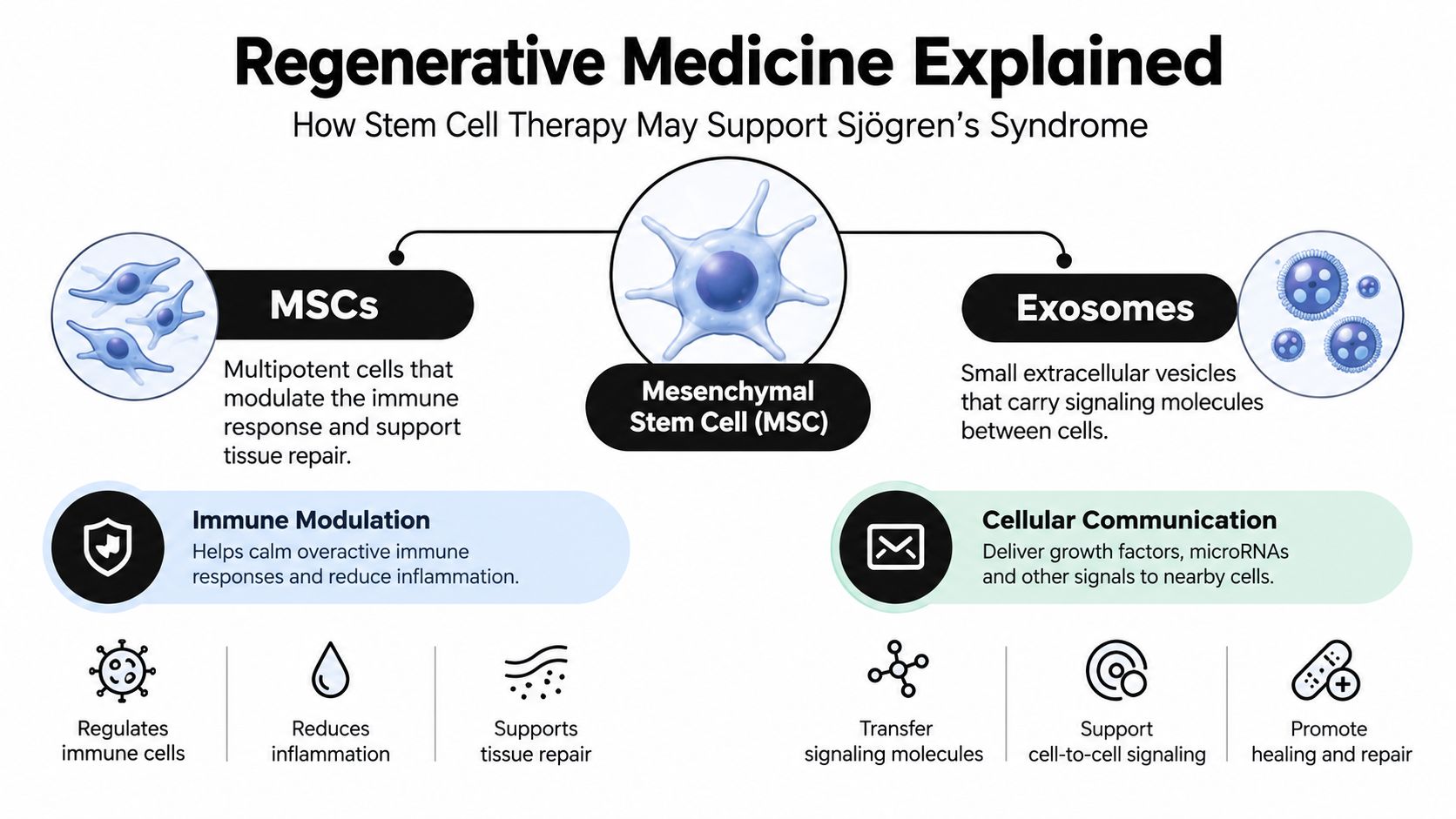
Researchers are studying mesenchymal stromal cells, commonly called mesenchymal stem cells or MSCs, because of their potential to influence immune activity and inflammatory signaling. That makes them relevant to a disease involving inflammation and impaired gland function.
Think of these cells less as replacement bricks and more as biological coordinators. They release signals that can influence how nearby cells respond to inflammation and injury. A systematic review of MSC research in Sjögren's describes changes in inflammatory and anti-inflammatory cytokines, the chemical messages immune cells use to communicate.
A plausible mechanism isn't a demonstrated outcome
Immune modulation means influencing immune behavior, not turning the immune system off. In Sjögren's research, the aim is to investigate whether changing inflammatory activity can help preserve or improve gland function.
A systematic review and meta-analysis covering 25 preclinical studies reported improved stimulated salivary flow and reduced inflammatory infiltration in animal models treated with MSCs or their derivatives. Those findings support further investigation, but animal results don't always translate to humans.
Preclinical research helps researchers identify mechanisms and possible treatment strategies.
Human studies test whether patients benefit and what adverse effects occur.
Comparative trials help distinguish treatment effects from other reasons symptoms might improve.
The broader discussion of MSC therapy for autoimmune disease provides useful context, but each autoimmune condition needs its own clinical evidence.
Published Human Stem Cell Studies in Sjögren's
The most useful human studies specify exactly what researchers administered and where they delivered it. They also distinguish measured gland secretion from patient-reported symptoms.
Xu and colleagues in Blood
In the Xu and colleagues study published in Blood in 2012, 24 patients received intravenous umbilical cord-derived MSCs and were followed for 12 months. Average disease activity scores decreased from 5.63 to 3.08, and among 11 patients assessed for significant dry mouth, unstimulated saliva production approximately doubled at one month, with improvements reported during subsequent follow-up.
Intravenous delivery means the cells entered through a vein rather than being injected directly into a gland. The findings suggested possible effects on both gland function and broader autoimmune activity.
A clinical review discussing this UC-MSC study also reports decreased autoantibody levels and no infusion-related side effects. That's encouraging, but favorable findings in a small study don't establish effectiveness for every Sjögren's patient.
Li and colleagues in Scientific Reports
The Li and colleagues randomized, triple-blind, placebo-controlled study published in 2023 enrolled 74 participants, with 64 completing treatment and follow-up. Researchers injected MSCs into the parotid salivary glands, reporting improvements in saliva and tear secretion at three months, alongside improvements in disease activity and patient-reported symptoms.
The study used ESSDAI, a clinician-assessed disease activity measure, and ESSPRI, a patient-reported symptom measure. These assess related but different aspects of living with Sjögren's.
Møller-Hansen and colleagues in The Ocular Surface
The Møller-Hansen and colleagues study published in 2024 included 54 participants: 20 received adipose-derived MSC injections into a tear gland, 20 received the injection vehicle, and 14 formed an observation group using lubricating eye drops.
Both injection groups experienced improved dry-eye symptoms compared with observation. The MSC group also showed additional tear-film stability findings, including an advantage over the vehicle group at four weeks.
The vehicle group is particularly informative. It received the carrier preparation without the cells, helping researchers examine whether improvements were specifically associated with MSCs rather than the injection process or carrier.
What These Findings Actually Mean for Patients
The human evidence provides a meaningful basis for cautious optimism. Some participants experienced improvements in secretion, symptoms, or disease activity. Those are clinically relevant signals, particularly for people whose daily lives remain affected despite ongoing care.

Match the proposed treatment to the actual study
IV infusion, direct salivary-gland injection, and tear-gland injection are different interventions.
Intranasal delivery, nebulization, and intrathecal administration, meaning delivery into the fluid surrounding the spinal cord, also require separate evidence and route-specific safety assessment. They aren't interchangeable ways to obtain the results described above, and oral capsules aren't the delivery method used in these studies.
Ask whether the proposed treatment matches the published study in its cell source, preparation, delivery route, and intended outcome.
Safety deserves its own discussion
MSC research includes favorable tolerability findings, but safety depends on the actual cell preparation, dose, route, physician experience, and patient's condition. Evidence about MSCs also doesn't establish equivalent results for MUSE cells or exosomes.
Exosome Research in Sjögren's and What It Adds
Exosomes are small signaling vesicles released by cells. They carry biological messages rather than functioning as living replacement cells. Researchers are investigating whether these messages can influence inflammation and support tissue function.
This makes exosomes scientifically interesting, but “cell-free” doesn't mean evidence-free or automatically safer. Researchers still need to characterize the preparation, its contents, how it's delivered, and what happens afterward.
Eye drops and IV treatment answer different questions
A small 2025 clinical trial examined MSC-derived exosome eye drops for Sjögren's-related dry eye, within the developing human literature discussed in this systematic review of stem-cell-based dry-eye therapies. This topical approach should be understood separately from intravenous exosome treatment.
Eye drops apply a preparation to the eye's surface. IV administration introduces it into the circulation. A topical finding cannot establish systemic benefits, improved salivary function, or control of autoimmune activity elsewhere.
| Research question | What would need to be established |
|---|---|
| Can topical exosomes help dry eye? | Reproducible improvements in ocular measures and symptoms |
| Can IV exosomes help Sjögren's? | Direct human evidence for that preparation and route |
| Is combining cells and exosomes better? | Comparative trials showing an advantage over either approach alone |
The distinction between exosomes and stem cells can help patients evaluate claims. Access to cell-derived exosome technology is a manufacturing capability, not, by itself, evidence of a Sjögren's-specific treatment effect.
Regenerative Dentistry and Oral Health in Sjögren's
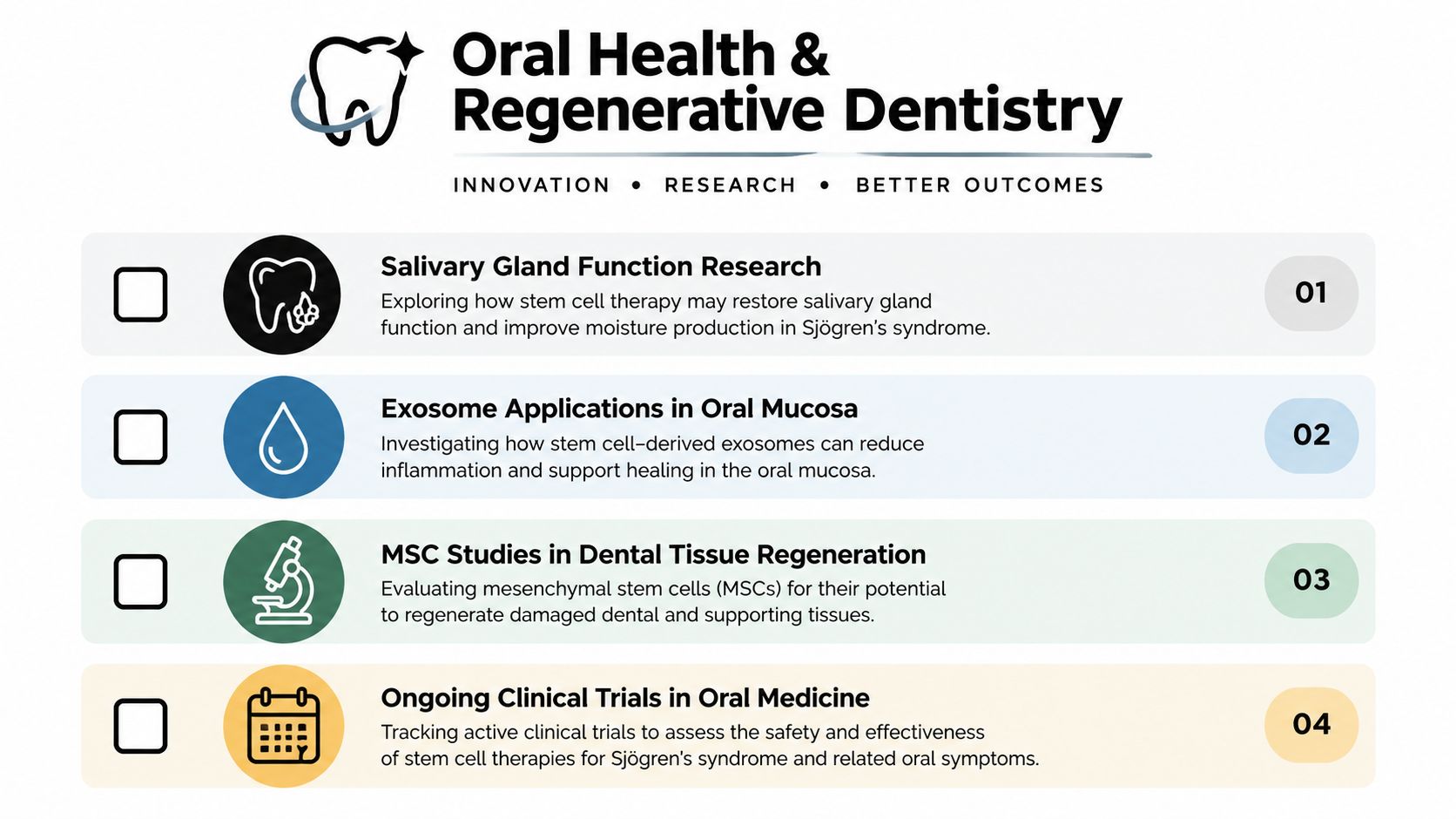
A regenerative conversation about Sjögren's should include the mouth, not just an infusion appointment. Salivary-gland research connects naturally with regenerative dentistry and oral medicine, because preserving oral function is central to patients' comfort and long-term health.
MSCs and exosomes are being investigated for their potential relevance to gland inflammation and tissue function. Those research questions remain distinct from established dental procedures and preventive care.
Build an oral-health plan around current needs
Coordinated physician and dental assessment can connect symptoms with findings that need attention:
Measure and discuss dryness: Review saliva production, swallowing discomfort, and the practical effects of dry mouth.
Check teeth and gums: Identify decay, gum problems, and areas that need closer preventive care.
Look for infection: Assess persistent soreness, irritation, or other changes rather than assuming every symptom is dryness.
Protect oral health: Include professional cleanings, individualized fluoride protection, and appropriate dry-mouth management.
Keep regenerative claims precise
The field of regenerative dentistry includes approaches addressing particular oral tissues and clinical problems. A dental procedure described as regenerative shouldn't be assumed to treat the underlying autoimmune disease.
Oral-care priority: Protect the teeth and tissues you have while researchers investigate ways to improve gland function.
Stem cells can't currently be presented as a reliable way to regrow teeth or rebuild damaged salivary glands in Sjögren's. The hopeful, practical goal is coordinated prevention today, with carefully evaluated opportunities to improve function as the evidence develops.
Questions to Ask Your Physician and How LMI Supports Your Care
A useful consultation should produce a specific plan, not a recommendation for "stem cells." Bring your diagnostic history, current medications, eye-care records, and recent dental findings so the physician can assess your needs in context.
The emerging Danish randomized, double-blind trial illustrates a focused research approach: 40 patients with primary Sjögren's receive allogeneic adipose-derived MSC injections into both submandibular glands, with unstimulated whole-saliva flow as the primary endpoint. Secondary measures include stimulated flow, adverse events, patient-reported outcomes, immune response, gland morphology, and disease activity.
Ask for a measurable, followable plan
Cell identity and quality: What is the source, and how are identity, viability, handling, and preparation documented?
Delivery and dose: Why is this route appropriate for my target symptoms and medical condition?
Expected outcomes: Will you measure saliva, tears, disease activity, and symptoms separately?
Follow-up and safety: Who monitors adverse events after I return home, and how is longer-term follow-up arranged?
Durability and alternatives: What remains unknown, and which established treatments should continue?
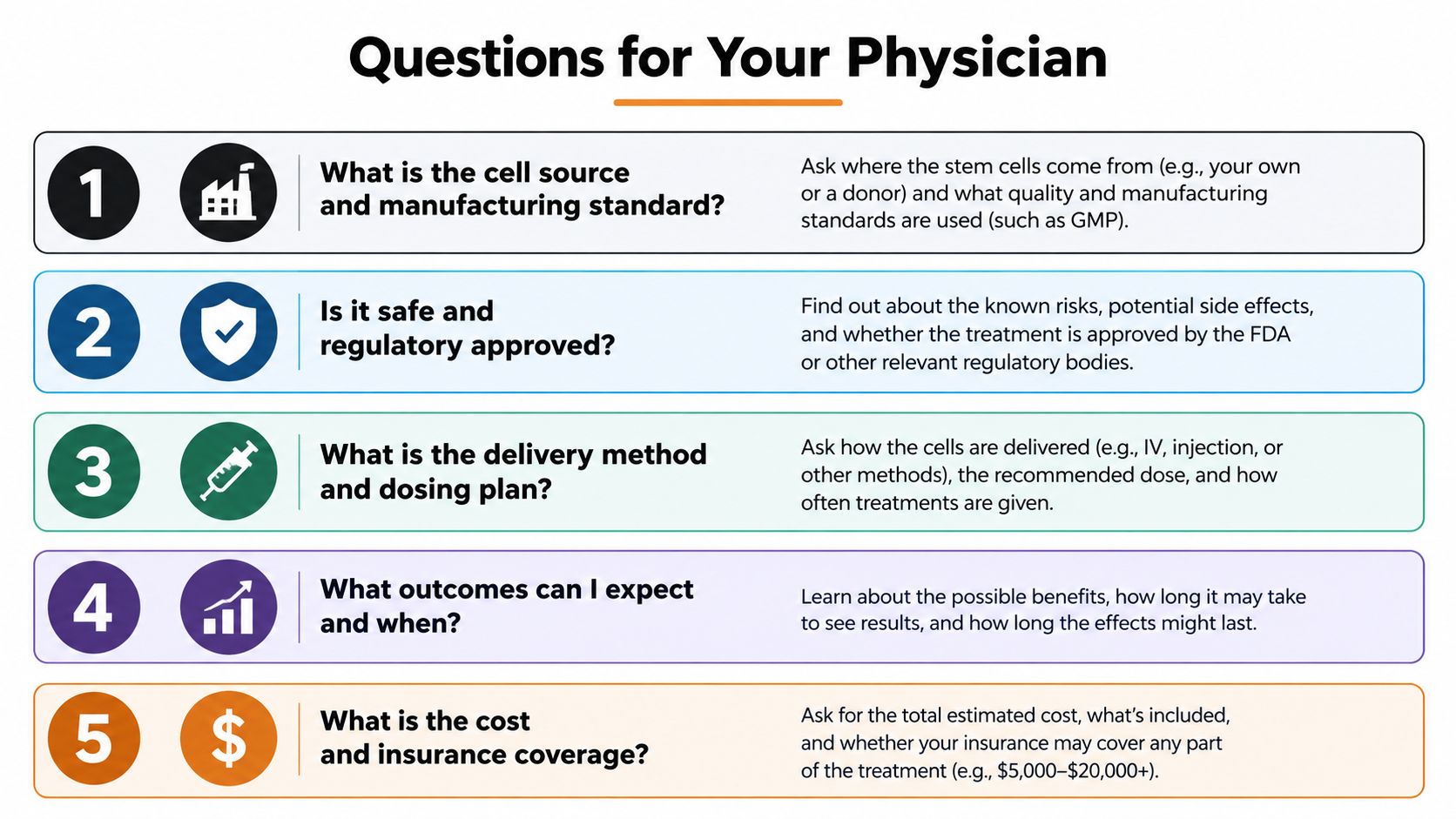
The stem cell clinic assessment checklist offers further questions. An in-house biotechnology laboratory and timely access to freshly prepared cells can support quality control and coordination, but neither replaces evidence of clinical benefit.
Evaluate the whole program without confusing its parts
Allogeneic means donor-derived. Placental, Wharton's jelly, adipose, endometrial, dental pulp, and MUSE cell preparations have different biological characteristics and shouldn't be treated as interchangeable.
Autologous NK cells are different again: these are a patient's own immune cells, expanded and activated in a laboratory for immune-surveillance applications. They aren't autologous stem cells, and that work doesn't establish a Sjögren's treatment benefit. TriFusion EBOO, physician-supervised peptides, and nutraceutical therapies also require separate explanations of purpose, evidence, and safety.
Author
Dr. Kirk Sanford, Founder & CEO, Longevity Medical Institute. Dr. Sanford focuses on patient education in regenerative and longevity medicine, translating complex therapies into clear, practical guidance for patients.
Medical Review
Dr. Félix Porras, MD, Medical Director, Longevity Medical Institute. Dr. Porras provides clinical oversight and medical review to help ensure accuracy, safety context, and alignment with current standards of care.
Last Reviewed
October 21, 2026
Short Disclaimer
This information is for educational purposes only and is not medical advice. It does not replace an evaluation by a qualified healthcare professional. For personalized guidance, please schedule a consultation.
Longevity Medical Institute offers personalized regenerative assessment, coordinated dental care, and advanced diagnostics within an integrated clinical and biotechnology setting. Its donor-derived cellular platform and cell-derived exosomes are supported by an in-house biotechnology laboratory, with treatment selection guided by individual needs rather than assumed equivalence to published Sjögren's protocols. Schedule a consultation to review your gland function, symptoms, current care, and whether an emerging regenerative approach is appropriate for you.