

Stem Cell Therapy for Stroke Recovery: A 2026 Guide
Your family's first question after a stroke is usually simple and heavy at the same time. Can anything more be done now that rehab has plateaued? If you've spent months watching movement, speech, or stamina improve slowly, then stall, it's natural to start looking beyond standard therapy for something that might help the brain recover more effectively.
Stem Cell Therapy for Stroke Recovery sits in that space between hope and caution. It isn't a replacement for rehabilitation, and it's not a promise to erase disability. The strongest clinical story so far is more measured, stem cells may support recovery by improving the brain's healing environment, especially when treatment timing and patient selection are right, and when it's paired with rehabilitation rather than used alone.
Understanding Stroke Recovery and Regenerative Medicine
A stroke survivor often reaches a point where the daily pattern feels painfully familiar. Physical therapy helps, speech work helps, and home exercises help, but progress can become slower than the effort going in. That's usually the moment families start asking whether the problem is no longer just training, but the tissue environment itself.
Why recovery can plateau
After a stroke, some brain cells die right away, while other nearby cells remain injured, inflamed, and underperforming. Conventional rehabilitation works by teaching the nervous system to use remaining pathways better, but it can't directly improve the biological condition of damaged tissue. That distinction matters, because a tired repair site won't respond the same way a healthy one does.
Regenerative medicine approaches stroke differently. Instead of trying to force a movement skill back through repetition alone, it looks at whether the surrounding biology can be made more supportive of repair. In plain terms, it asks whether the injured brain can become a better place for recovery to happen.
Practical rule: If rehab has helped but then leveled off, the next question isn't only “what exercise should we try next,” it's also “what is still limiting the brain's capacity to respond?”
A useful starting point is a clear explanation of how regenerative medicine is meant to work, which you can review in this overview of regenerative medicine. That kind of framing helps patients understand why stem cell therapy is considered an adjunctive strategy, not a standalone cure.
The emotional piece matters too. Families often arrive after hearing different opinions, some optimistic, some dismissive. A more honest model is this, stroke recovery is a long biological process, and regenerative medicine is one way clinicians try to support that process when standard recovery has slowed.
How Stem Cells Support Neurological Recovery
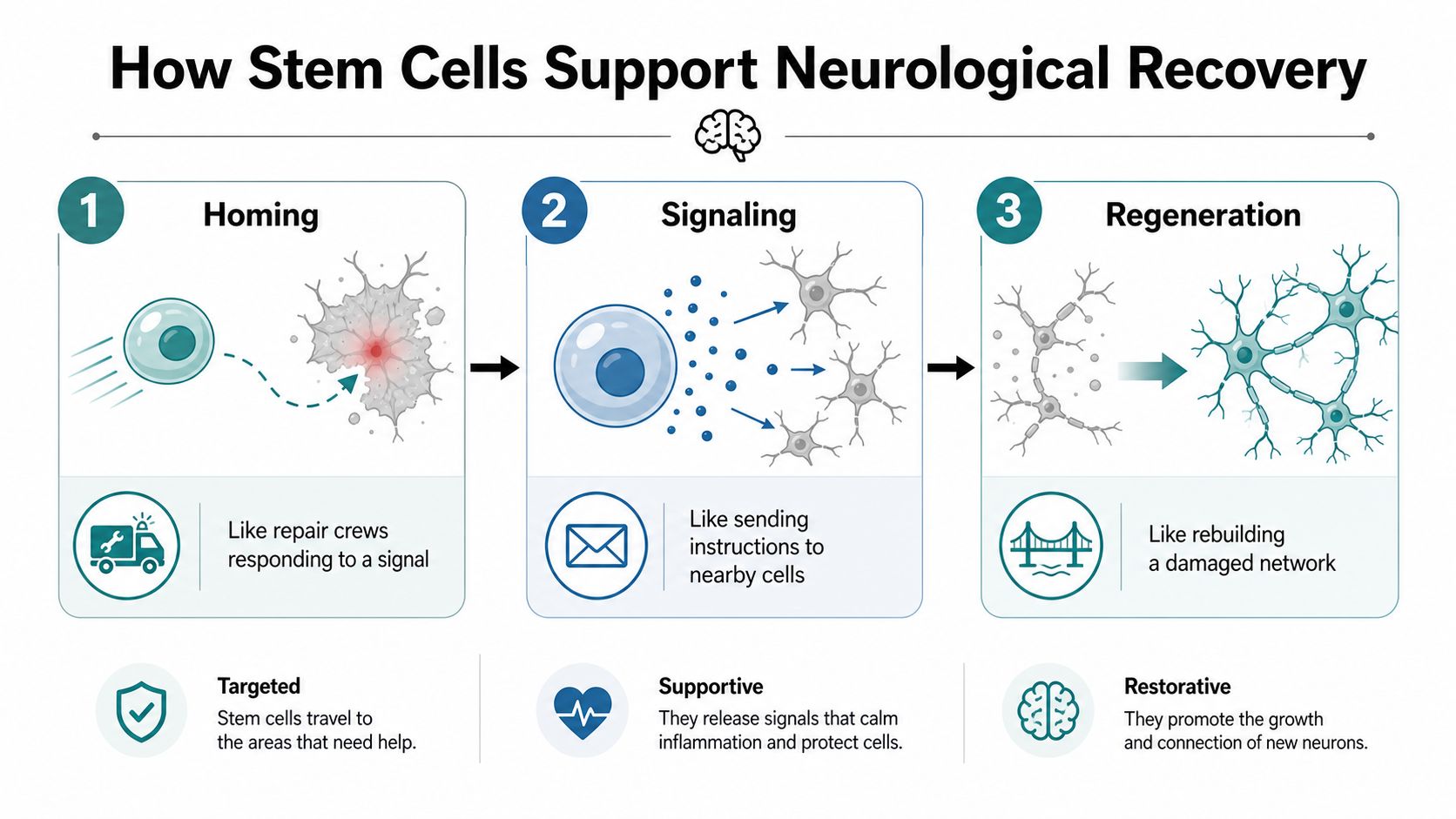
Stem cells are easiest to understand if you stop thinking of them as replacement parts and start thinking of them as biological project managers. They don't become new brain tissue on command. Instead, they send signals that help organize the repair environment, calm harmful processes, and support the tissue that's still alive but struggling.
The four mechanisms that matter most
The literature around stroke recovery keeps coming back to a few recurring biological effects. Immunomodulation means helping dial down damaging inflammation. Angiogenesis means supporting new blood vessel formation, which matters because injured tissue needs circulation to function well.
Neuroprotection is the idea that vulnerable neurons may be shielded from further stress. Neurogenesis and network support refer to helping the brain build or strengthen connections that can carry function around damaged areas. The best current evidence still supports indirect recovery support, not true replacement of lost brain tissue.
That's an important expectation reset. People often hope stem cells will rebuild a damaged brain region the way a carpenter repairs a wall. The process is closer to a site supervisor coordinating cleanup, rerouting resources, and making it easier for the remaining structure to stabilize.
The practical value of that distinction is huge. If you expect tissue replacement, you're likely to be disappointed. If you expect a therapy that may improve the conditions for rehab, plasticity, and functional adaptation, the evidence makes more sense.
Stem cells are not magic bricks. They're closer to a repair signal that helps the nervous system use what's still there more effectively.
A more detailed explanation of the clinical concept is available in this guide to how stem cell therapy works. For patients, that often clears up the biggest confusion, which is why a therapy can be biologically active without being a cure.
Clinical Evidence and Realistic Outcomes
A stroke survivor sitting across from a clinician usually wants one direct answer, will stem cell therapy help, and if so, how much. The honest answer is that the evidence points to real but variable functional gains, not a guaranteed repair. Across the current literature, the same theme appears again and again, some patients improve, some trials show clearer signals than others, and the size of benefit depends on patient selection, timing, and how the cells are used.
What the human data actually shows
A Stanford-led study from 2016 reported an 11.4-point improvement on the motor-function component of the Fugl-Meyer test after stem cell treatment, using a scale designed to measure post-stroke movement deficits, and the study helped move the field from theory toward early human evidence (Stanford report). For people living with chronic stroke, that kind of change stands out because later-stage rehabilitation often brings slower, smaller gains once the early recovery window has passed.
Meta-analytic data point in the same direction. One systematic review reported a pooled NIHSS reduction of 5.7 points from baseline to follow-up, and more recent meta-analysis work found average gains versus control in mRS by −0.34, NIHSS by −1.77, and Barthel Index by +6.20, without a significant increase in serious adverse events or mortality (systematic review and meta-analysis summary). A review focused on intravenous mesenchymal stem cells also found a Barthel Index improvement of 21.36 points versus placebo, with no significant difference in mortality or stroke recurrence (IV mesenchymal stem cell review).
How to interpret those numbers
These scales measure different parts of recovery. NIHSS reflects stroke severity, mRS reflects disability, and Barthel looks at day-to-day independence. When those scores shift in a favorable direction, the change may show up as easier transfers, less help with bathing or dressing, a steadier gait, or better participation in rehabilitation.
A newer multicenter trial in Europe is testing intravenous freshly cultured allogeneic adipose-derived stem cells (ADSCs) in a 1:1 randomized, double-blind design through the RESSTORE study (trial design). That kind of study does not prove routine benefit yet, but it does show the field is moving toward cleaner trial design and clearer answers about who is most likely to respond.
| Study/Review | Outcome Measure | Improvement | Significance |
|---|---|---|---|
| Stanford-led chronic stroke study | Fugl-Meyer motor function | 11.4 points | Early human signal of improved motor recovery |
| Systematic review | NIHSS | 5.7-point reduction | Suggests measurable neurological improvement |
| Recent meta-analysis | mRS, NIHSS, Barthel Index | −0.34, −1.77, +6.20 | Modest average benefit with acceptable safety context |
| IV mesenchymal stem cell review | Barthel Index | 21.36-point improvement | Functional gains in daily independence, placebo comparison |
For readers comparing treatment programs, a good next step is a look at regenerative neurological therapy, because outcome claims make more sense when they are tied to a full neurological program rather than a single procedure.
Cell Types, Delivery Methods, and Treatment Timing
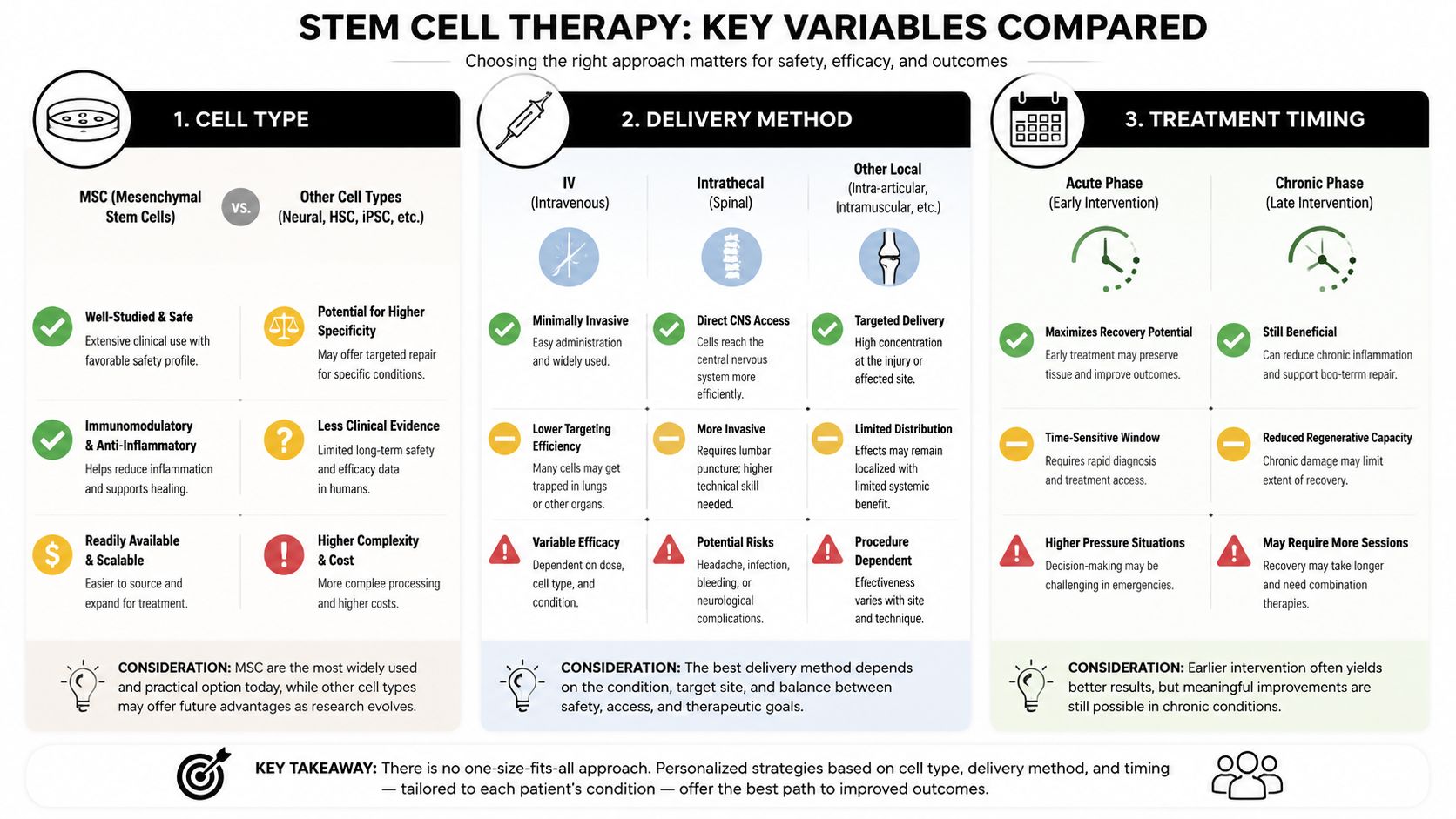
The biggest mistake people make is thinking all stem cell protocols are interchangeable. They're not. The field varies by cell source, delivery route, dose, and timing, and those variables often matter more than the label “stem cells” itself.
Why allogeneic cells are used
Longevity Medical Institute uses allogeneic stem cell sources only, including placental, Wharton's jelly, adipose, endometrial, and dental pulp cells. The clinical logic is straightforward. In regenerative medicine, younger donor-derived cells are generally chosen for their signaling capacity and consistency, while autologous options are not the model used here.
That choice fits a larger reality in stroke research. A detailed review of ischemic-stroke trials identified 43 clinical trials, and protocols varied widely by cell type, dose, route, and transplant timing (trial review). That variation is why one clinic's protocol can't be assumed to behave like another clinic's.
Delivery route and timing windows
Some studies use intravenous delivery, while others explore intrathecal or targeted routes. The practical appeal of IV treatment is simple, it's less invasive and fits a systemic signaling model. More targeted routes may be used in select settings, but the field still lacks one universal standard.
Timing is the part patients usually underestimate. Recent review work suggests benefit signals when therapy is delivered within 1 month of ischemic stroke onset, while older clinical summaries describe acute treatment windows of 36 to 72 hours in some protocols (timing review). The point isn't that one window is always superior, it's that the biologic state of the brain changes quickly, and that changes the potential value of treatment.
Clinical insight: The best candidate isn't always the person with the worst stroke. It's often the person whose diagnosis, timing, and recovery phase still leave room for the brain to respond.
A comparison of protocol categories is easier to evaluate in mesenchymal stem cell therapy, since mesenchymal cells are the most common reference point in this field. The takeaway is simple, patient selection and timing often determine the quality of the response more than marketing language does.
The Patient Journey from Evaluation to Rehabilitation
A stroke recovery program should never begin with a procedure alone. It should begin with whether the person is medically stable, what the brain imaging shows, and whether there are any problems that would make regenerative treatment inappropriate or less useful. That's where a serious evaluation becomes more than a formality.
What the workup should include
At Longevity Medical Institute, the practical baseline workup can include AI-enhanced full-body MRI, advanced heart evaluation, and in-house clinical laboratory testing measuring 140 biomarkers. Those tools help teams look for hidden risks, support treatment planning, and avoid guessing about overall medical fitness.
Stroke patients often have more going on than the stroke itself. Blood pressure issues, vascular disease, inflammation, medication interactions, and deconditioning can all influence whether a recovery plan is realistic. The point of a broad diagnostic review is to make the treatment path safer and more precise.
The clinic can also integrate stem cell care with rehabilitation modalities and adjunctive therapies such as hyperbaric oxygen therapy, but the recovery process still depends on the patient showing up for the work after the procedure. That usually means physical therapy, occupational therapy, speech rehab when needed, and follow-up monitoring over weeks and months.
How the process usually feels for the patient
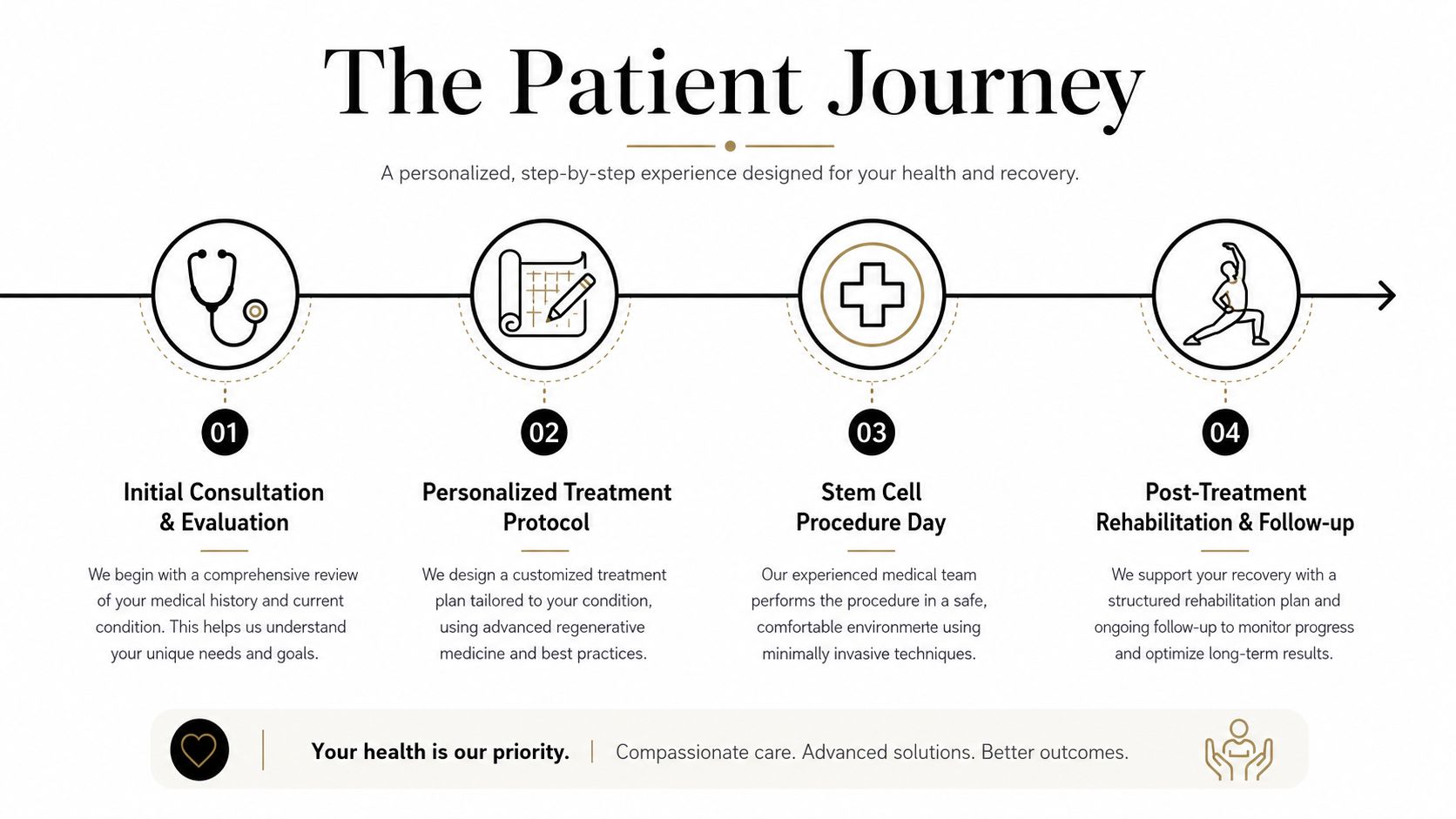
First comes the consultation and record review. Then the team builds a personalized plan around medical history, imaging, goals, and practical travel logistics if the patient is coming from abroad. Procedure day is only one part of the experience.
The more important part is what happens after. Rehab is what trains the nervous system to use any improved biological environment, so the treatment plan has to support function, not just laboratory theory.
A stroke recovery plan should feel coordinated, not fragmented. If the diagnostic picture, procedure, and rehab plan don't fit together, the patient ends up carrying too much of the burden alone.
For some patients, the right environment includes a broader longevity and recovery platform such as Longevity Medical Institute, especially when neurological care needs to be integrated with diagnostics, follow-up, and rehabilitation support.
Common Misconceptions and Important Limitations
The most expensive mistake in this field is confusing experimental support with guaranteed restoration. Stem cell therapy is not a miracle cure, it doesn't rebuild dead brain tissue on demand, and it doesn't replace standard stroke rehabilitation. The evidence points to a supportive role, not a stand-alone solution.
What it can't do
It can't promise overnight reversal of paralysis. It can't guarantee speech will return to baseline. It can't erase chronic disability in every patient, and it shouldn't be presented that way.
Safety is another area where honesty matters. A careful review of the safety context is worth reading in this overview of stem cell therapy safety, because even when profiles are generally acceptable, no procedure is risk-free. Good candidates still need screening, monitoring, and realistic goals.
The evidence also shows variation from patient to patient. Stroke subtype, recovery phase, overall health, and treatment protocol all affect the odds of benefit. That's why two people with similar scans can still respond differently.
How to think about expectations
A better expectation is this, stem cell therapy may help create better conditions for recovery, then rehabilitation has to convert that potential into function. That's a very different promise from “you'll get your old life back.” It's also a more credible one.
Some clinics speak as if the therapy itself is the finish line. It isn't. For stroke survivors, the finish line is usually improved independence, safer movement, clearer communication, and a better day-to-day life, even if the gains are gradual rather than dramatic.
Is Stem Cell Therapy Right for You
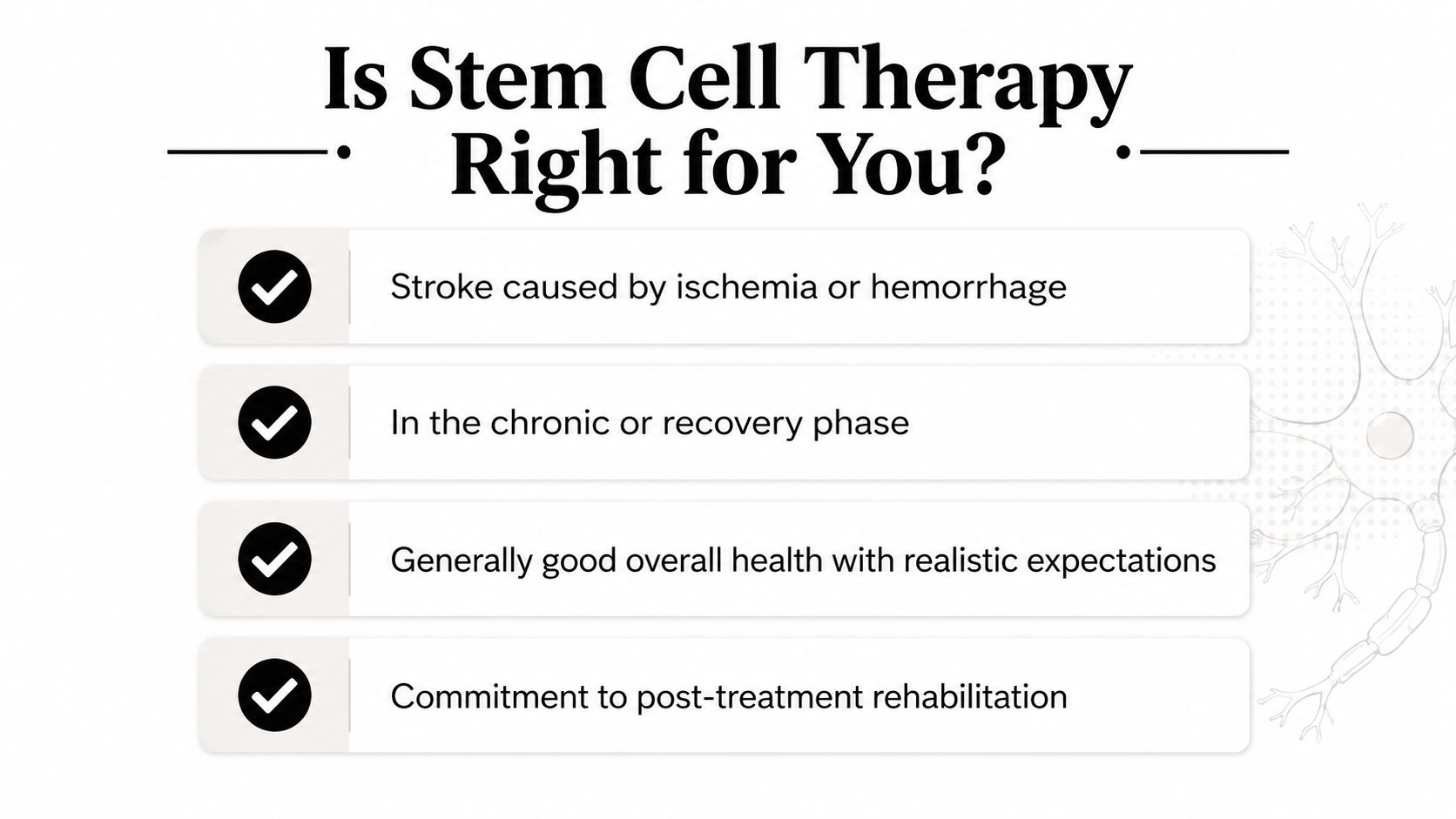
The clearest candidates are usually people with ischemic stroke, or selected hemorrhagic cases, who are in the subacute or early chronic phase, have plateaued with conventional rehab, and still have enough residual function for recovery to build on. The overall health picture matters just as much as the scan.
Questions worth asking before you travel
What stroke type do I have? Ischemic and hemorrhagic strokes aren't evaluated the same way.
How far along is recovery? Timing can influence whether the brain is still responsive to regenerative support.
What does my current health profile look like? Cardiac risk, medication use, and imaging findings all matter.
Am I ready to commit to rehab after treatment? The procedure is only one step in the process.
If you're considering medical travel to San José del Cabo, gather your MRI or CT reports, medication list, prior rehabilitation notes, and a clear summary of your goals before scheduling. That makes the consultation more useful and helps the team judge whether the plan is realistic.
The right question isn't “Can stem cells help stroke?” It's “In my case, at this phase, with this recovery history, is there a meaningful role for them?” That's the question worth bringing to a specialist.
If you're weighing options for stroke recovery, schedule a consultation with Longevity Medical Institute to review your medical history, imaging, and rehabilitation goals in a structured setting. The team can help you understand whether an allogeneic stem cell approach fits your situation, and how it would be coordinated with diagnostics, rehab, and follow-up care. Visit Longevity Medical Institute to start that conversation.
Author
Dr. Kirk Sanford, DC, Founder & CEO, Longevity Medical Institute. Dr. Sanford focuses on patient education in regenerative and longevity medicine, translating complex therapies into clear, practical guidance for patients.
Medical Review
Dr. Félix Porras, MD, Medical Director, Longevity Medical Institute. Dr. Porras provides clinical oversight and medical review to help ensure accuracy, safety context, and alignment with current standards of care.
Last Reviewed: August 9, 2026
Short Disclaimer
This information is for educational purposes only and is not medical advice. It does not replace an evaluation by a qualified healthcare professional. For personalized guidance, please schedule a consultation.