

Stem Cell Therapy for Type 1 Diabetes
You wake up, check your glucose, dose your insulin, and still wonder whether anything can help the insulin-making cells you have left. That question is common after a type 1 diabetes diagnosis. Daily management keeps you safe, yet it doesn't answer whether the immune attack on the pancreas can be eased.
Stem cell therapy for type 1 diabetes is opening up two promising avenues: helping preserve the insulin-producing beta cells you still have and replacing cells that have been lost. Early human studies have reported slower declines in remaining insulin production in some patients, while small islet-replacement studies have shown that transplanted cells can produce insulin and, in some cases, eliminate the need for injected insulin during follow-up. These are meaningful advances, even though the approaches remain different and most are still being studied.
This guide explains where the strongest signals of progress are, what C-peptide and HbA1c can tell you, and which questions to ask before considering a treatment. The goal is informed optimism, not a reason to change your insulin without your diabetes team's guidance.
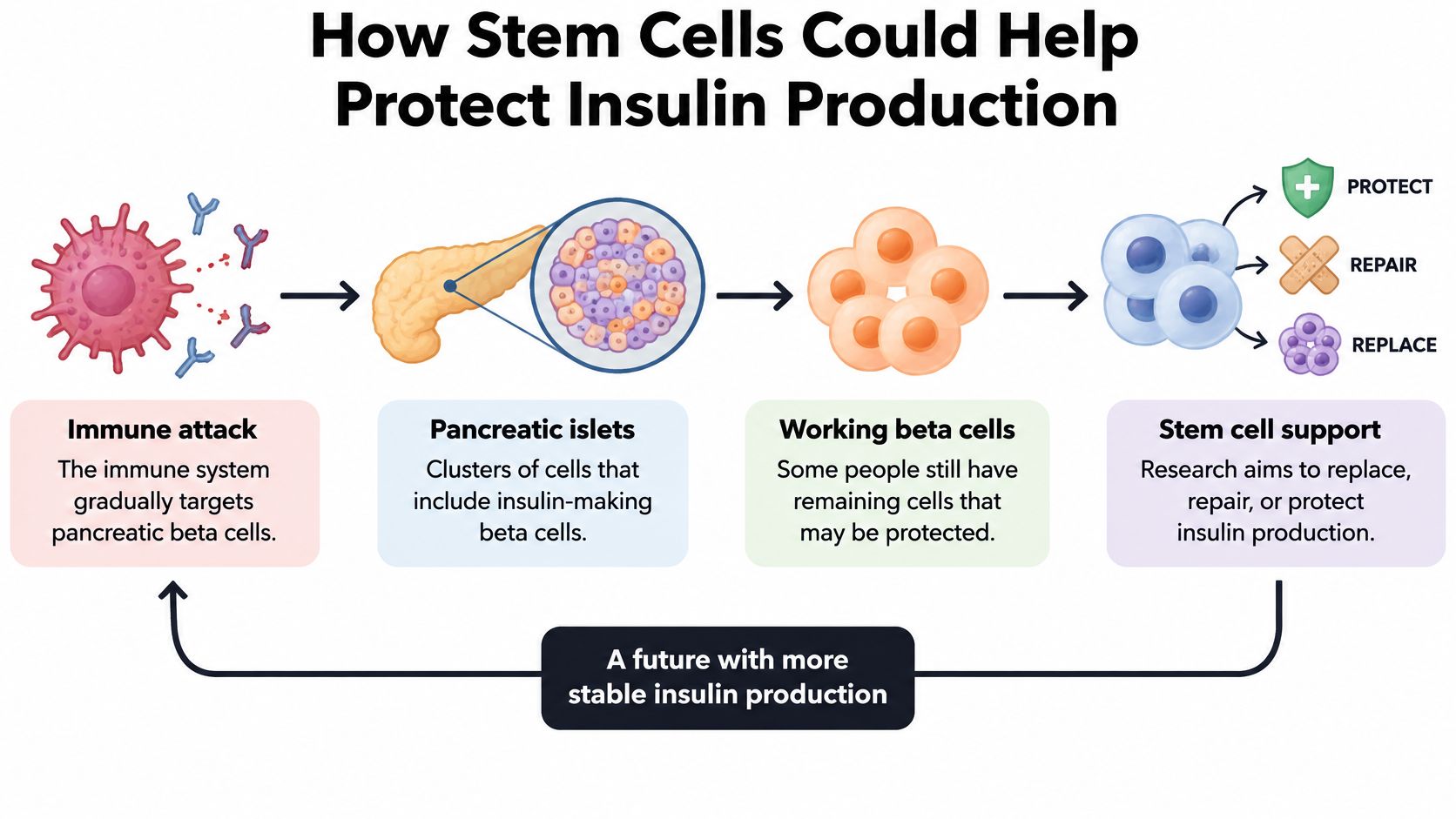
How Stem Cells Could Help Protect Insulin Production
Say your immune system is a security team that starts treating the household staff as intruders. In type 1 diabetes, that staff is the beta cells inside the pancreatic islets, the clusters that release insulin when glucose rises. Many people still have some working beta cells at diagnosis. The attack often continues, and the body's own insulin signal fades over time.
Stem cell research approaches that problem in two ways.
Replacement brings in new insulin-producing cells, a new staff hired from outside. Preservation tries to quiet the alarm so the staff already on duty can keep working. Preservation is the more realistic near-term goal for many people, especially when diabetes is recent and some C-peptide is still measurable. It doesn't mean throwing away insulin. It means supporting what the pancreas can still do.
Immune modulation in plain language
Mesenchymal stem cells (MSCs) are studied mainly for immune modulation, not because they turn into beta cells. They release signaling molecules, which you can think of as short messages passed from cell to cell. Those messages may lower inflammation and nudge immune activity back toward balance. That is the logic behind immune modulation with stem cells in autoimmune disease: ease the mistaken attack, rather than promise a new pancreas.
Timing matters. If almost no beta cells remain, there is less function to protect. If some remain, slowing the loss can keep insulin needs steadier.
What one transplant case can and can't show
Replacement research has its own early signal. In 2024, The Lancet Diabetes & Endocrinology00314-0/fulltext) reported that a 25-year-old woman in a first-in-human study of autologous, chemically induced pluripotent stem-cell-derived islets became insulin-independent 75 days after transplantation, and her HbA1c fell from 7.57% to 5.37% by Day 120. One person can't set a trend. The case does show that lab-grown, insulin-producing cells can function in a human body.
Practical rule: Ask whether a program is trying to protect your remaining beta cells or replace them. Those are different procedures, different follow-up plans, and different promises.
The next sections test preservation with a randomized trial, then line up the other approaches side by side.
What the 2023 Wharton's Jelly Trial Showed
A useful place to start is a 2023 randomized, placebo-controlled study of intravenous Wharton's jelly mesenchymal stem cells in people with type 1 diabetes, followed for one year and indexed on PubMed. Wharton's jelly is the cushioning tissue inside the umbilical cord. The cells were given by vein, and the comparison was against placebo, which is stronger evidence than a clinic series with no control group.
The one-year numbers
| Outcome after one year | Treated patients | Placebo patients |
|---|---|---|
| C-peptide change | Declined about 10% | Declined about 47% |
| Insulin requirements | Remained stable | Increased |
| What it suggests | Slower loss of remaining insulin production | Faster loss and rising insulin needs |
C-peptide is a lab marker of insulin your own body still makes. When doctors measure it, often with a stimulation test, they are asking how much reserve is left. In this trial, C-peptide declined about 10% in the treated group and about 47% with placebo. Insulin requirements stayed stable in treated patients and rose in the control group.
Why a slower decline is encouraging
A smaller drop in C-peptide means the body kept more of its own insulin-making signal. When that signal holds, daily insulin needs are more likely to stay steady instead of climbing. For someone in the first years after diagnosis, that is a meaningful clinical goal. You still use insulin. You may avoid a faster slide toward needing more of it.
Recent-onset disease is the logical focus. More remaining beta-cell function means more to preserve. Once C-peptide is already very low, an immune-calming infusion has less native function to support. That is why a good program looks at your labs before talking about this kind of care, rather than offering the same infusion to everyone.
What this trial does not show
This is one trial. The pattern is a slower loss, not freedom from insulin.
Keep taking insulin exactly as prescribed. Never stop it because a study, a headline, or a clinic conversation sounds promising.
Larger studies still need to clarify how many people benefit, whether the effect lasts past one year, which patients respond best, and what dose and timing work best. A stable insulin dose for twelve months is encouraging. It isn't proof that the same result will hold for five years, or that every source of MSCs will behave like Wharton's jelly given by vein.
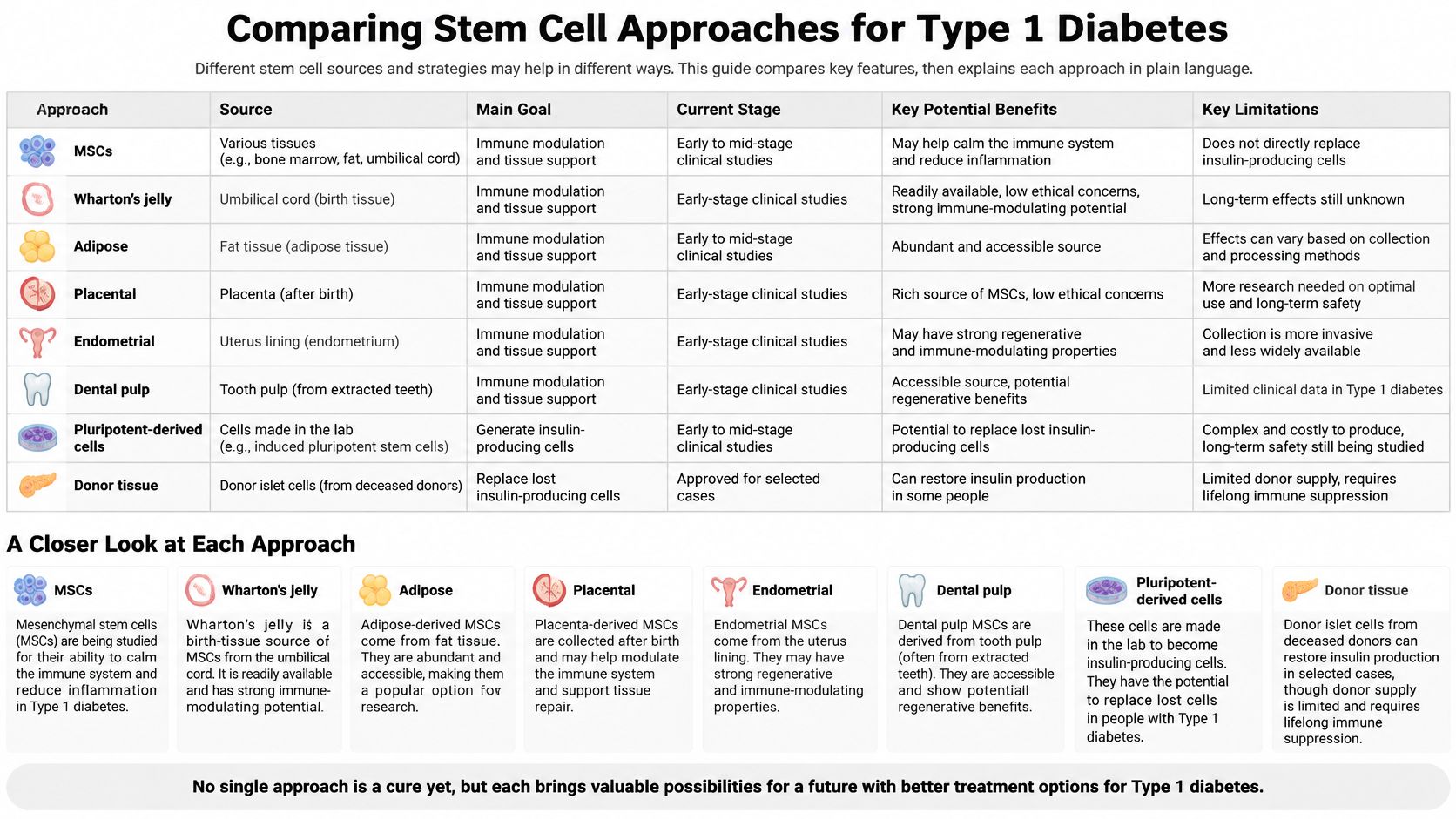
Comparing Stem Cell Approaches for Type 1 Diabetes
Approaches differ by cell source, by what the cells are expected to do, and by how far human studies have gone. None of them has proven type 1 diabetes outcomes in large, long trials. Multipotent and pluripotent stem cells are not interchangeable, and that difference should shape any conversation about diabetes.
| Approach | Cell source | Human evidence stage | Main consideration |
|---|---|---|---|
| MSC infusion | Wharton's jelly, adipose, placental or other donor tissue | Randomized trials; small studies | Mainly immune-modulating; benefits modest so far |
| Stem-cell-derived islets | Pluripotent stem cells grown into islet-like cells | Phase 1-2 (zimislecel); Phase 3 planned | Immunosuppression needed; long-term monitoring |
| Donor islet therapy (Lantidra) | Pancreatic islets from deceased donors | Regulatory approval in 2023 for a narrow group | Donor supply and immunosuppression |
| MUSE cells | Allogeneic stress-enduring stem-like cells | Early research; limited diabetes data | Evidence still developing |
| Exosomes | Cell-derived signaling particles, cell-free | Preclinical and early clinical | Standardization and dosing still being studied |
MSC infusions are the preservation track. Sources include Wharton's jelly, adipose tissue, placenta, endometrium, and dental pulp. These cells mainly work through immune modulation and cellular signaling. They aren't expected to become beta cells. At Longevity Medical Institute, stem cell therapy uses ethically sourced MSC and MUSE stem cells under physician supervision, with the source chosen to fit the person rather than a single menu item.
Stem-cell-derived islets are the replacement track. In a phase 1–2 study of zimislecel, an allogeneic, fully differentiated islet-cell therapy, PubMed reports that 14 adults were followed for at least 12 months, 12 received the full dose, and 10 of those 12 (83%) no longer needed injected insulin at day 365. The same full-dose group had measurable islet function, better glucose control, and no severe hypoglycemic events. The study was small, follow-up was limited, and participants needed immunosuppression. It supports more research. It doesn't establish a cure.
Donor islet therapy, including Lantidra, uses islets from deceased donors. It reached regulatory approval in 2023 for a narrow adult group, not for everyone with type 1 diabetes. Donor supply is limited, and immunosuppression comes with the graft.
MUSE cells are allogeneic, stress-enduring, stem-like cells. Diabetes data in people are still thin, so they belong in a careful research conversation, not a results promise.
Exosomes are cell-free messengers. They carry signals without implanting whole cells. Most support is preclinical or very early in humans, and dosing standards are still being built.
How the cells are given
MSCs in this setting are typically given by intravenous infusion. Islet-style products are usually delivered through the portal vein or an implanted device. The route decides who is a fit and what monitoring follows, from infusion reactions to graft and immune-drug follow-up.
Benefits, Risks and Safety Trade-Offs
Benefit and safety are not the same finding. A therapy can be well tolerated and still change blood sugar only a little.
A systematic review of seven randomized trials with 169 participants, summarized in PMC, found an average HbA1c reduction of 0.57 percentage points at 6 months. At 12 months the difference was 0.49 points, and the confidence interval reached zero, so it was not statistically significant. Read that as a modest average shift in blood sugar, not a change in insulin dependence. HbA1c reflects glucose over about three months. It doesn't tell you whether your own beta cells recovered.
What safety looked like in those trials
Across the same seven trials, no severe adverse events were reported. Effects that did appear were generally mild and short-lived: headache, cough, abdominal discomfort, flu-like symptoms, injection-site reactions, and minor lab changes. That record is encouraging for people weighing time off work or travel. It doesn't prove the treatment works, and it doesn't make any cell product risk-free.
Safety depends on the cell product, how it is prepared, the dose, the delivery route, the physician's experience, and your own health. MSC safety data in these trials shouldn't be borrowed to describe MUSE cells or exosomes, where human diabetes evidence is much thinner. A clear look at whether stem cell therapy is safe starts with which product is being offered.
| Area | What the evidence shows | Who it matters most for |
|---|---|---|
| HbA1c change | About -0.57 points at 6 months; not significant at 12 months | Patients hoping for glucose-lowering benefit |
| Serious adverse events | None reported across the seven reviewed trials | All prospective patients |
| Mild side effects | Headache, cough, abdominal discomfort, flu-like symptoms, injection-site reactions | Patients planning around recovery time |
| Immunosuppression | Used with some islet approaches to protect implanted cells | Patients with infection, kidney or cancer concerns |
| Abnormal growth | Concern with incompletely differentiated pluripotent cells | Patients considering pluripotent-derived products |
Trade-offs that change who should consider treatment
Islet replacement can require immunosuppression so the new cells aren't rejected. That raises the need to watch for infection, kidney strain, malignancy, and drug toxicity. Pluripotent-derived products also need surveillance for abnormal tumor growth if cells aren't fully specialized before transplant.
A calm side-effect list is not proof of effectiveness. Ask what was measured: C-peptide, HbA1c, time-in-range, severe lows, and insulin dose.
The right balance is personal. Someone with repeated severe lows faces a different risk math than someone who is otherwise well and already meeting glucose targets.
Who May Qualify and Where the Therapy Stands Today
Cell replacement crossed a regulatory threshold in 2023, and that milestone is easy to over-read. Lantidra, made from pancreatic islets of deceased donors, was approved for a narrow group of adults with type 1 diabetes who can't recognize or manage severe low blood sugar and who keep having severe hypoglycemic events despite intensive care. It sets a precedent for replacing islet cells in people with serious complications. It is not a broad green light for stem-cell products, nor is it suitable for individuals who are managing well on insulin.
A candidacy checklist
Current clinical discussion of stem-cell-derived islets points to a direct mechanism: implanted beta-like cells can release glucose-responsive insulin and restore C-peptide. Those cells are allogeneic, so the recipient's immune system can attack them. Systemic immunosuppression is the trade-off, which limits suitability for otherwise healthy patients and makes infection, kidney, cancer, and drug-toxicity monitoring part of the plan.
Before anyone talks about a procedure, a careful review usually includes:
Documented C-peptide: Know whether your body still makes insulin, and how much reserve a stimulation test shows.
Severe lows or impaired awareness: These matter most when replacement, not preservation, is on the table.
Optimized diabetes technology: Continuous glucose monitoring or a pump, when they fit your care, should already be in use.
Screening: Infection risk, kidney function, and cancer history change the safety of immune-suppressing drugs.
A plain discussion of limits: Early insulin-independence results don't prove that a graft lasts, or that the same result applies broadly.
A younger person with recent-onset disease and stable glucose may be a better fit for preservation research than for a transplant that requires lifelong immune drugs. Someone with repeated severe hypoglycemia may accept that trade-off because the lows themselves are dangerous. The same protocol shouldn't be offered to both.
Where programs stand
Most stem-cell approaches for type 1 diabetes are still being studied. Zimislecel has moved into a larger confirmatory trial. MSC infusions and exosomes remain research-stage tools for this disease. A clinic license or a polished lab doesn't, by itself, mean a product is approved to treat diabetes. Ask which study framework applies, and whether care is part of a research protocol. People comparing metabolic options can also read how this differs from stem cell therapy for type 2 diabetes, where the underlying biology isn't the same autoimmune loss of beta cells.
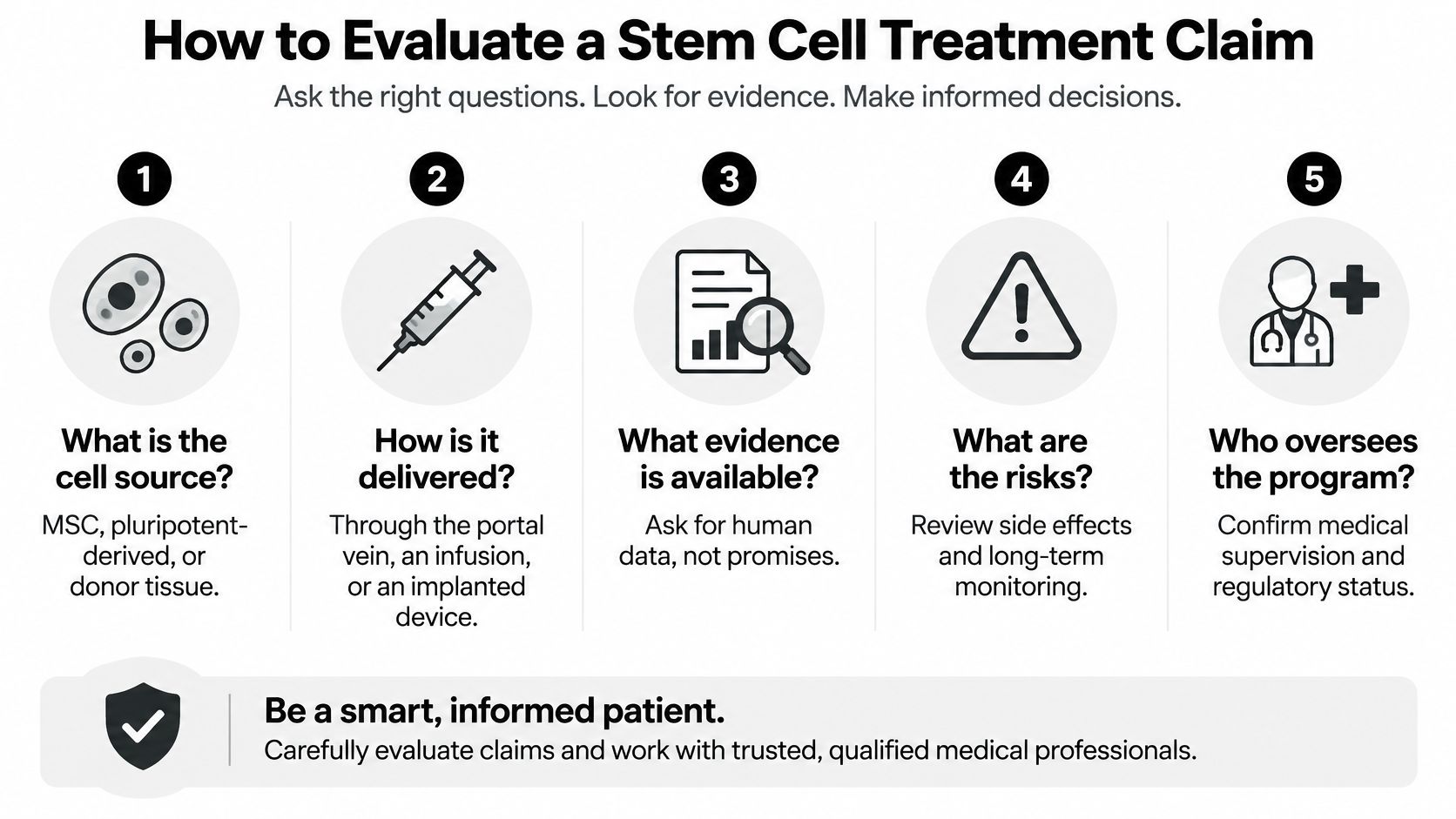
How to Evaluate a Stem Cell Treatment Claim
Put these five questions to any program before you book travel.
What is the cell source? MSC, pluripotent-derived islets, or donor tissue.
How is it delivered? Portal vein, intravenous infusion, or an implanted device.
What independent testing exists? Identity, potency, sterility, tumorigenicity, and genetic stability.
What if something goes wrong? Graft failure, infection, or abnormal growth.
Who follows you for life? A named clinician, not a one-time visit.
Ask for these measurements in writing.
| Measurement | What it tells you |
|---|---|
| C-peptide | Marker of insulin the body still produces; stimulated testing shows remaining reserve |
| HbA1c | Average blood sugar over roughly three months |
| Time-in-range | Share of time glucose stays within target, from continuous glucose monitor data |
| Severe hypoglycemia events | Number of episodes needing outside help; especially important with impaired awareness |
| Insulin dose | Total daily insulin, showing whether needs rise, fall or stay steady |
A 2025 report of gene-edited human islets making insulin in one patient without systemic immunosuppression is a proof of concept, not proof of durability or approval. Encapsulation without immune drugs has looked safer so far and less effective. Full immunosuppression has produced stronger glucose restoration with ongoing immune risk.
Our programs aren't standardized packages. Each one is built from your clinical picture, goals, evaluation, delivery method, and the therapeutic quantity required. Every product from our biotechnology lab is checked with flow cytometry, and the lab is ISO-6 certified, in partnership with ITC, the largest stem cell bank in Mexico. Use a structured list such as 15 questions every patient should ask. Pause if you hear a guaranteed cure, advice to stop insulin, one protocol for every patient, or no written follow-up.
Your Next Step Is an Individualized Assessment
Stem cell research may point toward protecting insulin production that remains, but that is different from restoring enough function for insulin independence. To judge any treatment claim, bring together your C-peptide and HbA1c results, glucose-monitor downloads, current medicines and insulin doses, prior imaging or labs, and questions from the checklist above. These measures help frame a clinical discussion; they do not establish that a therapy will work for every patient.
An assessment at Longevity Medical Institute can include a broad in-house clinical laboratory panel, AI-enhanced full-body MRI, cardiovascular evaluation, and physician review of whether an option fits your clinical picture and goals.
Keep taking insulin and following your diabetes care plan unless your own physician changes them. No cellular therapy described here replaces that care, and promising findings do not guarantee insulin independence.
If you want an in-person assessment, schedule a consultation to discuss your history, results, and goals rather than assume a generic protocol is right for you.
Longevity Medical Institute offers physician-supervised regenerative care, with programs shaped around a patient's clinical picture. For help distinguishing preservation from replacement and discussing whether an option may fit, visit Longevity Medical Institute to schedule a consultation.
Author
Dr. Kirk Sanford, DC — Founder & CEO, Longevity Medical Institute. Dr. Sanford focuses on patient education in regenerative and longevity medicine, translating complex therapies into clear, practical guidance for patients.
Medical Review
Dr. Félix Porras, MD — Medical Director, Longevity Medical Institute. Dr. Porras provides clinical oversight and medical review to help ensure accuracy, safety context, and alignment with current standards of care.
Last Reviewed: October 29, 2026
Short Disclaimer
This information is for educational purposes only and is not medical advice. It does not replace an evaluation by a qualified healthcare professional. For personalized guidance, please schedule a consultation.