

Full Body MRI vs CT Scan: A Clinician's Decision Guide
You're sitting in a consultation room, tablet open, trying to decide whether a full body MRI vs CT scan is the smarter move for a baseline check. The conversation usually starts with radiation, but that's not the primary decision. The core question is whether a broad scan is justified at all, and if it is, which modality matches the organ system and clinical purpose you care about most.
A thoughtful clinician doesn't treat imaging as a luxury add-on. Imaging is a tool that should answer a specific question, change management, or clarify risk in a way that makes the next step cleaner. That's why I walk patients through the decision in layers, not as a simple contest between a “safer” scanner and a “faster” one.
| Decision Point | Full Body MRI | Full Body CT |
|---|---|---|
| Radiation | No ionizing radiation | Uses ionizing X-rays |
| Typical full-body time | About 60–90 minutes | About 10–15 minutes |
| Soft tissue detail | Stronger for soft tissue | Useful, but generally less detailed than MRI |
| Bone and lung detail | Limited in some settings | Stronger for bones, lungs, calcifications |
| Repeat surveillance | Better when cumulative dose matters | Less ideal if scans may be repeated often |
| Common trade-off | Comfort, time, motion tolerance | Radiation exposure, but speed and broad utility |
The Decision Most Patients Get Wrong
An executive books a longevity workup because he's heard CT exposes the body to radiation and MRI doesn't. He wants the scan that sounds cleanest, and he's already leaning toward the most expensive option. That instinct is understandable, but it skips the part that matters most, what problem are we trying to solve.
I see this pattern often in patients coming in for prevention, especially medical tourists who want a one-stop answer. They assume the right move is to choose the scan with the gentlest reputation, then hope the imaging report will tell the whole story. It usually doesn't work that way.
Practical rule: first ask what you're looking for, then ask whether you'd actually act on what the scan might find.
The three questions that change the answer
The first question is what are you looking for. If the concern is marrow-based disease, soft-tissue detail, or repeated surveillance where radiation matters, MRI may fit better. If the concern is lungs, calcification, fracture, or a rapid look at something acute, CT often makes more sense.
The second question is what will you do with the answer. A scan that produces incidental findings without a clear action plan can create more work than value. That's why the most responsible decision is often to step back and decide whether a full-body scan is justified before comparing scanners at all, which is also why public-health guidance remains cautious about whole-body screening in healthy people (Health Canada guidance on whole-body screening).
The third question is what is your baseline risk. A healthy adult with no symptoms and no specific risk factor is very different from a patient with known cancer risk, trauma, chronic orthopedic symptoms, or a disease that needs serial follow-up. That's where the conversation becomes clinical instead of promotional. If you want a deeper patient-facing comparison from our own practice framework, this overview of Prenuvo and Longevity MRI questions is a useful companion.
A full-body scan is not a trophy. It's a decision, and it should earn its place.
A resource many oncology patients also find helpful is CT and MRI for cancer patients from Hirschfeld Oncology, because it frames the same issue from a cancer-care perspective rather than a wellness perspective.
The Physics Behind CT and MRI
CT and MRI solve the same general problem, but they use different physics to get there. CT uses X-rays, so it involves ionizing radiation. In a whole-body setting, that matters because repeated scans add up over time, and anyone who is followed year after year should think about cumulative exposure, not just a single appointment.
MRI uses a strong magnetic field and radiofrequency pulses to build images. There is no ionizing radiation involved, which is one reason clinicians prefer it for repeat surveillance when dose is a concern. The trade-off is different, though, because MRI usually asks more of the patient in terms of stillness, time, and tolerance of the scanner environment. For a practical overview of how an AI-enhanced full-body MRI works, it helps to separate the scan mechanics from the marketing language around them.
Time, motion, and comfort are not minor details
A full-body CT is typically much quicker than a full-body MRI, and that speed helps with workflow, breath-holding, and patients who cannot tolerate a long time in the bore. MRI takes longer, and motion can degrade the study. If a patient is claustrophobic, uncomfortable lying flat, or likely to move, the scan can become harder to complete well.
A slower scan is not automatically a better scan. It is only better if the patient can stay still long enough for the images to be clean.
Contrast adds another layer. CT often uses iodinated contrast, while MRI may use gadolinium-based contrast. Each has its own screening questions, and each can be inappropriate for some patients depending on kidney function, allergy history, and the exact clinical need. Contrast is not something to assume, it is something to justify.
The practical point is simple. CT is often the better operational tool when speed, motion, or lung detail matters. MRI is often the better tool when tissue contrast matters more than speed and when avoiding radiation is a priority.

Where Each Modality Wins Organ by Organ
A single scanner doesn't win every category. The right choice depends on the anatomy you need to see and the question you're asking. That's why the “MRI is safer” and “CT is faster” shorthand never fully solves the problem.
Full Body MRI vs CT Scan by Body Region
| Body Region | MRI Strength | CT Strength | Better Default |
|---|---|---|---|
| Brain | Better soft tissue detail | Faster overview, useful in urgent settings | MRI for most non-urgent soft tissue questions |
| Spine | Better for cord, discs, ligaments | Strong for bone detail and trauma | MRI for chronic symptoms, CT for fracture or acute bone concern |
| Musculoskeletal | Excellent for ligaments, cartilage, marrow | Strong for fracture and cortical bone | MRI for soft-tissue injury, CT for bony injury |
| Chest | Limited for tiny lung lesions | Strong for lungs and calcified findings | CT |
| Abdomen | Strong soft tissue contrast | Good for broader structural review | Depends on the target organ |
| Pelvis | Excellent for organs and soft tissues | Strong for calcification and some bony questions | MRI for many soft tissue questions |
| Cardiovascular | Useful for soft tissue characterization | Strong for calcium-focused assessment | CT for calcium, MRI for tissue characterization |
MRI is consistently described as stronger for the brain, spinal cord, ligaments, joints, and internal organs, while CT is stronger for bones, lungs, and internal bleeding. That's a useful starting point, but the default can flip depending on the clinical problem.
The organ can stay the same while the answer changes
A chronic knee injury usually pushes me toward MRI because cartilage, ligaments, and marrow detail matter. An acute fall with suspected fracture pushes me toward CT because bone architecture matters more and the exam needs to be fast. The same logic applies in the chest, where CT is generally better for lung evaluation and MRI can't compete for tiny pulmonary findings.
For a man being worked up for prostate concerns, a targeted approach is often more informative than a broad sweep, which is why a focused prostate MRI resource can be more useful than a generic body scan. Same scanner family, different clinical intent.
The best scan is the one that answers the question with the least ambiguity, not the one with the most impressive marketing.
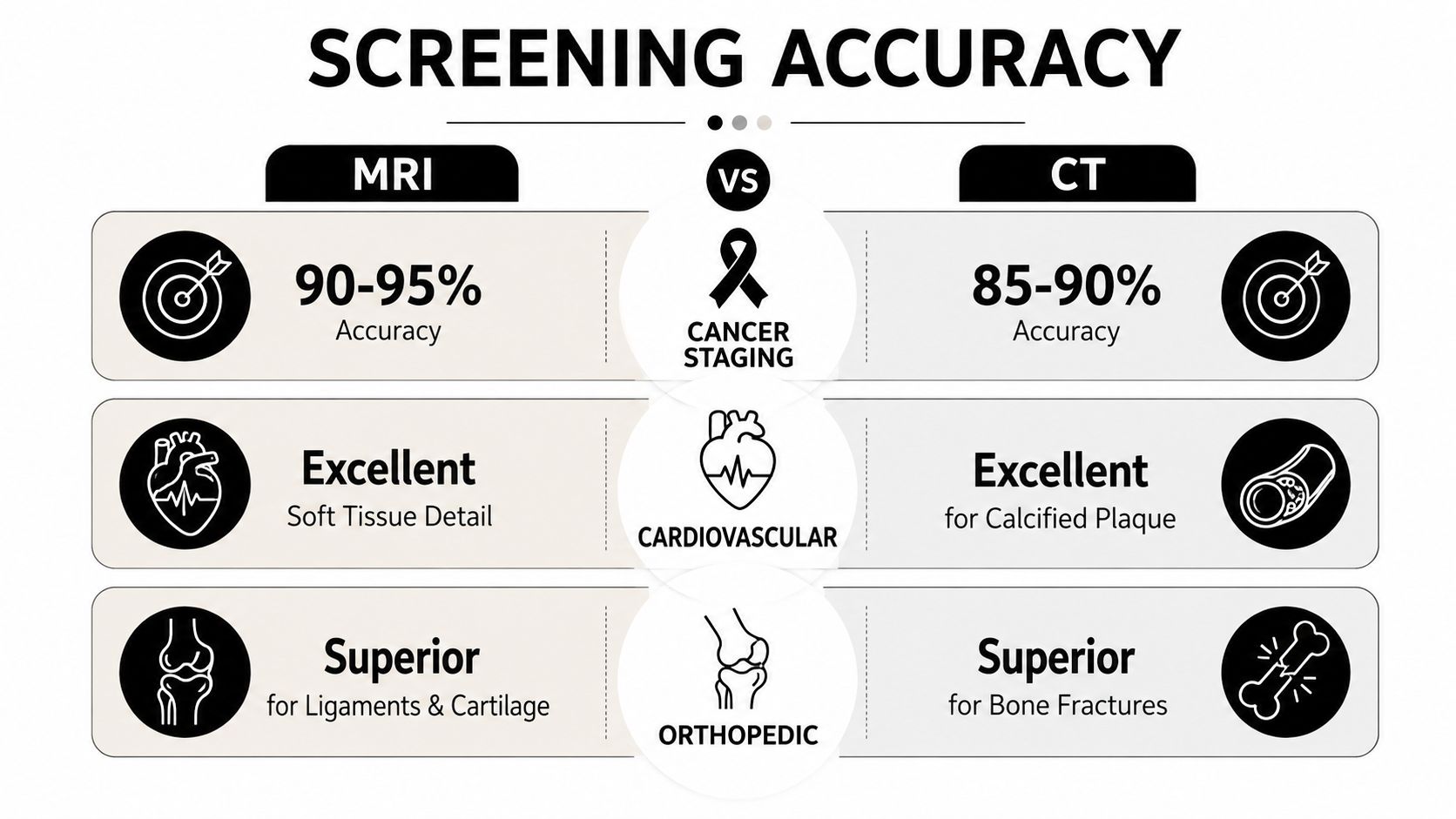
Accuracy for Cancer, Cardiovascular, and Orthopedic Conditions
A scan can look reassuring and still miss the finding that changes management. Accuracy depends on lesion size, location, and the question being asked. In practice, the modality choice changes once the target shifts from broad screening to a specific organ system.
Oncology is size dependent
In lymphoma staging, whole-body MRI had 35% overall sensitivity versus CT as the reference standard, but performance improved sharply with lesion size. MRI sensitivity was 10.7% for nodes measuring 1–6 mm, 67.0% for 6–12 mm nodes, and 92.0% for nodes greater than 12 mm. Specificity stayed extremely high at 99.5%, 99.6%, and 99.9% across those same size groups, and the authors concluded MRI was a practical alternative to CT for staging disease while adding the advantage of bone marrow assessment (AJR whole-body lymphoma staging study).
Melanoma staging adds a different nuance. Among the two most experienced observers, MRI sensitivity was 73.4% versus 78.2% for CT, while CT was far more sensitive for 1–5 mm pulmonary nodules at 66.9% versus 2.9% for MRI. MRI, however, was more specific at 83.4% versus 50.4% (melanoma whole-body MRI study). This represents the practical trade-off, better specificity on one side, better tiny-lung-lesion detection on the other.
Cardiovascular and orthopedic use cases are more selective
For calcium-heavy questions, CT remains important because it shows calcification well. For soft-tissue plaque characterization, MRI has the edge. That is why an early workup may use a dedicated heart disease detection pathway instead of depending on one full-body exam to answer everything at once.
Orthopedics follows the same pattern. MRI is the reference-style choice for ligaments, cartilage, and marrow. CT is often preferred for fractures and surgical planning because bone detail is clearer and the acquisition is faster. The scanner does not decide the diagnosis, the clinical question does.
Safety Beyond Radiation and the Screening Question
A scan that avoids radiation is not automatically the safer choice. The first question is whether a person should be screened at all, especially if they feel well, have average risk, and have no symptoms.
Public-health guidance stays cautious about whole-body screening in healthy people because incidental findings can lead to more imaging, biopsies, anxiety, and cost without proven outcome benefit (Health Canada on whole-body screening). That caution applies to both MRI and CT. If the result is unlikely to change care, the most advanced scanner is still the wrong tool.
The screening question matters more than the scanner
Targeted screening is a different decision. Lung cancer screening in selected smokers, coronary calcium assessment in specific adults, and age-based breast or colon screening all have a clearer rationale than a broad body scan. A full-body MRI can still make sense in selected high-risk settings, but healthy adults should not confuse access with evidence.
MRI also has its own safety checks. Implanted devices, pacemakers, claustrophobia, and renal impairment all need to be reviewed before the exam. Gadolinium-based contrast can be a poor choice in some patients with kidney disease, and the small but real risk of nephrogenic systemic fibrosis belongs in that discussion. That is not a reason to avoid MRI across the board, it is a reason to screen carefully before ordering it.
If the question is “Should I be scanned?”, start there. Modality choice comes second.
A scan is only as safe as the decision behind it. If the clinical target is narrow, a targeted test is often cleaner than a whole-body sweep.
Cost, Time, and Logistics You Should Plan For
In the U.S. market, reported average costs cluster around $1,000 to $3,000 for a full-body MRI versus about $500 to $1,500 for a CT scan (pricing overview). In practice, concierge longevity programs may package that differently, but the MRI is still usually the higher-ticket study.
The appointment footprint is different too. A CT visit is often easier to fit into a tight day because it's faster and less demanding on the patient. MRI asks for more time on the table, more stillness, and more tolerance for the machine itself. If contrast is used, there's also the check-in process, screening questionnaire, and post-scan observation when needed.
A simple planning checklist
Bring prior imaging: Old scans help the radiologist compare what's changed and what hasn't.
List implants and devices: MRI safety screening is not optional.
Ask about contrast early: Don't assume it's included or needed.
Plan for downtime: MRI is longer, and rushing it hurts image quality.
Confirm the next step: Know who reads the study and who explains the result.
Insurance coverage is another realistic issue. Elective whole-body screening often isn't covered, so patients should assume out-of-pocket payment unless a specific medical indication exists. That's especially important if you're choosing between a targeted exam and a broad preventive scan.
If timing matters, CT is usually easier. If radiation avoidance and soft-tissue detail matter more, MRI may justify the extra time and cost.
From Imaging Results to a Personalized Treatment Plan
A scan only matters if someone knows what to do with the findings. In a longevity setting, the image is the starting point, not the endpoint. The core value comes when a clinician connects that image to symptoms, labs, and a treatment plan.
At Longevity Medical Institute, that can mean an AI-enhanced full-body MRI being reviewed alongside an in-house clinical lab panel, advanced cardiac evaluation, and clinician oversight to decide whether a patient needs peptide therapy, hyperbaric oxygen, physical medicine, or another targeted protocol. The imaging then becomes one input in a broader decision, not a stand-alone product.
That model also fits our allogeneic regenerative platform. We use placental, Wharton's jelly, adipose, endometrial, and dental pulp sources in our biotechnology lab, and we don't use autologous sources. The point is not that every scan leads to a regenerative intervention, it's that the scan should clarify whether a patient is a candidate for something more specific.

Choosing the Right Scan and Common Patient Questions
If you're an executive wanting a baseline, MRI makes more sense when you want to avoid radiation and accept a longer appointment. If you're an athlete with a joint injury, MRI usually fits better. If you're being evaluated for lung concerns, acute trauma, or calcium-focused questions, CT is often the cleaner choice. For long-COVID workups, post-viral fatigue, or a family cancer history, the best scan is still the one tied to a specific clinical question, not a general fear.
If you want to know what the appointment feels like, this full-body MRI overview is a useful pre-visit read.
FAQ
Do I need to fast? Sometimes, especially if contrast is planned.
Will contrast be required? Not always, it depends on the target and the question.
Can I repeat a baseline scan? Yes, but the reason for repeating it should be clear.
What if there's an incidental finding? It should be reviewed in context, not ignored and not overtreated.
Can imaging be combined with treatment planning? Yes, and in a good clinic it should be.
If you're deciding between MRI and CT and want a clinician-led answer instead of a generic scan package, Longevity Medical Institute can help you match the imaging to your actual goal, then connect the result to labs, cardiac assessment, and a personalized longevity plan. Book a consultation if you want a careful review of whether a full-body scan is justified, and which modality fits your situation best.
Author
Dr. Kirk Sanford, DC, Founder & CEO, Longevity Medical Institute
Medical Review
Dr. Félix Porras, MD, Medical Director, Longevity Medical Institute
Last Reviewed: August 2, 2026
Short Disclaimer
This information is for educational purposes only and is not medical advice. It does not replace an evaluation by a qualified healthcare professional. For personalized guidance, please schedule a consultation.