

Stem Cell and Exosome Therapy for Psoriasis
Living with psoriasis can mean planning around plaques, itch, and flares even after trying creams, light therapy, or biologics. If relief has been partial or has faded, it is reasonable to ask whether stem cell or exosome therapy could offer another path. Early human studies have reported meaningful improvements in some patients. Those findings are promising, although the treatments remain investigational for psoriasis and do not replace established dermatology care.
Why Researchers Are Interested in Regenerative Approaches
Psoriasis is an immune-driven condition, not simply dry skin. Signals including IL-17, IL-23, and TNF-alpha help sustain inflammation and rapid skin-cell turnover. Approved topical medicines, phototherapy, and biologics can help substantially, but not everyone gets lasting relief. People weighing their options can explore dermatology and skin health services with a qualified clinician.
Researchers are investigating whether mesenchymal stromal cells, commonly called MSCs, and the exosomes released by cells can influence the inflammatory environment behind plaques. MSCs are living cells; exosomes are cell-free packages of molecular signals. They are distinct approaches, with different preparation and delivery considerations.
The appeal is not that either treatment has already been proved to clear psoriasis. It is that small human studies, alongside laboratory research, have produced enough encouraging observations to justify further investigation.
What the Early Psoriasis Findings Show
The most useful question is not whether every study was large or definitive. It is what patients actually experienced, whether the changes were measured, and what remains to be learned.
| Approach | Who was studied | Encouraging observation | What remains uncertain |
|---|---|---|---|
| Umbilical cord MSC infusion | 17 patients with psoriasis | 8 patients reached at least PASI40 at six months; 6 reached PASI75 | Who responds, how durable the benefit is, and how it compares with standard care |
| Adipose MSC infusion | A small pilot cohort | Psoriasis severity declined during the observation period | Whether results hold in larger, more varied groups |
| MSC treatment in biologic-resistant psoriasis | A small case series | Some patients improved substantially, including an 87% improvement in the best responder at four weeks | How representative and lasting that response is |
| Intradermal MSC-derived exosomes | 12 adults with plaque psoriasis | The highest tested dose showed improvements in symptoms and inflammatory markers | The best dose, duration of benefit, and reproducibility |
| Topical MSC-exosome ointment | Healthy volunteers | Early safety and tolerability findings | Whether the ointment improves psoriasis |
| Laboratory and animal research | Preclinical models | Reduced inflammatory signals and skin thickening in some models | Whether those effects translate into consistent patient benefit |
PASI stands for Psoriasis Area and Severity Index. PASI40 means a 40% improvement from a person's starting score; PASI75 means a 75% improvement. These are meaningful ways to track change, but a small study cannot tell every future patient what to expect.
A review of MSC research in psoriasis identified 69 publications from January 2012 through April 2022 across laboratory, animal, and human research. That breadth reflects sustained interest in immune modulation, while the number of patients treated in clinical studies remains modest. For broader context, see MSC therapy research for autoimmune disease.
How Stem Cell Signals May Help Calm Psoriasis
MSCs are being studied mainly for the signals they release, not because they are expected to turn directly into new skin. Researchers are examining whether those signals can influence immune cells, support regulatory T-cell activity, and temper inflammatory pathways associated with psoriasis. Learn more about how stem cells may support immune modulation.
That mechanism helps explain why the approach is interesting for an immune-driven condition. It does not guarantee that a particular product or patient will achieve a specific result.

Cell source and preparation matter
Investigators have studied MSCs from umbilical cord, Wharton's jelly, adipose tissue, placenta, endometrium, and dental pulp. MUSE cells have distinct characteristics. Those sources are not automatically interchangeable, and current psoriasis research does not establish a best cell type.
Longevity Medical Institute offers ethically sourced MSC and MUSE stem cells under physician supervision. That describes its treatment approach, not proof that one source produces better psoriasis outcomes. Its on-site biotechnology laboratory supports stem cell, exosome, and NK cell therapies. NK cells have a separate immune-surveillance role; their availability does not establish NK cell therapy as a psoriasis treatment.
A Closer Look at the MSC Results
In a phase 1/2a study, 17 patients received intravenous umbilical-cord-derived MSCs. At six months, 8 of 17 (47.1%) achieved at least PASI40, 6 (35.3%) reached PASI75, and 3 (17.6%) exceeded PASI90, according to the clinical study report. For patients and clinicians looking for new options, those measured improvements are an encouraging early signal.

Investigators reported no obvious treatment-related adverse effects during treatment or the six-month follow-up. They also observed an association between clinical response and regulatory T-cell levels. That connection may eventually help researchers understand who is most likely to benefit, although it is not yet a validated prediction tool.
A 2025 case series of biologic-resistant psoriasis reported an 87% improvement at four weeks in its best responder, according to the PubMed record. The result matters because it describes change in a difficult-to-treat patient. It should not be mistaken for the typical response across all patients.
These studies give physicians and patients concrete findings to discuss: measured reductions in disease severity, early observations about tolerability, and possible links to immune activity. They do not yet tell us the ideal candidate, optimal protocol, or long-term outcome.
Exosomes: Promising Cell-Free Research
Exosomes are cell-free extracellular vesicles that can carry proteins, RNA, and other molecular material. Unlike living MSCs, they do not continue producing new signals after administration. Their potential lies in the messages contained in the preparation and how those messages interact with tissue.
Laboratory and animal studies have found reductions in skin thickening and inflammatory markers with some MSC-derived exosome preparations. More importantly for patients, an early study has now examined exosomes in people with psoriasis.
What happened in the 12-person study?
A phase I/II study enrolled 12 adults with plaque psoriasis. Participants received one intradermal dose of adipose-derived MSC exosomes at 50, 100, or 200 micrograms per square centimeter. The highest dose was associated with improvement in clinical symptoms and inflammatory-marker profiles during a three-month observation period. Investigators also reported changes in markers linked to psoriasis inflammation, including IL-17, IL-23, and TNF-alpha.
This is a promising patient-level observation, especially because the researchers assessed both visible symptoms and biological markers. The sample was small, however, and the study cannot establish how consistently other patients would respond or how long an improvement would last. A review of clinical and preclinical exosome research likewise describes an evolving field rather than an established psoriasis treatment.
Delivery route matters. Intradermal injection and a topical ointment expose the skin differently. A topical MSC-exosome ointment has been studied for safety in healthy volunteers, not established as effective for psoriasis. Longevity Medical Institute offers exosome therapy independently or alongside other regenerative therapies, but an added psoriasis-specific benefit from combining them has not been demonstrated.
For a fuller comparison, see how exosomes differ from stem cells.
Why an In-House Biotech Lab and Fresh Handling Matter
With living-cell therapies, the product delivered to a patient depends on more than the name of the cell type. Collection or sourcing, cultivation, testing, storage, transport, and preparation can all affect what is administered. Fresh handling matters because living cells can change during storage and transport, and exosome preparations also require careful control of processing and handling.
Longevity Medical Institute has an on-site, ISO-certified biotechnology laboratory with separate federal COFEPRIS licensure. Its laboratory supports stem cell, exosome, and NK cell therapies, and preparations are validated through flow cytometry testing from cultivation through preparation. Keeping laboratory and clinical operations on-site can make handling and communication between teams more direct; it should not be presented as proof of superior psoriasis results.
Ask a clinician about the actual product proposed for you, including:
Identity and source: Which cells or vesicles are used, and where do they come from?
Release testing: How are identity, concentration, sterility, endotoxin, mycoplasma, and potency assessed?
Handling: What storage, transport, and preparation conditions apply to this batch?
Timing and follow-up: How soon is the product administered after preparation, and how will outcomes and adverse effects be tracked?
The meaningful standard is validated, product-specific quality and a physician-led assessment. LMI's MSC protocols generally use 10 million to 100 million cells according to indication and treatment strategy; that is not an established psoriasis dose.
Where PBM and HBOT Fit Into the Conversation
An individualized program may include supportive services beyond stem cells or exosomes. These services have their own proposed benefits and should be discussed separately from treatments shown to improve psoriasis in clinical studies.
Photobiomodulation in the Longevity Recharge Station
Photobiomodulation (PBM) uses light to influence cellular processes. Longevity Medical Institute offers it through the Longevity Recharge Station, a 5-in-1 regenerative therapy station that combines 10-wavelength PBM light therapy, molecular hydrogen inhalation, vagus nerve stimulation, and micro-impact plate therapy.
PBM is being explored for its potential effects on cellular activity, inflammation, and tissue recovery. That makes it a reasonable topic for a supportive-care conversation, but evidence does not establish the Longevity Recharge Station as a psoriasis treatment or show that its PBM component improves stem cell or exosome outcomes in psoriasis. It is also distinct from dermatologist-directed UV phototherapy. A review of emerging psoriasis research can help place investigational approaches alongside established care.
Hyperbaric oxygen therapy
Hyperbaric oxygen therapy (HBOT) delivers high-dose oxygen in a pressurized chamber. Longevity Medical Institute offers HBOT to support healing and cellular repair and to address inflammation. Those potential benefits can be relevant to a broader wellness or recovery discussion, particularly when a physician is considering a person's overall health.
For psoriasis specifically, HBOT may play a supportive role. A clinician should explain the goal of a proposed HBOT session, expected benefits for your particular situation, and whether the therapy is appropriate for you. Neither HBOT nor PBM should replace prescribed psoriasis treatment.
Safety, Product Quality, and Follow-Up
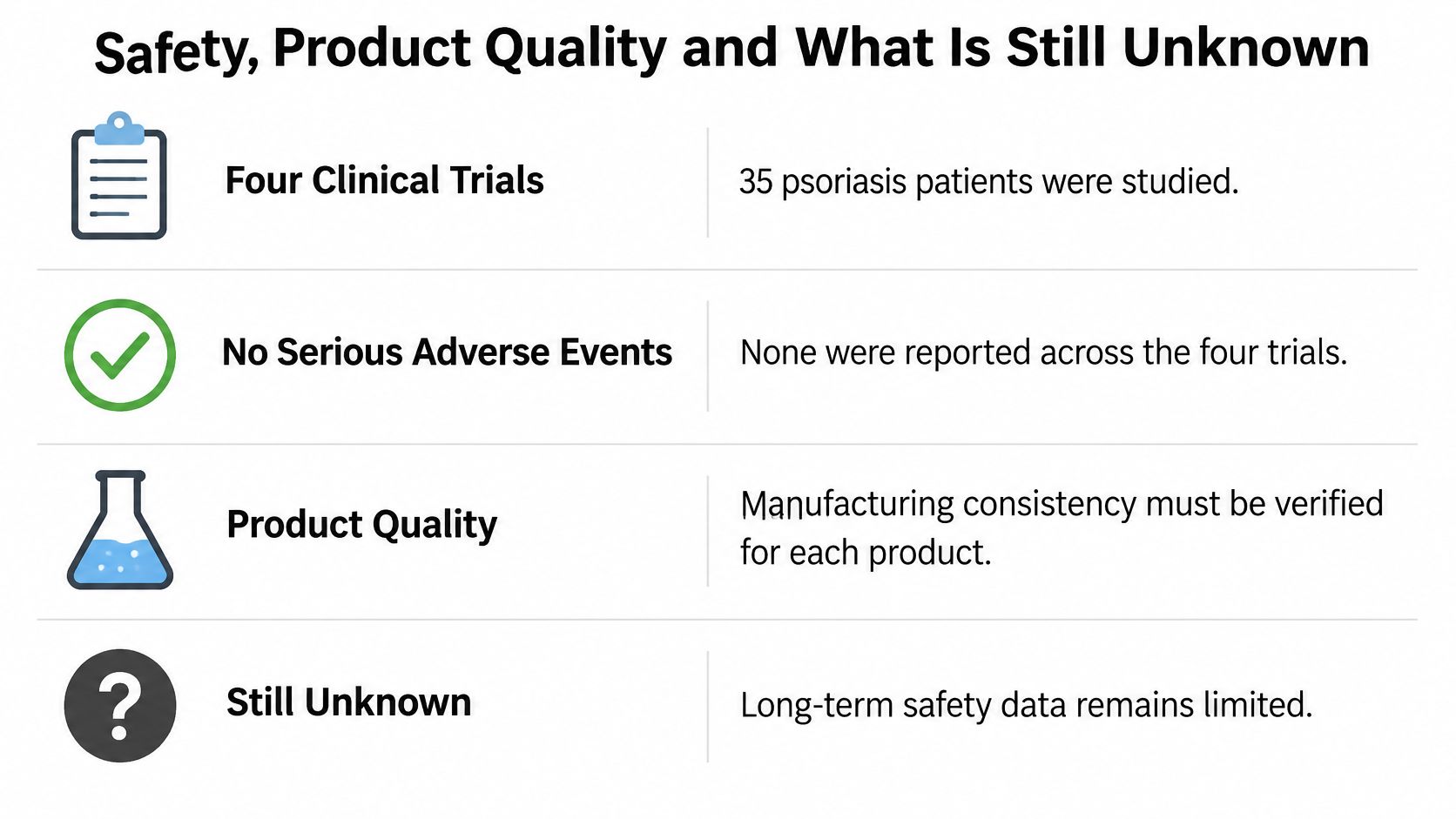
Small early studies have reported encouraging tolerability, including no obvious treatment-related adverse effects in the 17-person MSC study and no severe treatment-related adverse events in the 12-person exosome study.
Safety depends on the product, dose, route, screening, administration, and follow-up. A physician should discuss possible lack of benefit, local irritation or infection after injections, infusion reactions, and other biological risks in the context of your medical history.
A practical quality checklist
Donor screening: How is donor eligibility established?
Sterility: How is contamination checked before administration?
Endotoxin and mycoplasma: Are both specifically tested?
Identity and concentration: How is the product characterized and measured?
Potency: What test assesses the intended biological activity?
Storage and transport: What product-specific handling limits have been validated?
Follow-up: Who monitors symptoms and delayed adverse events after treatment?
Oversight varies by country. Ask which authority licenses the relevant facility and treatment activities, and what records are available for the batch you would receive. A guide to stem cell therapy safety can help you prepare for that discussion.
Who Might Consider an Individualized Evaluation?
Someone whose psoriasis remains troublesome despite established care may want to discuss the early findings with a physician. An evaluation does not assume that stem cells, exosomes, PBM, or HBOT are right for that person. It establishes whether any proposed approach fits their disease, treatment history, risk factors, and goals.
A physician may review:
Disease severity: PASI, body surface area, symptoms, and flare history.
Previous care: Topicals, dermatologist-directed phototherapy, biologics, and reasons treatments changed.
Health history: Infection or cancer history, cardiovascular factors, current medicines, and pregnancy or breastfeeding status.
Expectations: What improvement would be meaningful, how it would be measured, and when to reconsider the plan.
Bring these questions to a consultation:
| Question | Why it helps |
|---|---|
| Which specific cell or exosome product is proposed? | Source, preparation, and testing vary between products. |
| How similar is my psoriasis to that of study participants? | Early studies enrolled small, selected groups. |
| What is the role of PBM or HBOT in my plan? | Supportive services should have a clear goal, separate from claims of psoriasis efficacy. |
| How are fresh handling and batch quality verified? | Product-specific handling and release testing matter more than a general promise of freshness. |
| What will be measured at follow-up? | PASI, symptoms, and safety checks help distinguish a meaningful response from an impression. |
| What happens if I do not improve or I have a delayed problem? | A clear follow-up and escalation plan is essential. |
An intradermal approach targets a skin area directly; intravenous infusion reaches the body more broadly. The right route cannot be inferred from one patient's result.
Plan Your Next Step With a Physician
The emerging psoriasis results offer a reason for measured optimism: some people in small MSC and exosome studies experienced notable improvement, and researchers are beginning to examine possible immune mechanisms behind those changes. The next step is not to assume the same result for everyone. It is to discuss your own circumstances and the specific product and care plan being proposed.
Gather your records. Bring your diagnosis, photographs or PASI history if available, prior treatments, current medications, and recent laboratory results.
Ask for an individualized assessment. Discuss what the early psoriasis evidence means for your severity and treatment history.
Clarify each component of the plan. If stem cells, exosomes, PBM, or HBOT are proposed, ask what each is intended to do and how response and safety will be monitored.
At Longevity Medical Institute, physician-supervised regenerative programs are supported by an in-house clinical laboratory and an on-site stem cell biotechnology laboratory. The institute also offers AI-powered MRI imaging. Its separate COFEPRIS licensure for the on-site, ISO-certified biotechnology laboratory provides a specific point to discuss when asking about product preparation and oversight.
If you are weighing the promising early findings on stem cell or exosome therapy for psoriasis, visit Longevity Medical Institute to request a physician-led consultation about your care options, product quality, and follow-up.
Author
Dr. Kirk Sanford, DC, Founder & CEO, Longevity Medical Institute. Dr. Sanford focuses on patient education in regenerative and longevity medicine, translating complex therapies into clear, practical guidance for patients.
Medical Review
Dr. Félix Porras, MD, Medical Director, Longevity Medical Institute. Dr. Porras provides clinical oversight and medical review to help ensure accuracy, safety context, and alignment with current standards of care.
Last Reviewed
October 27, 2026
Short Disclaimer
This information is for educational purposes only and is not medical advice. It does not replace an evaluation by a qualified healthcare professional. For personalized guidance, please schedule a consultation.