

Stem Cell Therapy for Chronic Interstitial Cystitis
You know the pattern if you've lived with bladder pain for months or years. Nighttime trips to the bathroom, pressure that feels bigger than your bladder, urgency that changes where you sit and how far you drive, and a kind of exhaustion that creeps into work, travel, and intimacy. When standard care only blunts the pain for a while, it's natural to ask a more serious question, whether anything can help the bladder heal.
Stem Cell and Hyperbaric Oxygen Therapy for Chronic Interstitial Cystitis is getting attention because it shifts the conversation from symptom suppression to tissue repair. In interstitial cystitis, also called bladder pain syndrome or IC/BPS, the target isn't just discomfort, it's the inflamed and injured bladder wall itself. That's why regenerative medicine now focuses on mesenchymal stromal cells and hyperbaric oxygen therapy, two approaches that may help calm inflammation and support repair rather than masking the signal. For readers looking for a broader urologic context, this overview of why urologic health belongs in longevity medicine gives a helpful frame.
Living With Bladder Pain and the Search for Real Repair
A patient with IC/BPS often describes the same exhausting cycle. The bladder feels irritated even when it is not full, urgency shapes every errand, and repeated nighttime urination breaks sleep into fragments. Over time, that daily disruption does more than cause pain. It changes how a person works, travels, and plans intimacy.
Why symptom relief can feel incomplete
Conventional therapies can help, but many people experience them as temporary patches. Pentosan, bladder instillations, and hydrodistension may calm symptoms or give the bladder a little room to recover, yet they do not always address the injured lining and the inflammatory microenvironment underneath it. That gap is why regenerative medicine has become so compelling, because it asks whether the bladder wall can be supported toward actual repair.
Practical rule: if a treatment only quiets the alarm, the problem often returns when the alarm resets.
The same frustration is why so many patients keep searching online for something more specific.
Regenerative care is being studied because the bladder in IC/BPS can behave like a damaged barrier with a false alarm system that stays switched on. The goal is to repair the barrier, calm the false alarms, and reduce the pain signaling that keeps symptoms stuck on high. That is the promise driving interest in MSC-based therapy and HBOT, especially for people whose symptoms return after standard urologic care. For a broader look at how bladder care fits into preventive medicine, see Longevity Medical Institute's urology resource page.
What Interstitial Cystitis Is
IC/BPS is a chronic bladder pain syndrome marked by pelvic pain, urgency, frequency, and often nighttime urination, without evidence of infection driving the symptoms. The condition is not one single pattern. Some patients have visible inflammatory lesions, while others have symptoms that feel just as severe even though the bladder surface looks different on cystoscopy.
Hunner lesions versus non-Hunner disease
The main clinical split is between Hunner-lesion IC and non-Hunner IC/BPS. Hunner lesions are visible inflammatory patches, often with urothelial denudation, meaning the protective lining is stripped or damaged. Non-Hunner disease can look less dramatic on scope, yet the person may still have urgency, frequency, and pain that disrupt daily life.
The urothelial GAG layer is the bladder's protective barrier against urine. When that barrier weakens, urine can irritate deeper tissue, mast cells may become more active, and inflammation can drive a pain-urgency loop that is hard to break.
That is why some patients feel trapped in a cycle that seems out of proportion to the size of the bladder itself. The problem is a barrier issue, an inflammatory issue, and in some people a visible injury issue.
For a broader clinical comparison, this guide on whether bladder pain is truly interstitial cystitis or something else can help readers understand why accurate diagnosis matters before any regenerative plan starts.
How Mesenchymal Stem Cells May Help the Bladder Heal
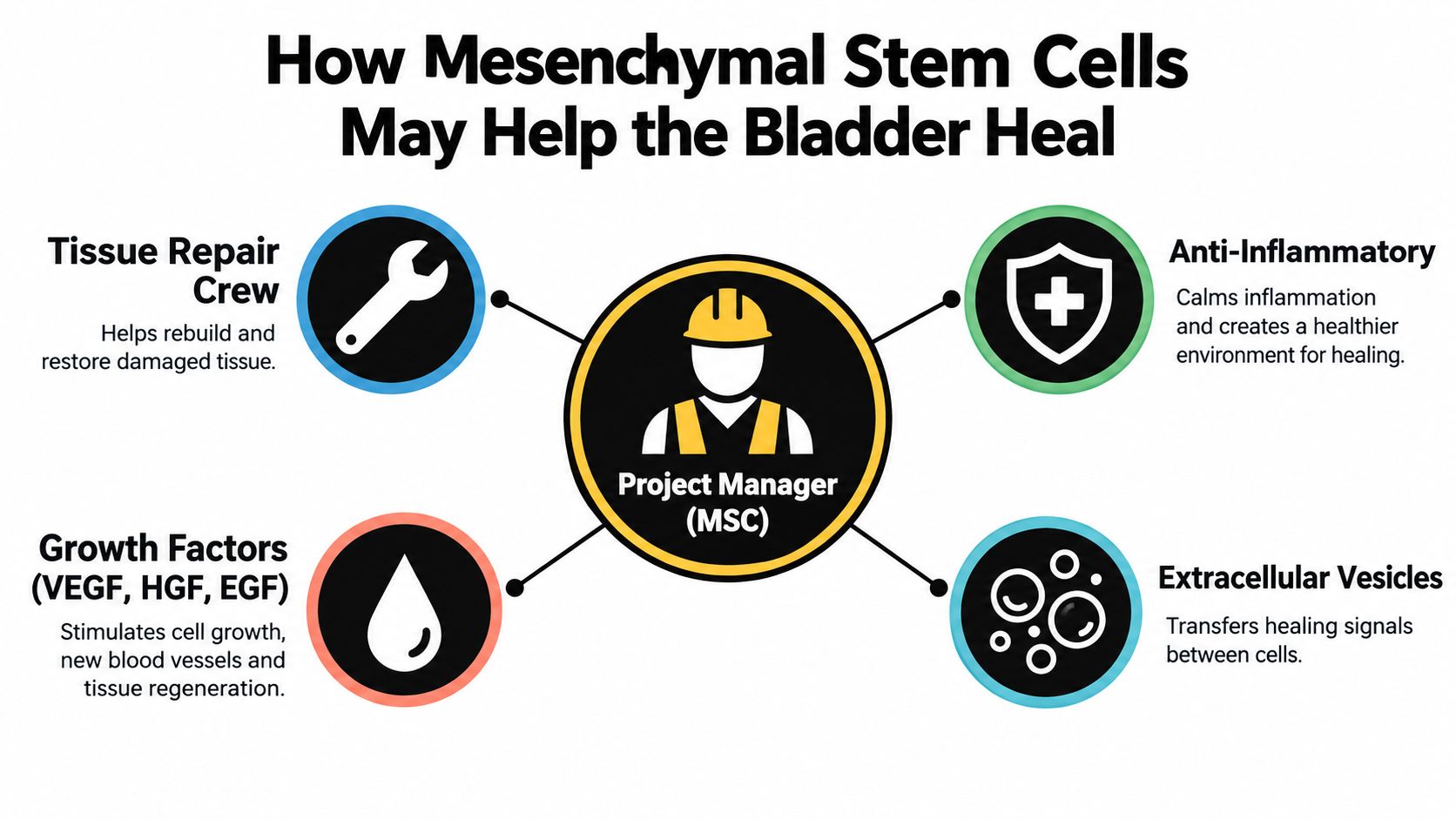
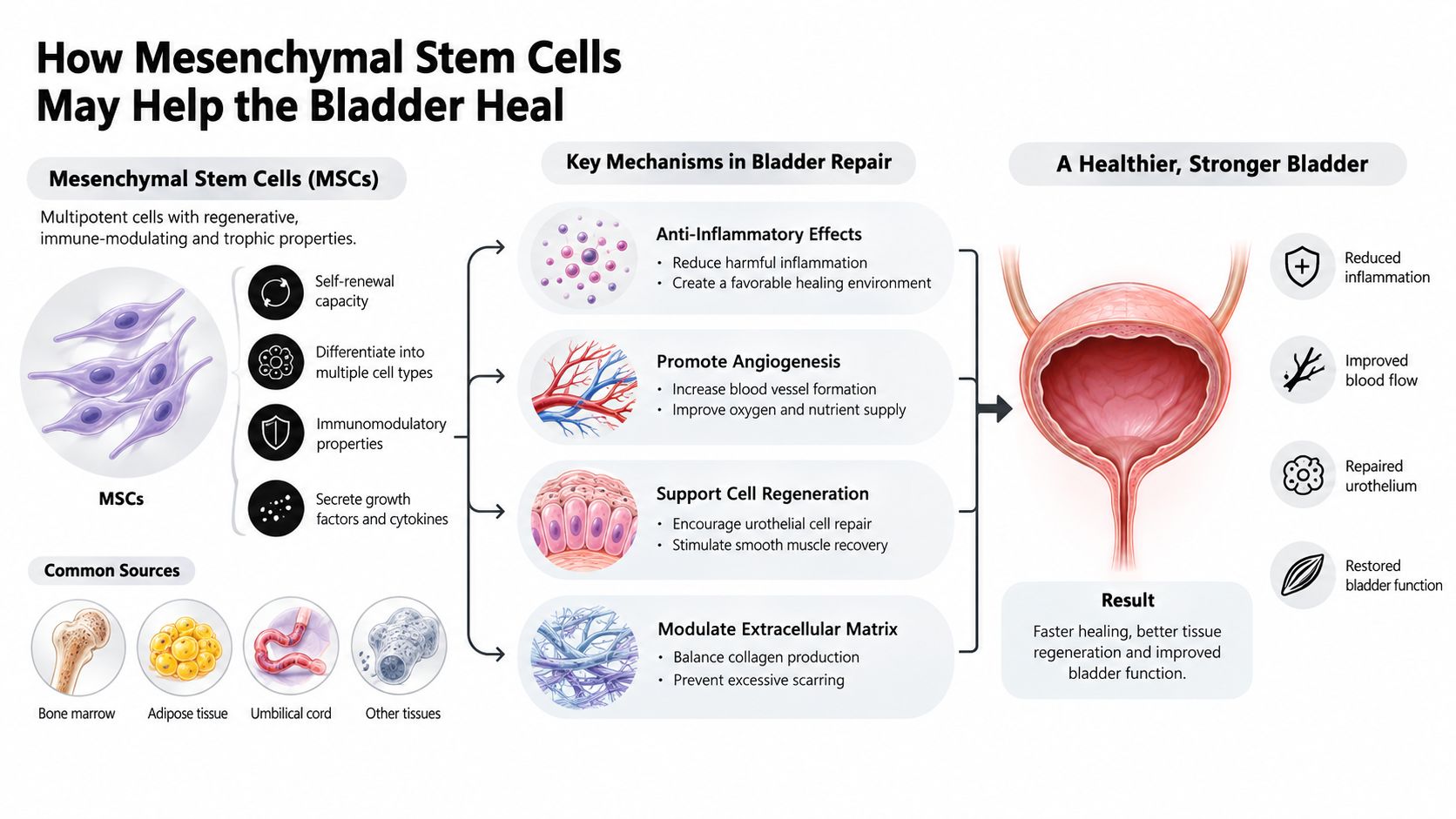
Mesenchymal stromal cells, often shortened to MSCs, usually help by releasing biologic signals rather than by becoming bladder tissue themselves. Those signals shape the local repair environment. They influence nearby cells through paracrine signaling, which means the cells send out growth factors, cytokines, and extracellular vesicles that change how surrounding tissue responds.
The repair signals they send
In practice, those messengers may calm overactive inflammation, support a more reparative macrophage response, encourage new microvessel formation, protect urothelial cells, and soften the fibrotic environment that makes healing harder. That is why MSCs are studied as part of regenerative care, not just as another way to chase pain relief.
The source of the cells matters too. For IC, what matters most is whether the cells are well characterized, clinically handled, and matched to the route of delivery. MSCs can come from different tissues, but a standardized product can make the treatment easier to define and monitor. That point matters when a clinic is choosing between a loose cell source and a protocol built around manufacturing control.
Clinical insight: the best cell isn't the one with the nicest label, it's the one that is characterized well enough to be delivered safely and consistently.
A patient exploring mesenchymal stem cell therapy should ask what is being delivered, how it is prepared, and how the clinic is tracking safety and response. That level of detail helps separate a thoughtful regenerative plan from a vague promise.
What the Human Evidence on Stem Cells Shows So Far
A patient with bladder pain usually wants one simple answer, does this treatment just quiet symptoms, or can it help the tissue itself heal? The human stem cell studies so far point to the second question as the more interesting one, especially for Hunner-type IC, where the injury is visible and easier to target directly.
The strongest signal so far comes from the 2025 randomized, double-blind, placebo-controlled Phase I/IIa study of MR-MC-01, an hESC-derived mesenchymal stromal cell product for Hunner-type IC. Researchers injected 20 million and 50 million MSCs through a cystoscope into 20 sites around Hunner lesions, which matters because the treatment was aimed at a defined bladder-wall lesion rather than a broad symptom complaint. The trial reported no dose-limiting toxicities. At published follow-up, the treatment arm showed a global response assessment of 41.67% versus 25% in placebo, with 8 patients showing reduction or complete resolution of Hunner lesions and 5 of 12 treated patients, or 41.7%, reporting moderate or marked overall improvement. The report also described symptom score gains over follow-up, including roughly 18.5% improvement in IC symptom scores and about 21% improvement in pain, urgency, and frequency scores. The published trial report is encouraging because it linked symptom relief to measurable lesion improvement, which is the stronger clinical signal.
Why lesion improvement matters
That tissue change is what clinicians watch most closely. If a therapy eases pain but leaves the ulcerative bladder injury in place, the repair story is still unfinished. When the bladder surface looks better too, the treatment signal is easier to trust as something more durable than short-term symptom suppression.
The earlier human benchmark was the 2019 multicenter SVF study, which enrolled 109 patients across 18 centers and followed them every 3 months for 2 years. At 1 year, 78 patients reported a positive response, and the authors described statistically improved symptom and bother scores with minimal adverse events during harvesting, processing, and treatment. That multicenter study matters historically because it showed cell therapy could be delivered at scale, not only in small pilot cases.
A separate first-in-human experience in 2022 tested hESC-derived MSCs in 3 patients with severe Hunner-type disease. All 3 reported significant pain improvement at 1 month, and no safety issues or immune reactions were reported over follow-up. The same program later advanced into a randomized, double-blind phase 1/2a trial in 22 patients, with no dose-limiting toxicities and a positive signal that helped justify continued study. That trial program remains early, but it is one of the clearest human datasets available.
| Study | Cell Type & Route | Population | Key Outcomes | Limits |
|---|---|---|---|---|
| Multicenter SVF study | Autologous adipose-derived stromal vascular fraction, local treatment | 109 patients across 18 centers | 78 positive responders at 1 year, improved symptom and bother scores, minimal adverse events | Historical benchmark, not a controlled comparison |
| First-in-human hESC-MSC study | hESC-derived MSCs, transurethral submucosal injection | 3 patients with severe Hunner-type disease | Pain improved in all 3 at 1 month, no immune reactions reported | Very small cohort |
| Phase 1/2a MR-MC-01 trial | hESC-derived MSCs, cystoscopic bladder-wall injection | 22 patients | No dose-limiting toxicities, response signal versus placebo, lesion reduction in 8 patients | Small sample, short follow-up |
| Chronic IC/BPS animal model | Local injection of human embryonic stem cell-derived multipotent stem cells | Preclinical model | Improved voiding dysfunction and reduced pathology | Animal data only |
The limit is just as important as the promise. These studies do not prove long-term durability, they do not show superiority over all standard care, and they do not tell us whether non-Hunner IC responds the same way. For patients comparing regenerative options, a careful review of mesenchymal stem cell research helps separate early human evidence from bigger claims than the data can support.
Why Hyperbaric Oxygen Therapy Is Part of the Conversation
Hyperbaric oxygen therapy, or HBOT, gives the bladder something injured tissue often struggles to get on its own, oxygen under pressure. A patient lies in a chamber and breathes 100% oxygen while ambient pressure rises, which increases how much oxygen dissolves into the plasma and reaches poorly perfused tissue. In bladder pain syndromes, that extra oxygen may help support angiogenesis, reduce edema, improve urothelial healing, and quiet inflammatory signaling.
What the human studies actually showed
The randomized, double-blind, sham-controlled trial using 30 sessions of HBOT at 2.4 ATA found that at 3 months, pain decreased by about 27.6%, urgency by about 17.1%, total IC symptom scores by about 22.6%, and functional bladder capacity increased by about 15.7%. 3 of 14 treated patients, or 21.4%, reached moderate or marked overall improvement, while the sham group had no responders, and those responses persisted for 12 months. The trial report is encouraging because it shows a noninvasive option can do more than temporarily dull symptoms.
The Japanese study used 2.0 ATA for 10 or 20 sessions in patients who had not improved with conventional treatment. 7 of 11 patients, or 63.6%, responded and maintained improvement for at least 1 year. Among responders, pelvic pain decreased by about 55.8%, urgency by about 34.8%, IC symptom scores by about 30%, and daily urinary frequency by about 34.8%. 7 of 8 ulcerative or Hunner-type patients responded, or 87.5%, while none of the 3 non-ulcerative patients responded, and cystoscopy showed granulation and healing of ulcerative lesions in responders. That subtype split is one of the clearest signals that HBOT may be particularly relevant when there's visible bladder-wall injury.
HBOT isn't a casual add-on. It usually means repeated sessions, and some people need to think about ear pressure, claustrophobia, and practical scheduling before they start. A clinic discussing hyperbaric oxygen therapy should explain chamber type, pressure, treatment count, and how they monitor tolerability.
Combining Stem Cells and Hyperbaric Oxygen as a Layered Approach
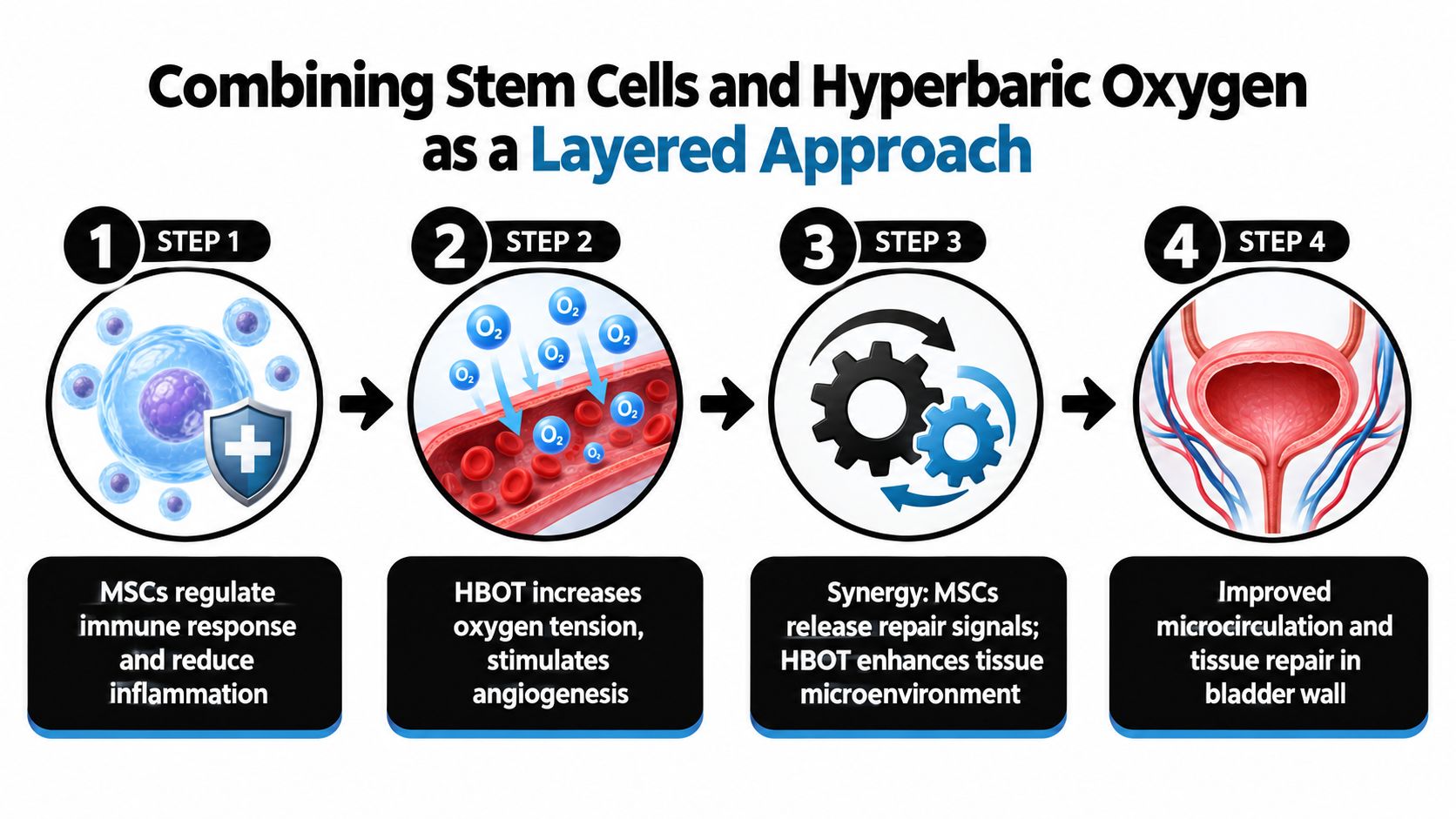
The logic of combining MSCs with HBOT is simple: one therapy can help coordinate repair signals, while the other can help create the oxygen-rich environment those signals need to work well. MSCs may calm the inflammatory terrain, influence macrophage behavior, and release regenerative factors. HBOT may improve microcirculation, oxygen tension, and tissue conditions that support healing.
Why the pairing makes sense biologically
The project-manager metaphor still fits here. MSCs are the manager who sends out the repair crews, but the crews work better when the site has fuel, access, and a stable work environment. HBOT may improve that environment by helping inflamed tissue get more oxygen and by supporting the biologic conditions that let repair processes proceed.
This is a scientifically reasonable layered strategy, but it's still a hypothesis-driven one. No controlled human trial has tested MSCs and HBOT together for IC, so no one should present the combination as proven. What exists now is complementary evidence, human and preclinical, that points in the same direction.
For patients, the important question is sequencing. Some clinics may prefer oxygen support first, others may layer it around cell delivery, and some may separate them entirely. The right answer should be individualized, based on bladder anatomy, symptom severity, and the center's protocol rather than on a one-size-fits-all script.
A responsible regenerative program should also explain how it measures response. Pain, urgency, frequency, nocturia, cystoscopic appearance, and function all matter. Without those measures, it's hard to tell whether a layered protocol is helping or merely sounding complex.
Who Is a Candidate and How to Evaluate a Regenerative Program
The best candidates are usually people with refractory Hunner-lesion IC, especially those who've already tried standard options like pentosan polysulfate and bladder instillations without enough relief. Patients with visible bladder-wall injury are the clearest fit for regenerative thinking right now, because that's where the human evidence is strongest. People with active infection, untreated pelvic floor dysfunction, or pregnancy need a different pathway first.
What a serious evaluation should include
A careful workup starts with the basics and then gets more specific:
Detailed history: symptom pattern, nighttime urination, pain triggers, prior procedures, and what has or hasn't helped.
Infection exclusion: labs and urine testing to make sure this isn't an active UTI or something else treatable.
Voiding diary: a practical way to track urgency and frequency before and after treatment.
Cystoscopy with mapping: needed when Hunner lesions are suspected, since visible lesions change the treatment conversation.
Biopsy when available: can help confirm the inflammatory picture and rule out other causes.
Clinical reality: if a clinic can't explain how it confirms the diagnosis, it probably isn't ready to offer a regenerative protocol.
Patients should also ask about product quality, because cell therapy isn't interchangeable between centers. The clinic should be able to explain MSC source, viability and potency assays, third-party certification, and whether the product is allogeneic and carefully characterized. If HBOT is part of the plan, ask whether the chamber is multiplace or monoplace, what pressure is used, how many sessions are planned, and what emergency transfer pathways exist.
The question of candidacy becomes more complicated when the lesions are visible and bleeding risk is higher. That's why pre-treatment cystoscopic mapping matters in Hunner-type disease. It helps the team know exactly where the injury sits before they think about injection, oxygen support, or combined sequencing.
An Honest Outlook and Answers to Common Patient Questions
The outlook is encouraging, but it's still early. The stem cell trials in Hunner-lesion IC are small and phase 1/2a in design, the non-Hunner evidence remains mostly preclinical, and MSC plus HBOT has not yet been tested in a controlled human trial. The biggest unanswered questions are durability beyond a year, the right MSC dose, the best oxygen schedule, and how often retreatment should happen.
Longevity Medical Institute's approach is to evaluate the bladder carefully, rule out infection and other causes, review prior therapies, and then consider layered regenerative options only when the anatomy and clinical picture support it. The program uses physician oversight and characterizes the biologic product before treatment, because the details matter when the goal is repair rather than temporary symptom control. In practice, that means a discussion about whether local injection, IV, HBOT, or a staged protocol makes the most sense for the individual patient.
Common questions patients ask
How fast do people notice change? Some studies reported early improvement within weeks, but the safer expectation is weeks to months, not overnight relief.
How many HBOT sessions are typical? The published human studies used different schedules, so the count depends on the protocol and chamber setting.
Are results permanent? No one can promise permanence yet, and the existing data don't answer that with confidence.
Will insurance cover it? Coverage varies widely and often depends on diagnosis, documentation, and the payer.
Can I keep taking pentosan or amitriptyline? That decision belongs with the treating clinician, since concurrent medication plans are individualized.
What about recovery after cystoscopy or injection? Patients typically want clear guidance on pelvic rest, hydration, and follow-up timing before they commit.
What's the difference between autologous and allogeneic MSCs? Autologous cells come from the patient, while allogeneic cells come from a donor source and are manufactured as a standardized product.
The goal here isn't to promise a cure. It's to identify whether a person has the subtype of IC most likely to benefit from a biologically plausible strategy that targets the injured bladder wall.
If you're trying to decide whether a regenerative approach makes sense for your bladder pain, schedule a consultation with Longevity Medical Institute to review your history, prior treatments, and cystoscopy findings in a physician-led setting. The team can help you understand whether a layered plan using cell-based therapy, hyperbaric oxygen, or another urologic pathway fits your case and your goals.
Author
Dr. Kirk Sanford, DC, Founder & CEO, Longevity Medical Institute. Dr. Sanford focuses on patient education in regenerative and longevity medicine, translating complex therapies into clear, practical guidance for patients.
Medical Review
Dr. Félix Porras, MD, Medical Director, Longevity Medical Institute. Dr. Porras provides clinical oversight and medical review to help ensure accuracy, safety context, and alignment with current standards of care.
Last Reviewed: September 15, 2026
Short Disclaimer
This information is for educational purposes only and is not medical advice. It does not replace an evaluation by a qualified healthcare professional. For personalized guidance, please schedule a consultation.