

Stem Cell Therapy for Diverticulitis: Patient Guide
You know the feeling if you've had diverticulitis more than once. A normal day can turn into pain, bloating, fever, and a diet you'd rather not be on again. Then the big question lands, why does this keep happening, and what else can I do besides waiting for the next flare?
Diverticulitis and Regenerative Medicine deserves a calm, honest answer. Diverticulitis is inflammation of small pouches in the colon wall, and repeated episodes can leave people frustrated, cautious about food, and unsure whether lingering discomfort means another attack is starting or the bowel is just slow to settle. In a major review, diverticulitis is described as a substantial clinical burden, with an annual U.S. incidence of about 180 cases per 100,000 people, about 200,000 hospital admissions each year, and more than $6.3 billion in annual health-care spending, with earlier population data showing incidence rising from 115 per 100,000 person-years in 1980 to 1989 to 188 per 100,000 in 2000 to 2007, and peaking at 245 per 100,000 in 2007 (NCBI Bookshelf review). That burden is one reason more patients and physicians are exploring regenerative medicine as part of a broader conversation about recovery and inflammation support.
For many readers, the harder part is not the diagnosis, it is the uncertainty after the diagnosis. Some people are in an active episode, some are dealing with recurrent diverticulitis, and some are left with persistent symptoms after the inflammation has settled. Those situations can look similar from the outside, but they do not always call for the same evaluation or the same plan. If you're trying to make sense of that gap, a practical place to start is a plain-language resource like supplements for a calmer gut, then bring the conversation back to your own imaging, history, and symptoms.
Understanding Recurrent Diverticulitis and Your Options
A patient I often think about is the person who has had the same story play out more than once. They start avoiding certain foods, they notice every cramp, and they keep wondering whether the next twinge is a flare or just a bad meal. That emotional strain is real, and it is one reason people search for something beyond the usual cycle of antibiotics, rest, and waiting.
What recurrent disease usually means
Recurrent diverticulitis does not mean the colon is failing. It means the pouches, called diverticula, have become inflamed more than once, and each episode can leave a different footprint. Some flares are straightforward, some involve an abscess or other complication, and some leave behind discomfort that does not fit neatly into the “active infection” box.
The key distinction is between diverticulosis and diverticulitis. Diverticulosis means the pouches are present, while diverticulitis means one or more of those pouches has become inflamed. That distinction matters because not every abdominal symptom after a flare means the disease is active again.
Practical rule: recurrent pain deserves evaluation, but it does not automatically mean another infection.
The reason regenerative medicine enters the conversation is not because it replaces standard care. It is because many patients want a physician-directed discussion about whether advanced therapies may help support inflammation balance, tissue recovery, and a more complete healing process alongside the usual workup. For patients who want a deeper look at the immune and inflammatory side of care, immune modulation with stem cells is one related topic that often comes up in broader regenerative discussions.
Why people ask about alternatives
People do not ask about stem cells because they want buzzwords. They ask because they are tired of unpredictability. They want to know whether there is a way to reduce inflammation, support recovery, or at least make the next decision more informed.
That is where regenerative medicine becomes meaningful. While direct evidence for stem cell therapy specifically targeting diverticulitis is still limited, the broader science around stem cells, immune signaling, and tissue repair helps explain why this area continues to gain attention (NCBI Bookshelf review). For the right patient, a serious discussion can be both hopeful and medically grounded.
The Science Behind Stem Cells and Exosomes for Inflammation
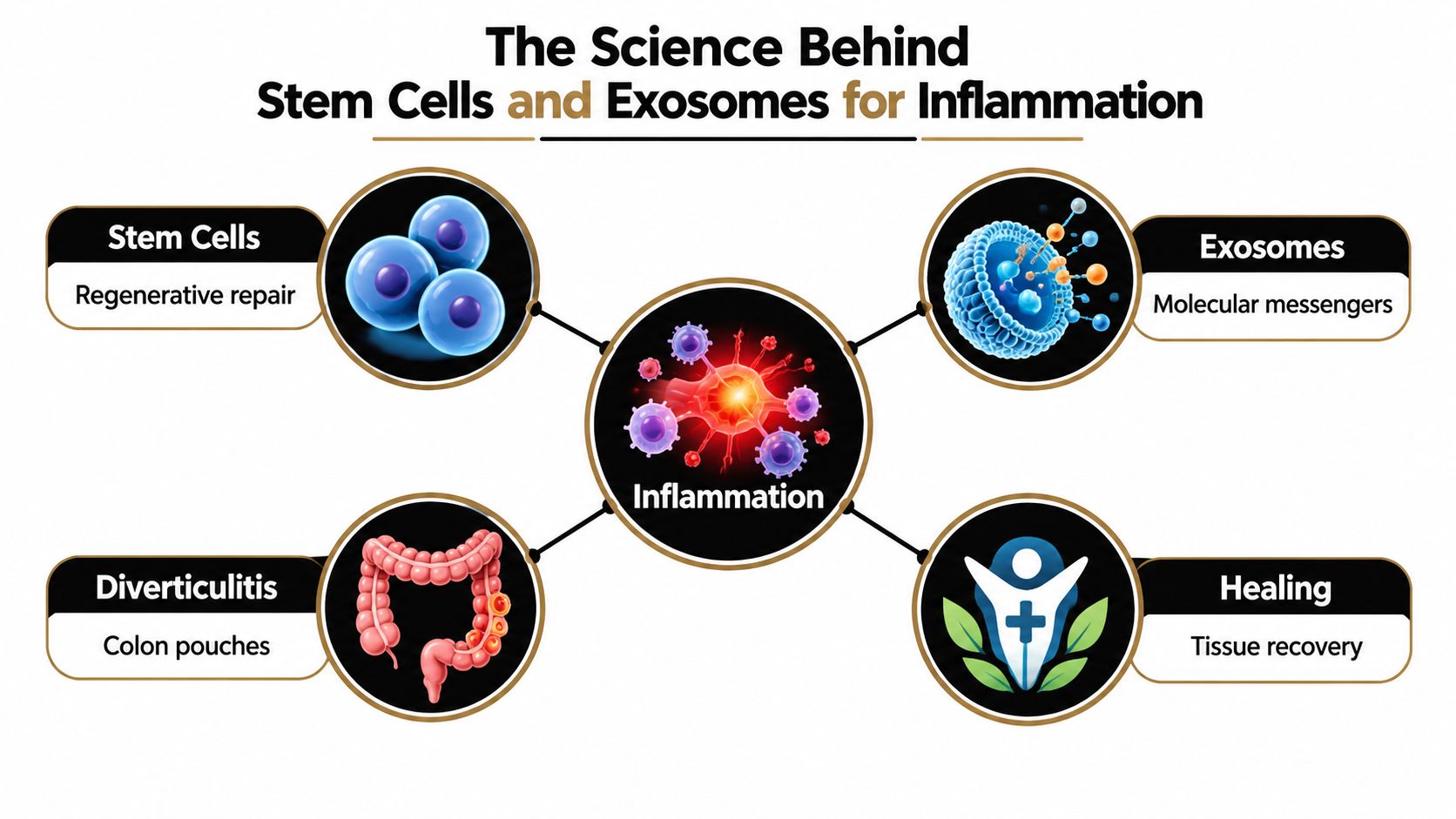
Diverticula form when small pouches push through weak points in the colon wall. When one of those pouches gets inflamed, the result is diverticulitis, and the pain can be sharp, localized, and hard to ignore. The biology is local, not vague, which is one reason any regenerative strategy has to be matched carefully to the anatomy and the clinical picture.
Why MSCs and exosomes get attention
Mesenchymal stem cells, or MSCs, are studied because they can influence inflammation, immune communication, and repair signals. In related colorectal inflammatory conditions, local MSC injection appears to suppress inflammatory-cell infiltration and cytokine signaling while supporting tissue repair. In systematic evidence summarized in 2025, remission rates in refractory perianal fistulizing Crohn's disease reached 36.2% at 3 months and 57.9% at 6 months, with MSC therapy outperforming placebo in pooled analyses (WJG review).
That is not diverticulitis, and it should not be presented as such. It does, however, help explain why physicians interested in regenerative medicine think in terms of local delivery, biologic signaling, and tissue support. If the target is a defined inflammatory defect, the logic is more precise than the broad marketing language often attached to stem cells.
Exosomes are the cell-derived messengers that carry biological signals without the full cell. Some patients find that appealing because it can feel like a more focused, cell-free way to discuss repair biology. For a broader primer on this topic, stem cell exosomes is a useful reference point in the regenerative medicine conversation.
The most credible regenerative discussion is focused and individualized. It asks where inflammation is, what tissue needs support, and which biologic tools may fit the patient best.
Why Fresh Cells Matter
In regenerative medicine, not all cell preparations are viewed the same. One reason some clinics emphasize fresh stem cells is the belief that cell vitality, signaling activity, and responsiveness may matter when the goal is to support healing in a highly individualized way.
Fresh cells are often discussed in contrast to cells that have been frozen, stored, and later thawed. In physician-guided regenerative care, the argument for fresh cells is straightforward. The more biologically active and viable the cells are at the time of treatment, the more confidence clinicians may have in the quality of the therapeutic material being delivered.
This is one reason patients often ask detailed questions about sourcing, processing, handling, viability standards, and timing. Those questions are appropriate. A sophisticated regenerative program should be prepared to explain how its cells are handled, what quality controls are used, and why that matters in real-world patient care.
At LMI, the discussion around fresh cells produced in our on-site biotechnology lab is part of a broader focus on precision, quality, and physician oversight. It is not just about having access to stem cells. It is about how those cells are selected, prepared, and matched to the patient's clinical picture.
Safety and the Importance of Medical Oversight
For many patients, one of the first questions is simple, is stem cell therapy safe?
In a physician-led setting, safety starts with patient selection. Not every person with abdominal pain is a regenerative candidate, and not every case of diverticulitis should even be discussed in those terms right away. A responsible process begins by clarifying whether the patient is in an acute flare, whether complications are present, and whether conventional treatment needs to come first.
From there, safety depends on several layers of oversight. Those layers include careful review of imaging, assessment of severity and recurrence, attention to infection risk, and consideration of whether any proposed biologic therapy fits the patient's broader medical context. This is one reason physician guidance matters so much.
When stem cells or exosomes are discussed in a professional setting, the goal is not to skip standard medical thinking. The goal is to build on it. A strong safety culture includes thoughtful screening, high standards for biologic handling, and clear communication about what is known, what is still evolving, and what realistic goals look like.
Safety starts with good judgment: the right therapy only makes sense for the right patient, at the right time, after the right evaluation.
The Role of a Biotechnology Lab in Regenerative Care
One of the clearest differences between a basic stem cell sales pitch and a serious regenerative program is the presence of real scientific infrastructure behind the scenes. Patients often hear about stem cells in abstract terms, but quality regenerative care depends on much more than the treatment label itself.
A biotechnology lab can play an important role in supporting consistency, handling standards, and biologic quality. That matters because regenerative medicine is highly process-dependent. How cells are sourced, prepared, evaluated, and managed can shape the confidence a physician has in the final product being used in care.
For patients, this translates into a more informed conversation. Instead of hearing only broad promises, they can ask practical questions about quality control, preparation methods, viability, and the rationale behind a fresh-cell approach. Those questions help separate serious clinical programs from clinics that rely mostly on marketing.
In a setting that values biotechnology support, regenerative therapy is framed as a precision-based medical service. That means the laboratory side and the clinical side are expected to work together, with patient safety, consistency, and individualized planning at the center.
What Current Evidence Shows and What Remains Unclear
The evidence gap remains important, but it should be understood in context. Direct evidence for stem cell therapy in diverticulitis is still sparse, and one peer-reviewed review notes only a single reported patient whose perforated diverticulitis and peritonitis improved after MSC therapy in the setting of acute graft-versus-host disease, which is anecdotal and not a diverticulitis trial (Nature review). Even so, that kind of signal helps explain why interest in regenerative applications continues.
What that means in practice
A few practical conclusions follow. There is not yet an established, reproducible protocol, and patient selection matters for treating routine diverticulitis with stem cells. At the same time, physician interest in this area reflects a broader understanding that inflammation control and tissue support may eventually have a larger role in gastrointestinal care.
Clinical experience and published trial data also need to stay separate. A clinic may observe encouraging responses in selected patients, and those observations can shape how physicians think about supportive regenerative care. At the same time, those observations are not the same as controlled diverticulitis research.
Clinical perspective: the most promising use of regenerative medicine is often as an individualized adjunct, guided by medical history, imaging, and physician judgment.
For readers who want broader context, mesenchymal stem cell research helps show where the field is active and where diverticulitis still sits outside standard stem-cell use.
What remains unknown
The unanswered questions are practical. Who benefits most, which delivery method matters most, how durable any effect might be, and how to define a meaningful outcome in someone with recurrent abdominal pain all remain open. Until disease-specific studies answer those points, the most constructive stance is informed optimism paired with individualized medical care.
What to Expect During a Physician Consultation
A good consultation starts with the records, not with the treatment menu. If someone comes in after recurrent diverticulitis, the physician should look at the CT reports, the number and severity of prior episodes, any abscess or other complication, colonoscopy history when appropriate, current symptoms, medications, and prior treatments. That is how you avoid guessing.
What gets reviewed
| Information Type | Why It Matters |
|---|---|
| CT report | Confirms whether the episode was uncomplicated or involved complications |
| Episode history | Shows whether the pattern is truly recurrent or persistent |
| Abscess or other complication | Changes the urgency and the type of care needed |
| Colonoscopy history | Helps determine whether follow-up is already complete or still needed |
| Current symptoms | Distinguishes active inflammation from residual discomfort |
| Medications | Identifies treatments that may affect symptoms or recovery |
| Prior treatments | Shows what has already been tried and what did not help |
That review shapes the conversation. A patient with repeated mild episodes may need a different plan than someone who has had a complicated flare, and a patient with ongoing symptoms after an episode may need a different workup again. The proposed approach depends on those findings, and it may involve coordination with the patient's gastroenterologist or colorectal surgeon.
A consultation should feel collaborative. If the plan is thoughtful, it usually begins by asking what the imaging showed and what the bowel has actually done over time.
People who want a sharper sense of how to evaluate a clinic's process can use the stem cell clinic test, 15 questions every patient should ask as a checklist before any decision is made.
In a physician-led setting, LMI may also discuss MSCs, exosomes, and other supportive therapies in the context of the full history, not in isolation. The value is in matching the plan to the problem, not in assuming one tool fits every patient.
When Conventional Medical Care Comes First
If someone suspects an acute flare, the first priority is standard medical evaluation. That is especially true when symptoms suggest an abscess, obstruction, or perforation, because those situations can become dangerous quickly and may need antibiotics, bowel rest, drainage, or surgery. Regenerative therapy is best considered after the acute situation has been defined and stabilized.
The NIDDK treatment overview lists the core tools used in diverticulitis care, including selective antibiotics, diet-related measures, probiotics, weight management, and surgery when needed, and it does not describe stem cells as an established treatment for diverticulitis (NIDDK treatment overview). That context matters because regenerative care works best when it is integrated responsibly, not used as a substitute for urgent intervention.
Red flags that need prompt attention
Worsening abdominal pain: especially if it becomes severe or stops feeling like a typical flare.
Fever or systemic illness: a possible sign that infection is active and needs prompt evaluation.
Vomiting or inability to keep fluids down: can signal obstruction or a more serious episode.
Marked bloating or inability to pass stool or gas: can point to obstruction.
Pain after a known complicated episode: should be taken seriously, not watched casually.
Regenerative therapies are generally considered only after the acute situation is stabilized. They also should not be framed as a way to avoid drainage or surgery when those are needed. For a broader inflammatory-disease discussion that often comes up in the same patient conversations, stem cell therapy for autoimmune and inflammatory diseases can help set the boundaries, but diverticulitis still deserves its own decision tree.
In other words, the sequence matters. Treat the acute problem first, then decide whether regenerative support belongs in the recovery plan.
Frequently Asked Questions About Regenerative Options
Do stem cells remove the pouches?
No. Stem cells do not remove diverticula, and they should not be described as a way to erase the anatomy of the colon. The pouches are structural, and current regenerative discussion is about inflammation support and tissue recovery, not pouch removal.
What is the difference between diverticulosis and diverticulitis?
Diverticulosis means the pouches are present. Diverticulitis means one of those pouches has become inflamed. That distinction is important because someone can have pouches without active disease, and lingering discomfort after an episode does not automatically mean a new flare has started.
Have exosomes been studied specifically for diverticulitis?
Not in a way that establishes a standard treatment. The more credible discussion is still about adjacent inflammatory conditions and the biology of cell signaling, not a validated diverticulitis protocol.
Why do some clinics emphasize fresh cells?
Some clinics place special emphasis on fresh stem cells because they believe cell viability and biologic activity matter. In that view, fresher cells may offer stronger signaling potential and better alignment with a quality-focused regenerative approach. Patients should feel comfortable asking how cells are sourced, prepared, and handled before treatment.
How does safety fit into treatment planning?
Safety starts with proper diagnosis, review of imaging, and physician oversight. A good program does not rush into treatment. It first determines whether standard care, antibiotics, drainage, or surgical evaluation are needed, then considers whether regenerative options may be appropriate in a later phase.
Where does hyperbaric oxygen therapy fit?
Hyperbaric oxygen therapy, or HBOT, can increase oxygen delivery to tissues inside a pressurized chamber, which is why some physicians consider it when building an individualized recovery plan. Research in other intestinal conditions does not establish a benefit for diverticulitis, and the combination of MSCs, exosomes, and HBOT has not been tested in a diverticulitis clinical trial.
How does LMI evaluate recurrent episodes?
The review starts with imaging, episode severity, complication history, symptom pattern, medications, and prior treatment response. If the case fits a physician-directed regenerative discussion, the plan is individualized and may involve coordination with the patient's gastroenterologist or colorectal surgeon. In the right setting, that can include a discussion of MSC-based support, exosomes, and HBOT, with attention to safety, biologic quality, and whether a fresh-cell strategy is appropriate.
Can they prevent future attacks?
No one should promise that. Recurrent diverticulitis still needs a medical plan built around history, imaging, and standard care first, with regenerative options discussed as a possible adjunct in selected patients.
If you're dealing with recurrent diverticulitis or lingering symptoms after an episode, bring your CT reports, colonoscopy records, and prior treatment history to a physician consultation. Longevity Medical Institute evaluates these cases in a physician-led setting, with attention to safety, biologic quality, and individualized regenerative planning, and you can learn more or request an appointment at Longevity Medical Institute.