

Stem Cell Therapy for Pulmonary Fibrosis: A Patient Guide
You may be living with a simple but exhausting pattern. The stairs at home feel longer than they used to, a short walk can drop your oxygen reading, and every clinic visit seems to end with the same message, the scarring can be slowed, but it can't be undone. That is exactly why Stem Cell Therapy for Pulmonary Fibrosis has attracted so much attention, not as a cure, but as a serious attempt to support the injured lung in a different way.
Pulmonary fibrosis creates a hard, inflamed, poorly compliant lung environment that makes oxygen transfer harder over time. Conventional antifibrotic medication can slow progression, but it doesn't regenerate established scar tissue, so patients and physicians keep looking for adjunctive options that might calm inflammation, support repair signaling, and preserve function longer. The key is to separate hope from hype, and to measure every step with FVC, DLCO, 6-minute walk distance, imaging, and oxygen data rather than with impressions alone.
Living with Pulmonary Fibrosis and the Search for New Options
A common story starts in an ordinary place, on the stairs, in the parking lot, or halfway through a neighborhood walk. A person notices that the chest feels tighter than last season, the pulse oximeter dips sooner than it used to, and recovery takes longer after even mild exertion. Pulmonary fibrosis has a way of turning small efforts into reminders that the lungs are working against stiffness, not just air.
That frustration often grows when patients hear that standard treatment can slow the disease but can't rebuild what's already scarred. The emotional burden is real, because the disease becomes a long negotiation with breath, energy, and uncertainty. In that setting, people start asking whether allogeneic mesenchymal stem cells, MSC-derived exosomes, or hyperbaric oxygen therapy could play a supportive role alongside pulmonology care.
Practical rule: if a therapy promise can't be followed by a measurable outcome, it shouldn't drive the treatment decision.
The patient-friendly goal is not to chase a miracle. It's to understand what pulmonary fibrosis is, why repair becomes so difficult, and how investigational options might fit into a broader plan that includes medication, oxygen support, pulmonary rehab, and transplant evaluation when appropriate. For readers who also have chronic obstructive lung disease, a related explanation is available in the institute's guide on stem cell therapy for COPD.
The best way forward is usually not “Should I believe in stem cells?” but “What would an honest evaluation look like for my lungs, my stage of disease, and my rate of decline?” That shift moves the conversation from anxiety to informed review, which is where serious decisions belong.
Understanding Pulmonary Fibrosis and Why New Approaches Matter
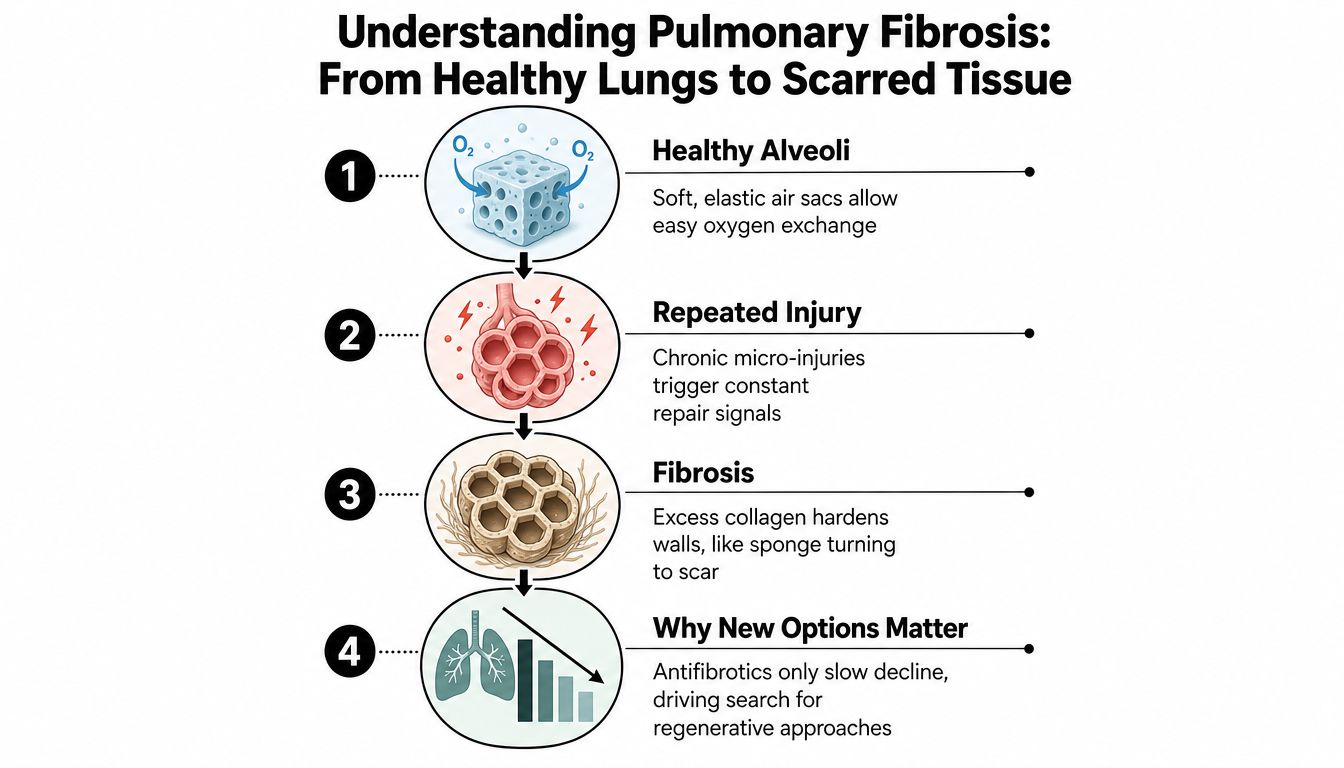
Healthy alveoli work like a soft, elastic sponge. They expand, recoil, and let oxygen slip into the bloodstream across a thin, efficient surface. In pulmonary fibrosis, that soft sponge gradually becomes more like stiff leather, less flexible, harder to inflate, and far less effective at exchanging gas.
What drives the scarring
The process usually begins with repeated micro-injury to the lung lining, followed by abnormal repair signals. Epithelial cells send distress messages, fibroblasts become overactive, and collagen accumulates where delicate tissue used to be. Over time, the lung architecture changes, and oxygen transfer becomes less efficient even if the patient is still trying hard to breathe normally.
That's why fibrosis feels so different from a temporary infection or a reversible airway flare. The tissue itself has changed shape. In idiopathic pulmonary fibrosis, autoimmune-related fibrotic disease, post-inflammatory scarring, and exposure-related patterns, the common problem is that repair becomes excessive and disorganized instead of restorative.
Why standard therapy is helpful, but incomplete
Antifibrotic medicines matter because they can slow the march of disease. They don't, however, rebuild the parenchyma that has already been remodeled by scar. That gap is where MSC paracrine signaling and exosome-based approaches enter the discussion, not as replacements for standard care, but as investigational ways to influence the environment that drives ongoing injury.
The lungs don't just need less damage, they need a better repair signal.
This is also where confusion often starts. Patients hear the word "stem cells" and assume replacement, as if the cells become new lung tissue. In pulmonary fibrosis, the more plausible story is signaling, not structural replacement. The hope is that biologic messages from MSCs may reduce inflammatory pressure, soften fibroblast activation, and support more orderly repair.
How IV Allogeneic MSC Therapy May Support the Lungs
Intravenous allogeneic MSC therapy is easier to understand when you stop thinking of it as a cell replacement program and start thinking of it as a communication program. The donated cells are infused into the bloodstream, travel through the pulmonary circulation, and make first contact with the lung capillary network, which is exactly why the lungs are such an important early site of interaction.
The paracrine idea in plain language
MSC therapy is often discussed as paracrine signaling. That means the cells are not expected to permanently engraft and rebuild the lung like construction workers laying new brick. Instead, they act more like a skilled control room, releasing growth factors, anti-inflammatory cytokines, and extracellular vesicles that influence what surrounding cells do next. A repaired neighborhood often starts with better messaging, not with new buildings.
The clinical research field has moved far enough to show feasibility. A 2026 systematic retrospective review of registered pulmonary fibrosis stem-cell trials found 62 trials after removing duplicates, which shows repeated investigation across registries and study types, but the broader literature still emphasizes that the work remains experimental and not standard care yet systematic review and registry analysis.
Why allogeneic delivery matters
For diffuse lung disease, IV delivery is attractive because the treatment reaches the lungs through the bloodstream rather than trying to place cells into scattered injured regions one by one. The emphasis is on systemic immune modulation and pulmonary interaction, not on harvesting the patient's own cells. The institute's overview of mesenchymal stem cell therapy is one example of how this modality is being framed in a regenerative setting.
The important boundary is this, the biological logic is compelling, but pulmonary fibrosis still lacks definitive proof of reversal or survival benefit from IV MSC therapy. That's why any honest discussion has to stay in the realm of investigation and objective follow-up, not certainty.
Nebulized Exosomes and the Promise of Targeted Lung Delivery
Nebulized whole MSCs and nebulized MSC-derived exosomes are not the same thing, and that distinction matters. Whole living MSCs are large, biologically active cells, while exosomes are tiny extracellular vesicles that are released by MSCs and carry signaling cargo without needing to stay alive in the same way a cell does.
The inhaled concept
When a mesh nebulizer turns a liquid into a fine mist, the idea is to distribute MSCs and exosomes deeper through the airways and toward the alveolar surface. That localized route may help deliver MSC messages more directly to the respiratory environment, and it may reduce dependence on cell survival after delivery. It also raises practical questions, including mucociliary clearance, particle behavior in the distal lung, repeat dosing, cold-chain handling, and standardization between batches.
An early human nebulized MSC-extracellular-vesicle study has been reported, which supports continued investigation of inhaled vesicle therapy, but it doesn't settle efficacy, dosing, or durability early human EV pilot. In other words, the concept is biologically reasonable, but it's still being tested.
Whole cells versus vesicles
The simplest way to think about it is this. Nebulized whole MSCs are like trying to deliver an orchestra. Exosomes are more like sending the sheet music and recorded cues.
The institute's resource on stem cell exosomes is a useful reference point for how these vesicles are being discussed in regenerative medicine. For pulmonary fibrosis specifically, the honest position is that inhaled exosomes are promising, inhaled living cells are less established, and both remain investigational.
Combining IV MSCs with HBOT and Inhaled MSC's and Exosomes
A combined strategy makes scientific sense because each piece plays a different role. IV MSCs and exosomes may offer systemic immunomodulatory signaling and interact with the lungs through the circulation, while inhaled MSC's and exosomes deliver concentrated messages straight to the airway surface. HBOT can sit beside those biologic approaches as supportive oxygen-based care, not as an antifibrotic therapy.
Why the combination is attractive
The logic is complementary rather than redundant. Systemic signaling may reduce inflammatory pressure across the body, local inhalation may focus the message at the respiratory interface, and carefully supervised hyperbaric oxygen may support oxygenation in selected patients who can tolerate it. That's a therapeutic triangle, not a proven formula.
HBOT deserves caution in fibrotic lungs. Advanced disease, air trapping, bullae, oxygen sensitivity, and unstable respiratory status can all affect eligibility, so pulmonary review matters before chamber pressure or oxygen exposure is individualized. The principle is support, not brute force. A structured overview of this supportive role is discussed in the institute's article on hyperbaric oxygen therapy and stem cells.
A realistic sequencing mindset
A specialist team might think in terms of layered care, for example an IV biologic intervention, then a period of oxygen-based support, then inhaled exosome therapy where appropriate. That sequencing is a conceptual model, not an approved protocol. It should only be considered with pulmonology oversight, imaging review, and individualized chamber settings when structural lung disease raises concern.
Clinical caution: if the chest CT shows significant cystic change or the patient already has unstable oxygen needs, the chamber plan should be adjusted, not assumed.
The promise here is not replacement of standard care, but a more nuanced way to support a lung that's already under stress.
Evaluation, Candidacy, and Objective Monitoring Tools
Before any adjunctive regenerative plan is considered, the diagnosis and current status need to be clear. That starts with recent HRCT, pulmonary function testing with FVC and DLCO, 6-minute walk distance, resting and exertional SpO2, and an echocardiogram if pulmonary hypertension is suspected. A baseline symptom inventory also matters, because the patient's own experience needs to be matched with objective data, not left as a loose impression.
The internal guide on objective monitoring tools is a useful reminder that change should be measured, not guessed. The same logic applies here, even though the disease and the tools are different.
Who is more likely to be considered
Candidacy usually depends on a confirmed fibrotic pattern, stability on or tolerance of antifibrotics, absence of active malignancy or uncontrolled infection, and enough functional reserve to tolerate procedures. The goal is not to fit everyone into the same pathway. It is to screen carefully so the plan matches the biology and the risk profile.
| Objective Monitoring Toolkit for Pulmonary Fibrosis | What It Measures | Typical Follow-Up Interval |
|---|---|---|
| HRCT | Scar pattern, extent, and structural change | At baseline and when clinically needed |
| FVC | How much air the lungs can force out | Repeated over months to track trend |
| DLCO | Gas transfer across the alveolar-capillary surface | Repeated over months to track trend |
| 6-minute walk distance | Functional exercise capacity | Repeated during follow-up |
| Resting and exertional SpO2 | Oxygenation at rest and with activity | At baseline and during serial visits |
| Symptoms | Breathlessness, fatigue, and day-to-day function | At each follow-up visit |
How to read progress objectively
A patient may feel better before the numbers move, or the numbers may stay stable while symptoms improve slightly. Neither should be dismissed. The safest reading comes from triangulation, which means comparing symptoms, oxygen data, lung function, and imaging together instead of trusting one measure in isolation.
Stability can be meaningful in pulmonary fibrosis. A small change may matter if the disease had been worsening before, but it still has to be interpreted in context. The practical goal is slower decline, better oxygenation, and preserved function over time.
Clinical Trial Evidence and What the Numbers Actually Show
The most cited human milestone in idiopathic pulmonary fibrosis came from early MSC safety studies that were encouraging but limited. In the first human high-cumulative-dose study, FVC increased by +7.8% from baseline at 12 months in the MSC group, while the placebo group declined by -5.9%, and the same report found better 6-minute walk distance at 13 weeks and better DLCO at 26 weeks, with no significant safety signal high-dose MSC trial.
What those numbers mean, and what they don't
Those changes are interesting because they point in the right biological direction. They do not prove reversal of fibrosis. Sample size remains small, follow-up is limited, and controlled evidence is still too thin to treat the numbers as definitive proof of efficacy.
A second phase Ib study of endobronchial MSCs used 0.5 × 10^6 cells/kg in 3 doses over 3 months and reported no ectopic tissue formation, no increase in adverse events versus placebo, a median progression-free survival of 26 months, and 100% survival at 2 years after first administration same trial source. Those figures are historically important, but they still sit inside a very small evidence base.
Where the broader field stands
The review literature shows the same pattern across models. In animal meta-analysis, MSC therapy was associated with higher survival, OR 3.10, 95% CI 2.06 to 4.67, and lower fibrosis scores, WMD 2.05, 95% CI −2.58 to −1.51 preclinical review. That supports biological plausibility, but it doesn't replace human proof.
The correct question is not whether MSCs look promising in early work. It's whether they can produce durable, clinically meaningful change in the right patients under controlled conditions.
A placenta-derived MSC trial and the AETHER human work are part of the same early stage, useful because they show feasibility and safety signals, but not enough to declare the therapy established. For patients, the practical takeaway is simple, antifibrotics remain the standard backbone, and MSC-based strategies belong in specialist-supervised investigational care.
| Key MSC Trials in Pulmonary Fibrosis | Cell Type and Dose | Duration | FVC Change | DLCO/6MWD Change | Key Limitation |
|---|---|---|---|---|---|
| High-dose MSC trial | High-cumulative-dose MSC therapy | 12 months | +7.8% in treated group, −5.9% in placebo trial | Better 6MWD at 13 weeks, better DLCO at 26 weeks trial | Small study, no proven reversal or survival benefit |
| Phase Ib adipose-derived MSC study | 0.5 × 10^6 cells/kg, 3 doses over 3 months trial | 2 years follow-up noted | No definitive efficacy claim established | 100% survival at 2 years, median progression-free survival 26 months trial | Endobronchial design, small sample |
| AETHER and placenta-derived MSC work | Early regulated MSC studies | Early phase | Safety and feasibility focus | Directionally encouraging only | Limited by size, heterogeneity, and short follow-up |
Realistic Expectations, Safety, and Your Next Steps
The most important thing to say clearly is this, Stem Cell Therapy for Pulmonary Fibrosis is an adjunctive concept, not a replacement for antifibrotics, oxygen therapy, pulmonary rehabilitation, or transplant evaluation. Patients do best when every new option is measured against the current standard of care, not floated above it as if routine treatment no longer matters.
Safety and quality should be addressed first
Any biologic therapy carries some risk, including infusion reactions, product variability, and theoretical tumorigenicity concerns that deserve serious review. Preparation quality matters, too, which is why credentialed sourcing and manufacturing standards matter far more than marketing language. In practice, patients should ask how the product is handled, what quality controls exist, and whether the team can explain the rationale in plain language.
A good clinic should also speak openly about logistics. Medical travel, timing, cost, and monitoring frequency all need to be discussed before any treatment decision is made. In a well-run setting, the plan is built around diagnosis, imaging, oxygen needs, and objective follow-up, not around a headline.
What to do next
Confirm the diagnosis. Make sure you have HRCT and pulmonary function data in hand.
Stay under pulmonology care. Regenerative care should sit beside specialist lung management.
Ask for candidacy review. Not every patient is a match for investigational support.
Track outcomes carefully. Recheck FVC, DLCO, 6MWD, and SpO2 on a planned schedule.
Treat improvement as data. If you feel better, the numbers still need to agree.
If you're weighing options, ask for an individualized review rather than a booking link. The right plan for pulmonary fibrosis depends on the cause, stage, genetics, lung function, and rate of progression, and those variables deserve a careful conversation.
Longevity Medical Institute offers physician-guided regenerative and diagnostic care that can help patients review complex lung cases with structure and clarity, including stem cell and exosome-based discussions, oxygen-based support, and objective testing. If you're exploring options for pulmonary fibrosis and want an individualized evaluation grounded in measurable outcomes, visit Longevity Medical Institute to learn more and request a consultation.
Author
Dr. Kirk Sanford, DC, Founder and CEO, Longevity Medical Institute
Medical Review
Dr. Félix Porras, MD, Medical Director, Longevity Medical Institute
Last Reviewed: September 11, 2026
Short Disclaimer
This information is for educational purposes only and is not medical advice. It does not replace an evaluation by a qualified healthcare professional. For personalized guidance, please schedule a consultation.