

Stem Cell Therapy for Traumatic Brain Injury (TBI)
You can leave the hospital, finish rehab, and still feel like your brain never quite came back online. The headaches linger, the fog comes and goes, balance feels off, and ordinary tasks take more effort than they should. For many people with traumatic brain injury, that gap between “survived” and “recovered” is exactly where Stem Cell Therapy for Traumatic Brain Injury (TBI) starts to feel relevant, not as a promise of a miracle, but as a serious attempt to support the brain's own repair biology.
When the Brain Does Not Fully Recover
A person can do everything right after a traumatic brain injury and still feel stuck. Emergency care may be over, rehab may be finished, and the scans may no longer show an acute crisis, yet daily life still feels different. The outside may look normal, while the person inside the injury is still dealing with fatigue, headaches, cognitive fog, memory strain, mood changes, and motor limitations.
Why regenerative medicine enters the conversation
Regenerative neurology gets attention because it offers a different goal. Stem cells are not presented as spare parts that rebuild a damaged brain cell by cell. The more realistic idea is that they may help calm harmful inflammation, support repair signaling, and improve the biological setting around injured tissue when standard rehabilitation has already reached its limit.
The scale of traumatic brain injury helps explain why this remains an active area of interest. In the United States, severe and moderate TBI affect approximately 350,000 people annually, and about 80,000 people each year sustain injuries that lead to significant long-term disability, according to the epidemiologic summary in the NCBI Bookshelf chapter on TBI (NCBI Bookshelf). The same source notes the broader burden, including more than 3 million disabled citizens and about 53,000 deaths per year in the U.S. alone.
That level of need is one reason patients, families, and clinicians keep asking whether regenerative medicine can do more than symptom management. The right question is not whether stem cells are a cure. The better question is whether they can meaningfully improve function, resilience, or recovery tolerance when the brain has stopped rebounding on its own.
Practical rule: If symptoms persist months or years after injury, the issue is not whether the injury was “serious enough.” The real question is whether the remaining deficits are stable, measurable, and worth targeting with a biologically guided plan.
How Stem Cells and Exosomes Act in the Injured Brain
After a traumatic brain injury, the brain can look less like a neatly organized control center and more like a damaged network where signals are scattered, inflammation stays switched on, and the repair process loses coordination. In that setting, mesenchymal stem cells, or MSCs, are not acting like spare parts that rebuild one neuron at a time. Their main value is in the signals they send, which can help organize the response around injured tissue.
The main biological jobs
The first job is immunomodulation. After TBI, inflammation may remain active longer than it should, and that can interfere with recovery. MSCs appear to help calm that response so the brain is not stuck in a constant emergency state.
The second job is neurotrophic support. These cells can release repair-oriented signals, including growth factors such as BDNF and NGF, which are associated with neuronal support and plasticity. In plain English, they help create a more favorable setting for healing.
The third job is paracrine signaling, especially through exosomes. Exosomes are tiny messenger packages loaded with proteins, mRNA, and microRNA. If MSCs act as the project manager, exosomes work like sealed instruction envelopes sent to different parts of the repair site.
The appeal of exosomes is their precision. They can deliver signals without bringing a whole living cell into the picture, which is why some clinicians view them as a promising cell-free tool.
Human neural stem cells are a different category. In preclinical TBI models, hNSCs have been associated with reduced lesion volume, better performance on the Morris water maze, and trends toward lower acute and chronic neurological deficits, which suggests both neuroprotection and repair rather than simple symptom masking. That said, the same literature still points to unresolved questions around dose, route, and treatment window.
If you want a clean comparison between cells and cell-derived signals, Longevity Medical Institute provides an internal explainer on exosomes vs stem cells.
Cell Types, Delivery Routes, and Why They Differ
A family walking into a clinic after a TBI usually wants the same basic answer, what exactly is being given, and how does it reach the injured brain? The details matter because different cell products behave differently, and the path they take into the body changes what they can realistically do.
What gets used in trials
The human TBI literature has focused heavily on bone marrow mononuclear cells, or BMMNCs, and the 2024 review found intrathecal delivery was the most common route in that body of work. Other studies have used bone marrow-derived MSCs, the modified SB623 cell line, and allogeneic MSCs from perinatal sources, while neural stem cells appear more often in preclinical work and select trials (Frontiers in Neurology).
That range is not a sign of confusion alone. It reflects a field still sorting out which cell type fits which injury pattern, much like different tools are useful for different kinds of repair.
Why the route matters
Three delivery routes come up again and again in TBI studies.
Intravenous, which places cells into the bloodstream.
Intrathecal, which delivers cells into the cerebrospinal fluid through a lumbar puncture.
Intranasal, which delivers cells from nose-to-brain tissue through the olfactory and trigeminal nerve pathways.
Intracranial, which places cells directly into or near brain tissue.
Each route changes the tradeoff between reach and invasiveness. Intrathecal treatment brings the therapy closer to the central nervous system than an IV infusion does, without requiring direct brain injection. Intracranial delivery can be considered in selected chronic protocols, but it is more invasive and usually appears in specific trial designs (PMC review).
Timing matters too. A pediatric acute study used early infusion in children with severe TBI, with a phase 1/2 design that enrolled children ages 5 to 17 within 24 hours of injury and used diffusion tensor MRI to look at preservation of white and gray matter (PMC article).
Clinical shortcut: The right cell type and delivery route depend on the injury phase. What is reasonable right after trauma is different from what is reasonable months later in chronic TBI.
For readers trying to sort cell complexity, the difference between multipotent and pluripotent stem cells also matters, and Longevity Medical Institute has a helpful internal guide on multipotent vs pluripotent stem cells.
What the Clinical Evidence Shows
TBI is one of the main reasons regenerative neurology keeps advancing. In the United States, the burden includes tens of thousands of severe cases each year, substantial long-term disability, and an enormous economic toll. That scale has pushed the field from theory into clinical testing.
The evidence base is bigger than it used to be
The modern human stem-cell and TBI literature has grown from a small number of papers in the early years to a much larger body of work, with hundreds of articles now published overall (Frontiers in Neurology). That does not mean every study gives the same answer, but it does show the field has moved beyond isolated interest and into sustained research.
A 2024 review of human trials included 11 studies and 402 participants, and the authors reported no serious adverse events across those studies (Frontiers in Neurology). That safety signal matters. It suggests the therapy has been tested in structured clinical settings rather than only in case reports and small experimental series.
For readers who want a safety-focused companion piece, Longevity Medical Institute's internal review on whether stem cells are safe is a useful next read.
What improved, and what still did not
The clearest functional signal in chronic TBI came from an interim double-blind randomized controlled trial of SB623. In that study, the Fugl-Meyer Motor Scale improved by 8.3 points versus 2.3 points in control at 6 months, with a least-squares mean difference of 6.0 (Neurology). The study concluded the therapy was well tolerated and associated with a statistically significant motor benefit (Neurology).
A 2024 meta-analysis of five controlled studies with 367 participants also found cellular therapy significantly improved overall patient performance, reported as OR = 0.26, 95% CI 0.15 to 0.48, P = 0.0001 (PubMed). The important nuance is that function-specific measures such as FMM and DRS were not statistically significant in some analyses (PubMed). That is why the strongest claims should stay tied to the endpoints that were measured.
The honest takeaway is simple. Stem cell therapy has encouraging human data, especially for selected motor outcomes, but it is not proven to repair every lost brain function. Larger randomized multicenter trials are still needed to sort out the best cell type, dose, timing, route, and number of transplants (PubMed).
Who Is a Candidate and Who Should Wait
A person with TBI is not automatically a candidate for regenerative treatment, and that is appropriate. Timing and medical stability shape the discussion more than excitement about a new therapy. In TBI care, the stage of injury often matters as much as the diagnosis itself.
The timing categories that matter
Acute TBI refers to treatment right after injury, sometimes within 24 hours in pediatric study designs. Subacute TBI usually covers the weeks and months after injury, when inflammation and recovery are still active. Chronic TBI is the stage where persistent deficits have settled in, often six months or more after injury, and that is where many regenerative protocols are studied.
The stage matters because the injured brain is not static. Early on, the main question may be whether a treatment can reduce secondary injury. Later, the question shifts to whether it can support function that has plateaued despite rehabilitation.
Common candidacy features
In practice, good candidates often have persistent neurological symptoms despite standard rehabilitation, stable medical status, and a clear diagnostic story. They are usually people who still have room to improve in areas like motor control, cognition, endurance, or functional independence. The realistic goal is usually better day-to-day function, not a promise of full reversal of injury.
Some people should wait and get a full evaluation first. Red flags include active malignancy, uncontrolled infection, severe coagulopathy, pregnancy, recent stroke, or a medical situation that makes immune-based therapy inappropriate. If a person is taking immunosuppressive therapy, medication review becomes especially important. For a plain-English review of treatment safety before scheduling anything, see Longevity Medical Institute's page on is stem cell therapy safe.
Practical rule: If the brain injury is still unstable, the rest of the body is not ready for an elective regenerative plan either.
A candidate evaluation should never rely on symptoms alone. It should include in-person medical review, imaging, and laboratory workup so the team can decide whether the patient has a stable chronic injury, an unresolved complication, or a different diagnosis entirely.
That kind of screening also helps set expectations. In TBI studies, the outcomes that are measured matter more than broad claims about brain repair. A treatment may show improvement in selected motor or functional scores, while other domains remain unchanged, so the best candidates are the ones whose goals match what the evidence can reasonably support.
The Patient Journey at Longevity Medical Institute
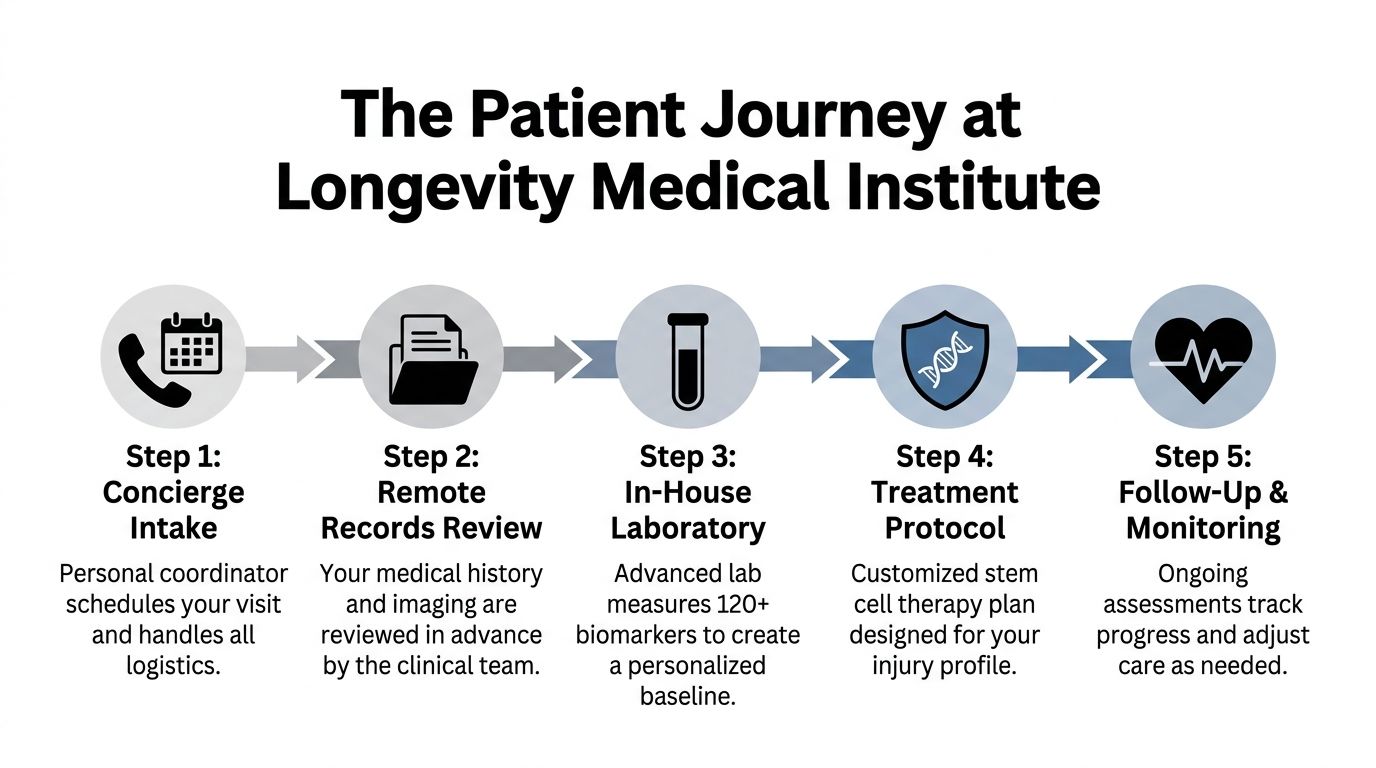
A lot of people don't need more theory. They need to know what happens from the first call to follow-up. The process below is how a careful regenerative neurology pathway should feel, structured, measured, and built around safety screening before treatment is even discussed.
From intake to baseline testing
The first step is concierge intake, where a coordinator collects records and helps organize the visit. That is followed by remote records review, so the clinical team can see prior imaging, rehab history, and the pattern of symptoms before the patient arrives.
Then comes the lab and imaging workup. Longevity Medical Institute's in-house clinical laboratory measures 120 biomarkers to build a personalized baseline around inflammation, metabolic status, and hormonal context. That matters because a brain injury rarely exists in isolation. Sleep, endocrine balance, and systemic inflammation can all shape how someone feels after TBI.
The same visit also includes AI-enhanced full-body MRI and an advanced heart evaluation to screen for contraindications and establish a quantified baseline. In a patient with chronic symptoms, that's not overkill. It's how you avoid missing a second problem that could change the treatment plan.
What treatment day can look like
Longevity Medical Institute uses allogeneic cells rather than autologous cells. Its biotechnology lab produces five cell families, placental, Wharton's jelly, adipose, endometrial, and dental pulp mesenchymal stem cells. The lab is described as COFEPRIS-licensed and ISO-certified, which is the kind of quality-control language patients should ask about directly.
The infusion is typically intravenous, intranasal, and/or intrathecal, depending on the injury profile and the physician's assessment. Recovery monitoring follows, along with supportive therapies that may include hyperbaric oxygen and peptides when they fit the broader plan.
The follow-up phase matters as much as the treatment itself. Repeat imaging and biomarker panels help the team see whether the patient is moving in the right direction, not just feeling hopeful for a few days.
A different kind of neurological platform is also part of the broader institute ecosystem, including its regenerative neurological therapy offering.
The workflow is visualized here.
The video below shows the clinical environment and patient-centered approach.
Questions Worth Asking Any Regenerative Clinic
The best consultations feel more like due diligence than sales. If a clinic can't answer the basics clearly, that's a warning sign. The right questions protect your time, your money, and your expectations.
A simple checklist for decision-making
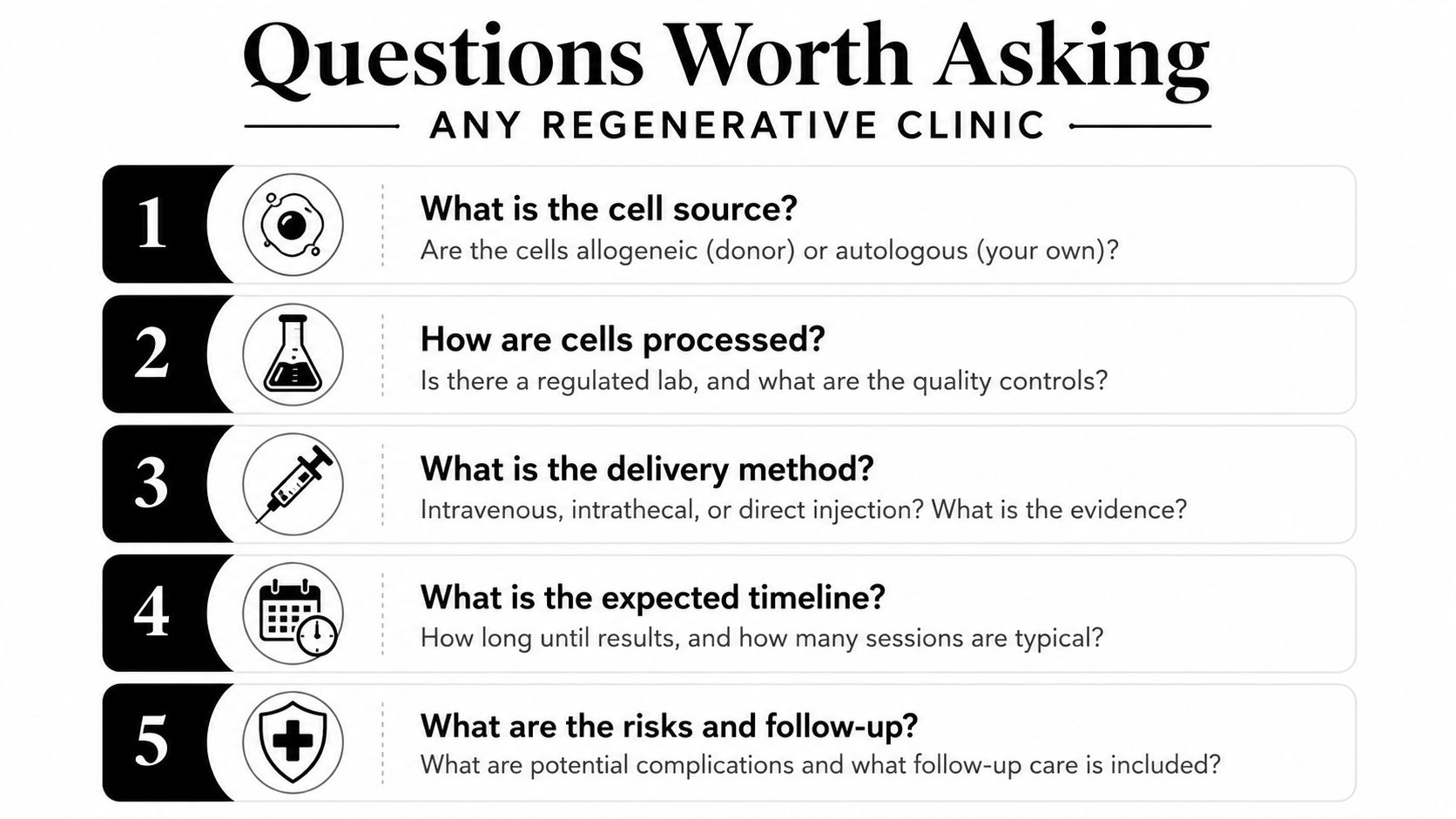
Ask where the cells come from and whether they're allogeneic or donor-derived. Ask how the cells are screened, processed, and released for use, and whether the lab has the right regulatory and quality framework.
Then ask for the clinical reasoning, not just the brochure.
What evidence supports this cell type in TBI? Ask for the specific trial data, not general regenerative claims.
What route will be used? Intravenous, intranasal, intrathecal, or another approach, and why that choice fits your injury.
Who performs the procedure? The answer should name the clinician role, not leave it vague.
What happens after treatment? You want a clear follow-up plan, including imaging and biomarker checks.
What is the full cost? Travel, accommodations, and repeat visits should all be clear up front.
A good clinic should also have a medical director reviewing cases and should be willing to give you written protocols and outcome expectations, not just verbal reassurances. If they can't explain risks plainly, keep looking.
Realistic Expectations and Your Next Step
Stem cell therapy for TBI deserves attention because the biology makes sense, the safety record is encouraging, and the clinical signal is real, even if it's still early. The most honest expectation is measurable improvement, not instant reversal. That may mean better motor function, less inflammatory burden, or a more stable rehab trajectory, rather than a complete reset of chronic deficits.
If you're comparing options, a neurology rehab program can still be part of the plan, and a resource like neurological rehab shows how much value structured rehabilitation can add alongside other therapies.
The next step is personalized evaluation. A qualified clinician should match your injury phase, symptoms, imaging, and medical history to a plan that's medically defensible, not aspirational. If you're still searching for clarity, schedule a consultation and bring your records so the conversation can start from facts, not guesswork.
Author
Dr. Kirk Sanford, DC, Founder & CEO, Longevity Medical Institute. Dr. Sanford focuses on patient education in regenerative and longevity medicine, translating complex therapies into clear, practical guidance for patients.
Medical Review
Dr. Félix Porras, MD, Medical Director, Longevity Medical Institute. Dr. Porras provides clinical oversight and medical review to help ensure accuracy, safety context, and alignment with current standards of care.
Last Reviewed: August 13, 2026
Short Disclaimer
This information is for educational purposes only and is not medical advice. It does not replace an evaluation by a qualified healthcare professional. For personalized guidance, please schedule a consultation.
Longevity Medical Institute offers physician-led regenerative evaluations, advanced imaging, and allogeneic stem cell-based programs designed to support recovery in complex conditions like TBI. If you're looking for a careful, clinically grounded assessment, visit Longevity Medical Institute to review your options and request a consultation.