

Stem Cell Therapy for Ulcerative Colitis: Patient Guide
Living with ulcerative colitis can feel like planning your day around your colon. One morning it's manageable, then a flare turns every commute, meal, and meeting into a question mark. The condition causes recurring inflammation in the lining of the colon, and the day-to-day reality often includes bleeding, urgency, diarrhea, abdominal discomfort, and fatigue.
For many people, the first goal is simple and very practical, calm the inflammation and stay in remission. That's what standard care is designed to do, and that's also why emerging therapies draw so much attention when symptoms keep coming back despite medication. Stem cell therapy for ulcerative colitis sits in that space, where patients are no longer asking only how to manage a flare, but whether there's a way to change the inflammatory pattern itself.
Understanding Ulcerative Colitis and Its Impact
A patient with ulcerative colitis often already knows the rhythm. Days of relative stability can be interrupted by bloody diarrhea, urgent bathroom trips, cramping, and the kind of exhaustion that makes a normal schedule feel impossible. The disease is limited to the large intestine, unlike Crohn's disease, which can affect any part of the digestive tract, and that distinction matters because it shapes both the symptoms and the treatment strategy.
What the disease is doing underneath the symptoms
Ulcerative colitis is not just “an upset colon.” It is recurring inflammation in the innermost lining of the colon and rectum, and that inflammation can leave the tissue raw and fragile. When the lining is irritated again and again, the body has a harder time maintaining normal function, which is why people can feel sick even when the flare seems to have settled.
Practical rule: symptom control matters, but symptom relief alone doesn't always mean the lining has fully healed.
The standard goals are straightforward, control inflammation during flares and maintain remission so tissue damage doesn't accumulate. That's why patients often keep track of more than how they feel, they also watch tests, scopes, and lab trends. For a broader overview of regenerative medicine in immune-driven disease, see the separate guide on stem cell therapy for autoimmune and inflammatory diseases.
Why stem cell research entered the conversation
Stem cell therapy became interesting in UC because some forms of inflammation don't respond cleanly to the usual medication ladder. Patients who've already tried steroids, biologics, or maintenance drugs may still have recurring disease activity, and that's where researchers began looking at whether mesenchymal stem cells could influence the inflammatory environment itself. The hope isn't that they act like a painkiller. The idea is that they may help quiet the immune signals that keep injuring the colon lining.
A person managing UC usually wants two things at once, fewer symptoms now and a more durable remission later. That combination is exactly why investigational therapies get attention, because they aim higher than short-term relief without promising miracles.
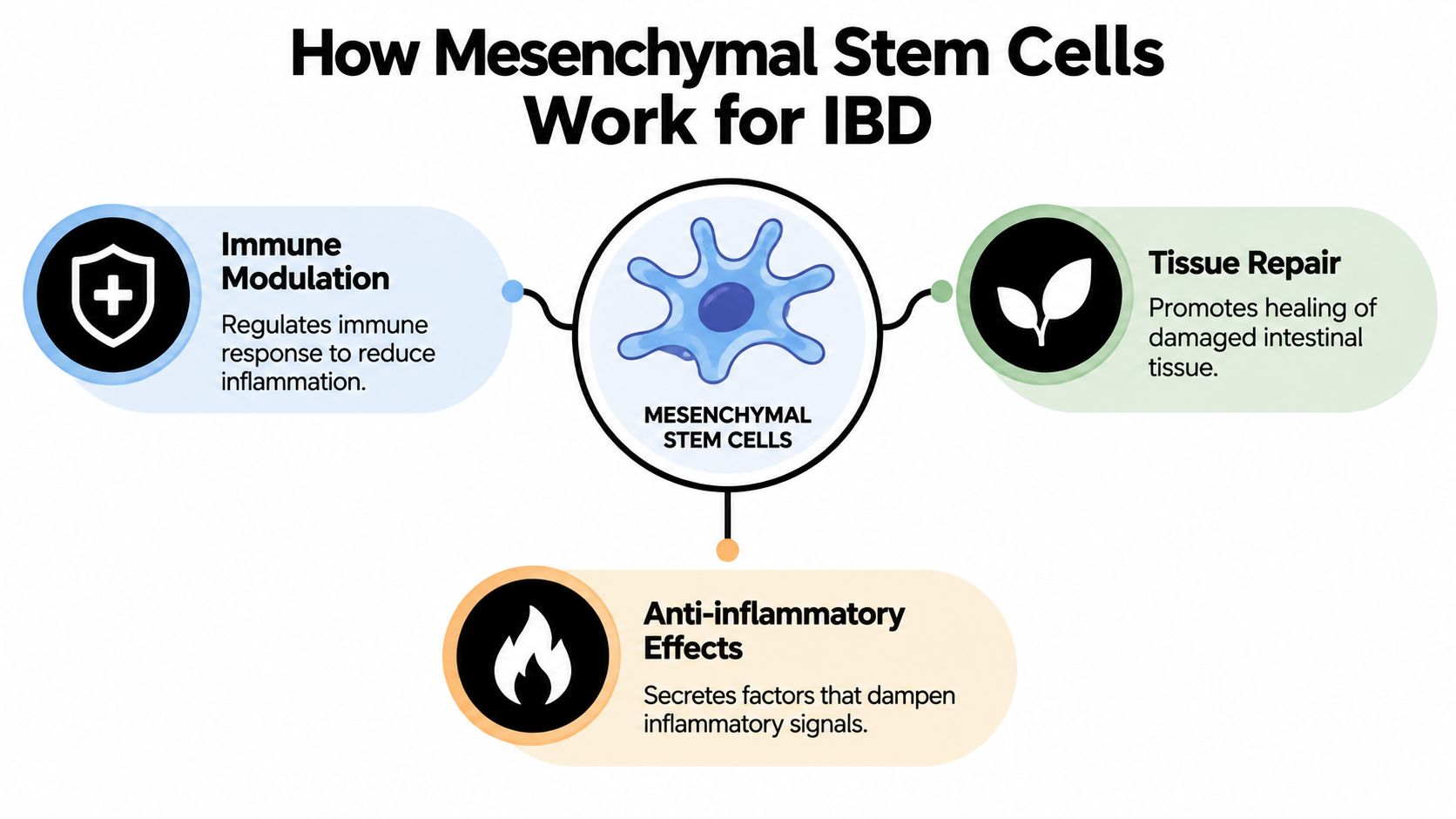
How Mesenchymal Stem Cells Work for IBD
Mesenchymal stem cells, or MSCs, are often described in simple terms as repair cells, but that misses their main role. They behave more like biological communicators, reading the inflammatory environment and releasing signals that can influence immune activity around them. In ulcerative colitis, that matters because the problem isn't only damaged tissue, it's the immune system repeatedly creating the conditions that damage the tissue in the first place.
The human evidence has mostly focused on allogeneic cells, meaning donor-derived cells. In practice, that includes sources such as adipose, Wharton's jelly and placental tissue, which are handled under controlled processing standards. The reason clinicians care about source and delivery route is simple, different cell products can behave differently in the body, and the route can shape how much reaches the inflamed bowel versus how broadly it acts in circulation.
What MSCs appear to do
In plain language, MSCs may help turn down an overactive alarm system. They don't replace the colon lining directly in the way a graft replaces tissue after surgery, but they seem to influence the local environment so healing becomes more possible. That's why researchers describe them as immunomodulatory rather than purely regenerative.
The best way to think about them is as a calming signal in a noisy room. If the immune system is stuck in a pattern of overreaction, MSCs may help reduce that intensity and give the tissue a better chance to recover.
MSC therapy is being studied as a way to influence the immune environment, not as a stand-alone replacement for gastroenterology care.
What the 2024 pilot study adds
A 2024 pilot study reported that patients received three IV infusions of umbilical cord-derived MSCs, and three of the five patients who completed long-term follow-up had a Mayo disease activity score of zero at both 12 and 24 months. That's encouraging because it suggests durable remission in a small subset of patients.
For a patient deciding whether to explore cell therapy, the right reading is cautious optimism, not certainty.
For a deeper look at immune signaling, see immune modulation with stem cells. And for context on the broader program, Longevity Medical Institute uses physician-supervised allogeneic stem cell approaches within a broader regenerative care model.
Reviewing the Clinical Evidence and Safety
A patient with ulcerative colitis often wants a simple answer. Should care stay focused on symptom control, or is it reasonable to discuss investigational additions such as MSCs or hyperbaric oxygen? The current evidence helps frame that decision. It does not settle it.
The MSC literature has moved beyond scattered case reports into human trials, but the field is still early. A 2019 systematic review and meta-analysis identified 7 clinical trials involving 216 patients, with a pooled healing rate of 78.7%, and controlled comparisons showed a higher healing rate than 5-ASA alone. That finding is meaningful because it shows measurable human outcomes, not just laboratory theory.
The same review also showed that delivery method matters. Some studies used submucosal colonoscopic administration, while others used intravenous infusion. Those are different tools for different jobs. Local injection tries to place cells near damaged mucosa, while IV delivery aims for broader immune effects. Researchers are still working out which approach fits which disease pattern.
What newer human data suggest
A 2024 clinical report on mesenchymal stem cells in UC described 41 treated patients with 73.2% clinical response, 41.5% clinical remission, and 43.9% mucosal healing at 2 months. At 6 months, after 2 losses to follow-up, response remained 61.0%, remission 34.2%, and mucosal healing 41.5%. The same report noted that 14 patients had no recurrence during follow-up, with maintenance lasting from 8 months to 5 years, including 13 patients beyond 1 year and 6 patients beyond 3 years.
For patients, the practical question is not whether these numbers sound impressive. It is whether they come from enough controlled evidence to justify a discussion with a gastroenterologist. Pilot studies can suggest a signal, but a controlled comparison to optimized standard therapy is what helps separate real treatment effect from the natural ups and downs of the disease.
Clinical caution: encouraging human data is not the same as standard-of-care proof. The field is still emerging.
Safety and practical interpretation
Across the major human studies cited here, MSC therapy has been discussed as generally well-tolerated in controlled settings, as summarized in our overview of is stem cell therapy safe. A phase IB/IIA trial of remestemcel-L used 150 million MSCs delivered by direct endoscopic injection during colonoscopy, and all treated patients showed a decrease in Mayo endoscopic severity score by 2 weeks. That is an early signal, not a final answer, but it supports the idea that local delivery can produce a quick mucosal response.
The most responsible way to read the evidence is straightforward. MSCs appear biologically plausible, early human outcomes are encouraging, and the therapy remains investigational rather than a proven cure. If your disease has stayed active despite standard treatment, the meaningful comparison is not hype versus hope. It is whether your situation justifies considering an investigational option, or whether optimizing established care should remain the main plan.
Hyperbaric Oxygen Therapy as Adjunctive Care
Hyperbaric oxygen therapy, or HBOT, is a different kind of tool. Instead of cells, it uses a pressurized chamber to increase oxygen delivery to tissues, which is why researchers have studied it as a possible support for healing and inflammation control in ulcerative colitis. The logic is simple, tissue that's struggling in an inflamed environment may benefit from a better oxygen supply while standard treatment does the heavy lifting.
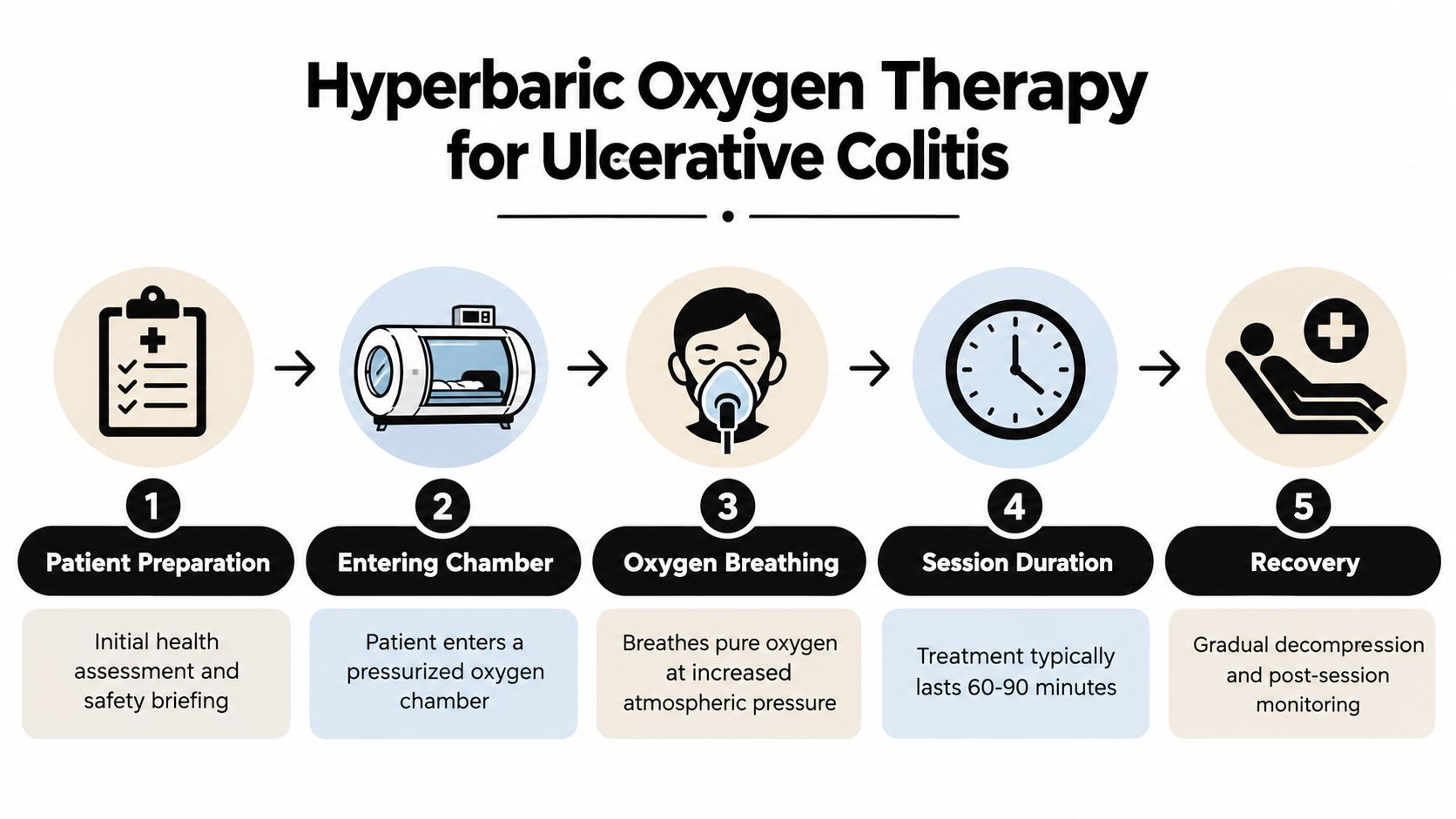
Where HBOT fits
A small randomized trial in patients hospitalized with moderate to severe UC flares found higher short-term remission rates when HBOT was added to steroids. A 2026 pilot study in treatment-resistant UC also reported clinical and endoscopic improvements in some patients. Those are promising signals, but they studied HBOT alongside existing care, not as a replacement for it.
That distinction is important. The evidence doesn't show that HBOT lets people stop medication, and it doesn't prove that combining HBOT with MSCs is better than either therapy alone. What it does suggest is that oxygen-based support may have a role as an additional layer in carefully selected patients.
What patients usually ask next
HBOT is often considered when a patient wants a non-drug adjunct that still has a medical rationale. It may feel more concrete than a supplement and less invasive than an infusion program, but it still requires clinical screening, a treatment schedule, and follow-up. For patients exploring combined regenerative and supportive care, the hyperbaric oxygen therapy and stem cells resource helps place the therapy in context.
The most honest summary is this. HBOT is being investigated as a supportive therapy for intestinal inflammation and healing, but it's not a standalone answer, and the current human evidence is still limited. For patients who like to think in layers, that's often the right mental model.
The Individualized Evaluation at LMI
A thoughtful UC plan starts with the disease in front of you, not with a generic protocol. A physician reviews the diagnosis, current disease activity, prior treatment history, colonoscopy findings, medications, and the patient's own goals before deciding whether MSC therapy and HBOT should even be on the table. That kind of review matters because two people with the same diagnosis can have very different clinical needs.
The evaluation is intentionally layered. One patient may be dealing with persistent bleeding despite maintenance therapy, while another may be stable symptomatically but worried about recurring inflammation on scope. Those are not the same case, and they shouldn't be treated that way.
Best practice: bring your medication list, recent lab work, colonoscopy report, and a clear timeline of flares to the consultation.
Longevity Medical Institute structures this discussion as part of a broader physician-led regenerative medicine process, and the conversation stays grounded in what the patient's gastroenterologist is already doing. These therapies are considered complementary options, not replacements for standard GI care. No one should stop prescribed medication without direct supervision from the specialist managing the disease.
For patients who want a sense of how the clinic thinks about individualized care, the page on what makes LMI different from traditional longevity clinics provides useful context. The practical question is never just “Can I do this?”, it's “Does this fit my disease pattern, my current treatment, and my goals?”
Practical Considerations for Treatment Seekers
People looking into regenerative care often need more than science. They need a plan. That usually means thinking through travel, time away from work, the number of visits required, and how follow-up will happen once the patient returns home. For those coming from the US or Canada, those logistics can matter as much as the therapy itself.
The regulatory picture also deserves a straight answer. In Mexico, these therapies may be available under clinic oversight and safety standards, while some US insurance plans may still treat them as investigational. That doesn't make the therapies unavailable, but it does mean patients should expect to self-fund some or all of the care and to clarify what follow-up can be shared with their home physician.
What to ask before you travel
Clarify the protocol: ask which cell source is being used, how the product is prepared, and how many sessions are planned.
Review the timeline: understand how much time the treatment schedule and recovery may require.
Plan follow-up: decide how lab monitoring, symptom tracking, and colonoscopy coordination will be handled after you go home.
Check nearby support: if you're staying in San José del Cabo, line up accommodation and transportation before treatment day.
A good consultation should make the plan feel more structured, not more mysterious.
Different medical centers will approach the problem differently, but the important part is understanding which details are evidence-based, which are investigational, and which are marketing language.
Frequently Asked Questions
Is ulcerative colitis the same as Crohn's disease?
No. UC is limited to the colon and rectum, while Crohn's disease can affect any part of the digestive tract. The symptoms can overlap, but the disease pattern and treatment considerations are different. If you need the Crohn's comparison, see the separate Crohn's disease guide where available.
Can stem cells cure UC?
Current human research doesn't prove a cure. The data show encouraging response and remission signals in selected patients, but stem cell therapy is still an experimental, adjunctive option, not a replacement for standard care.
What has human research shown?
A 2019 review found 7 clinical trials with 216 patients and a pooled healing rate of 78.7%, and a newer report described 41 treated patients with measurable response, remission, and healing outcomes. Those findings are promising, but they don't settle the question for every patient or every protocol.
Why might HBOT be considered?
Because it may help support tissue oxygenation while existing treatment addresses inflammation. The available studies examined HBOT with standard care, not as a stand-alone cure, and not as a proven partner to MSCs.
How is progress measured?
Patients usually look at both symptoms and objective markers. That means bowel frequency, bleeding, urgency, and fatigue on one side, and fecal calprotectin, inflammatory markers, and colonoscopy findings on the other. When those line up, it gives a clearer picture than symptoms alone.
If you're trying to decide whether MSC therapy or hyperbaric oxygen belongs in your UC plan, Longevity Medical Institute can review your diagnosis, treatment history, and goals in a physician-led consultation. You can learn more and explore next steps at Longevity Medical Institute.
Author
Dr. Kirk Sanford, DC — Founder & CEO, Longevity Medical Institute. Dr. Sanford focuses on patient education in regenerative and longevity medicine, translating complex therapies into clear, practical guidance for patients.
Medical Review
Dr. Félix Porras, MD — Medical Director, Longevity Medical Institute. Dr. Porras provides clinical oversight and medical review to help ensure accuracy, safety context, and alignment with current standards of care.
Published: September 24, 2026
Short Disclaimer
This information is for educational purposes only and is not medical advice. It does not replace an evaluation by a qualified healthcare professional. For personalized guidance, please schedule a consultation.