

Stem Cell Therapy for Cardiovascular Repair and Recovery
A heart attack can leave scar tissue where healthy muscle used to work, and that changes how the heart pumps. Stem cell research in cardiovascular repair has moved beyond hype into measurable clinical gains, though the effects are still modest. Recent studies show improvements in heart structure and function, which helps explain why regenerative care is attracting attention without overselling what it can do. For patients, the key point is simple. These therapies are being studied as a way to support healing, not replace damaged heart tissue.
Understanding Stem Cell Therapy for Cardiovascular Repair
After a stent, bypass surgery, valve procedure, or heart attack, recovery is not just about survival. The harder task is helping the heart heal, limiting scar burden, and supporting circulation so it can work more efficiently again. Allogeneic stem cell therapy enters that conversation, especially approaches built around mesenchymal stromal cells, or MSCs.
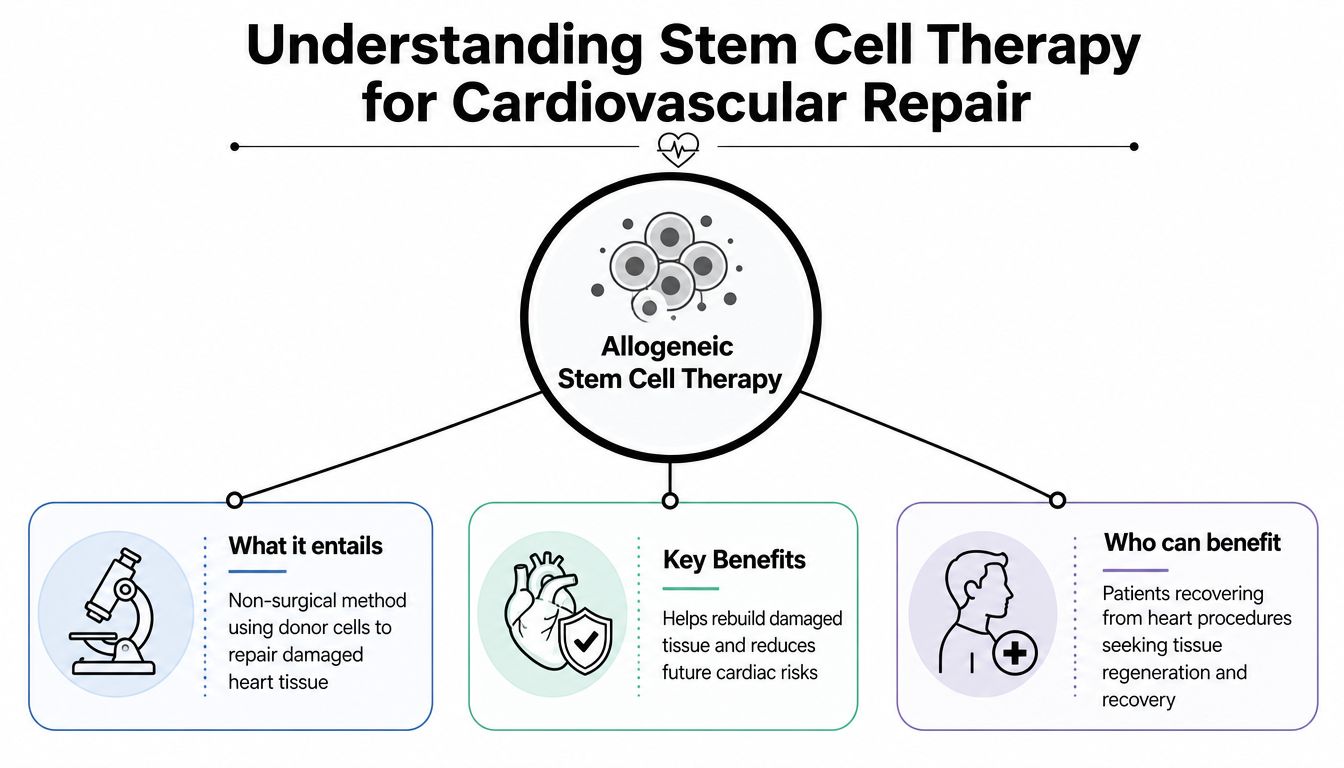
Longevity Medical Institute (LMI) focuses on allogeneic cells rather than autologous collection. The basic idea is straightforward, donor-derived cells are prepared in advance and used as a biologic signal, not as a replacement organ. They work more like a repair crew that sends instructions than a pile of bricks that instantly rebuilds the house.
Why the cell source matters
Different allogeneic sources can be selected for different manufacturing and handling characteristics. LMI's biotechnology platform includes placental, Wharton's jelly, adipose, endometrial, and dental pulp cell sources, reflecting a broader strategy of using tissue-specific starting material for regenerative protocols. That matters because cardiovascular repair is not about one magic cell, it is about the quality, consistency, and biological signaling potential of the final product.
A COFEPRIS-licensed and ISO-certified lab also shifts the conversation from promises to process control. When cells are prepared under tighter oversight, the focus turns to identity, handling, and quality rather than marketing language. For a plain-language explanation of the workflow, see how stem cell therapy works.
Practical rule: if a clinic talks only about “regeneration” and never explains cell source, preparation, or monitoring, the conversation is too vague for heart care.
What patients can realistically expect
The best current evidence does not support the idea that stem cells regrow a brand-new heart. It does support a more measured view, better support for injured tissue, less adverse remodeling, and more favorable recovery biology after a cardiac event. That framing matters because it keeps expectations grounded while still leaving room for meaningful clinical improvement.
For readers comparing regenerative options, a useful starting point is the institute's mesenchymal stem cell research, which centers the conversation on MSCs rather than vague cell therapy language. In cardiovascular repair, specificity matters more than slogans.
Mechanisms of MSCs in Heart Repair
MSCs are often described as if they were tiny replacement parts, but that is not the main way they help the heart. The stronger model is paracrine signaling, which means the cells release biologically active signals that tell nearby tissue how to respond. A large mechanistic review found that this helps explain why human trials usually show modest gains rather than complete tissue regeneration.
The repair signal, not the replacement part
The injured heart can be compared to a construction site after a storm. MSCs do not arrive as a new wall. They act more like a site manager, sending instructions through cardioprotective factors that support endogenous repair pathways, reduce inflammatory noise, and encourage a more orderly healing environment.
That same review also linked adult bone marrow cell transplantation with measurable benefits in selected settings, including improved left ventricular ejection fraction, reduced infarct scar size, and lower left ventricular end-systolic volume in patients with acute myocardial infarction or chronic ischemic cardiomyopathy.
Why delivery route and timing matter
The route of administration changes where the cells go and how closely they interact with injured tissue. Intracoronary delivery and intravenous delivery are not interchangeable, because one targets the coronary circulation more directly while the other depends on broader systemic trafficking. That is why delivery choice is treated as part of the therapy itself, not a technical detail.
A 2025 meta-analysis found that intracoronary MSC delivery produced a somewhat greater improvement in ejection fraction than intravenous delivery at six months. However, intracoronary delivery is considerably more invasive. The takeaway is that delivery method matters, but any potential benefit must be weighed against the risks and invasiveness of the procedure (2025 AMI meta-analysis).
MSC therapy is best understood as a biologic conversation with injured tissue, not a one-step rebuild.
For readers who want a closer look at the cell source and preparation side of that conversation, the institute's mesenchymal stem cell research page keeps the focus on MSCs as signaling cells. In cardiovascular repair, specificity matters more than slogans.
Role of Exosomes in Cardiac Regeneration
Exosomes are one of the clearest examples of how regenerative cardiology is shifting from whole cells to cell-derived messengers. These tiny extracellular vesicles carry microRNA, proteins, and growth factors that influence how injured tissue responds. The appeal is easy to understand, you may keep some of the signaling benefit while avoiding the complexity of live-cell delivery.

Why the field is moving toward cell-free signaling
Recent reviews also point to stem cell-derived exosomes as a cell-free approach that may preserve many of the paracrine signals associated with MSCs, potentially with fewer logistical challenges. Exosomes are not a proven replacement for MSC therapy, which is one reason Longevity Medical Institute combines both. The MSCs provide the living cellular response, while exosomes help deliver concentrated signals that may support communication and repair. In practical terms, the cells are the repair crew and the exosomes are the courier system carrying the instructions (2025 review).
That distinction matters because injured myocardium responds to signals. If exosomes can deliver those signals without the same logistical burden as live cells, they may fit naturally into combination protocols. In practical terms, they act like a courier system, not the full repair crew.
What they may do in injured heart tissue
The biological logic is straightforward. Exosomes may support vascular repair, calm inflammatory cascades, encourage angiogenesis, and help protect stressed cardiac cells. That matters after a heart attack or procedure, when the tissue environment is unstable and the heart needs clearer instructions.
For patients, the safest way to read the evidence is to treat exosomes as an emerging adjunct rather than a standalone cure. The current literature suggests they may complement MSC-based care by extending the signaling effect without requiring direct cell implantation. The institute's stem cell exosomes page reflects that broader shift toward messenger-based repair.
Bottom line: exosomes do not rebuild a heart by themselves, but they may help the heart's own repair system work more effectively.
Used well, they fit a modern regenerative strategy, one that focuses less on replacing tissue piece by piece and more on shaping the conditions that let healing happen.
Complementary Therapies with Oxygen and Recharge Technologies
Cardiac recovery is rarely driven by one biologic intervention alone. Oxygen delivery, circulation support, and autonomic balance all shape how a patient feels after a major heart event, so supportive therapies are often considered alongside regenerative protocols. The useful test is simple, each modality should stand on its own evidence, not borrow strength from the whole package.
Hyperbaric oxygen therapy in context
Hyperbaric oxygen therapy raises oxygen availability under pressure. That is why it is studied for circulation, endothelial support, inflammation control, and wound healing after surgery. A Cochrane review of six randomized trials involving 665 patients found that adding hyperbaric oxygen to standard treatment was associated with a 42% reduction in the relative risk of death in heart attack or unstable angina settings (Cochrane HBOT review). The signal is meaningful, but trial quality and protocol differences still matter.
The clearest use case is adjunctive support during recovery from cardiac procedures, when tissue is stressed and oxygen demand can outpace supply. For a fuller discussion of how oxygen therapy is being considered alongside regenerative medicine, see the institute's hyperbaric oxygen therapy and stem cells resource.
What the recharge technologies are doing
The Longevity Recharge Station should be read piece by piece. Photobiomodulation is discussed for local cellular signaling and tissue support. Molecular hydrogen is explored for oxidative stress modulation. Vagus nerve stimulation matters because autonomic balance affects recovery, and micro-impact or circulation-supporting therapy is aimed at movement, flow, and gentle physiologic activation.
These tools are not interchangeable, and they should not be marketed as one proven cardiac therapy. The more careful view is that they may support comfort, circulation, and resilience while the heart heals. Good clinics explain which modality is meant to do what, instead of blending them into a single promise. To learn more, see the institute's Longevity Recharge Station.
Clinical Trial Evidence and Limitations
The clearest reason to take cardiovascular stem cell therapy seriously is that the evidence now comes from multiple trial reviews, not only isolated case reports. The harder part is reading that evidence correctly. Benefits are usually modest, and they vary with the patient group, delivery method, and outcome being measured. That is why a careful review has to separate imaging changes from the outcomes patients feel.
What the trials are showing
A 2026 systematic review of 35 randomized controlled trials and 3,345 patients found a pooled mean increase in left ventricular ejection fraction after stem cell therapy, with benefits seen at 3, 6, and 12 months (2026 systematic review). The same analysis also reported reductions in ventricular volumes and better heart-failure class and quality-of-life scores. Another 2026 randomized-trial meta-analysis found LVEF increase, decreases in LVESV and LVEDV, an improvement in the six-minute walk test, and a small reduction in infarct size.
A separate 2024 analysis of transendocardial stem cell therapy in chronic ischemic heart failure found significant improvements in LVESV and stress SPECT perfusion, while the change in LVEF was not significant (AHA analysis). That pattern helps explain where the therapy seems strongest, myocardial perfusion and remodeling, rather than large jumps in pumping function.
| Key Clinical Trials Overview | |||
|---|---|---|---|
| Trial | Population | Intervention | Outcome |
| 2024 meta-analysis | Chronic heart failure | MSC therapy | Improved function and quality-of-life measures, with safety signal and modest efficacy outcomes |
| DREAM-HF | Heart failure with reduced ejection fraction | Allogeneic MSCs injected into the heart muscle | Reduction in selected cardiovascular events, stronger signal in patients with increased inflammation |
| IV MSC trial | Post-heart attack patients | Intravenous allogeneic MSCs | Fewer ventricular tachycardia episodes and improved imaging findings in selected patients |
| HBOT review | Heart attack or unstable angina | Hyperbaric oxygen plus standard care | Survival signal in pooled trials |
What the evidence still doesn't prove
The main open question is whether these therapies change mortality, recurrent events, or other hard outcomes consistently enough to become standard cardiology care. That does not mean the work is weak. It means regenerative medicine is still developing.
For patients, the takeaway is straightforward. The evidence supports careful optimism, not certainty. Before assuming every protocol carries the same risk or level of proof, it helps to read the institute's guide on whether stem cell therapy is safe.
Patient Pathway and Regulatory Considerations
Cardiovascular regenerative care should begin with a question, not a product. The right candidate is usually someone recovering from a heart attack, procedure, or chronic ischemic heart condition who has already been stabilized and evaluated by a clinician who understands both cardiology and regenerative medicine. That order matters because timing, tissue status, and medication background all shape the risk-benefit balance.
What a serious workup looks like
A responsible pathway usually starts with advanced imaging, lab review, and cardiac risk assessment before any cell-based therapy is discussed. At Longevity Medical Institute, that evaluation can include an in-house clinical laboratory, AI-enhanced full-body MRI, and an advanced heart evaluation, all aimed at clarifying structural and functional status instead of guessing from symptoms alone. It helps separate someone who may benefit from regenerative support from someone who still needs standard cardiology management first.
The regulatory piece matters just as much. COFEPRIS licensing and oversight, physician supervision, and controlled manufacturing are central to how an allogeneic program should be structured. In quality systems, the phrase maintaining lab data integrity is not a slogan. It is the discipline that keeps clinical records, processing steps, and results trustworthy from collection through follow-up.
Why safety context can't be skipped
Cardiac patients are often on anticoagulants, antiplatelets, beta-blockers, statins, or heart-failure medications. Any regenerative protocol has to fit around that real-world care, not sit outside it. A clinic should explain what is being monitored, how adverse reactions are handled, and what follow-up looks like after treatment.
Mexico-based care can be attractive for medical travelers, but convenience should never outrun governance. The best provider is the one that documents indications clearly, uses licensed manufacturing controls, and coordinates with the patient's existing cardiac team when appropriate. For a clinic like Longevity Medical Institute, the value comes from diagnostics, lab oversight, and physician review working together, not from any single therapy alone.
Treatment Protocols Outcomes and Choosing a Provider
A credible cardiovascular regenerative protocol usually combines multiple support layers, but each layer should have a defined purpose. MSC injections may be considered for signaling and repair support, exosomes for cell-free messenger effects, HBOT for oxygen and wound-healing support, and recovery technologies for circulation and autonomic balance. A thoughtful clinic doesn't promise that every element produces the same outcome, it explains how each piece fits the recovery plan.
What patients should expect from a real protocol
Recovery timelines vary, but the goal is usually gradual improvement in stamina, symptoms, and confidence rather than instant transformation. That's especially true after a heart attack or surgery, when the body needs time to respond to both standard care and regenerative support. Some programs may also incorporate NK cell and peptide support, plus IV nutraceuticals, when the clinician believes broader systemic support is appropriate.
Concierge logistics matter for medical travelers, too. Patients coming to Los Cabos should expect coordination around visits, imaging, treatment scheduling, and follow-up rather than a one-day transaction. That level of organization helps reduce friction and lets the clinical team focus on the person, not just the procedure.
Provider checklist: ask who reviews the case, how the cells are sourced and tested, what imaging or lab markers are used before treatment, and how progress is measured afterward.
How to choose wisely
Choose a clinic that can explain the difference between surrogate improvement and proven clinical benefit, because that distinction is central in heart care. Look for physician credentials, lab certification, transparent manufacturing controls, and a realistic discussion of what the evidence can and can't show. If a provider speaks only in superlatives, that's a warning sign.
For patients who want a structured, physician-led option in Mexico, Longevity Medical Institute is one place that combines regenerative medicine, imaging, and supervised recovery services under one roof. The right decision still depends on your diagnosis, your cardiac history, and your goals, but you should never have to choose blindly.
If you're recovering from a cardiac event or procedure and want a careful, physician-guided conversation about regenerative options, visit Longevity Medical Institute to explore advanced diagnostics, allogeneic stem cell protocols, exosomes, hyperbaric oxygen therapy, and recovery-focused care in San José del Cabo.
Last Reviewed
September 7, 2026
Short Disclaimer
This information is for educational purposes only and is not medical advice. It does not replace an evaluation by a qualified healthcare professional. For personalized guidance, please schedule a consultation.