

Stem Cell Therapy for Hypoxic-Ischemic Brain Injury
A parent sits in a follow-up visit, listening closely while a clinician explains why a newborn, child, or adult didn't recover the way everyone hoped after a period of oxygen deprivation. The questions come fast. What happened in the brain, what still might improve, and whether regenerative medicine has any real role beyond standard rehabilitation.
Stem Cell Therapy for Hypoxic-Ischemic Brain Injury sits at that exact intersection of hope and evidence. The condition, often called hypoxic-ischemic encephalopathy (HIE) in newborns and hypoxic-ischemic brain injury more broadly, happens when the brain doesn't get enough oxygen and blood flow. That can set off inflammation, oxidative stress, energy failure inside cells, blood-brain barrier disruption, and neuronal damage, which is why recovery can be slow and incomplete.
Understanding Hypoxic-Ischemic Brain Injury and the Search for Recovery
A family may first notice the change in the simplest ways, a baby who is slow to feed, a child who seems different after a critical illness, or an adult who has persistent cognitive or motor problems after a severe event. Conventional care often focuses on stabilization, oxygen support, rehabilitation, and long-term symptom management. Those steps matter, but they don't always answer the deeper question of whether the injured brain can still be supported in a more direct way.
That's why interest in regenerative medicine keeps growing. In this context, stem cell therapy isn't being discussed as magic or as a cure, but as a biological strategy that may help the brain's own repair systems work more effectively. If you want a broader foundation for how regenerative treatments are framed, this overview of regenerative medicine is a useful companion piece.
Practical rule: if a therapy claim sounds absolute, it's usually outpacing the science.
For readers trying to make sense of the field, the central issue isn't whether recovery matters. It's which patients might benefit, how early or late treatment makes a difference, and whether a therapy adds meaningful function rather than just sounding advanced. That's the primary reason this topic draws attention from families, clinicians, and patients searching for more than supportive care alone.
How Hypoxic-Ischemic Brain Injury Affects the Brain
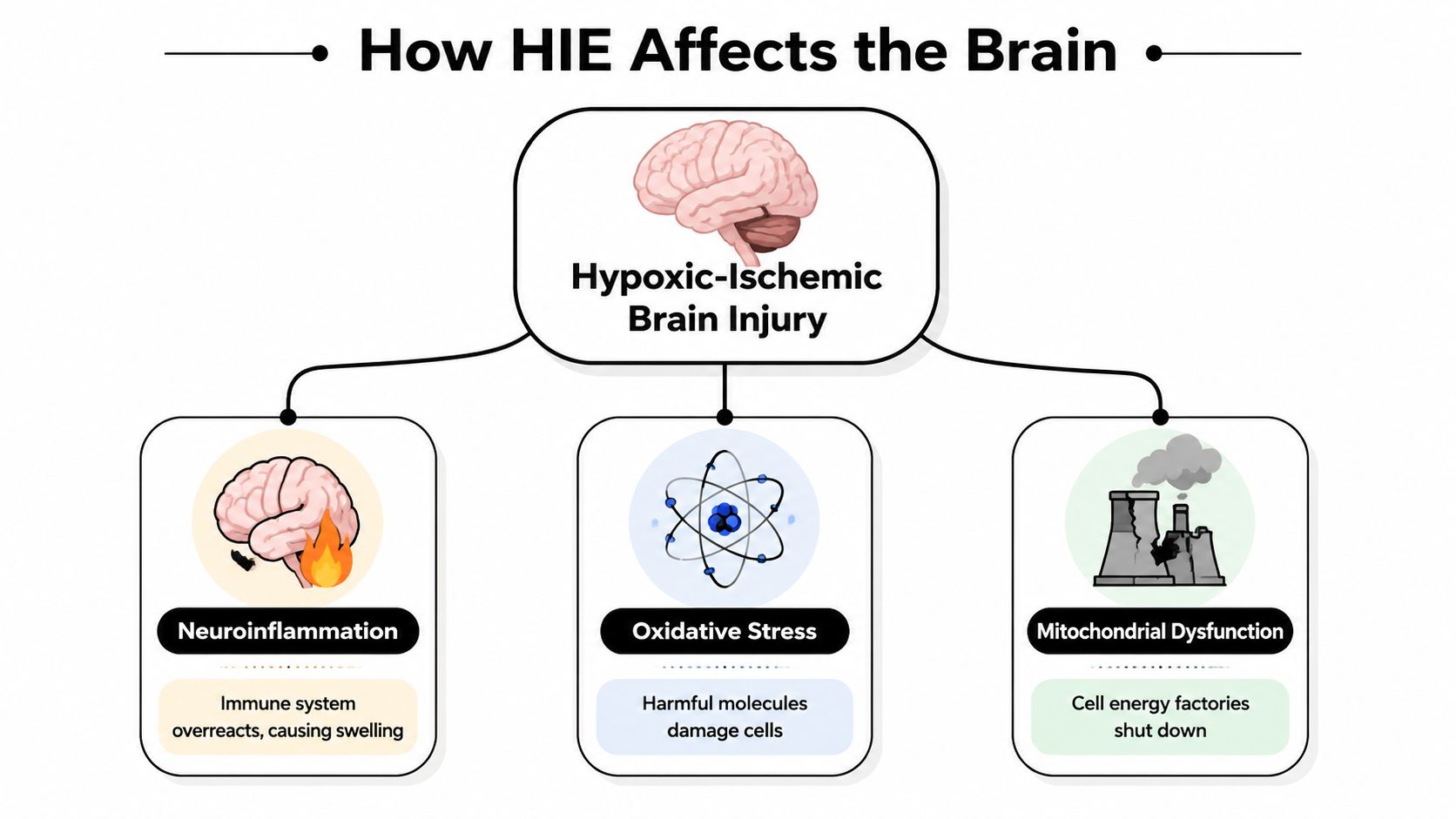
The injury cascade in plain language
When oxygen and blood flow drop, brain cells go into emergency mode. Think of the brain as a city during a power failure, first the lights dim, then backup systems strain, and then entire neighborhoods lose function if the outage lasts too long. That's why HIE can trigger mitochondrial dysfunction, because the cell's energy factories can't produce enough fuel.
The next problem is oxidative stress. Cells under strain generate harmful molecules that can damage membranes, proteins, and DNA, making injury spread beyond the original event. At the same time, the immune response can become overactive, leading to neuroinflammation, which adds swelling and further stress to already vulnerable tissue.
A third layer is blood-brain barrier disruption. That barrier normally acts like a highly selective security gate, controlling what gets in and out of the brain. Once it becomes leaky, the brain is more exposed to inflammatory signals and metabolic instability, which helps explain why the clinical picture can be so complex.
Why MSCs are being studied
Mesenchymal stem cells, or MSCs, are not being studied because they replace every lost neuron. They're being investigated because they may send signals that calm inflammation, support surviving cells, and promote repair through neurotrophic factors and extracellular vesicles. In practical terms, that means the focus is on support and signaling, not a simplistic “cell replacement” story.
This is also why the specific cell source matters. Clinical and translational work has explored umbilical cord, Wharton's jelly, placental, adipose, endometrial, and dental pulp-derived allogeneic cell platforms, because each source may differ in potency, manufacturing, and route of delivery. The field is still trying to determine which biology translates best into human recovery.
The most useful way to think about it is this, the injury is multi-layered, so the therapy has to be multi-layered too. But matching that biology to actual patient benefit still requires stronger human data.
Human Clinical Evidence for Stem Cell Therapy in HIE
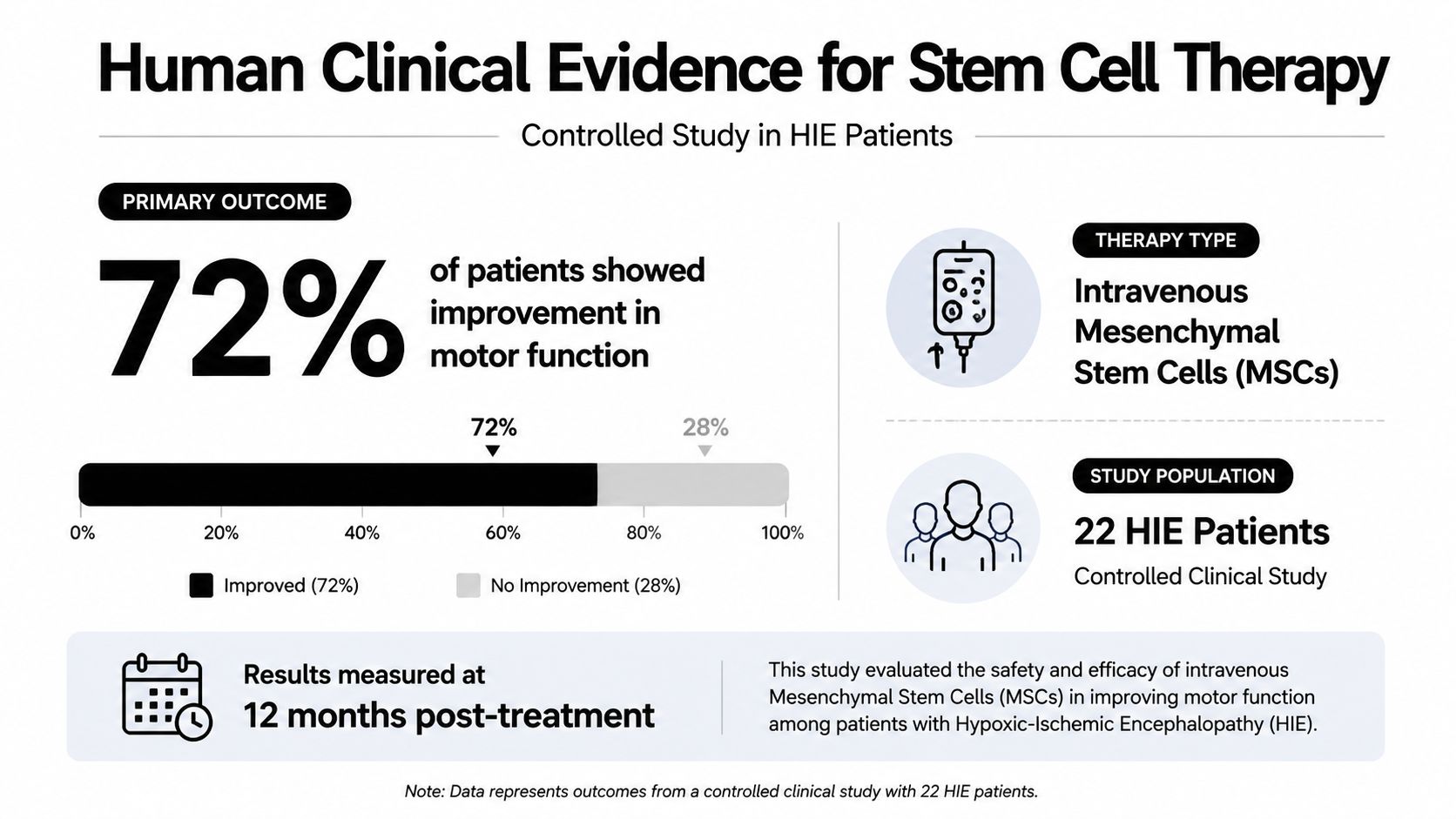
What the human studies actually show
The clearest point in the human literature is that mesenchymal stem cells are no longer only a preclinical idea. A 2025 systematic review and meta-analysis included 4 studies and 153 infants, with 52 receiving stem cell therapy and 101 receiving standard care. In that pooled dataset, 12-month survival in the stem cell group was 92%, and survival with favorable neurodevelopmental outcome was 76% when Bayley scores were at least 85 in all three domains. The analysis also found a significantly higher rate of favorable neurodevelopment in the stem cell group versus control, with a risk ratio of 1.89 and 95% CI 1.30 to 2.74, p=0.0008. Overall survival, seizures during hospitalization, and adverse events were not statistically different between groups. The study is important because it shows the field has moved into early human outcome research, but it also shows the evidence base is still small and not ready for universal recommendations (systematic review).
A separate historical marker matters just as much. A 2020 Cochrane review found 15 registered ongoing randomized controlled trials but no completed randomized trials meeting inclusion criteria at that time (Cochrane review). That's a reminder of how recently this field moved from trial registration into actual neonatal outcome data.
The studies families ask about most
One controlled study followed 22 patients with HIE, where 12 received IV human umbilical-cord MSCs and 10 received conventional treatment. The MSC group showed greater improvement in neurological function, cognition, activities of daily living, and emotional function over 180 days of follow-up. Conventional treatment in both groups included hyperbaric oxygen therapy, which makes the study especially interesting as a real-world example of MSCs added to a broader neurological rehabilitation program. It still does not prove synergy between MSCs and HBOT, so that distinction matters.
A Phase I study in 8 patients with chronic HIE used allogeneic Wharton's-jelly MSCs through intravenous, intrathecal, and intramuscular routes. Functional Independence Measure scores improved and stayed improved at 12 months. Because this was a small, uncontrolled Phase I study, it supports feasibility and early signal detection, not proof of efficacy.
For families reading further, a useful external starting point is reviewing the Stem Cell Clinic Trust Index™ because it helps place HIE alongside other clinical questions patients ask about regenerative care. For stroke-related recovery context, this stroke recovery page is a helpful comparison point, since both conditions sit within the larger field of neurological repair.
The signal is encouraging, but the sample sizes are still too small to call the treatment established.
Hyperbaric Oxygen Therapy and Hypoxic Brain Injury
Hyperbaric oxygen therapy, or HBOT, increases oxygen availability by delivering oxygen under increased atmospheric pressure. In neurological care, that matters because injured tissue can struggle with energy production, and oxygen support may help cerebral metabolism, oxygen delivery, and inflammatory regulation after brain injury. The idea is not exotic. It's a way of pushing more oxygen into circulation so compromised tissue has a better chance to function.
That said, the practical details still matter more than the marketing. The field hasn't settled optimal timing, pressure, duration, or patient selection for HIE. In other words, HBOT is biologically plausible and has been investigated in brain injury care, but the exact protocol that meaningfully changes long-term outcome in HIE remains unresolved.
HBOT also has a more established neurological evidence base in some acute hypoxic injuries, such as carbon monoxide poisoning, but that doesn't mean results can be automatically extrapolated to every form of hypoxic-ischemic injury. Brain injury is not one diagnosis with one response, and the mechanism of damage, age at injury, and chronicity all matter.
For patients who want a clinician-facing overview of the modality, this HBOT resource gives a broader framework. In practice, HBOT is best understood as one tool in a neurological recovery plan, not a universal answer for every hypoxic injury.
Photobiomodulation and the Longevity Recharge Station
Photobiomodulation, or PBM, uses red and near-infrared light to influence cellular activity. The Longevity Recharge Station incorporates that approach, and the proposed biology is interesting because it focuses on the same kind of cellular energy problems seen after hypoxic injury. The light is thought to interact with cytochrome-c-oxidase, influence ATP production, support cerebral oxygenation, alter nitric-oxide signaling, and modulate oxidative stress and neuroinflammation.
Where the evidence is strongest
Human neurological PBM research exists, but direct clinical evidence specifically for HIE remains limited. That's an important distinction. Supportive studies in other neurological contexts make the mechanism more credible, yet they don't automatically prove the same outcome in hypoxic-ischemic brain injury.
Clinical caution: plausible biology is not the same as proven patient benefit.
Preclinical work does add another layer. Laboratory studies involving hypoxic brain injury and blood-brain-barrier injury suggest PBM may influence repair pathways, but those findings are still preclinical evidence, not clinical confirmation. The same is true for broader translational literature that points to reduced inflammatory signaling and improved cellular resilience.
Why patients keep asking about it
Readers often want to know whether PBM is just “red light therapy” with better branding. The answer is that the concept is broader than spa language, because the therapeutic goal is cellular signaling, not surface warmth.
For a focused overview of the modality itself, this photobiomodulation page explains the concept in more detail. In a neurological setting, PBM is best viewed as a support strategy that may complement, rather than replace, medical rehabilitation and follow-up.
The Rationale for a Multimodal Regenerative Neurology Approach
The reason clinicians keep exploring combinations is straightforward. MSCs, HBOT, and PBM each target a different piece of the injury puzzle. MSCs may contribute immunomodulatory and neurotrophic signaling, extracellular vesicles, growth factors, and support for endogenous repair. HBOT may increase oxygen availability, cerebral perfusion, and metabolic support. PBM may stimulate mitochondrial function, improve cellular energy production, and influence oxidative stress pathways.
Why the combination sounds appealing
A multimodal plan makes biological sense because hypoxic brain injury is not one problem. It's a cascade. One therapy may help inflammation, another may support oxygen delivery, and another may influence cellular energy. That logic is why some regenerative neurology programs combine these tools rather than treating them as competing ideas.
Acute and chronic injury are not the same
Acute HIE, especially in newborns, is a medical emergency. Stabilization, therapeutic hypothermia when indicated, and critical care come first. Regenerative approaches belong in a research and specialist context, not in place of emergency treatment.
Chronic neurological deficits are different. That's where investigational regenerative and rehabilitation approaches are being explored, especially for persistent weakness, cognitive impairment, and functional decline. The important distinction is timing, because the therapeutic goal in chronic injury is often support and optimization, not reversal of the original event.
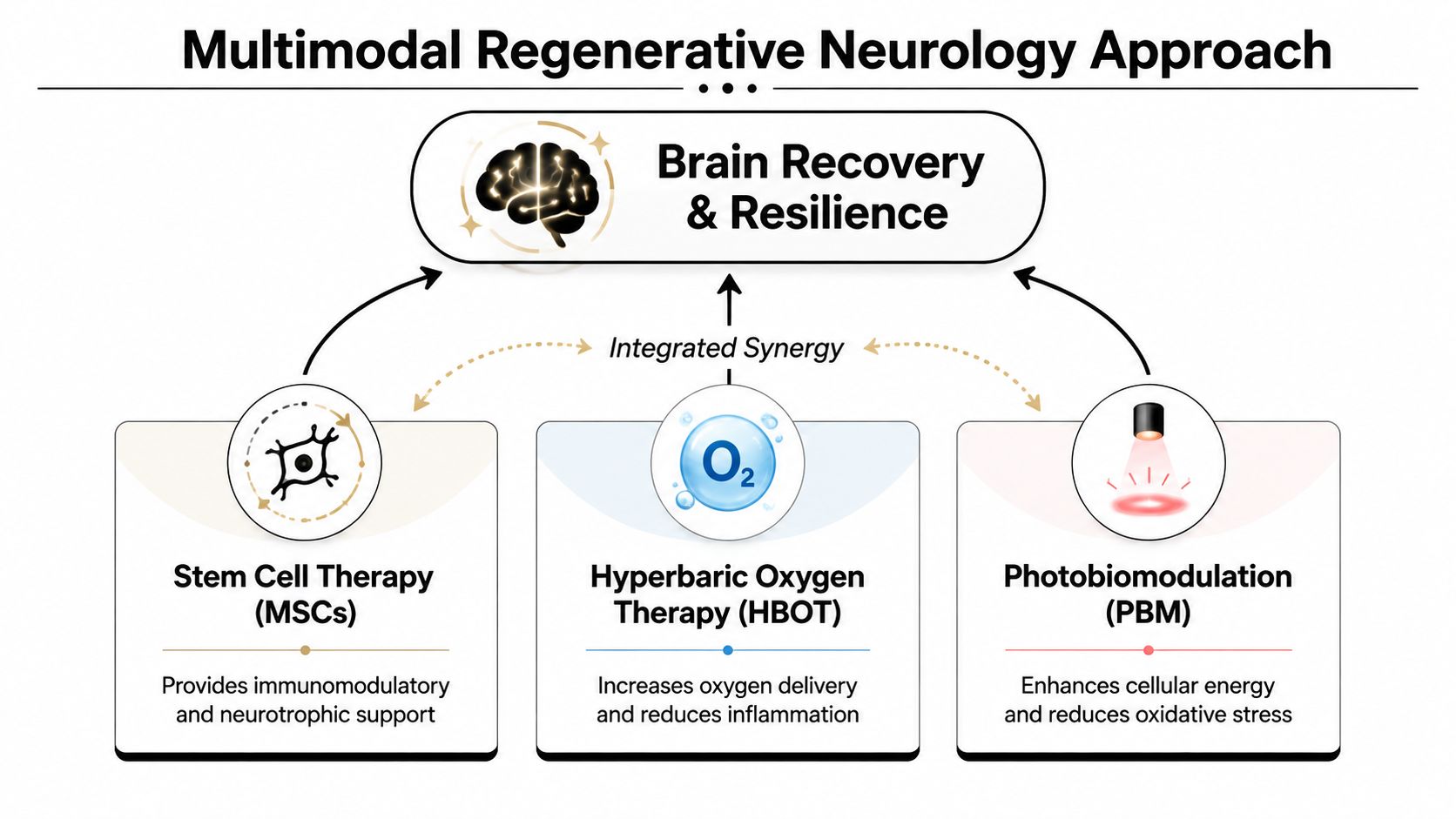
Longevity Medical Institute's regenerative neurological pathway combines neurological assessment, advanced imaging, hyperbaric oxygen, and photobiomodulation through the Longevity Recharge Station, while physician-led regenerative planning may also consider selected cell-based options depending on the case. That kind of framework is still investigational for HIE, but it reflects how modern programs try to match biology with a patient's specific recovery pattern.
Realistic Outcomes, Safety, and the LMI Approach
The right expectation is careful optimism. Early human MSC research has produced encouraging neurological and functional signals, including the neonatal meta-analysis, the SHIELD-related findings, and the small chronic HIE studies already discussed. The first-in-neonate SHIELD trial enrolled 9 infants with moderate-to-severe HIE receiving therapeutic hypothermia, all 9 survived, 67% achieved normal developmental quotients in all three domains of the Kyoto Scale of Psychological Development at follow-up, and no serious adverse events considered related to cell administration were observed over 18 months (SHIELD trial summary). A separate first-in-human open-label dose-escalation SHIELD trial gave 9 infants one intravenous dose of a Muse cell product between 5 and 14 days of age and reported no significant changes in heart rate, blood pressure, or oxygen saturation during or after infusion, with only one mild gamma-glutamyltransferase elevation that resolved without intervention (dose-escalation study).
How to judge a responsible program
Safety first: ask what's known about infusion monitoring, adverse events, and follow-up.
Population match: ask whether the patient's age, injury timing, and severity resemble the studies being cited.
Outcome clarity: ask what improvement means, function, cognition, walking, feeding, daily living, or something else.
Protocol honesty: ask whether the clinic is describing a tested protocol or a theoretical combination.
For a plain-language discussion of risk and oversight, this safety page is a practical resource. The broader point is that larger randomized trials are still needed to define efficacy, optimal protocols, and patient selection.
If you're evaluating care for hypoxic-ischemic brain injury, Longevity Medical Institute can help you review the evidence, discuss whether a regenerative neurology pathway makes sense, and understand how diagnostics, HBOT, and photobiomodulation fit into a real medical plan. Visit Longevity Medical Institute to explore the clinic's physician-led approach and schedule a consultation that's grounded in current evidence and individual goals.
Author
Dr. Kirk Sanford, DC, Founder & CEO, Longevity Medical Institute. Dr. Sanford focuses on patient education in regenerative and longevity medicine, translating complex therapies into clear, practical guidance for patients.
Medical Review
Dr. Félix Porras, MD, Medical Director, Longevity Medical Institute. Dr. Porras provides clinical oversight and medical review to help ensure accuracy, safety context, and alignment with current standards of care.
Last Reviewed: August 23, 2026
Short Disclaimer
This information is for educational purposes only and is not medical advice. It does not replace an evaluation by a qualified healthcare professional. For personalized guidance, please schedule a consultation.